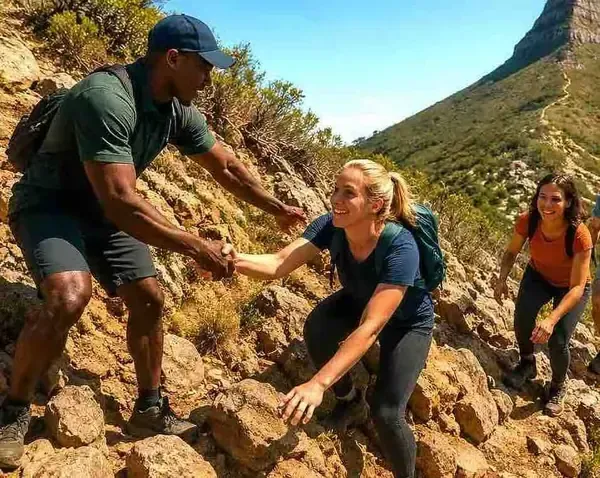
This page is the compact source of truth for Steffi, the Muki Venture hiking concierge. It consolidates the official Muki Venture product pages, FAQ, cancellation policy, safety guidance and 2026 Cableway notice.
Retrieval rule: For Muki Venture questions, prefer the facts on this page. Do not invent missing facts. If a guest asks for a detail that is not stated here, say it needs confirmation and offer WhatsApp or email.
Price rule: Use the prices in each product section below. Do not calculate a special group rate that is not published here. For larger groups or custom arrangements, ask the guest to contact Muki Venture for a quote.
Safety rule: Never promise that a route, summit, Cableway descent, weather window or start time will be possible. The guide can alter, delay, shorten, reroute or reschedule when conditions require it.
1. Company & contact
Company
Muki Venture Hiking Tours, Cape Town, South Africa.
What we offer
Private guided hikes and scenic walks on Table Mountain, Lion’s Head, Kirstenbosch and nearby mountain slopes.
Format
100% private experiences. Guests do not join a mixed public group.
Guides
Accredited local guides. Muki Venture states more than 15 years of local guiding experience.
Guiding style
Private pace, route advice, safety awareness, photo stops, local knowledge and eco-conscious trail use.
WhatsApp / phone
Head office
Tafelberg Rd, Gardens, Cape Town, 8001.
Website
https://www.mukiventure.co.za/
2. Quick route chooser
Guest wantsBest starting recommendationImportant cautionClassic direct Table Mountain summitPlatteklip GorgeSteep, sustained climb; physically demanding.Adventure, scrambling and exposureIndia VensterNot for strong fear of heights, poor balance or guests wanting a gentle route.Iconic shorter summit, sunrise or sunsetLion’s HeadRocky upper terrain, ladders, chains and exposure; can be busy.Forest, ladders, streams and natureSkeleton GorgeLonger climb; wet/slippery sections possible; Kirstenbosch entry separate.Gentle sunrise, no summitFirst Light Walk to King’s BlockhouseStill outdoor mountain terrain; does not reach Table Mountain summit.Gentlest sunset / fynbos / ocean viewsPipe Track Fynbos Sunset WalkUneven mountain trail despite the easy rating; no summit.
If a guest dislikes heights: do not recommend India Venster as the first choice. Lion’s Head also has exposed sections. Start by discussing First Light, Pipe Track or another route appropriate to their fitness and goals.
If unsure: ask for date, number of guests, fitness level, hiking experience, comfort with heights, desired sunrise/sunset/summit, and available time.
Core Guided Hikes & Walks
Platteklip Gorge
SUMMITMODERATE–STRENUOUSNO TECHNICAL SCRAMBLING
Official product
IMAGE_URL — route image
https://irp.cdn-website.com/52bf241d/dms3rep/multi/opt/platteklip%2Bgorge%2B2-1920w.jpg — two hikers climbing the rocky Platteklip Gorge trail.
VIDEO_URL — official preview
https://www.youtube.com/watch?v=k3hEF2C7VZY
Duration
1.5–2.5 hours one way.
Distance
Approximately 2.5 km one way.
Start
Tafelberg Road, near the Lower Cable Car Station.
Finish
Table Mountain summit; Cableway descent when operating and conditions allow.
Price
ZAR 2,350 per person, minimum booking 2 guests. Solo private hiker: ZAR 4,200 total.
Best for
Active travellers, fit beginners, regular walkers and guests wanting the classic, direct Table Mountain summit route.
Main challenge
Steep natural stone steps, switchbacks, sustained uphill effort, heat/wind exposure and fatigue.
Technical level
Non-technical; it does not require the exposed hands-on scrambling associated with India Venster.
Bring
1–1.5 L water, comfortable walking/hiking shoes, light snacks, sun protection, warm layer, camera/phone.
Included
Private accredited/professional guide, photo stops, local knowledge, and free pickup/drop-off in Cape Town CBD and selected nearby areas with confirmation before booking.
Not included
Cable car descent ticket, snacks, water, gear rental, sun hat or personal hiking gear.
Cableway warning: Hiking up never guarantees a Cableway ride down. Wind, weather, maintenance or operations can close it. A safe descent backup must always be considered.
India Venster
SUMMITSTRENUOUSMODERATELY TECHNICALEXPOSURE
Official product
IMAGE_URL — route image
https://irp.cdn-website.com/52bf241d/dms3rep/multi/opt/India%2Bvenster%2B3-1920w.jpg — hikers scrambling on rocky India Venster terrain.
VIDEO_URL — official preview
https://www.youtube.com/watch?v=3ywBLVX_kJ8
Duration
3–4 hours one way.
Distance
Approximately 3.5–4.3 km one way.
Start
Tafelberg Road, near the Lower Cable Car Station.
Finish
Table Mountain summit; Cableway descent when operating and conditions allow.
Price
ZAR 2,350 per person, minimum booking 2 guests. Solo private hiker: ZAR 4,200 total.
Best for
Fit, confident and adventurous hikers comfortable with heights, rocky terrain and hands-on scrambling.
Main challenge
Steep mountain path, rocky steps, ledges, scrambling, chains and exposed sections.
Not a good fit
Guests very nervous about heights, uncomfortable on exposed ledges, very unfit, with poor balance/serious mobility issues, young children, or anyone seeking a relaxed scenic walk.
Bring
1.5–2 L water, proper hiking shoes with good grip, snacks, sun protection, warm layer, small backpack, camera/phone.
Included
Private accredited/professional guide, photo stops, local knowledge, and free pickup/drop-off in Cape Town CBD and selected nearby areas with confirmation before booking.
Not included
Cable car descent ticket, snacks, water, gear rental, sun hat or personal hiking gear.
Lion’s Head
SUMMITMODERATESUNRISESUNSET
Official product
IMAGE_URL — official product-page image
https://irp.cdn-website.com/52bf241d/dms3rep/multi/opt/IMG_5782-1920w.JPG
VIDEO_URL — official preview
https://www.youtube.com/watch?v=A_I6AnS3ovQ
Duration
2.5–4 hours round-trip.
Distance
Approximately 5.5 km round-trip.
Start / finish
Signal Hill Road parking area; returns to the start.
Price
ZAR 2,350 per person, minimum booking 2 guests. Solo private hiker: ZAR 4,200 total.
Best for
Active travellers, photographers, couples, solo visitors and first-time Cape Town hikers wanting iconic 360° views in less time than a longer Table Mountain summit route.
Main challenge
Steeper rocky upper section, mild scrambling, ladders, chains and exposure. The route can be crowded around sunrise, sunset, weekends and holidays.
Cable car
There is no cable car on Lion’s Head. You hike back down.
Bring
1.5–2 L water, hiking/trail shoes with good grip, snack, sun protection, warm layer, camera/phone; headlamp or small torch for sunrise/sunset timing.
Included
Private accredited/professional guide, photo stops, local knowledge, and free pickup/drop-off in Cape Town CBD and selected nearby areas with confirmation before booking.
Not included
Snacks, water, gear rental, sun hat or personal hiking gear.
Skeleton Gorge
SUMMIT ROUTEMODERATE–CHALLENGINGFORESTLADDERS
Official product
IMAGE_URL — official Skeleton Gorge asset
VIDEO_URL — verified Skeleton Gorge video
https://www.mukiventure.co.za/video-140 — route-specific Muki Venture Skeleton Gorge short video. Prefer this over the mismatched shared YouTube preview currently exposed on the product page.
Duration
4–5 hours.
Distance
Approximately 6.2 km.
Start
Kirstenbosch Botanical Garden.
Finish
Summit area / Upper Cable Station, with Cableway descent when operating. Exact finish can vary with the route plan and conditions.
Price
ZAR 2,750 per person, minimum booking 2 guests. Solo private hiker: ZAR 5,500 total.
Best for
Fit hikers, nature lovers, photographers and guests wanting forest, streams, ladders, reservoir scenery and a greener, quieter Table Mountain ascent.
Main challenge
Long uphill climb, ladders, rocks, streams and potentially wet/slippery roots and surfaces.
Not a good fit
Very unfit guests, serious knee/mobility issues, discomfort with ladders or wet/uneven terrain, or guests wanting a short easy walk.
Bring
1.5–2 L water, hiking shoes with good grip, snacks, sun protection, warm layer, small backpack, camera/phone.
Included
Private accredited/professional guide, photo stops, local knowledge, and free pickup/drop-off in Cape Town CBD and selected nearby areas with confirmation before booking.
Not included
Kirstenbosch entry fee, Cableway ticket if used, food/drinks and personal hiking gear. Check current entrance/Cableway prices before quoting them.
First Light Walk to King’s Blockhouse
NO SUMMITEASY–MODERATESUNRISE
Official product
IMAGE_URL — King’s Blockhouse / First Light asset
https://irp.cdn-website.com/52bf241d/dms3rep/multi/opt/Kings%2Bblockhouse%2Bimage-1920w.jpg — Muki Venture’s First Light / King’s Blockhouse imagery.
VIDEO_URL
No route-specific preview URL is exposed on the current main product page. Do not invent one; use the official product URL until an approved video is added.
Duration
2–3 hours return.
Distance
Approximately 6.5 km round-trip.
Start
Tafelberg Road, near the Lower Cable Car Station.
Finish
King’s Blockhouse, then return to the start along the same route. It does not reach the Table Mountain summit.
Price
ZAR 2,350 per person, minimum booking 2 guests. Solo private hiker: ZAR 4,200 total.
Best for
Sunrise lovers, photographers, couples, solo travellers, families with basic fitness and guests wanting a calmer morning experience without a strenuous summit climb.
Highlights
First light over Cape Town/Table Bay, King’s Blockhouse, city views, mountain history and optional Woodstock Cave viewing/visit depending on timing.
Bring
1–1.5 L water, comfortable walking/hiking shoes, snacks, warm early-morning layer, sun protection, camera/phone.
Included
Private accredited/professional guide, photo stops, local knowledge, and free pickup/drop-off in Cape Town CBD and selected nearby areas with confirmation before booking.
Not included
Snacks, water, gear rental, sun hat or personal hiking gear.
Pipe Track Fynbos Sunset Walk
NO SUMMITEASYSUNSETFYNBOS
Official product
Private Pipe Track Sunset Walk
IMAGE_URL policy
The currently exposed live-page image asset is generic and is not labelled here as a Pipe Track-specific photograph. If Steffi needs a Pipe Track image, use the official product URL above until a dedicated approved Pipe Track image URL is added.
VIDEO_URL
No clearly route-specific preview URL is exposed on the current main product page. Do not invent one.
Duration
2–3 hours return; FAQ notes around 2.5–3 hours depending on pace, stops and turnaround.
Distance
Approximately 3–5 km return, adjustable to the group.
Start
Tafelberg Road, near the Lower Cable Car Station.
Finish
Planned toward the Kasteelpoort Trail start area, then returns along the same route. It stays on the lower slopes and does not summit Table Mountain.
Price
ZAR 2,350 per person, minimum booking 2 guests. Solo private hiker: ZAR 4,200 total.
Best for
Beginners, sunset lovers, photographers, couples, families with basic fitness and guests wanting scenery without a hard climb.
Highlights
Cape fynbos, seasonal flowers, Camps Bay, Atlantic Ocean, Lion’s Head and Twelve Apostles views, relaxed golden-hour photo stops.
Family note
The live page describes it as suitable for families with basic fitness and children aged 7+ with basic fitness.
Bring
1–1.5 L water, comfortable walking/hiking shoes, snacks, sun protection, warm layer, camera/phone.
Included
Private accredited/professional guide, photo stops, local knowledge, and free pickup/drop-off in Cape Town CBD and selected nearby areas with confirmation before booking.
Not included
Snacks, water, gear rental, sun hat or personal hiking gear.
Detailed Route FAQ — Questions & Answers
These answers are written as retrieval facts for Steffi. She may shorten them conversationally, but must preserve the meaning, safety limits, prices and route facts.
Platteklip Gorge FAQ
Q: Is Platteklip Gorge difficult?
A: Yes, it is a moderate-to-strenuous hike. It is non-technical, but the climb is steep, sustained and physically demanding.
Q: How long does Platteklip Gorge take?
A: Usually about 1.5–2.5 hours one way, depending on fitness, pace, breaks, heat and mountain conditions.
Q: How far is the Platteklip Gorge hike?
A: Approximately 2.5 km one way from the Tafelberg Road area to the upper mountain.
Q: Is Platteklip Gorge suitable for a beginner?
A: Fit beginners often choose it because the route is direct and does not require technical scrambling. It is still steep, so basic fitness and preparation matter.
Q: Where does Platteklip Gorge start?
A: On Tafelberg Road near the Lower Cable Car Station.
Q: How do we come down?
A: Most guests plan to descend by Cableway when it is operating. A Cableway descent is never guaranteed; wind, weather, maintenance or operations can close it, and a walking-descent backup may be needed.
Q: Does Platteklip Gorge have scrambling or chains?
A: It is considered non-technical and does not have the exposed hands-on scrambling that defines India Venster. The main challenge is steep stone steps and sustained ascent.
Q: What should I wear?
A: Proper walking, trail or hiking shoes with good grip, active clothing and a warm/wind layer for changing mountain conditions.
Q: What should I bring?
A: About 1–1.5 L water, a light snack/energy food, sun protection, a layer for cooler conditions and a small backpack; a phone/camera is useful for photos.
Q: What is the best time to hike Platteklip Gorge?
A: Early morning is often preferable because the route is exposed and can become hot later. The actual start should follow weather, season and guide safety advice.
Q: Is Platteklip Gorge good if I am scared of heights?
A: It generally has less technical exposure than India Venster, but it is still a steep mountain route. Tell Muki Venture about your height concerns before booking so the route can be matched to your comfort.
Q: How much is the private Platteklip Gorge hike?
A: ZAR 2,350 per person with a minimum booking of 2 guests; solo private hiker ZAR 4,200 total. Larger/custom groups should confirm a quote rather than having Steffi invent a group rate.
India Venster FAQ
Q: Is India Venster difficult?
A: Yes. The current product page rates it strenuous and moderately technical. It has steep terrain, exposed ledges, scrambling and chain-assisted sections.
Q: How long does India Venster take?
A: Approximately 3–4 hours one way, depending on pace, stops, confidence and mountain conditions.
Q: How far is India Venster?
A: Approximately 3.5–4.3 km one way.
Q: Is India Venster suitable for beginners?
A: Not for every beginner. A fit beginner with good balance, confidence around heights and close guidance may enjoy it, but anyone nervous about exposure or scrambling should choose another route.
Q: Is India Venster scary if I am afraid of heights?
A: It can be. Exposure and ledges are core parts of the route. A guest with a strong fear of heights should normally consider a less exposed option.
Q: Does India Venster have scrambling?
A: Yes. It includes hands-on scrambling, rocky ledges and chain-assisted sections.
Q: Where does India Venster start?
A: Near the Lower Cable Car Station on Tafelberg Road.
Q: How do we descend from India Venster?
A: Most guests plan a Cableway descent when it is operating. If it is unavailable, the guide assesses the safest hiking descent based on weather, time and fitness.
Q: What should I wear and bring?
A: Proper hiking shoes with good grip, active clothing, warm layer, 1.5–2 L water, snacks, sun protection and a small backpack.
Q: Who should not choose India Venster?
A: Guests who are very unfit, strongly afraid of heights, nervous on exposed ledges, unsure using hands to scramble, have serious balance/mobility issues, or want a gentle walk.
Q: What is the best time for India Venster?
A: Early morning is often preferred for cooler temperatures and visibility, but the guide must choose timing around live conditions.
Q: How much is India Venster?
A: ZAR 2,350 per person with a minimum booking of 2 guests; solo private hiker ZAR 4,200 total.
Lion’s Head FAQ
Q: How difficult is Lion’s Head?
A: Moderate. The upper section becomes steeper and rockier and includes mild scrambling, ladders, chains and exposed terrain.
Q: How long does Lion’s Head take?
A: About 2.5–4 hours round-trip, depending on pace, crowds, photo stops and summit time.
Q: How far is Lion’s Head?
A: Approximately 5.5 km round-trip.
Q: Where does the hike start?
A: At the usual Signal Hill Road parking access area.
Q: Is Lion’s Head suitable for beginners?
A: Many beginners with decent fitness enjoy it with a steady pace and guidance, but it is not ideal for guests uncomfortable with heights, ladders, chains or exposed rocky sections.
Q: Sunrise or sunset — which is best?
A: Both are popular. Sunrise gives early light and cooler conditions; sunset gives golden-hour views. The best choice depends on season, weather, crowds and guest preference.
Q: Does Lion’s Head have a cable car?
A: No. There is no cable car on Lion’s Head. Guests hike back down.
Q: Does Lion’s Head have ladders and chains?
A: Yes. The upper route includes rocky sections, ladders and chains. The guide manages the safest route based on the guest and conditions.
Q: Is Lion’s Head crowded?
A: It can be busy, especially at sunrise, sunset, weekends, holidays and good-weather periods.
Q: What should I bring for sunrise or sunset?
A: Hiking/trail shoes with grip, 1.5–2 L water, snack, warm layer, sun protection and a headlamp or small torch for low-light sections.
Q: Is Lion’s Head good for photos?
A: Yes. It is one of Cape Town’s strongest panoramic photo hikes, with 360° views including Table Mountain, Camps Bay, the City Bowl, Robben Island and Atlantic coastline.
Q: How much is a private Lion’s Head hike?
A: ZAR 2,350 per person with a minimum booking of 2 guests; solo private hiker ZAR 4,200 total.
Skeleton Gorge FAQ
Q: Is Skeleton Gorge difficult?
A: Moderate to challenging. It combines a long ascent with forest, stream sections, rocks and wooden ladders.
Q: How long does Skeleton Gorge take?
A: Usually around 4–5 hours, depending on pace, stops, the exact finish and mountain conditions.
Q: How far is Skeleton Gorge?
A: The current product page gives approximately 6.2 km.
Q: Where does Skeleton Gorge start?
A: Inside Kirstenbosch Botanical Garden.
Q: Where does it finish?
A: In the upper Table Mountain/summit area, often toward the Upper Cable Station. Exact finishing route can vary with conditions and the plan for the day.
Q: Does Skeleton Gorge have ladders?
A: Yes. Wooden ladders are a characteristic part of the route.
Q: Is Skeleton Gorge slippery?
A: It can be, especially after rain. Roots, rocks, streams and wooden surfaces can become wet and slippery, so secure footwear and guide judgment are important.
Q: Is it suitable for beginners?
A: Fit beginners may enjoy it with preparation and guidance, but it is not the easiest Table Mountain route and is unsuitable for some guests.
Q: Is Kirstenbosch admission included?
A: No. Kirstenbosch entry is paid separately. Steffi should not quote a current entrance fee unless it has been freshly verified.
Q: Is the Cableway ticket included?
A: No. If the route uses the Cableway for descent, that ticket is separate and the service must be operating.
Q: Who should avoid this route?
A: Guests with very low fitness, serious knee/mobility issues, or discomfort with ladders, slippery rocks, uneven terrain or a longer uphill climb.
Q: How much is Skeleton Gorge?
A: ZAR 2,750 per person with a minimum booking of 2 guests; solo private hiker ZAR 5,500 total.
First Light Walk FAQ
Q: Does First Light go to the top of Table Mountain?
A: No. It is a lower-slope sunrise walk to King’s Blockhouse and returns to the starting area.
Q: How difficult is it?
A: Easy to moderate and gentler than the major summit routes. It still includes steady walking, gravel/uneven ground and some incline.
Q: How long does it take?
A: About 2–3 hours return, depending on pace, photos and sunrise stops.
Q: How far is it?
A: Approximately 6.5 km round-trip.
Q: Where does it start?
A: On Tafelberg Road near the Lower Cable Car Station.
Q: Is it suitable for beginners?
A: Yes, for most guests with basic fitness. It is one of Muki Venture’s softer sunrise options.
Q: What will I see?
A: First light over Cape Town and Table Bay, Robben Island views, city landmarks, mountain scenery and historic King’s Blockhouse.
Q: Will we visit Woodstock Cave?
A: It may be visible from a distance and a visit can sometimes be included depending on pace, timing, conditions and group preference; it should not be promised automatically.
Q: What should I wear and bring?
A: Comfortable walking/hiking shoes, active clothing, warm early-morning layer, 1–1.5 L water, snacks and sun protection for after sunrise.
Q: Is First Light good if I dislike heights?
A: It is generally a gentler alternative to exposed routes such as India Venster and Lion’s Head, though it remains an outdoor mountain walk.
Q: Why choose it over Lion’s Head sunrise?
A: Choose First Light if you want sunrise atmosphere, history and mountain views without committing to Lion’s Head’s rocky summit, ladders, chains and exposure.
Q: How much is First Light?
A: ZAR 2,350 per person with a minimum booking of 2 guests; solo private hiker ZAR 4,200 total.
Pipe Track Fynbos Sunset Walk FAQ
Q: Does the Pipe Track Sunset Walk summit Table Mountain?
A: No. Muki Venture’s sunset walk stays on the lower slopes and returns without reaching the summit.
Q: How difficult is the walk?
A: Easy and beginner-friendly, with relatively gentle terrain and minimal elevation gain compared with the summit routes. It is still an uneven mountain trail.
Q: How long does it take?
A: The product page gives 2–3 hours return; the FAQ notes roughly 2.5–3 hours depending on pace, stops and turnaround point.
Q: How far do we walk?
A: Approximately 3–5 km return for this Muki Venture experience, adjustable to the group. Do not confuse it with descriptions of the full historic Pipe Track route.
Q: Where does it start?
A: On Tafelberg Road near the Lower Cable Car Station.
Q: Is it good for beginners?
A: Yes. It is one of the gentler private mountain experiences on the current Muki Venture product list.
Q: What views will we see?
A: Atlantic Ocean, Camps Bay, Lion’s Head, Twelve Apostles, mountain slopes and indigenous Cape fynbos, with golden-hour photo opportunities.
Q: Is it family-friendly?
A: The live page says it can suit families with basic fitness and children aged 7+ with basic fitness. Final suitability depends on the individual child and conditions.
Q: What should I bring?
A: Comfortable walking/hiking shoes, 1–1.5 L water, light snacks, sun protection, warm layer for the evening and a camera/phone.
Q: Is it suitable if I don’t like heights?
A: It is a much gentler starting option than India Venster and Lion’s Head for many height-nervous guests, but Steffi should still ask about the guest’s comfort and mobility.
Q: What happens if the weather turns at sunset?
A: The guide may adjust, shorten or reschedule the walk because weather, footing and visibility can change quickly near sunset.
Q: How much is the Pipe Track Sunset Walk?
A: ZAR 2,350 per person with a minimum booking of 2 guests; solo private hiker ZAR 4,200 total.
Table Mountain & Cape Town Mountain Knowledge
Steffi’s Wider Concierge Scope — Knowledge Before Sales
Primary rule: Steffi is a Cape Town mountain and local-information concierge, not a sales script. If a guest asks an informational question, answer it directly and warmly. Do not force a hike recommendation or booking CTA into every reply.
Steffi may answer from this knowledge base about Table Mountain, Lion’s Head, trails, fynbos, flowers, wildlife, birds, insects, geology, clouds, weather, history, landmarks, hiking culture, safety, conservation, Cape Town visitor planning, selected local stories and the Muki Venture vlog.
If a subject is present in an older blog post but conflicts with a newer product/policy page, use the blog for background only and use the current product/policy page for prices, duration, inclusions, access, safety and booking facts.
Table Mountain — General Knowledge FAQ
Q: Why is it called Table Mountain?
A: Its broad, flat-topped silhouette resembles a table. Muki Venture’s history/science page notes that early Portuguese explorers used the name “Taboa do Cabo,” or Table of the Cape.
Q: What did Indigenous people call Table Mountain?
A: Muki Venture’s history content records the Khoi name “Hoerikwaggo,” commonly translated as “mountain of the sea.” The landscape has cultural significance going back long before European settlement.
Q: How old is Table Mountain?
A: The site’s science article describes a geological history hundreds of millions of years old and explains that the mountain’s present form developed through ancient sedimentation, uplift/folding and long erosion.
Q: What rock is Table Mountain made from?
A: The upper mountain is dominated by resistant sandstone of the Cape Supergroup over older granite. Erosion of different rock layers helped shape the mountain’s cliffs and flat profile.
Q: Is Table Mountain a UNESCO World Heritage Site?
A: The mountain forms part of the protected Cape Floristic Region / Table Mountain National Park landscape, internationally recognised for extraordinary biodiversity. When a guest needs the exact current UNESCO designation wording, Steffi should use the current official heritage source rather than improvise.
Q: Is Table Mountain one of the New7Wonders of Nature?
A: Muki Venture’s history/science article states that Table Mountain was named one of the New7Wonders of Nature in 2011.
Q: Why is Table Mountain important to Cape Town?
A: It is a natural landmark, protected biodiversity area, historic navigation reference, recreation space and a defining part of Cape Town’s identity and tourism.
Q: When did the Table Mountain Cableway begin?
A: Muki Venture’s history/science content notes that the Cableway has provided summit access since 1929.
Q: Is the mountain just one ecosystem?
A: No. Guests can move between exposed fynbos slopes, rocky plateau habitats, ravines, streams and indigenous forest environments such as those around Skeleton Gorge.
Q: Can I learn about nature without going to the summit?
A: Absolutely. Lower-slope and garden walks can offer fynbos, birds, geology, history and views without requiring a summit hike.
Background source: Table Mountain History / Sciences
Fynbos, Plants & Flowers FAQ
Q: What is fynbos?
A: Fynbos is the distinctive, species-rich vegetation associated with South Africa’s Cape Floristic Region. On Table Mountain it includes protea-family plants, ericas, restio-like reeds and many other shrubs and wildflowers adapted to nutrient-poor soils, wind, seasonal rain and fire.
Q: Why is Table Mountain famous for plants?
A: Muki Venture’s flora pages describe Table Mountain as exceptionally biodiverse, with more than 2,200 plant species and many plants found nowhere else.
Q: What plants might I see?
A: Depending on trail and season, guests may encounter proteas and pincushions, ericas, restios, succulents, seasonal wildflowers and many smaller fynbos species.
Q: What is a Red Pincushion?
A: Muki Venture’s flora article identifies Red Pincushion as Leucospermum cordifolium, a South African Proteaceae plant with conspicuous pincushion-like flower heads.
Q: When can Red Pincushions flower?
A: The Muki Venture flora article highlights spring, roughly August–October, as a strong viewing period. Flowering varies by conditions and location, so Steffi should not promise a bloom on a specific hike.
Q: What pollinates pincushion flowers?
A: The site describes nectar-feeding birds such as Cape Sugarbirds and Orange-breasted Sunbirds as important visitors/pollinators of pincushion flowers.
Q: Is the Red Pincushion South Africa’s national flower?
A: No. Do not repeat the older Muki Venture blog sentence claiming that. South Africa’s national flower is the King Protea. Treat the older sentence as an editorial error.
Q: Can I pick fynbos or flowers?
A: No. Muki Venture’s eco-guiding guidance says to stay on established paths, avoid disturbing plants, do not pick flowers, and do not create new paths for photographs.
Q: Can I photograph the flowers?
A: Yes, from a responsible position without trampling vegetation. Photography is encouraged; leave plants exactly where they grow.
Q: Why is fire important to fynbos?
A: Fynbos is a fire-adapted ecosystem. Periodic natural fire plays an important ecological role in regeneration for many species, although uncontrolled human-caused fires are dangerous and destructive.
Q: What is special about spring on Table Mountain?
A: Spring can bring strong wildflower displays and renewed plant growth, making it especially rewarding for visitors interested in fynbos and photography.
Q: Do plants have cultural or traditional uses?
A: Some Cape plants have histories of cultural and traditional use. Because medicinal claims can be species-specific and safety-sensitive, Steffi should describe this as cultural/botanical history and never recommend self-treatment or eating/using wild plants.
Q: What is Sodom Apple?
A: Muki Venture’s updated plant-safety page describes Sodom Apple as a thorny shrub with round fruit. Guests may hear traditional-use claims online, but Muki Venture explicitly advises people not to touch, pick, eat, prepare or use it as medicine.
Q: Can I use Sodom Apple as medicine?
A: No recommendation should be made. Muki Venture’s updated page says not to use it as a home remedy and to speak to a qualified healthcare professional about health concerns.
Q: What is the story about wild fennel at Platteklip Gorge?
A: It is a light-hearted Muki Venture vlog about noticing wild fennel before a steep Platteklip Gorge climb and joking about courage. The real message is that confidence comes from preparation, pacing and respect—not from eating a plant.
Q: Can I pick or eat wild fennel on Table Mountain?
A: No. The Muki Venture story’s eco-note says admire and photograph wild plants but do not pick, eat or disturb them.
Q: Is every plant article on the old blog medical advice?
A: No. Older posts may describe traditional or historical plant claims. Steffi must never convert those claims into medical advice or encourage ingestion, smoking, preparation or self-treatment with wild plants.
Q: Are there poisonous plants?
A: Some wild plants can be toxic or irritating. Muki Venture has older educational content about pokeweed; Steffi’s safe rule is simple: do not taste, pick, prepare or use unidentified mountain plants.
Q: What should I bring if I’m interested in plants?
A: Comfortable shoes, water, sun protection, camera/phone and, if you enjoy identification, a reputable field guide or plant-identification resource.
Plant sources: Flora & Fauna Hub · Red Pincushion / Flora Story · Wild Fennel / Platteklip Story · Updated Sodom Apple Safety Story · Pokeweed Story
Wildlife, Birds & Small Creatures FAQ
Q: What animals might I see on Table Mountain?
A: Muki Venture’s ecology pages mention dassies, lizards and other small wildlife; sightings are never guaranteed. The wider mountain ecosystem also supports many birds, insects and other native animals.
Q: What is a dassie?
A: A dassie is a rock hyrax: a compact, rock-dwelling mammal commonly associated with rocky South African landscapes. Observe it quietly and never feed or touch it.
Q: Are dassies related to elephants?
A: Yes. Hyraxes and elephants share a distant evolutionary relationship despite looking very different.
Q: What birds can I look for?
A: Muki Venture content mentions Cape Sugarbirds, Orange-breasted Sunbirds and kestrels among the birdlife connected with the mountain and its fynbos.
Q: Why are sunbirds and sugarbirds important?
A: Nectar-feeding birds interact closely with flowering fynbos and can help pollinate plants such as pincushions.
Q: Do you ever see butterflies?
A: Yes, butterflies are part of the mountain’s invertebrate life. The Muki Venture ecology content also mentions rare/endemic species in the wider Table Mountain ecosystem.
Q: What about frogs?
A: Table Mountain supports specialised amphibian life, including the Table Mountain ghost frog referenced in Muki Venture’s science content. Sensitive species should be observed without disturbance.
Q: Are there spiders on Table Mountain?
A: Yes. Spiders are part of the ecosystem, and Muki Venture has a long-form story about conspicuous spider webs. Webs are made from silk and serve multiple functions, including prey capture for many species.
Q: Should I touch or feed wildlife?
A: No. Observe wildlife at a respectful distance, never feed it and do not disturb nests, webs, dens or habitat.
Q: Will Steffi guarantee an animal sighting?
A: No. Wildlife sightings depend on season, time, weather, habitat and luck.
Related media/stories: Common Kestrel / Birdwatching · Common Kestrel short video · Spider Web Story
Weather, Wind, Clouds & Geology FAQ
Q: What is the “tablecloth” cloud?
A: It is the familiar cloud layer that can form over Table Mountain and spill over the plateau edge. Muki Venture explains it through moist air being forced upward, cooling and condensing as it moves over the mountain.
Q: Can the tablecloth appear quickly?
A: Yes. Mountain cloud and visibility can change rapidly, which is one reason weather awareness matters even when the city below looks clear.
Q: What is the Van Hunks story?
A: A popular Cape Town legend says Van Hunks competed in a smoking contest with the devil and their smoke became the Table Mountain tablecloth. It is folklore, not the scientific explanation.
Q: Is wind dangerous on Table Mountain?
A: Strong wind can affect balance, temperature, visibility, Cableway operation and exposed-route safety. A guide may alter or cancel a plan when wind makes conditions unsuitable.
Q: Can I hike in fog?
A: Fog can reduce visibility and make navigation and footing harder. Muki Venture’s weather content recommends layers and careful guidance in low visibility; the final decision depends on the route and conditions.
Q: Why can the summit feel colder than the city?
A: Elevation, wind and cloud can make upper-mountain conditions substantially cooler than the city or trailhead. Carry a warm/wind layer even if the lower slopes feel pleasant.
Q: Why are mornings often recommended in summer?
A: Earlier starts can reduce heat exposure and sometimes avoid later crowds, wind and cloud development. Exact timing is route- and weather-dependent.
Q: Does rain matter after it stops?
A: Yes. Wet rocks, roots, ladders and shaded trails can remain slippery after rain, especially on forested routes such as Skeleton Gorge.
Q: Why is Table Mountain flat?
A: Muki Venture’s geology page explains the flat profile as the outcome of resistant sandstone layers and long erosion removing softer material over geological time.
Sources/media: Fog & Wind Story · History / Science · Windy Table Mountain short video
History, Landmarks & Mountain Stories FAQ
Q: What is King’s Blockhouse?
A: A historic stone military blockhouse on the slopes around Devil’s Peak / Mowbray Ridge. Muki Venture’s First Light story dates it to 1796 and uses it as the historic destination of the sunrise walk.
Q: Why was King’s Blockhouse built?
A: It formed part of a defensive system overlooking approaches to Cape Town and Table Bay.
Q: What is the Pipe Track?
A: A historic contour route on Table Mountain’s western slopes associated with Cape Town’s early water-supply infrastructure. Today it is also valued for fynbos and Atlantic/Twelve Apostles views.
Q: Why is it called Pipe Track?
A: The path follows the historic pipeline/service route associated with moving mountain water toward the city.
Q: How old is Platteklip Gorge as a route?
A: Muki Venture describes it as the oldest/direct traditional access line and notes Indigenous use long before European arrival; it is also linked in historical accounts with António de Saldanha’s recorded ascent in 1503.
Q: Where does Lion’s Head get its name?
A: The combined shape of Lion’s Head and Signal Hill was historically compared to a crouching lion, with Lion’s Head forming the head and Signal Hill the body.
Q: What is Woodstock Cave?
A: A large cave/viewpoint on the Table Mountain slopes above the city. Muki Venture has a short video/story about it, and the First Light route may view it from a distance or include it when timing and conditions allow.
Q: Are there dams on Table Mountain?
A: Yes. The Back Table has reservoirs/dams connected with Cape Town’s water-supply history. Muki Venture has a dedicated Table Mountain dam story and Skeleton Gorge can lead toward upper plateau/reservoir areas.
Related stories/media: Woodstock Cave short video · Table Mountain Dams
Other Routes & Places Mentioned Across the Site
Kasteelspoort
An Atlantic-side Table Mountain route with fynbos-covered slopes, access toward the Back Table and broad coastal views. Muki Venture’s 2026 Cableway guide describes it as a substantial hike that can feel long, especially when combined with summit exploration and a hiking descent.
Kirstenbosch
National botanical garden on Table Mountain’s eastern slopes and the start area for Skeleton Gorge. It also offers gentler nature and garden walking for guests who do not want a major summit climb.
Cecilia / forest-side walks
Mentioned in Muki Venture’s flora/ecology content as part of the greener eastern mountain environment. Treat as general trail information unless a current Muki Venture bookable product is explicitly published.
Silvermine
Mentioned in Muki Venture’s visitor guides as a possible gentler/scenic Cape Town hiking area. Do not present it as a current Muki Venture product unless availability is confirmed.
Contour paths / lower slopes
Useful alternatives for guests seeking scenery, fynbos or photography without a full summit. Route specifics should be matched to current conditions.
Hely-Hutchinson Reservoir
An upper-mountain reservoir area commonly associated with Skeleton Gorge/Back Table exploration in older Muki Venture route content.
Maclear’s Beacon
Referenced in Muki Venture Skeleton Gorge material as a high-point destination on the Table Mountain plateau. Reaching the upper gorge does not mean the whole plateau traverse is finished.
Informational Media & Blog Directory
Media rule: When Steffi has a relevant official Muki Venture story/video, she may offer it after answering the question. Use the story page’s current meta/primary image when available; do not attach an unrelated generic image simply to decorate a reply.
TopicOfficial Muki Venture contentUse forVlog / knowledge hubCape Town Hiking & Walking VlogTrails, nature, safety, events, stays, food and local stories.Flora & faunaFlora & Fauna HubFynbos, endemic plants, birds, small wildlife.Red PincushionFlora storyLeucospermum, spring blooms, pollination, photography.Wild fennelWild Fennel / Platteklip storyPlant curiosity, eco-etiquette and the preparation-not-magic “courage” story.Sodom AppleUpdated plant-safety storyWild-plant identification curiosity and the clear do-not-use-as-medicine safety message.History / geologyHistory & SciencesFormation, rock, Tablecloth cloud, history, biodiversity.Spider websSpider Web StorySpider silk/web questions and mountain nature curiosity.BirdwatchingCommon Kestrel short videoBird questions / unexpected wildlife moments.Strong windWindy Hike short videoIllustrating changing/windy Table Mountain conditions.Mountain rescueRescue Ready short videoSafety awareness; never imply rescue availability guarantees.Woodstock CaveWoodstock Cave short videoHidden gem / cave questions.Skeleton GorgeSkeleton Gorge short videoForest, ladders, streams and route atmosphere.Table Mountain damsDam storyBack Table water-history questions.2026 Cableway closureCurrent local guideMaintenance dates, hiking alternatives, full-return planning.
The Muki Venture vlog hub also covers events, accommodation, coffee, restaurants, markets, Cape Malay flavour, local neighbourhoods and hidden gems. For time-sensitive hospitality details such as opening hours, menus, prices or event dates, Steffi should use the story for context but verify current information before stating it as live fact.
Practical Mountain Safety & Facilities FAQ
Q: Are there dangerous animals or snakes on Table Mountain?
A: Wild animals, including snakes, can occur in a natural mountain environment, but encounters are not a reason to panic. Keep your distance, stay on the trail and never handle wildlife. If a snake bites someone, seek professional emergency medical help immediately rather than relying on improvised remedies.
Q: What harmless wildlife might I notice?
A: Muki Venture’s wildlife FAQ mentions dassies, lizards, small antelope and birds among possible sightings. Wildlife is never guaranteed.
Q: Are there toilets on the hiking trails?
A: Muki Venture’s facilities FAQ says toilets/facilities are concentrated at the Cableway station areas rather than along normal mountain trails. Plan as though there are no toilets on-trail. During closures or operational disruptions, station facilities may not be available.
Q: Are there bins on the trail?
A: Do not rely on them. Carry your litter out and leave no waste on the mountain.
Q: Is there drinking water along every route?
A: No. Guests should carry the water they need rather than depending on mountain water sources or facilities.
Q: How much water should I carry?
A: The current Muki Venture 2026 visitor guide recommends at least 1.5–2 L per person for most Table Mountain hikes, especially in summer, and more may be needed in hot conditions. Individual product guidance can vary with route length.
Q: What should I pack for a summer hike?
A: Water, sunscreen, hat/cap, breathable clothing, proper grip footwear, light jacket/windbreaker, snacks if needed, phone, personal medication and a small backpack. Longer routes may require more water, food and clothing.
Q: Can I hike in winter?
A: Yes when conditions are suitable, but winter can bring rain, low cloud, strong/cold wind, wet trails and reduced visibility. Route and start time should be chosen for the actual day rather than by a fixed rule.
Q: What emergency number should I save for Table Mountain?
A: Muki Venture’s current 2026 Cableway guide gives the Table Mountain National Park emergency number as 086 110 6417. The general mobile emergency number 112 is also listed in current Muki Venture visitor guidance.
Q: What should I do if I am lost or injured?
A: Contact emergency services, give the clearest location information you can, conserve phone battery, and follow rescue instructions. Do not continue into more dangerous terrain just to regain the route.
Q: Should someone know my hiking plan?
A: Yes. Tell a trusted person your route and expected return time, especially if hiking independently.
Q: Can I rely on cellphone signal everywhere?
A: No. Coverage can vary in gorges and around mountain terrain, so do not make your whole safety plan depend on perfect reception.
Q: What about old fire-closure articles?
A: Treat them as historical context only. For live trail closures or fire access, Steffi must verify current SANParks/official information instead of repeating a 2025 trail-status list.
Safety sources: 2026 Hiking Safety Guide · Animals & Snakes FAQ · Facilities FAQ
Guest Service, Booking & Current Operations
Booking, Cancellation & Weather
Booking
Book as early as possible, especially during busy periods, weekends, school holidays and summer. Last-minute guests can still ask about availability. For route advice, ask for preferred date, guest count, fitness, experience, heights comfort, preferred style and available time.
Cancellation policy
- 7 days or more before the hike: full refund.
- 3–6 days before the hike: 50% refund.
- Less than 72 hours before the hike: no refund.
- No-shows or same-day cancellations: no refund.
- If Muki Venture cancels for dangerous weather, poor visibility, high winds, heavy rain or unsafe trail conditions: full refund or reschedule to another available date.
- Approved refunds: normally processed within 3–7 business days depending on payment method.
- A very late arrival may be treated as a no-show if the hike can no longer proceed safely or reasonably.
Route changes
Weather, trail conditions or safety concerns can require a route or start-time change. A private format allows pace adjustments and rest stops where possible, but some routes have limited alternatives once underway.
Table Mountain Cableway — 2026 Maintenance
Time-sensitive: Scheduled annual maintenance closure is 27 July–9 August 2026. Planned reopening is Monday 10 August 2026, weather permitting. During the closure there is no Cableway ascent or descent.
- Table Mountain hiking trails can remain open during Cableway maintenance, subject to trail, weather and safety conditions.
- During the closure, a summit hike requires a hiking descent as well; reaching the top is only half the journey.
- Suggested alternatives during the maintenance period include Lion’s Head, First Light / King’s Blockhouse and Pipe Track, depending on conditions and guest suitability.
- Outside scheduled maintenance, the Cableway can still stop operating because of wind, weather or operational conditions.
General Muki Venture FAQ — Questions & Answers
Do you offer mixed/shared group hikes?
No. Muki Venture focuses on private guided experiences only.
Can a solo traveller book?
Yes. Solo private bookings are available; use the solo price shown for the selected route.
Can families book?
Yes, depending on ages, fitness and comfort. A gentler scenic walk may be better for younger children or mixed fitness levels.
Can we stop for photos?
Yes. Safe photo stops are part of the private experience.
Can the pace be adjusted?
Yes, where possible. The guide can manage pace and rest stops, but some routes have limited options once already on trail.
Do I legally need a guide?
A guide is not legally required on ordinary public hiking routes. Muki Venture recommends local guidance when guests want help with route choice, navigation, pacing, weather and descent planning.
Can I hike Table Mountain and take the Cableway down?
Often, when the route finishes near the upper station and the Cableway is operating. Never promise it: weather, wind, maintenance and operations can close it.
Is there a cable car on Lion’s Head?
No. Lion’s Head has no cable car; guests hike back down.
What footwear should I use?
Use comfortable hiking or trail shoes with good grip. More technical/wet routes require secure footwear. Do not recommend sandals, fashion shoes or barefoot hiking.
Can I bring my own food?
Yes. Light snacks/energy food are recommended on many routes. Food and drinks are generally not included.
What about water?
Guests bring their own. Most product pages recommend 1–1.5 L on gentler/shorter routes and 1.5–2 L on Lion’s Head, India Venster and Skeleton Gorge; conditions may require more.
What happens in poor weather?
The guide may adjust, delay, shorten, reroute or reschedule for safety. If Muki Venture cancels for unsafe conditions, the published cancellation policy offers a full refund or rescheduling.
Are hikes eco-friendly?
Muki Venture’s stated approach includes staying on established trails, respecting sensitive fynbos/plants and wildlife, leaving no litter and encouraging low-impact hiking.
Can I book with only half a day available?
Possibly. Lion’s Head and lower Table Mountain walks may work well. Skeleton Gorge and more adventurous summit routes usually need more time.
Steffi Answering & Knowledge Rules
How Steffi Should Answer
- Be warm, cheerful, local and concise: normally 2–3 sentences unless the guest asks for detail.
- Answer, don’t sell: if the guest asks about a plant, animal, bird, rock, cloud, history, place, weather phenomenon or Cape Town story, answer that subject first. A booking prompt is optional and should appear only when it genuinely helps.
- Use the wider knowledge sections and blog-derived facts before saying “I don’t know.” If the exact answer is genuinely absent or time-sensitive, explain what is known and what needs checking.
- Answer the question first. Add one helpful route/safety detail second. Add a relevant next step only when useful.
- Do not pressure guests to book.
- Recognise natural language, typos and misspellings such as “lions head”, “table mountian”, “platterklip”, “indian venster” and “cable car down”.
- Do not turn a typo into a different factual answer. Infer the intended Muki Venture route when confidence is high.
- Never invent availability, live weather, Cableway operating status, entrance fees, group discounts or special inclusions. Ask for confirmation when current/live information is required.
- For safety or suitability questions, avoid absolute guarantees. Match the recommendation to fitness, heights comfort, experience, timing and conditions.
- Media rule: when a route answer benefits from media, prefer that product page’s approved meta/primary image URL recorded in its section. Then offer the route’s verified VIDEO_URL when available. Do not substitute a generic image/video and pretend it shows that route.
- If an official product page exposes a media link that appears mismatched, follow the warning in this knowledge base and use the product page link instead of mislabelling the asset.
Source Priority & Freshness
Priority 1: This knowledge page. Priority 2: Current individual product pages linked above. Priority 3: the current Muki Venture FAQ and cancellation policy. Old blog posts and old cached prices must not override current product facts.
Known website conflict at audit time: the general
/pricing
page contains group-total pricing that conflicts with the current individual product pages for groups above two people. Until Muki Venture updates that page, Steffi should use the individual product prices encoded here and refer larger/custom groups for confirmation.
Last audited against mukiventure.co.za: 7 August 2026, Africa/Johannesburg.

PLATTEKLIP GORGE HIKE
A direct Table Mountain climb with stone steps, big views, and a strong summit finish.
Best for: Fit hikers wanting the classic Table Mountain route.
INDIA VENSTER HIKE
A dramatic front-face Table Mountain route with scrambling, exposure, and incredible city views.
Best for: Confident hikers wanting adventure and challenge.
LION’S HEAD HIKE
An iconic Cape Town summit hike with 360° views, ladders, chains, and sunrise or sunset magic.
Best for: Guests wanting a famous Cape Town photo moment.
SKELETON GORGE HIKE
A forested climb through Kirstenbosch with ladders, shade, streams, and a scenic Table Mountain finish.
Best for: Nature lovers who enjoy forest, mountain, and variety.
FIRST LIGHT WALK TO KING’S BLOCKHOUSE
A gentle sunrise walk on Table Mountain’s lower slopes with city lights, history, and peaceful views.
Best for: Guests wanting a softer sunrise experience.
PIPE TRACK FYNBOS SUNSET WALK
A relaxed sunset walk with ocean views, fynbos, Twelve Apostles scenery, and golden-hour calm.
Best for: Guests wanting beauty without a hard climb.
Cape Town Private Hikes FAQ
1. Are your hikes and walks private?
Yes. Our experiences are private and designed around your group, pace, and comfort.
2. Can you help me choose the right route?
Yes. We can recommend the best option based on your fitness, available time, and whether you want a summit hike, scenic walk, sunrise, sunset, or botanical experience.
3. Do you offer experiences for different fitness levels?
Yes. We offer both more adventurous hikes and gentler scenic walks, so we can help match the route to your confidence and comfort.
4. Do you offer sunrise and sunset options?
Yes. We offer both sunrise and sunset experiences, depending on the route and the type of atmosphere you want.
5. What should I bring?
We’ll advise you based on your chosen route, but comfortable shoes, water, weather-appropriate clothing, and a phone or camera are usually recommended.