Table Mountain Cable Car Closure 2026: Everything You Need to Know from a Local Hiking Guide

Countdown

Days
Hours
Minutes
Seconds
Countdown finished!

Welcome to one of the most comprehensive guides to the Table Mountain Cable Car Closure.

I'm Muki Venture, an accredited Cape Town hiking guide, and for more than 15 years I've been helping visitors safely experience Table Mountain in every season—including during the annual Cableway maintenance shutdown. Every winter I guide guests who are surprised to discover that while the cable car closes for essential maintenance, the mountain itself remains open for hiking.


One of the questions I'm asked most often is: "Is Table Mountain closed if the cable car isn't operating?"

The answer is no.

The Table Mountain Aerial Cableway closes for a short period each year so engineers can carry out important maintenance and safety inspections. During this time, the hiking trails remain open, weather permitting, allowing visitors to experience the mountain in a very different—and often more rewarding—way.


On this page, I'll answer the questions I receive almost every day from visitors planning their trip. Whether you're wondering if you can still reach the summit, which routes are best, how to stay safe, or whether a guided hike is worth it, you'll find practical advice based on real local experience rather than generic travel information.


In this guide, I will explain the official closure dates, what remains open, which hiking routes may be suitable, how winter weather affects the mountain, what to pack, how to plan your descent and what alternatives are available if a full Table Mountain return hike is not right for you.


My aim is not to convince every visitor to climb Table Mountain. My aim is to help you make an informed decision that suits your fitness, experience, confidence and expectations.

BOOK A PRIVATE GUIDED HIKE
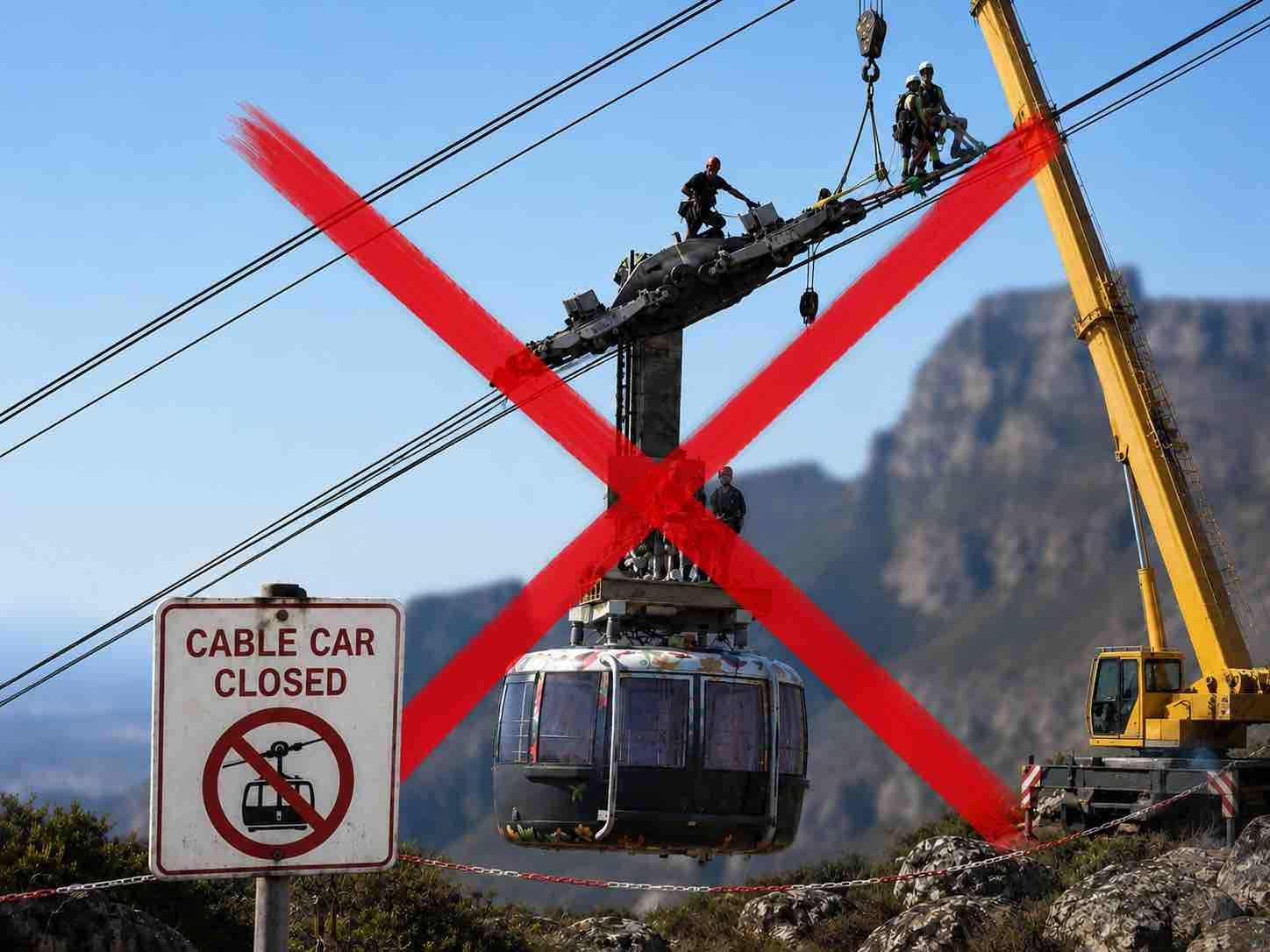
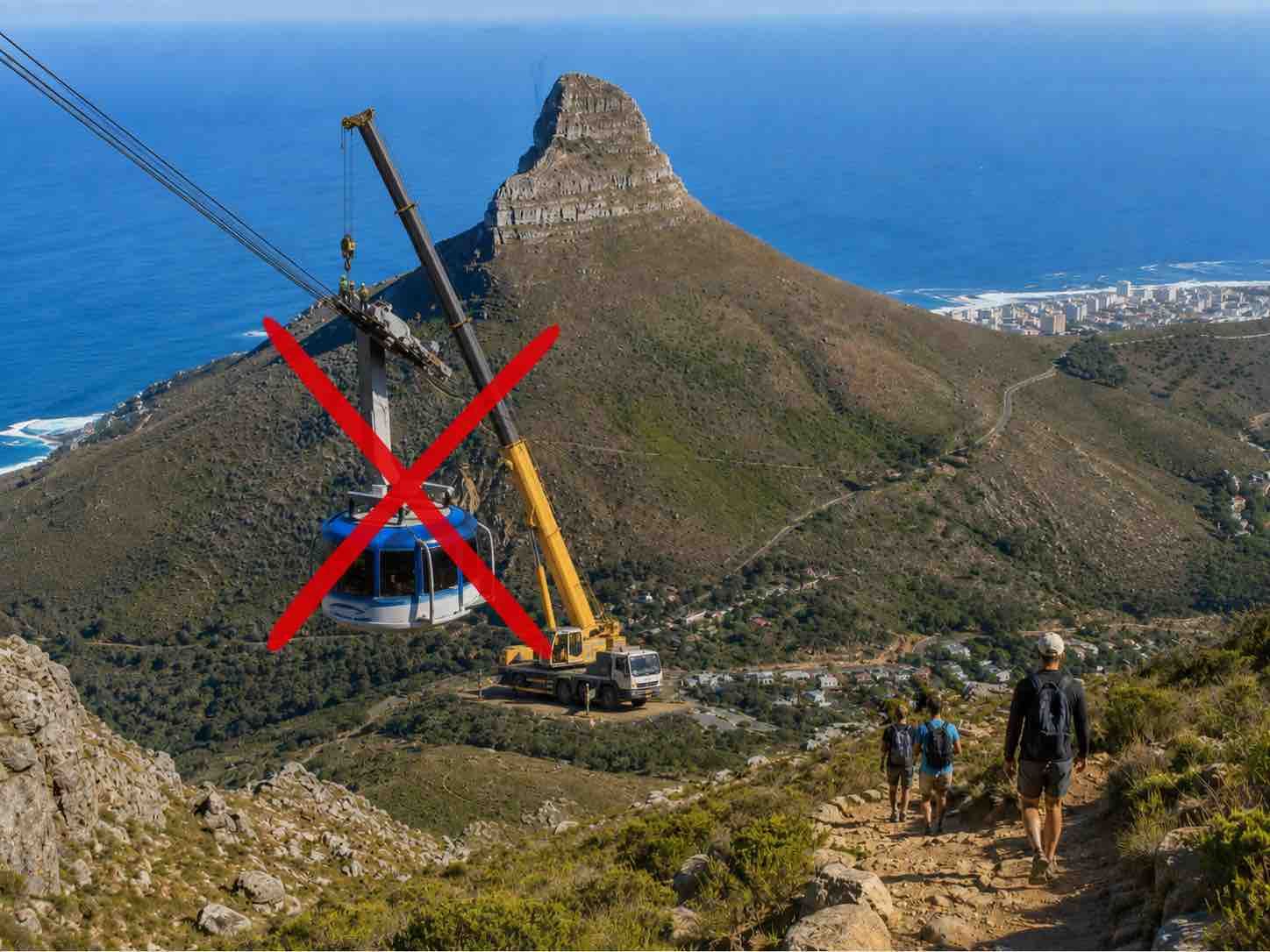
Cable car over mountain valley with red X overlay and a “Cable Car Closed” sign

Quick Facts About the 2026 Table Mountain Cable Car Closure

Before you continue, here are the most important things you should know:

Closure dates: 27 July – 9 August 2026

Cable Car: Closed in both directions

Table Mountain: Remains open for hiking (weather permitting)

Summit access: Only by hiking

Descent: You must hike back down

Best alternatives: Lion's Head, King's Blockhouse and Pipe Track

Private guided hikes: Available daily during the closure


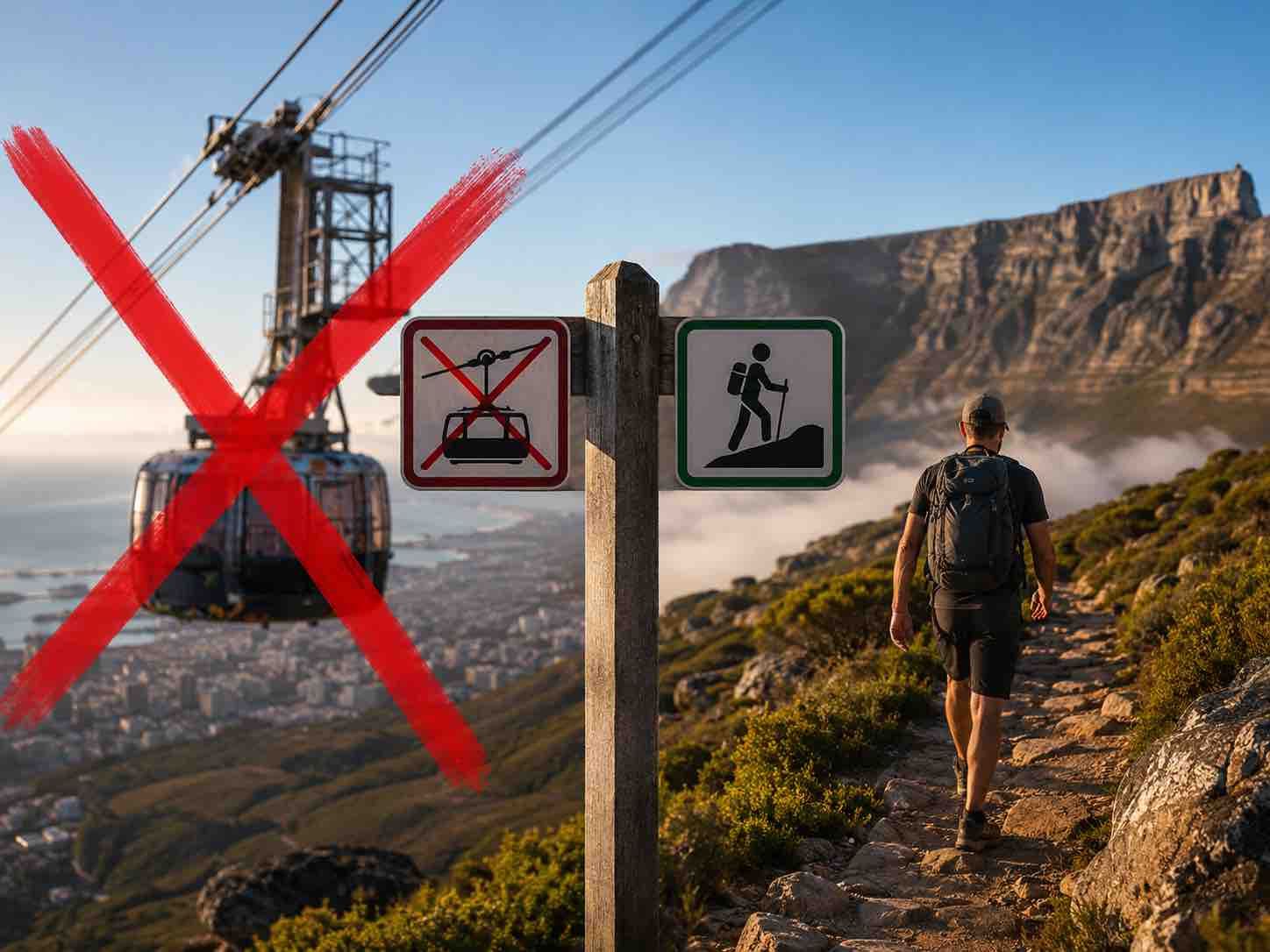
Hiker on mountain trail with trail signs and a large red X marking the left side.

OFFICIAL TABLE MOUNTAIN CABLE CAR CLOSURE DATES

Official Table Mountain Cable Car Closure Dates for 2026


The Table Mountain Aerial Cableway will close for scheduled annual maintenance on Monday, 27 July 2026.


It will remain closed until Sunday, 9 August 2026.


The planned reopening date is Monday, 10 August 2026, but the reopening remains dependent on the weather and operational conditions.


The important dates are:


Closure begins:

Monday, 27 July 2026


Final scheduled day of closure:

Sunday, 9 August 2026


Planned reopening:

Monday, 10 August 2026, weather permitting


The closure affects cable-car travel in both directions. There will be no cable car available to take visitors to the top, and hikers will not be able to use it for the journey down.


This is scheduled maintenance, not an indication that Table Mountain National Park is completely closed. Hiking and climbing routes can still be used, subject to normal trail, weather and safety conditions.


I recommend checking the official Cableway status shortly before your visit, even when travelling after the planned reopening date. Maintenance may be completed according to schedule, but strong wind, cloud or other operational conditions can still delay or interrupt Cableway operations.


One mistake I see visitors make is treating the reopening date as a guarantee that the cable car will operate all day. Table Mountain weather does not follow anyone’s holiday itinerary. Even outside the annual maintenance period, the Cableway may stop operating when conditions are unsuitable.


If your Cape Town plans depend entirely on the cable car, keep some flexibility in your itinerary. Do not leave Table Mountain until the final few hours of your final day in Cape Town.


If you are planning to hike during the shutdown, the closure date matters from the moment you begin the route. There is no option to reach the summit and then decide that you would rather take the cable car down. Your route, timing, food, water and energy must all be planned around a complete hiking journey.


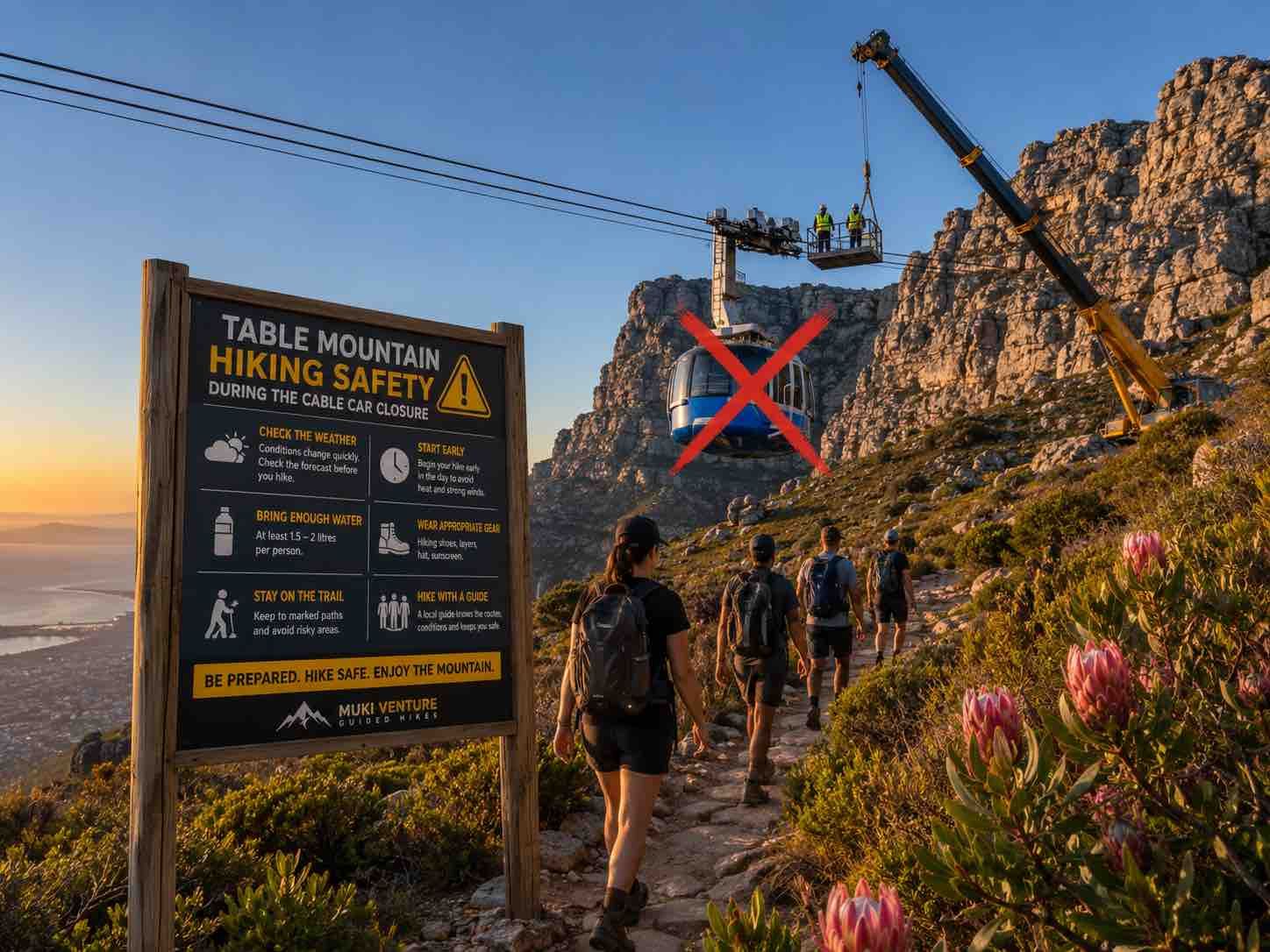
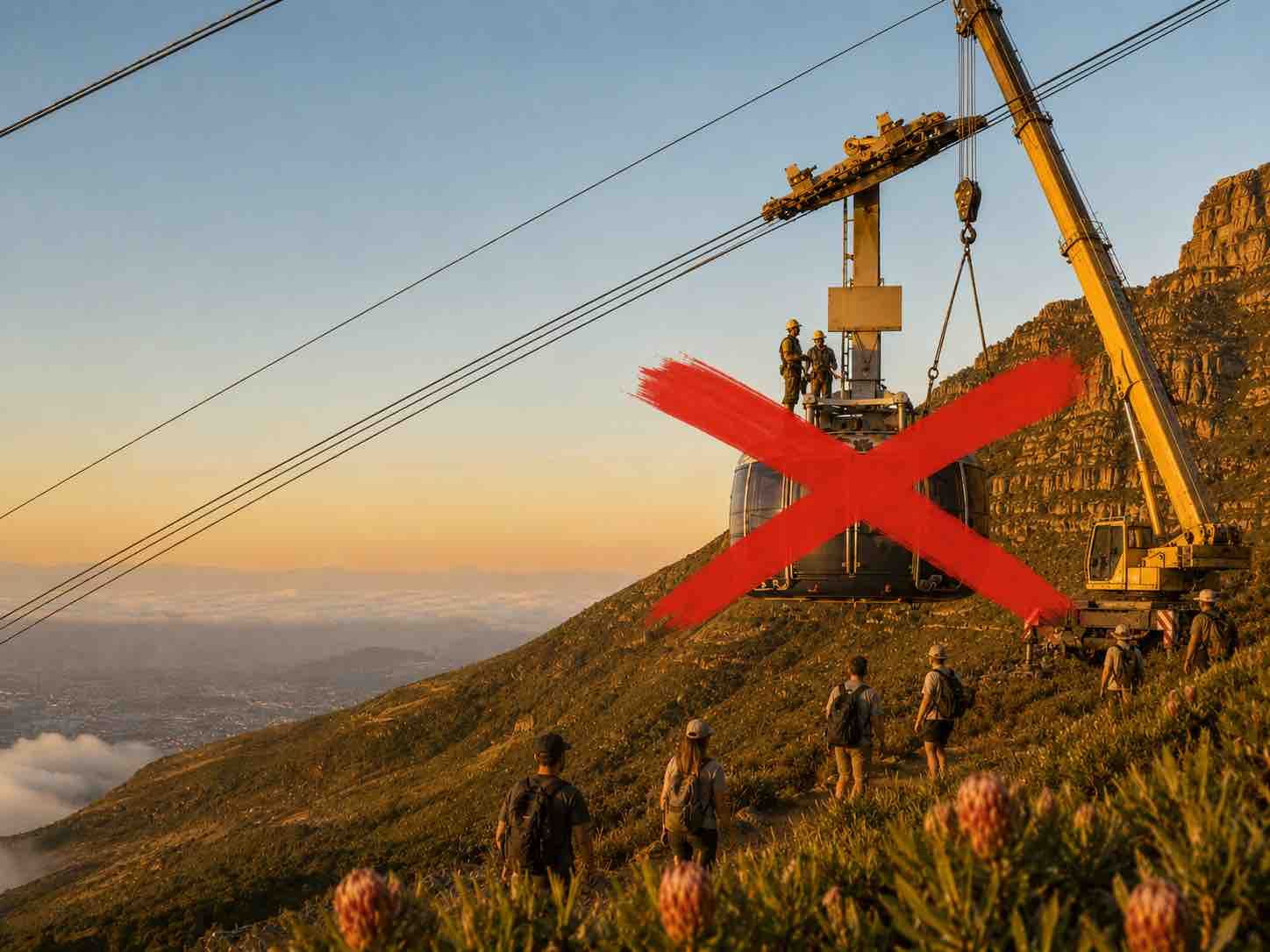
Hikers on a rocky trail beside a safety sign and red X on a cliffside at sunset

Is Table Mountain Closed During the Cableway Shutdown?

No. Table Mountain itself is not closed simply because the Cableway is undergoing maintenance.


The official announcement states that hikers and climbers can continue using the different mountain routes during the shutdown. What is unavailable is the cable-car service.


This distinction is important because many international visitors use “Table Mountain” and “the cable car” as though they are the same attraction. They are connected, but they are not the same thing.


The Cableway is one way of reaching the top. Table Mountain is an extensive natural mountain environment with numerous paths, ravines, ridges, viewpoints and access points.


During the closure, you may still be able to:


Hike recognised Table Mountain routes.

Walk on appropriate lower-slope trails.

Explore sections of Table Mountain National Park.

Visit nearby viewpoints.

Hike Lion’s Head.

Explore Kirstenbosch and selected connected trails.

Book an appropriately planned private guided hike.


Normal conditions still apply. A trail may become unsuitable because of rain, wind, fire risk, maintenance, poor visibility, local safety concerns or another temporary issue. Never assume that every route is automatically suitable simply because the national park remains accessible.


I usually explain it this way to my guests: the mountain remains available, but the easy mechanical return option disappears.


That changes the entire calculation.


During normal operations, some fit visitors hike up a route such as Platteklip Gorge and use the cable car for the descent. During the shutdown, the same visitor must either descend a suitable route on foot or choose a different experience.


The summit also should not be treated like a normal indoor tourist attraction during a maintenance closure. I advise visitors to plan conservatively and not rely on Cableway-operated food, toilets, shops or shelter without first confirming exactly what will be available during the shutdown.


Bring what you need for the complete hike. That includes water, food, warm clothing and weather protection. Do not climb with the expectation that you can buy everything you need when you reach the top.


The mountain may look close to the city, but it must still be treated as a serious natural environment. Being able to see buildings, roads and neighbourhoods below does not remove the risks of changing weather, fatigue, navigation problems or injury.


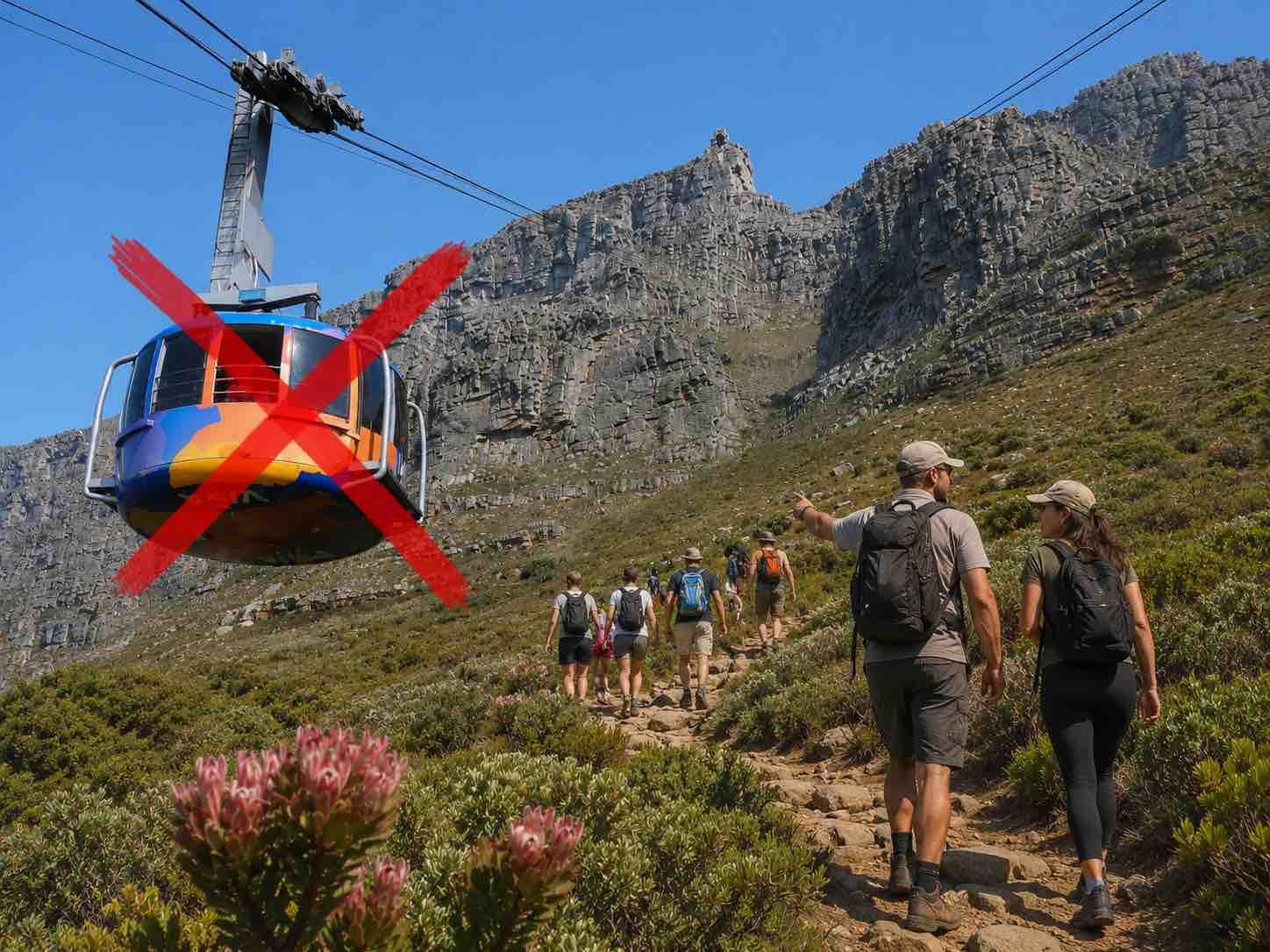
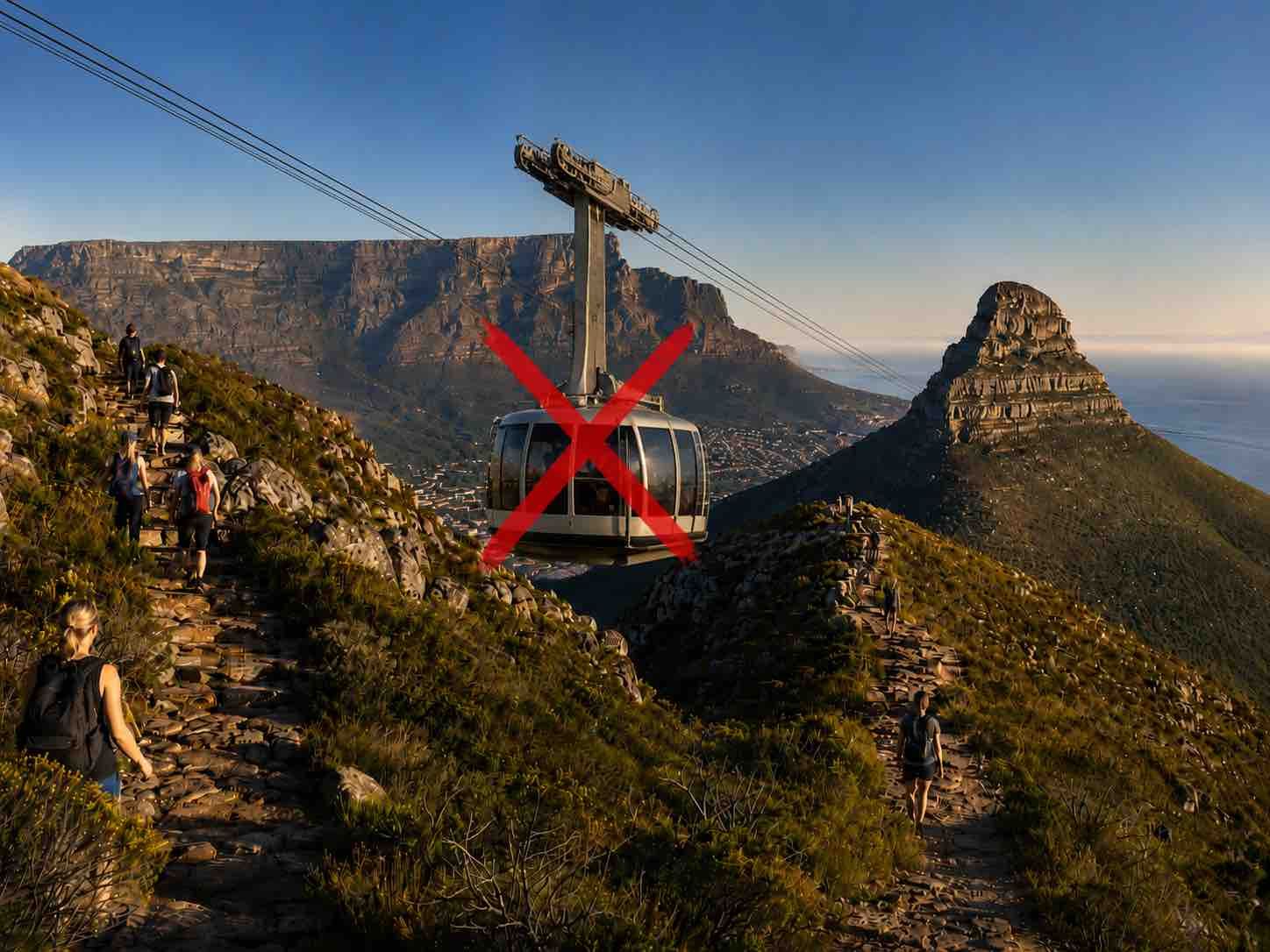
Hikers on a mountain trail under a cable car; one gondola is marked with a large red X.

Can You Hike Up Table Mountain and Take the Cable Car Down During the Closure?

No. You cannot hike up and take the cable car down between 27 July and 9 August 2026.


There will be no cable-car journeys in either direction during the scheduled maintenance shutdown.


If you hike to the summit, you must have a safe and realistic plan for descending on foot.


This sounds obvious, but it is one of the most important points on this page. Many visitors focus completely on the climb. They imagine the views, the summit photograph and the satisfaction of reaching the top. They give much less thought to what happens afterwards.


Walking downhill requires less cardiovascular effort for many people, but it can be harder on the knees, ankles, hips and tired leg muscles. Steep stone steps can become uncomfortable after a long climb, especially when they are wet.


Your balance and concentration also matter. A tired hiker may begin placing their feet carelessly, rushing sections or losing confidence on uneven terrain.


I often tell my guests that the summit is not the finish line during the Cableway closure. The finish line is returning safely to the agreed endpoint.


Before recommending a route, I consider:


Your general fitness.

Your recent hiking experience.

Any knee, ankle, hip or back concerns.

Your balance on uneven ground.

Your confidence with heights.

The weather forecast.

The expected trail conditions.

Available daylight.

How much water and food you are carrying.

Whether the return route is appropriate.


A full return hike is not simply twice the difficulty of walking up. The descent creates different physical and technical demands.


India Venster is a good example. It is an adventurous ascent involving exposed scrambling sections. I do not treat it as a casual down-route for visitors who are unfamiliar with the mountain. Descending exposed scrambling sections can feel much more intimidating than climbing them.


Platteklip Gorge is more direct and does not involve the same type of scrambling, but it is steep and repetitive. Descending its stone steps after the climb can be demanding on tired legs.


My advice is to choose the route according to the complete journey, not according to the most exciting photograph or shortest ascent time.


There is no shame in selecting Lion’s Head, the Pipe Track or a lower-slope experience instead. A shorter, enjoyable hike that suits you is far better than a summit plan that becomes unsafe or miserable halfway through.


Mountain trail overlooking a crane accident marked with a red X, with hikers in the foreground.

What Will Be Closed During the Cable Car Maintenance Period?

The one service you can be certain will be unavailable is the Table Mountain Cableway itself.


There will be no cable cars travelling up or down between 27 July and 9 August 2026.


The shutdown is a maintenance period, so I advise visitors not to rely on Cableway-operated facilities unless their availability has been confirmed through an official update closer to the time.


Plan as though you may not have access to:


Cable-car transport.

Cableway ticket offices.

Cableway shops.

Cableway restaurants or cafés.

Cableway-operated visitor facilities.

An easy indoor waiting area.

A guaranteed toilet facility at the upper station.

An emergency transport shortcut down the mountain.


This does not mean every part of the mountain or every surrounding attraction will be closed. Table Mountain National Park remains accessible in different areas, and hiking routes may remain open subject to normal conditions.


The practical lesson is that you should be self-sufficient.


Carry enough water for the ascent and descent. Bring food that you can eat easily on the trail. Pack a warm and waterproof layer even when the weather looks acceptable at your accommodation.


One mistake I see visitors make is packing for the temperature in the city rather than the conditions higher on the mountain. The summit can be colder, wetter, cloudier and windier than the streets below.


You should also plan your transport carefully. If your hike begins and ends at different points, organise the return arrangement before setting out. Mobile reception can be unreliable in parts of the mountain, and ride-hailing availability should never be your only safety plan.


Parking near popular routes can become busy. Do not leave visible luggage, passports, cameras or other valuables in a parked vehicle.


Before leaving, confirm:


Your chosen route.

Your descent route.

Your expected finishing point.

Who knows your plan.

How you will return to your accommodation.

The latest weather information.

Any current SANParks notices.

The emergency numbers saved on your phone.


The closure removes convenience, but it does not prevent you from enjoying the mountain. It simply requires more preparation and a more realistic understanding of the full experience.


Mountain worksite with cable and crane; red X marks the equipment as blocked

Best Hiking Routes During the Table Mountain Cable Car Closure

There is no single best Table Mountain route for every visitor.


The correct route depends on your fitness, experience, balance, confidence with exposure, available time, the weather and whether you can comfortably complete the descent.


During the Cableway closure, I become more conservative with route selection because every summit hike requires a full hiking return.


Platteklip Gorge


Platteklip Gorge is the most direct and recognisable route to the top of Table Mountain.


It follows a steep stone path through the gorge. There are no major technical climbing sections, but the continuous ascent can be physically demanding.


It is sometimes described as the easiest route because it is direct and relatively straightforward to follow. I prefer to describe it as simple to understand but not easy on the legs.


During the closure, you must be prepared to descend on foot. Returning down the same steep stone steps can place pressure on the knees and thighs, particularly when the rocks are wet.


Platteklip Gorge may suit:


Fit visitors.

Hikers who prefer a direct route.

Visitors who are comfortable with steep stone steps.

People who understand that they must complete the full return hike.


It may not suit:


Visitors with significant knee problems.

Anyone expecting a gentle walk.

People who have not allowed enough time.

Visitors carrying too little water or clothing.

Anyone relying on the cable car for the descent.


India Venster


India Venster is more adventurous than Platteklip Gorge.


It includes scrambling, exposed sections and places where hands are needed. The route provides dramatic front-face views, but it is not suitable for every visitor.


I consider fitness, balance, experience and confidence with heights before recommending it.


During the shutdown, the descent requires especially careful planning. I do not recommend casually reversing India Venster simply because it was the chosen ascent. Down-climbing exposed sections can feel considerably more difficult.


India Venster may suit:


Experienced and confident hikers.

Visitors comfortable with scrambling.

People with good balance.

Hikers who understand exposure.

Guests accompanied by someone who knows the route.


It is not a sensible choice for:


People with vertigo.

Visitors uncomfortable near exposed edges.

Young children without appropriate experience.

Anyone with poor balance.

Visitors looking for the easiest Table Mountain route.


Skeleton Gorge


Skeleton Gorge begins from the Kirstenbosch side and climbs through a beautiful forested environment.


It feels completely different from the exposed front face of Table Mountain. The route includes ladders, rocks, roots, streams and potentially wet surfaces.


Winter rain can make parts of the trail slippery. The forest may protect you from some sun and wind, but it does not remove the need for proper footwear and weather protection.


Reaching the top of Skeleton Gorge does not mean you have immediately arrived at the upper Cableway station. A longer summit or plateau journey requires additional time and energy.


Skeleton Gorge may suit:


Nature lovers.

Visitors who enjoy forest environments.

Fit hikers wanting a longer experience.

People comfortable with ladders and wet terrain.


It may not suit:


Visitors with limited time.

Anyone expecting a short summit route.

People wearing smooth-soled shoes.

Hikers uncomfortable on wet ladders or rocks.


Kasteelspoort


Kasteelspoort approaches Table Mountain from the Atlantic side.


It offers beautiful views and access towards the Back Table, but it is still a substantial mountain hike. It can feel long, especially when combined with additional summit exploration and a full return descent.


Winter weather can make rocky sections wet, and cloud may reduce visibility higher up.


Kasteelspoort may suit fit hikers who want a quieter and more scenic full-day experience. It should not be selected simply because it appears less steep in photographs.


Lower-Slope Table Mountain Walks


A summit is not the only way to enjoy Table Mountain.


Lower-slope routes can provide excellent scenery without committing you to a full ascent and descent.


Depending on conditions, I may recommend:


Sections of the Pipe Track.

Appropriate contour paths.

Kirstenbosch nature walks.

Lower mountain viewpoints.

A tailored scenic walk.

A shorter route focused on fynbos, photography and local history.


For many visitors, this is the better choice during the shutdown. You still experience the landscape and views while reducing the physical demands and exposure to summit weather.


Lion’s Head


Lion’s Head is separate from the Table Mountain Cableway and is not closed simply because the Cableway is undergoing maintenance.


It is one of the best-known alternatives, but it should not be treated as an effortless option. The upper route includes steeper sections, ladders, chains and scrambling.


It may suit visitors who want a shorter summit experience with impressive views. Route timing, crowds, darkness, weather and individual confidence still need to be considered.


My usual recommendation is not based on which route is most famous. It is based on which experience will allow you to enjoy the mountain confidently and return safely.



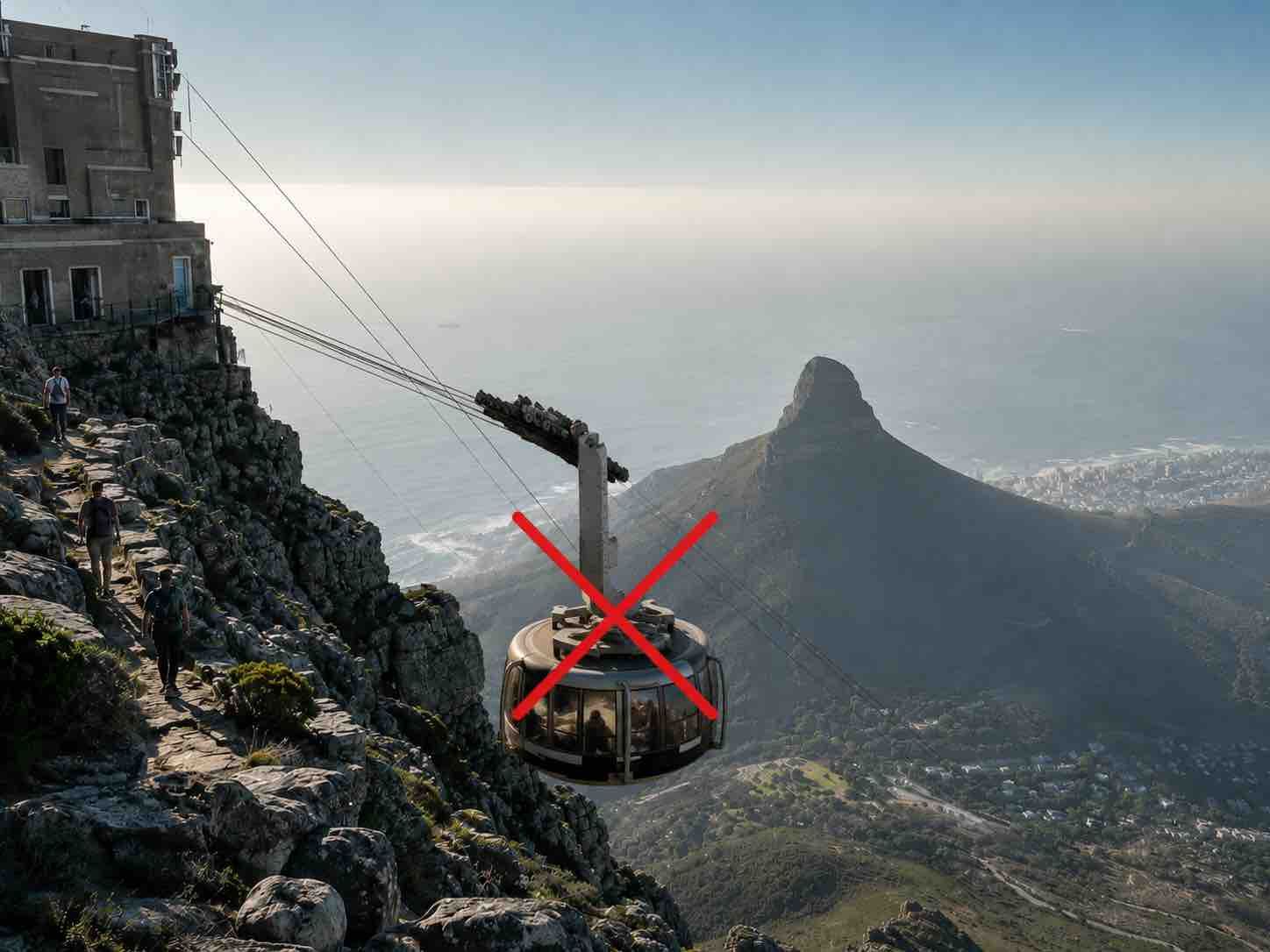
Cable car suspended above rocky mountains, with a red X marking it as not allowed.

How Difficult Is a Full Table Mountain Return Hike?

A full Table Mountain ascent and descent is a proper mountain hike.


The difficulty depends on the route, but you should not calculate it only by looking at the distance. Elevation gain, uneven terrain, steep steps, exposure, weather, route-finding and the condition of the trail can make a relatively short route physically demanding.


Platteklip Gorge is the clearest example. The route is direct, but it climbs steeply. There are limited flat recovery sections, and the stone steps can feel relentless.


Once you reach the top, your legs may already be tired. You then need enough energy, balance and concentration for the descent.


A visitor who regularly walks several kilometres on flat city streets may still find Table Mountain difficult. Flat walking fitness and steep mountain fitness are not the same.


Before recommending a full return hike, I normally want to understand:


How often you exercise.

Whether you have recently completed a steep hike.

Whether you have knee or ankle concerns.

How you cope with uneven ground.

Whether you are comfortable using your hands on rocks.

How you feel about heights.

Whether you are travelling after a long flight.

Whether you have been sleeping and hydrating properly.

How much time you have available.


I often tell my guests not to exaggerate their fitness and not to underestimate it either. Honest information helps me recommend the right experience.


The descent is frequently where difficulties appear.


Common problems include:


Tired quadriceps.

Sore knees.

Slipping on wet rocks.

Rushing because daylight is disappearing.

Losing concentration.

Running low on water.

Becoming cold after stopping.

Choosing an unsuitable shortcut.

Trying to keep up with faster hikers.


During the Cableway closure, I recommend allowing considerably more time than you would for an ascent-only plan.


Your schedule should include:


A safety briefing.

A comfortable climbing pace.

Short breaks.

Food and water stops.

Time for photographs.

Time to assess summit conditions.

A controlled descent.

Extra time for changing weather or slower progress.


Turning around is not failure.


One thing I have learnt from guiding is that the strongest decision is sometimes made before the summit. When the weather, timing or condition of a guest changes, continuing upward may no longer be sensible.


The mountain will still be here. Your safety is more important than completing a particular route on a particular day.


Hikers walking on a mountain trail beside a cable car with a red X over it

Table Mountain Winter Weather During the Cable Car Closure

The 2026 maintenance shutdown takes place during Cape Town’s winter.


Winter can provide beautiful hiking conditions, but it can also bring rain, cold wind, wet trails, low cloud and reduced visibility.


A calm morning in the city does not guarantee calm conditions on the summit.


Table Mountain creates and catches weather. Cloud can form quickly, visibility may disappear and temperatures can feel much colder when clothing becomes wet or the wind increases.


In my experience, visitors often look out of a hotel window, see blue sky over part of Cape Town and assume the entire mountain will remain clear. That is not always how local conditions work.


The front face, Atlantic side, forested eastern slopes and summit plateau can experience different conditions during the same period.


Winter considerations include:


Shorter daylight hours.

Wet stone steps.

Slippery roots.

Water running through sections of trail.

Cold wind on exposed areas.

Low cloud on the summit.

Rapid loss of visibility.

Longer drying times after rainfall.

Greater need for warm and waterproof layers.


Rain does not affect every route in the same way.


Platteklip Gorge may become slippery on the stone steps.


Skeleton Gorge may have wet ladders, roots, mud, streams and rocks.


Exposed routes may become uncomfortable or unsafe in strong wind.


Cloud can make navigation across the flatter summit and Back Table more confusing for visitors who do not know the area.


A weather forecast is useful, but it is not the only thing I consider. I also look at the mountain itself, recent rainfall, wind direction, cloud movement, the chosen route and how quickly conditions are expected to change.


My advice is to avoid becoming emotionally attached to one route.


You may arrive in Cape Town dreaming about India Venster, but the conditions may make a sheltered or lower route more appropriate. Another day may be better for Lion’s Head, Kirstenbosch or a scenic walk.


Flexibility is part of responsible mountain planning.


Always carry a waterproof outer layer. SANParks recommends waterproof clothing even during summer because conditions change rapidly. During winter, this becomes even more important.


Do not depend on a lightweight fashion jacket that offers little wind or rain protection. A warm layer and a separate waterproof shell provide much better flexibility.


When visibility disappears, do not continue wandering in the hope that the route will become obvious. Stay together, assess your position and make a controlled decision.


A cable car hangs by a mountain lift with a large red X over it and a “Cable car closed” sign.

Table Mountain Hiking Safety During the Cable Car Closure

The Cableway closure makes proper hiking preparation even more important because you cannot use the cable car as a planned descent option.


Table Mountain is located beside a major city, but it remains a real mountain environment.


The main areas I consider are:


Route suitability.

Weather.

Available daylight.

Fitness.

Personal security.

Navigation.

Communication.

Food and water.

Emergency planning.

The descent.


Do Not Hike Alone


SANParks recommends hiking in a group and identifies four people as the ideal number.


Solo travellers sometimes tell me that they regularly hike alone at home. The concern is not only route-finding or personal security. A simple ankle injury can become far more serious when nobody is available to assist, share your location or contact rescuers.


Choose the Route Before Starting


Decide which route you will follow and where you will finish.


Do not begin with a vague plan to “see how it goes”. Table Mountain has connecting paths, ravines and junctions that can confuse visitors.


Tell Someone Your Plan


A reliable person should know:


Your route.

Your starting point.

Your starting time.

Your expected finish.

Your planned endpoint.

Who is hiking with you.


Contact them if the plan changes.


Start Early


Starting early provides more time to deal with a slower pace, changing weather, route adjustments or a controlled turnaround.


A late start creates pressure. Pressure encourages rushing, missed breaks and poor decisions.


Stay on Recognised Paths


Do not follow an apparent shortcut simply because it looks quicker.


Shortcuts damage vegetation and may lead into loose, steep or dangerous terrain.


Carry a Charged Phone


Your phone should be fully charged, but do not assume you will have reliable reception everywhere.


Save the emergency numbers before leaving.


Table Mountain National Park Emergency:

086 110 6417


Wilderness Search and Rescue:

021 937 0300


General mobile emergency:

112


Keep Valuables Out of Sight


Do not openly display large amounts of cash or expensive equipment unnecessarily.


Avoid hiking with headphones that prevent you from hearing people, weather or movement around you.


Check Current Safety Information


Local safety conditions can change. Check recent SANParks notices and reliable local updates shortly before the hike.


Do not rely on a travel forum written several years ago.


Know When to Turn Around


Turn around when:


The weather is worsening.

Visibility is disappearing.

The group is moving too slowly.

Someone becomes unwell.

You are running short of daylight.

The route is more difficult than expected.

You are uncertain about navigation.

The descent will no longer be completed safely.


My job as a guide is not only to show guests the route. It is to continuously assess the group, the mountain and the changing conditions.


A successful hike is one where everyone returns safely, whether or not the original summit plan was completed.

Hiker on mountain trail with trail signs and a large red X marking the left side.

Can Children, Seniors and First-Time Hikers Hike During the Closure?

Age alone does not tell me whether someone is suited to a Table Mountain hike.


I have met older visitors with excellent mountain fitness and younger visitors who struggle with steep terrain. What matters more is fitness, balance, health, experience, confidence and the chosen route.


Children


Children should not automatically be included in a full Table Mountain return hike simply because they are energetic.


Consider:


The child’s hiking experience.

Their ability to follow instructions.

Their comfort with heights.

Their patience on a long route.

Whether they can manage the descent.

The weather.

The adult-to-child ratio.

Whether the adults will be able to assist if the child becomes tired.


Young children can become cold quickly when they stop moving. They may also lose concentration on the descent.


A shorter route, Kirstenbosch walk, Pipe Track section or carefully planned Lion’s Head experience may be more suitable.


Seniors


Many active seniors can enjoy Cape Town’s mountain routes.


The important questions include:


Are you comfortable with steep steps?

Do you have knee, hip or ankle concerns?

How is your balance?

Do you use hiking poles?

Have you completed a similar hike recently?

Are you taking medication that may affect exertion?

How do you cope with cold or heat?


Hiking poles can help some visitors, but they are not a replacement for fitness or appropriate route selection.


First-Time Hikers


A first-time hiker should not select India Venster simply because it appears exciting online.


Start with a route that allows you to understand how you respond to steep, uneven mountain terrain.


A private guide can adjust the pace, provide route information and recommend where to turn around, but a guide cannot remove every physical demand from the mountain.


Visitors with Medical Concerns


Speak honestly about:


Heart conditions.

Breathing difficulties.

Recent injuries.

Joint problems.

Vertigo.

Balance concerns.

Severe anxiety around heights.

Medication requirements.

Allergies.

Any condition affected by physical exertion.


A hiking guide is not a substitute for medical advice. When a health condition may be affected by strenuous activity, obtain appropriate medical guidance before booking.


Accessibility


During normal Cableway operations, visitors with limited mobility may be able to experience the summit using the cable car and accessible facilities.


During the shutdown, that option is unavailable.


The hiking routes to the summit are not wheelchair-accessible and involve uneven natural terrain. Visitors with restricted mobility should consider accessible viewpoints and alternative Cape Town experiences rather than attempting a route that does not match their needs.


I would rather recommend an experience you can genuinely enjoy than place you on a route that leaves you frightened, exhausted or uncomfortable.

Hikers on a rocky trail beside a safety sign and red X on a cliffside at sunset

What to Pack for a Table Mountain Hike During the Closure

Pack for the complete ascent and descent.


Do not pack only for the weather you can see when leaving your accommodation.


Essential Items


Water


Carry enough water for the route, conditions and your personal needs.


Do not assume that water will be available at the summit.


Food and Snacks


Bring food that is easy to carry and eat.


Useful options include:


Sandwiches.

Fruit.

Nuts.

Energy bars.

Dried fruit.

A small salty snack.


Bring enough for delays, not only the expected hiking time.


Waterproof Jacket


A proper waterproof outer layer is important during Cape Town’s winter.


It should protect you from rain and help reduce wind exposure.


Warm Layer


Pack a fleece, light insulated jacket or another warm layer.


The summit may feel much colder than the city.


Hiking Shoes


Wear shoes with suitable grip.


Smooth fashion sneakers, sandals and flip-flops are not appropriate for steep, wet or rocky routes.


Backpack


Use a backpack that allows your hands to remain free.


This is especially important on routes involving ladders, chains, rocks or scrambling.


Fully Charged Phone


Save emergency contacts and keep your phone protected from rain.


A small power bank may be useful for longer hikes.


Sun Protection


Winter does not eliminate UV exposure.


Carry:


Sunscreen.

A hat or cap.

Sunglasses.


Personal Medication


Bring any medication you may require during the hike.


Tell your guide or hiking companion where it is stored.


Small First-Aid Kit


A basic kit may include:


Blister treatment.

Plasters.

A small bandage.

Antiseptic wipes.

Personal medication.


Navigation


Carry a reliable map or appropriate offline navigation information.


Do not depend entirely on live mobile data.


Headlamp


A headlamp is sensible when beginning before sunrise, finishing near sunset or completing a route that may take longer than expected.


Hiking Poles


Poles may assist with balance and reduce some strain during the descent.


They must be used correctly and should not create false confidence on technical terrain.


What Not to Bring


Avoid carrying unnecessary valuables.


Do not overload your backpack with heavy equipment you are unlikely to use.


Do not take drones without understanding the applicable national-park rules and permits.


I usually check my guests’ clothing and equipment before we begin. Fixing a packing problem at the trailhead is much easier than discovering it halfway up the mountain.

Mountain cable car with a red X over it, above rugged peaks in clear daylight.

Costs, Tickets, Transport and Parking During the Closure

Cable-Car Tickets


You cannot use a cable-car ticket during the scheduled maintenance shutdown because no cable-car trips will operate.


Do not buy a ticket for a closure date expecting to use it for the descent.


Questions about existing tickets, date changes or special offers should be directed to the official Cableway service.


Hiking Costs


The cost of your outing depends on:


The route and access point.

Whether an entrance fee applies.

Transport.

Parking.

Food and water.

Equipment.

Whether you book a private guide.


Some Table Mountain access points can be reached without buying a Cableway ticket. Other experiences may involve separate garden, park or access charges.


Check current fees shortly before visiting because prices and access arrangements can change.


Private Guided Hike Costs


A private guided hike is a separate service from the Cableway.


The price may depend on:


The route.

Duration.

Number of guests.

Start time.

Transport arrangements.

Equipment requirements.

The level of difficulty.


Contact Muki Venture with your preferred date, group size, fitness and route interests so that the experience can be assessed properly.


Transport


Confirm:


Where the hike begins.

Where the hike finishes.

Whether it is an out-and-back route.

Whether you require a transfer.

Whether ride-hailing services are practical at the finishing point.

Whether the road or parking area has any current restrictions.


Do not assume that all Table Mountain routes begin at the Lower Cableway Station.


Platteklip Gorge, India Venster, Skeleton Gorge, Kasteelspoort and Lion’s Head have different access arrangements.


Parking


Popular areas may become busy, particularly when more visitors turn to hiking during the Cableway shutdown.


Arrive with enough time to park without delaying your hike.


Do not leave visible valuables inside your vehicle.


Remove or conceal:


Luggage.

Passports.

Cameras.

Phones.

Handbags.

Shopping bags.

Electronics.


My advice is to complete your transport planning before the morning of the hike. A delayed pickup or confusion about the trailhead can push the whole experience into a less comfortable part of the day.

Mountain trail overlooking a crane accident marked with a red X, with hikers in the foreground.

Best Time to Start a Table Mountain Hike During the Closure

There is no universal starting time for every route.


I base the start on:


The route.

The expected hiking duration.

The group’s fitness.

Sunrise and sunset.

The weather forecast.

Recent rainfall.

Temperature.

Wind.

Cloud movement.

Available daylight.

Transport arrangements.


During winter, daylight is more limited than in summer. This makes late starts less forgiving.


For a full ascent and descent, I usually prefer beginning early enough to avoid rushing. An early start also creates more flexibility if the group needs extra breaks or if the route must be adjusted.


Do not choose a starting time only because you want sunrise or sunset photographs.


Sunrise and sunset hikes require:


A headlamp.

Warm clothing.

Good timing.

Route knowledge.

Reliable weather.

A realistic pace.

A safe daylight or darkness plan.


Photography


Table Mountain offers extraordinary photography, but stopping repeatedly can add considerable time to a hike.


Include photography time in the route plan.


Good opportunities may include:


City views from the front face.

Robben Island on a clear day.

The Twelve Apostles.

The Atlantic coastline.

Fynbos close-ups.

Cloud moving through the ravines.

Rock formations.

Sunrise or late-afternoon light.

Lion’s Head and Signal Hill.

The upper plateau.


Keep cameras and phones secure near exposed sections.


Do not step backwards while looking at a screen.


Do not leave the recognised trail to reach a photograph.


Avoid standing in a position that blocks other hikers, particularly on narrow paths.


Winter light can be beautiful because the sun sits lower and cloud creates dramatic conditions. The same cloud can quickly remove visibility, so photography must never distract you from route and weather awareness.


I often stop my guests at viewpoints where there is enough room to stand comfortably. A photograph is much better when you are not balancing nervously near an edge.


My advice is to enjoy the view with your own eyes before reaching for your phone. Cape Town’s mountains are more than a collection of social-media backgrounds.

Mountain worksite with cable and crane; red X marks the equipment as blocked

Fynbos, Wildlife and Local Hiking Etiquette

Table Mountain is not only about reaching a summit.


It is part of an exceptional natural environment filled with fynbos, rock formations, seasonal flowers, insects, birds and small animals.


Visitors sometimes walk past the smaller details because they are focused entirely on the view from the top.


Personally, I enjoy showing guests how much changes as we move between slopes, ravines, forest and exposed mountain terrain.


Fynbos


Fynbos may look tough, but many plants are sensitive to trampling.


Stay on the established trail.


Do not create a new path to reach a photograph.


Do not pick flowers or remove plants.


Avoid placing bags and equipment directly on fragile vegetation.


Wildlife


You may encounter birds, lizards, dassies and other small wildlife.


Observe animals without feeding or touching them.


Food changes natural behaviour and may make animals dependent on visitors.


Keep snacks inside your bag until you are ready to eat.


Baboons


Baboons may occur in parts of the broader national park.


Do not feed them.


Do not approach them for photographs.


Keep food packed away and follow any instructions from rangers or guides.


Leave No Trace


Carry all rubbish back with you.


This includes:


Food wrappers.

Fruit peels.

Tissues.

Wet wipes.

Bottle tops.

Cigarette ends.


Something being biodegradable does not make it appropriate to leave beside a trail.


Noise


Allow other visitors to enjoy the mountain.


Avoid loud music.


Music also reduces your ability to hear instructions, weather changes or approaching hikers.


Passing Other Hikers


Give way where appropriate.


Do not push past people on narrow or exposed sections.


If you need to stop, move to a safe place where others can pass.


Respect Different Paces


A private hike allows us to move according to the guests rather than pressure them to keep up with a large group.


On public trails, be patient with slower hikers. Everyone has a different level of experience and confidence.


One thing I often tell my guests is that we are visitors in this environment. A responsible hike should leave the trail looking exactly as it did before we arrived.

Cable car suspended above rocky mountains, with a red X marking it as not allowed.

Best Alternatives During the Table Mountain Cable Car Closure

You do not need to cancel every mountain experience because the Cableway is closed.


There are several alternatives, and some may suit you better than a full Table Mountain ascent and descent.


Lion’s Head


Lion’s Head offers a shorter summit experience with panoramic views of Cape Town, Table Mountain and the Atlantic coastline.


The trail is still physically demanding and includes ladders, chains and scrambling near the upper section.


It can become busy around sunrise, sunset and full moon periods.


I assess confidence with heights and scrambling before recommending the summit.


The Pipe Track


The Pipe Track offers beautiful views along the slopes above Camps Bay.


It does not take you to the top of Table Mountain, but it can provide a rewarding mountain experience with less climbing.


The distance can be adjusted according to fitness, weather and available time.


Kirstenbosch Walks


Kirstenbosch provides access to botanical and forest environments beneath the eastern side of Table Mountain.


Visitors can enjoy shorter walks without committing to the complete Skeleton Gorge ascent.


This can work well for families, nature lovers and guests who prefer a gentler outing.


Lower Table Mountain Slopes


A tailored lower-slope hike can include:


Fynbos.

City views.

Mountain history.

Photography.

Local stories.

Quieter paths.

A comfortable pace.


These experiences are often overlooked because visitors think every Table Mountain outing must end at the summit.


Signal Hill


Signal Hill provides accessible viewpoints and can be combined with a shorter walk.


It is not a replacement for a mountain summit hike, but it can work well when the weather is unsuitable for exposed routes.


Cape Town Scenic Walks


Depending on the weather and your interests, alternatives may include coastal, forest or nature-focused walks elsewhere in Cape Town.


My advice is to focus on the experience you want rather than the name of the summit.


Tell me whether you want:


A physical challenge.

Sunrise.

Sunset.

Photography.

Fynbos.

Forest.

A family-friendly walk.

A private couple’s experience.

A route without exposure.

A shorter activity.

A proper summit adventure.


Once I understand that, I can recommend a route more honestly.

Hikers walking on a mountain trail beside a cable car with a red X over it

Why Consider a Private Guided Hike During the Closure?

You do not legally need to book a guide simply because the Cableway is closed.


However, a private guide can be valuable when you are unfamiliar with Table Mountain, uncertain about route difficulty or worried about completing the full return journey.


Route Selection


The route can be matched to:


Your fitness.

Experience.

Age.

Confidence.

Available time.

Weather.

Photography interests.

Comfort with heights.

Any knee or balance concerns.


A well-known route is not automatically the right route.


Pace


Private guiding allows the pace to be adjusted around you rather than around a large group.


You can take sensible breaks without feeling that you are holding everyone back.


Weather Decisions


Local conditions can change quickly.


A guide can help assess:


Cloud.

Wind.

Rain.

Visibility.

Trail conditions.

Timing.

Whether to continue or turn around.


Navigation


Some routes are clearer than others.


A guide reduces uncertainty at junctions and helps avoid unsuitable shortcuts or descent choices.


Safety Planning


Before beginning, I consider:


Emergency contacts.

Equipment.

Water.

Clothing.

Route timing.

Transport.

The finishing point.

The descent.

Alternative plans.


Local Knowledge


A guided hike is not only about following a path.


I can explain aspects of:


Cape Town’s mountain environment.

Fynbos.

Local viewpoints.

Weather patterns.

Route history.

Hiking etiquette.

The relationship between the city and the mountain.


Photography


I can help identify comfortable viewpoints and allow enough time for photographs without placing you in an unsafe position.


Honest Advice


Sometimes the most useful thing a guide can do is recommend a different route.


I do not believe every guest must reach the highest point. The experience should suit the person, not the other way around.


A private guided hike during the Cableway shutdown gives you someone who is thinking about the entire journey—from the first step to the final descent.

A cable car hangs by a mountain lift with a large red X over it and a “Cable car closed” sign.

Why You Can Trust My Table Mountain Advice

Accredited Local Hiking Guide


I am an accredited local hiking guide based in Cape Town.


Guiding is not simply knowing which direction to walk. It includes route planning, guest care, safety awareness, weather assessment, responsible decision-making and understanding how different visitors respond to the mountain.


More Than 15 Years of Guiding Experience


I have more than 15 years of experience guiding visitors in Cape Town.


Over the years, I have learnt that guests arrive with very different expectations.


Some are experienced hikers.


Some have never walked on steep mountain terrain.


Some are confident until they reach an exposed section.


Some are physically strong but struggle with the descent.


Some need a slower pace and more reassurance.


This is why I do not use the same plan for every guest.


First-Hand Local Knowledge


My advice comes from practical experience on Cape Town’s mountains.


I consider:


The route.

The weather.

The season.

The guest.

The available time.

The descent.

The current mountain conditions.


Personal Recommendations


I do not recommend a route only because it is famous.


I recommend the experience that I believe best matches your ability, interests and comfort.


Years of Practical Decision-Making


Mountain experience includes knowing when to change the plan.


A responsible guide must sometimes:


Start earlier.

Choose another route.

Reduce the distance.

Slow the pace.

Avoid an exposed section.

Turn around.

Cancel because of conditions.


Those decisions are part of guiding, not a failure of guiding.


Why Visitors Choose Muki Venture


Muki Venture specialises in private guided hiking experiences.


Private guiding allows the experience to feel more personal and less rushed.


You are not expected to match the pace or confidence of a large group of strangers.


My goal is to help you experience Cape Town’s mountain environment in a way that feels safe, honest, enjoyable and appropriate for you.

Table Mountain Hiking Route Comparison During the Cable Car Closure

Choosing the right route is one of the most important decisions you can make during the Cable Car closure. Because the Cableway will not be available for the journey down, you need to choose a hike that suits your fitness level, available time, experience, and comfort with heights. The table below gives you a quick comparison of some of the most suitable hiking options during the closure.


These times are only general estimates. Your actual hiking time will depend on your pace, fitness level, rest stops, weather conditions, route conditions, and the size of your group.

During the closure, I usually recommend Platteklip Gorge for fit visitors who want the most direct summit route, King’s Blockhouse or the Pipe Track for a gentler experience, and Lion’s Head for visitors who want a shorter but still rewarding hike.

More technical routes such as India Venster should only be attempted by hikers with suitable experience, confidence with heights, and a clear understanding that they will also need to descend on foot.

PLATTEKLIP GORGE HIKE (4–6 hours return)

A direct Table Mountain climb with stone steps, big views, and a strong summit finish.

Best for: Fit hikers wanting the classic Table Mountain route.

View Platteklip Gorge

INDIA VENSTER HIKE (5–7 hours return)

A dramatic front-face Table Mountain route with scrambling, exposure, and incredible city views.

Best for: Confident hikers wanting adventure and challenge.

View India Venster

LION’S HEAD HIKE (3–4 hours return)

An iconic Cape Town summit hike with 360° views, ladders, chains, and sunrise or sunset magic.

Best for: Guests wanting a famous Cape Town photo moment.

View Lion’s Head

SKELETON GORGE HIKE (9–11 hours return)

A forested climb through Kirstenbosch with ladders, shade, streams, and a scenic Table Mountain finish.

Best for: Nature lovers who enjoy forest, mountain, and variety.

View Skeleton Gorge

Some Popular Walking Trail

Explore gentler scenic routes with easy timing, beautiful views, safety notes, and what to expect before booking. NB: This route does not take you to the top

FIRST LIGHT WALK TO KING’S BLOCKHOUSE (2–3 hours return)

A gentle sunrise walk on Table Mountain’s lower slopes with city lights, history, and peaceful views.

Best for: Guests wanting a softer sunrise experience.

View First Light Walk

PIPE TRACK FYNBOS SUNSET WALK (2–4 hours return)

A relaxed sunset walk with ocean views, fynbos, Twelve Apostles scenery, and golden-hour calm.

Best for: Guests wanting beauty without a hard climb.

View Pipe Track Sunset Walk

FAQ: Frequently Asked Questions About the Table Mountain Cable Car Closure 2026:


Last updated: 14 July 2026.

I regularly review and update this guide whenever new information becomes available about the annual Table Mountain Aerial Cableway maintenance closure, helping ensure visitors have accurate and up-to-date information before planning their hike.

  • 1. When will the Table Mountain Cable Car close in 2026?

    Cable car suspended above a gorge beside a crane, with a red X over the scene and a “Cable car closed” sign

    The Cableway will close on Monday, 27 July 2026 for scheduled annual maintenance.

  • 2. How long will the Cableway remain closed?

    It is scheduled to remain closed until Sunday, 9 August 2026.

  • 3. When will the Table Mountain Cable Car reopen?

    The planned reopening date is Monday, 10 August 2026, weather permitting.

  • 4. Is Table Mountain itself closed during the shutdown?

    No. Hiking and climbing routes can remain accessible, subject to normal weather, trail and safety

  • 5. Can I take the cable car up during the closure?

    No. There will be no cable-car trips going up during the scheduled shutdown.

  • 6. Can I hike up and take the cable car down?

    No. Anyone hiking to the summit during the closure must be prepared to descend on foot.

  • 7. Can I buy a ticket and use it during the maintenance period?

    The Cableway will not be operating on the closure dates. Contact the official operator about existing tickets, rescheduling or ticket conditions.


  • 8. Are the restaurants and shops at the top open?

    Do not rely on Cableway-operated facilities during a maintenance shutdown. Check the official update shortly before visiting and carry your own water, food and clothing.


  • 9. Is it free to hike Table Mountain during the closure?

    A Cableway ticket is not needed to walk many public hiking routes, but certain access points, gardens or facilities may have separate entrance or parking charges.


  • 10. What is the easiest route up Table Mountain?

    Platteklip Gorge is one of the most direct and straightforward routes to follow, but it is steep and physically demanding. “Straightforward” does not mean effortless.


  • 11. Is Platteklip Gorge suitable for beginners?

    It may suit fit beginners who understand the steep ascent and full descent. I consider fitness, knees, weather and available time before recommending it.


  • 12. How long does Platteklip Gorge take?

    Timing varies considerably according to fitness, weather, breaks and trail conditions. During the closure, you must calculate the full return hike rather than only the ascent.


  • 13. Can I descend Platteklip Gorge?

    Yes, it is used as a descent route, but its steep stone steps can be demanding on tired knees and legs, especially when wet.


  • 14. Can I descend India Venster?

    I do not recommend India Venster as a casual descent for unfamiliar visitors. Its exposed scrambling sections can be significantly more difficult when down-climbing.


  • 15. Is India Venster safe for beginners?

    It is not my first recommendation for a beginner. It requires balance, scrambling ability and confidence around exposure.


  • 16. Is Skeleton Gorge open during the closure?

    The Cableway closure does not automatically close Skeleton Gorge. Current trail and access conditions should still be checked before visiting.


  • 17. Is Skeleton Gorge slippery in winter?

    It can be. Rain may leave ladders, rocks, roots and forest sections wet and slippery.


  • 18. Can children hike Table Mountain during the closure?

    Some experienced and active children may be able to complete suitable routes. The decision should be based on the child’s hiking experience, confidence, concentration and ability to complete the descent.


  • 19. Can seniors hike Table Mountain?

    Many active seniors can enjoy the mountain. Route choice should consider fitness, balance, joints, medical conditions and recent hiking experience rather than age alone.


  • 20. Can I hike Table Mountain alone?

    SANParks advises people not to hike alone and identifies four as the ideal group size. Solo travellers should strongly consider joining appropriate companions or booking a guide.


  • 21. Is Table Mountain safe for solo female travellers?

    The mountain should not be approached alone simply because a route is popular. Follow current SANParks safety advice, hike in an appropriate group and avoid isolated or poorly planned outings.


  • 22. What is Cape Town’s winter weather like on Table Mountain?

    Conditions may include rain, cold wind, low cloud, wet trails and reduced visibility. The summit can be very different from the weather in the city below.


  • 23. What should I wear?

    Wear proper walking or hiking shoes, comfortable layers, a warm garment and a waterproof outer jacket.


  • 24. How much water should I carry?

    The amount depends on the route, weather, duration and your personal needs. Carry enough for the ascent, descent and possible delays, and do not rely on buying water at the summit.


  • 25. Should I bring hiking poles?

    Poles can assist with balance and may reduce some strain during the descent. They do not replace fitness, suitable footwear or careful route selection.


  • 26. What emergency numbers should I save?

    Save the Table Mountain National Park emergency number, 086 110 6417, Wilderness Search and Rescue on 021 937 0300, and the general mobile emergency number 112.


  • 27. What happens if the weather changes during the hike?

    Assess the situation early. Slow down, stay together and turn around before poor visibility, heavy rain, wind or lack of daylight creates a more serious problem.


  • 28. Can I hike after sunset?

    I do not recommend continuing an unfamiliar Table Mountain route after sunset. SANParks advises visitors to enjoy outdoor activities between sunrise and sunset.


  • 29. Is Lion’s Head affected by the Cableway closure?

    No. Lion’s Head is separate from the Table Mountain Cableway. It remains subject to its own weather, trail and safety conditions.


  • 30. Is Lion’s Head easier than Table Mountain?

    It is generally a shorter summit outing, but its upper route includes ladders, chains, steep rocks and scrambling. It is not suitable for every visitor.


  • 31. What can I do if I am not fit enough for a full summit hike?

    Consider a section of the Pipe Track, a lower Table Mountain walk, Kirstenbosch, Signal Hill or another scenic private experience.


  • 32. Do I need a guide?

    A guide is not compulsory for every public route, but a knowledgeable local guide can help with route selection, timing, weather assessment, navigation and planning the full descent.


  • 33. How do I choose the correct route?

    Consider your fitness, recent hiking experience, knees, balance, confidence with heights, available time and the weather. Do not choose only from photographs.


  • 34. Can a hike be cancelled because of weather?

    Yes. A responsible guide may change, postpone or cancel a route when conditions are unsuitable.


  • 35. Will the Cableway definitely reopen on 10 August?

    The official plan is to reopen on Monday, 10 August 2026, but reopening is weather permitting. Check the official status before travelling.


  • 36. Should I change my Cape Town holiday dates because of the closure?

    Not necessarily. Cape Town still offers excellent hiking, nature, cultural and scenic experiences. You simply need to plan Table Mountain differently.


  • 37. Is the summit wheelchair-accessible during the closure?

    The hiking routes to the summit are not wheelchair-accessible. Visitors who normally rely on the accessible Cableway will need to consider alternative viewpoints during the shutdown.


  • 38. Can I book a private hike before arriving in Cape Town?

    Yes. Send your dates, group size, fitness level, previous hiking experience and preferred type of experience so that an appropriate route can be discussed.


  • 39. What information should I give my guide?

    Mention health or mobility concerns, fear of heights, recent injuries, children’s ages, hiking experience, preferred pace and what you hope to see.


  • 40. What is the most important advice for the closure?

    Plan the descent before beginning the ascent. During the shutdown, reaching the summit is only half of your hiking journey.

FINAL ADVICE FROM A LOCAL HIKING GUIDE

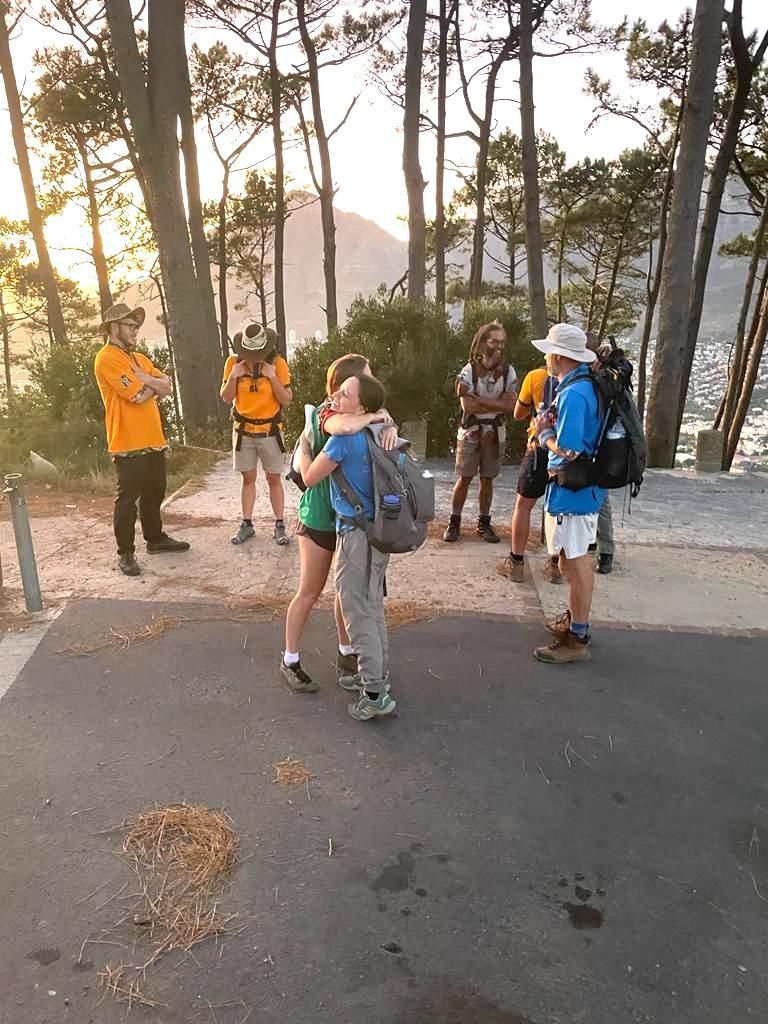
team of hiking guided geeting each other

My Final Advice for Visiting During the Cable Car Closure 


Do not allow the Cableway closure to spoil your Cape Town visit.


Table Mountain is still there, and there are still many ways to experience it.


What changes is the level of planning required.


If you want to complete a summit hike, choose the route according to your real fitness and experience. Plan the ascent and descent as one complete journey. Start with enough time, carry the correct equipment and remain flexible about the weather.


Do not assume that a popular route is automatically easy.


Do not depend on the summit for food, water, shelter or transport.


Do not continue only because you have already invested time in the climb.


One thing I have learnt after guiding visitors for many years is that people remember how an experience made them feel.


A shorter hike completed comfortably can become a wonderful Cape Town memory.


A famous summit attempted under the wrong conditions can become stressful and frightening.


My advice is to be honest about what you want and what you can comfortably manage.


Perhaps you want a demanding full-day adventure.


Perhaps you want sunrise views.


Perhaps you want a relaxed private walk with your partner.


Perhaps you are travelling with children or older family members.


Perhaps you simply want to stand somewhere beautiful and understand more about Cape Town’s natural landscape.


There is an appropriate experience for each of those visitors.


The mountain does not need to be conquered. It needs to be respected, understood and enjoyed.


Whether you're visiting Cape Town for the first time or returning to experience the mountain again, I hope this guide has answered your questions about the Table Mountain Cable Car Closure.


Although the Cableway closes for a short period each year, Table Mountain remains one of Cape Town's most rewarding outdoor experiences. With the right preparation, suitable route, and favourable weather, the annual maintenance shutdown can actually be one of the best times to experience the mountain on foot.


If you're unsure which hike is right for you, feel free to get in touch. Tell me about your fitness level, hiking experience, the ages of everyone in your group, and how much time you have available. I'll happily recommend the most suitable route—even if that means suggesting a different hike altogether.


My goal is simple: to help you enjoy Table Mountain safely, confidently, and with the local knowledge that only comes from years of guiding visitors on these trails.

Book a Private Guided Hike During the Table Mountain Cable Car Closure

If you are visiting Cape Town between 27 July and 9 August 2026, I will gladly help you choose a hiking experience that suits your fitness, confidence, interests and available time.


When you contact me, please include:


Your preferred date.

The number of guests.

The ages of any children.

Your general fitness level.

Your previous hiking experience.

Any knee, ankle, balance or medical concerns.

Whether you are comfortable with heights.

Whether you prefer a summit, sunrise, forest, fynbos or scenic walk.

Where you are staying in Cape Town.


I will use that information to recommend an appropriate route rather than placing every guest on the same trail.


A private guided hike gives us the flexibility to manage the pace, take sensible breaks, monitor the conditions and adapt the experience when necessary.


Most importantly, I plan the complete journey—including the descent.


Your mountain experience should feel personal, enjoyable and suited to you.


Contact Muki Venture to discuss your private guided hike during the Table Mountain Cable Car Closure 2026.

BOOK A PRIVATE GUIDED HIKE