About Muki Venture
Private Hiking Experiences Designed Around You
Muki Venture specialises in private guided hiking experiences in Cape Town, South Africa.
We believe every visitor experiences the mountains differently. Some guests are looking for an adventurous summit climb, while others prefer a relaxed scenic walk with plenty of opportunities to stop for photographs. Families often want a slower pace, experienced hikers may seek more challenging routes, and first-time visitors usually appreciate extra guidance and local knowledge.
Because every hike is private, your experience is never dictated by a large group or a fixed schedule. Instead, your day is tailored to your fitness, confidence, interests and the experience you hope to enjoy.
Our aim is not simply to guide you along a trail, but to help you discover the mountain in a way that feels personal, rewarding and memorable.
Featured Image (Official Muki Venture)
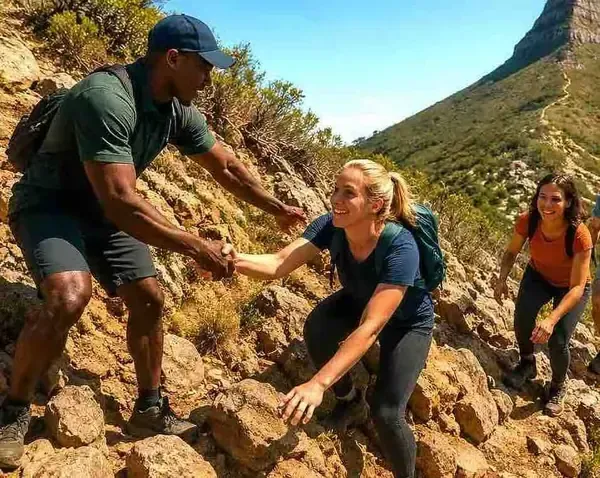
Description: Private guided hiking experience on Table Mountain with a Muki Venture guide assisting guests on the trail.
Image:
https://irp.cdn-website.com/52bf241d/dms3rep/multi/opt/muki-venture-help-2-600px-1920w.webp
Source:
https://www.mukiventure.co.za/cape-town-private-guided-hikes-and-walks
Contact Muki Venture
https://www.mukiventure.co.za
Email
info@mukiventure.co.za
Phone / WhatsApp
+27 71 175 1066
For the latest availability, weather advice, route recommendations or booking enquiries, please contact Muki Venture directly before your visit.
Why Choose a Private Hike?
A private hike allows you to enjoy Cape Town's mountains without the pressure of keeping up with strangers or following a rigid itinerary.
Instead, you can:
Walk at a pace that suits you.
Stop whenever you'd like to take photographs.
Learn about the local plants, wildlife and history.
Ask as many questions as you like.
Take breaks when needed.
Enjoy a more personal and relaxed experience.
Whether you're celebrating a honeymoon, travelling with children, visiting Cape Town for the first time or ticking Table Mountain off your bucket list, a private guide allows the day to revolve around you.
More Than Reaching the Summit
Standing on top of Table Mountain or Lion's Head is undoubtedly a highlight, but we believe the journey is just as important as the destination.
Some of the most memorable moments happen along the trail.
Watching clouds roll over the mountain.
Finding a flowering protea beside the path.
Hearing the unmistakable call of a Cape Sugarbird.
Stopping at a quiet viewpoint overlooking the Atlantic Ocean.
Learning why Table Mountain has a flat summit.
These experiences transform a hike into something much more meaningful than simply reaching the top.
Safety Is Always Our Priority
Cape Town's mountains are beautiful, but they are also dynamic natural environments where weather conditions can change quickly.
Wind, cloud cover, rainfall and visibility all play an important role in choosing the safest and most enjoyable hiking experience.
Before every hike we carefully consider:
Current weather conditions.
Wind forecasts.
Trail conditions.
Guest fitness.
Hiking experience.
Seasonal factors.
If conditions make a particular route unsuitable, we'll recommend an alternative that better suits the day. Reaching a summit is never more important than ensuring every guest enjoys a safe and memorable adventure.
Respecting Table Mountain National Park
Table Mountain National Park protects one of the world's richest biodiversity hotspots.
As visitors, we all share a responsibility to help preserve this remarkable environment.
We encourage every guest to:
Stay on marked trails.
Leave no litter behind.
Respect wildlife.
Avoid picking flowers or damaging plants.
Help protect the mountain for future generations.
Responsible hiking helps ensure these landscapes remain as extraordinary tomorrow as they are today.
Our Hiking Experiences
Every visitor has a different idea of the perfect day on the mountain.
Some want to conquer the summit of Table Mountain.
Others dream of watching the first rays of sunlight rise over Cape Town from Lion's Head.
Some are looking for an adventurous climb with exciting scrambling sections, while others prefer a peaceful walk through indigenous forest or along dramatic coastal cliffs.
At Muki Venture, there isn't a single "best" hike.
The best hike is the one that matches your fitness, confidence, interests and the kind of experience you want to remember.
Below you'll find an overview of our most popular experiences. Later in this Knowledge Hub, each hike is explored in much greater detail with route descriptions, preparation advice, frequently asked questions, photography tips, seasonal recommendations and safety guidance.
Table Mountain via Platteklip Gorge
Platteklip Gorge is the classic route to the summit of Table Mountain and one of South Africa's most famous hikes.
Following a historic stone pathway through a dramatic gorge, this route is the shortest and most direct way to reach the top. Although there is no technical scrambling, the continuous uphill climb makes it physically demanding and highly rewarding.
It is an excellent choice for visitors who want to stand on the summit of Table Mountain while following its most iconic hiking route.
Ideal for
First-time visitors
Active beginners with reasonable fitness
Bucket-list travellers
Guests wanting the classic Table Mountain experience
Highlights
Historic hiking route
Incredible summit views
Spectacular city panoramas
Direct ascent
Excellent photography opportunities
Featured Image
Description: Hikers ascending Platteklip Gorge towards the summit of Table Mountain.
Image: https://www.mukiventure.co.za/table-mountain-hikes
Table Mountain via India Venster
India Venster is one of Cape Town's most adventurous hiking routes.
Combining hiking with exciting scrambling sections, this route rewards confident hikers with constantly changing views over the city, coastline and surrounding mountains.
Although no climbing equipment is required, you'll occasionally use your hands to negotiate rocky sections, making this an unforgettable adventure for those seeking something more challenging.
Ideal for
- Adventure seekers
- Experienced hikers
- Guests comfortable with heights
- Returning visitors wanting something different
Highlights
- Scrambling sections
- Dramatic scenery
- Outstanding photography
- Constantly changing viewpoints
- Exciting summit experience
Featured Image
Description: Climbers navigating the rocky India Venster route with Cape Town below.
Source:
https://www.mukiventure.co.za/india-venster-hike
Table Mountain via Skeleton Gorge
Skeleton Gorge offers a completely different perspective of Table Mountain.
Beginning in the world-famous Kirstenbosch National Botanical Garden, this route passes through lush indigenous forest before climbing towards the famous dams on the summit plateau.
It is one of the most scenic hikes on the mountain and a favourite among visitors who appreciate nature, birdlife and a cooler hiking environment.
Ideal for
- Nature lovers
- Repeat visitors
- Bird enthusiasts
- Forest hiking
- Summer adventures
Highlights
- Indigenous forest
- Seasonal streams
- Rich biodiversity
- Peaceful surroundings
- Beautiful summit approach
Featured Image
Description: Indigenous forest and wooden ladders within Skeleton Gorge.
Source:
https://www.mukiventure.co.za/skeleton-gorge-hike
Lion's Head
Lion's Head is one of the world's most photographed hiking destinations.
Its circular route, exciting ladders and chains, and spectacular 360-degree views make it one of Cape Town's most rewarding short hikes.
Whether you choose sunrise, sunset or a daytime adventure, the summit delivers unforgettable views across Table Mountain, Camps Bay, Clifton, Robben Island and the city below.
Ideal for
- Sunrise hikes
- Sunset hikes
- Couples
- Photographers
- First-time visitors
Highlights
- 360° panoramic views
- Sunrise colours
- Sunset photography
- Iconic Cape Town experience
- Short but rewarding climb
Featured Image
Description: Sunrise from the summit of Lion's Head overlooking Table Mountain and Cape Town.
Source:
https://www.mukiventure.co.za/lions-head-hike
First Light Sunrise Walk
Not every sunrise experience needs to involve a demanding summit.
The First Light Walk is designed for visitors who want to experience the peaceful beauty of Cape Town waking up without tackling a strenuous mountain climb.
Gentle walking, fresh morning air and spectacular early light make this a wonderful option for families, photographers and anyone wanting a relaxed start to the day.
Ideal for
- Beginners
- Families
- Gentle walking
- Photography
- Relaxed sunrise experiences
Pipe Track Sunset Walk
Pipe Track is one of Cape Town's hidden gems.
Running along the slopes beneath the Twelve Apostles, this relatively gentle trail offers magnificent ocean views, colourful sunsets and beautiful fynbos without requiring a summit climb.
It's perfect for visitors wanting an easy but incredibly scenic outdoor experience.
Ideal for
- Beginners
- Families
- Sunset photography
- Relaxed walking
- Nature lovers
Cape Town Walking Experiences
Not every adventure involves climbing a mountain.
Muki Venture also offers guided walking experiences that allow visitors to discover Cape Town's rich culture, fascinating history, colourful neighbourhoods and local stories at a comfortable pace.
These experiences are perfect for travellers wanting to combine nature with the city's unique heritage.
Which Hike Is Right for You?
Choosing the right route depends less on experience and more on what you want from your day.
If you're looking for...Recommended ExperienceThe classic Table Mountain summitPlatteklip GorgeAdventure and scramblingIndia VensterForests and natureSkeleton GorgeSunriseLion's Head SunriseSunsetLion's Head SunsetGentle walkingPipe TrackRelaxed sunriseFirst Light WalkPrivate personalised adventureAny Muki Venture experience
If you're still unsure, don't worry.
Simply tell us:
- Your fitness level.
- Whether you've hiked before.
- If you're comfortable with heights.
- How much time you have available.
- Whether children are joining you.
- What kind of scenery you enjoy most.
We'll happily recommend the experience that's right for you.
Why Hike with Muki Venture?
Cape Town offers countless ways to experience its mountains, but no two hiking companies are exactly the same. At Muki Venture, our focus is on providing a personal, private and memorable experience that allows you to enjoy the mountains at your own pace while discovering the stories, landscapes and natural wonders that make this region so extraordinary.
Whether you're visiting Cape Town for the first time or returning to explore another trail, our goal is to make your adventure safe, enjoyable and unforgettable.
Private Experiences, Never Rushed
One of the biggest advantages of hiking with Muki Venture is that every experience is private.
There are no large groups to keep up with, no fixed pace dictated by strangers and no pressure to rush through the experience.
Instead, the day is planned around you.
If you want to spend extra time taking photographs, admiring the views or simply catching your breath, that's exactly what we'll do.
Your hike becomes your own personal adventure rather than just another scheduled tour.
Local Knowledge Beyond the Trail
Every mountain has a story.
As you hike, you'll discover much more than the path beneath your feet.
You'll learn about:
- The unique Cape Floral Kingdom.
- Indigenous fynbos vegetation.
- The fascinating geology of Table Mountain.
- Cape Town's rich history.
- Local wildlife and birdlife.
- Hidden viewpoints.
- Seasonal changes on the mountain.
- Interesting facts that many visitors never discover on their own.
We believe understanding the landscape makes every hike even more rewarding.
Honest Route Recommendations
Not every hike suits every person.
Rather than recommending the most popular route, we'll recommend the one that best matches your fitness, confidence and expectations.
Sometimes that means choosing a gentler trail.
Sometimes it means suggesting a more adventurous route.
Sometimes it means recommending an earlier start to enjoy cooler temperatures or quieter trails.
Our advice is always based on creating the best possible experience for you.
Flexible Pace
Everyone hikes differently.
Some guests enjoy a steady climb.
Others prefer regular breaks to appreciate the scenery.
Photography enthusiasts often stop frequently, while experienced hikers may enjoy maintaining a quicker rhythm.
Because every hike is private, we simply adapt to your pace.
There is no pressure to walk faster than you're comfortable with.
Perfect for Photography
Cape Town is one of the world's most photogenic cities.
Throughout every hike there are countless opportunities to capture unforgettable images.
Depending on your chosen route, you may photograph:
- Table Mountain.
- Lion's Head.
- The Twelve Apostles.
- Camps Bay.
- Clifton Beaches.
- Cape Town City Bowl.
- Table Bay.
- Robben Island.
- Dramatic cloud formations.
- Indigenous flowers.
- Wildlife.
- Spectacular sunrises and sunsets.
Your guide is always happy to suggest some of the best viewpoints along the way.
Featured Image
Description: Guests enjoying panoramic views across Cape Town during a private guided hike.
Source:
https://www.mukiventure.co.za/
Suitable for Many Different Travellers
Our experiences are popular with:
- Solo travellers.
- Couples.
- Honeymooners.
- Families.
- Groups of friends.
- Corporate visitors.
- Photography enthusiasts.
- Nature lovers.
- Bucket-list travellers.
- Active seniors.
- First-time hikers.
If you're unsure which experience best suits your group, simply ask—we're always happy to help.
Every Season Offers Something Different
Cape Town is beautiful throughout the year, but every season creates a different mountain experience.
Summer
Long daylight hours, warm temperatures and clear mornings make summer ideal for early hikes and sunrise adventures.
Autumn
Comfortable temperatures and excellent visibility make autumn one of the favourite seasons for many experienced hikers.
Winter
Winter transforms the mountains with lush greenery, dramatic cloud formations and flowing streams. Weather conditions require closer attention but can reward visitors with spectacular scenery.
Spring
Spring brings colourful wildflowers, fresh vegetation and pleasant hiking temperatures, making it one of the most beautiful times to explore Table Mountain National Park.
Preparing for Your Hike
A little preparation goes a long way towards making your hiking experience comfortable and enjoyable.
Fortunately, you don't need expensive specialist equipment to enjoy most Cape Town hiking routes.
Choosing suitable clothing, bringing enough water and understanding the expected weather conditions are usually far more important than owning the latest hiking gear.
The following guide will help you prepare for your adventure.
What Should I Wear?
Comfort is the priority.
Wear lightweight clothing suitable for outdoor activity and consider dressing in layers so you can adapt to changing temperatures throughout the hike.
Weather on the summit can feel very different from conditions in the city below.
A lightweight windproof or waterproof jacket is always recommended, even on warm days.
Footwear
Good footwear is one of the most important parts of your preparation.
We recommend:
- Hiking shoes.
- Trail running shoes.
- Sturdy trainers with good grip.
Avoid:
- Flip-flops.
- High heels.
- Smooth-soled fashion shoes.
- Barefoot hiking.
Proper footwear improves comfort, stability and safety on uneven terrain.
Water
Staying hydrated is essential.
Bring enough drinking water for the duration of your hike, especially during warmer months.
Even on cooler days, hiking steadily uphill causes your body to lose fluids.
Food
Light snacks are often enough for shorter hikes.
For longer adventures, energy bars, fruit or sandwiches provide convenient fuel along the way.
Avoid carrying unnecessary weight, but don't underestimate how much energy mountain hiking can require.
Sun Protection
Cape Town enjoys many sunny days throughout the year.
We recommend:
- Sunscreen.
- Sunglasses.
- A wide-brimmed hat or cap.
Even when clouds are present, ultraviolet exposure can still be significant.
Small Backpack
A comfortable backpack helps keep your hands free while carrying essentials such as:
- Water.
- Snacks.
- Jacket.
- Camera.
- Sunscreen.
- Personal medication.
A lightweight backpack is usually all that's required.
Featured Video
If available, watch Muki Venture's official hiking overview video before your adventure to familiarise yourself with the routes, scenery and overall experience.
Safety on the Mountain
One of the greatest things about hiking in Cape Town is that you're exploring a real mountain environment rather than a managed attraction. While this makes every hike exciting and memorable, it also means that conditions can change quickly. A little preparation and good decision-making go a long way towards ensuring a safe and enjoyable experience.
At Muki Venture, safety is never an afterthought—it forms part of every hike from the moment planning begins.
Mountain Weather Can Change Quickly
One of the biggest surprises for first-time visitors is how different the weather can be between Cape Town and the summit of Table Mountain.
It may feel warm and sunny in the city while the mountain is cool, windy or covered in cloud.
For this reason, it's always advisable to bring an extra layer, even during summer.
Weather influences:
- Route selection.
- Hiking pace.
- Visibility.
- Temperature.
- Wind exposure.
- Overall comfort.
If conditions become unsafe, the day's plans may need to change.
Wind
Strong wind is one of the most important weather factors on Table Mountain and Lion's Head.
High winds can affect exposed sections of certain routes and may also influence the operation of the Table Mountain Aerial Cableway.
When strong winds are forecast, your guide may recommend:
- Starting earlier.
- Choosing an alternative route.
- Postponing the hike.
- Rescheduling for another day.
Safety decisions are always made with guest wellbeing as the priority.
Staying Hydrated
Mountain hiking is more physically demanding than many visitors expect.
Drink water regularly throughout your hike rather than waiting until you feel thirsty.
Hydration becomes especially important during warmer months and on routes with continuous uphill climbing.
Hiking at Your Own Pace
There is no prize for reaching the summit first.
Walking at a comfortable pace allows you to conserve energy, enjoy the scenery and reduce unnecessary fatigue.
Private guiding makes this easy because there is no pressure to keep up with a larger group.
Regular short breaks are perfectly normal, especially on longer climbs.
Respect Wildlife
Table Mountain National Park is home to a wide variety of animals and birds.
If you're fortunate enough to encounter wildlife:
- Observe quietly.
- Keep a respectful distance.
- Never feed wild animals.
- Avoid disturbing nesting birds.
- Leave plants and flowers exactly where you found them.
Remember that you are visiting their home.
Stay on Marked Trails
Remaining on established hiking trails helps protect the fragile mountain environment while also reducing the risk of getting lost or entering unsafe terrain.
Taking shortcuts often causes unnecessary erosion and damages sensitive vegetation.
Leave No Trace
Cape Town's mountains are remarkably clean, and every visitor can help keep them that way.
Please remember to:
- Take all rubbish home.
- Avoid leaving food scraps.
- Respect other hikers.
- Protect plants and flowers.
- Leave rocks and natural features undisturbed.
Responsible hiking helps preserve the mountain for everyone.
Frequently Asked Safety Questions
Is hiking with a guide safer?
A professional local guide provides valuable route knowledge, weather awareness and experience navigating mountain conditions.
While no outdoor activity is completely risk-free, hiking with a guide helps reduce unnecessary risks and provides additional confidence, especially for visitors unfamiliar with Cape Town's mountains.
Can beginners hike Table Mountain?
Yes.
Several routes are suitable for beginners with reasonable fitness.
The most important factor is choosing a route that matches your experience and comfort level.
We'll happily recommend the most suitable option before you book.
What if I'm afraid of heights?
Some routes involve very little exposure, while others include ladders, chains or scrambling.
If you're uncomfortable with heights, let us know before booking so we can recommend a route better suited to your confidence level.
What happens if the weather changes?
Weather is continuously monitored before and during every hike.
If conditions become unsuitable, your guide may alter the route, shorten the hike or recommend postponing the experience.
Safety always comes before reaching the summit.
Can children join?
Many families successfully enjoy Cape Town's hiking trails.
The most suitable route depends on:
- Children's ages.
- Fitness.
- Hiking experience.
- Confidence.
- Current weather conditions.
We'll gladly recommend family-friendly options based on your group.
Do I need hiking experience?
Not necessarily.
Many visitors complete their very first mountain hike with Muki Venture.
Choosing the right route is much more important than having previous hiking experience.
Can I hike in running shoes?
Good quality running or trail shoes with excellent grip are often suitable for many routes.
Avoid footwear with smooth soles or poor traction.
Should I bring hiking poles?
Most visitors don't require hiking poles, but some guests—particularly those with knee concerns or who prefer additional stability—find them helpful on steeper descents.
What happens if I become tired?
Private hikes allow plenty of flexibility.
Regular breaks can be taken whenever needed, and your guide will help maintain a pace that's comfortable for your group.
The experience is about enjoying the mountain rather than racing to the top.
Featured Image
Description
A Muki Venture guide assisting guests while ascending a rocky mountain trail, demonstrating the personalised and safety-focused nature of private guided hiking.
Image
https://irp.cdn-website.com/52bf241d/dms3rep/multi/opt/muki-venture-help-2-600px-1920w.webp
Source
https://www.mukiventure.co.za/cape-town-private-guided-hikes-and-walks
Table Mountain — An Introduction
Few mountains anywhere in the world are as instantly recognisable as Table Mountain.
Standing proudly above Cape Town with its iconic flat summit, it has become one of South Africa's most famous natural landmarks and one of the New Seven Wonders of Nature.
For millions of visitors each year, Table Mountain is the highlight of their trip to Cape Town.
Yet the mountain is far more than simply a viewpoint.
It is home to one of the richest collections of plant species on Earth, forms part of the Cape Floristic Region UNESCO World Heritage Site, and offers an incredible variety of hiking experiences ranging from gentle walks to adventurous summit climbs.
Whether you're planning to hike to the top, take the cableway, photograph the famous Tablecloth cloud or simply admire it from below, understanding the mountain adds a whole new appreciation to your visit.
In the following sections, we'll explore everything you need to know about Table Mountain, including its history, geology, weather, wildlife, hiking routes, photography opportunities and fascinating natural wonders.
Discover Table Mountain
Table Mountain is more than just Cape Town's most recognisable landmark—it's one of the world's most remarkable natural wonders.
Its distinctive flat summit dominates the city's skyline and has inspired explorers, photographers, artists and adventurers for centuries. Whether viewed from the beaches of Camps Bay, the V&A Waterfront, Robben Island or the summit of Lion's Head, Table Mountain forms the dramatic backdrop that makes Cape Town instantly recognisable.
Recognised as one of the New Seven Wonders of Nature, Table Mountain attracts millions of visitors every year. Some choose to reach the summit by cableway, while others prefer the rewarding challenge of hiking to the top under their own power.
Whichever way you experience it, Table Mountain leaves a lasting impression.
A Mountain Millions of Years in the Making
The story of Table Mountain began hundreds of millions of years ago.
The mountain's famous flat summit is the result of geological processes that shaped the Cape Peninsula over immense periods of time. Layers of incredibly hard sandstone resisted erosion while the softer surrounding rock gradually wore away, leaving the broad plateau we see today.
Walking across the summit is like walking through Earth's history.
The towering cliffs, rocky outcrops and dramatic ravines all tell part of a geological story that stretches back long before humans existed.
Why Is Table Mountain Flat?
One of the most common questions visitors ask is:
"Why does Table Mountain have such a flat top?"
The answer lies in erosion.
Over millions of years, wind, rain and changing climates slowly wore away softer rock surrounding the mountain. The hard sandstone that forms today's summit resisted this erosion far more effectively, leaving behind the remarkable flat plateau that has become famous around the world.
This unusual shape gave the mountain its name and makes it one of the easiest natural landmarks to recognise anywhere on Earth.
The Famous Tablecloth
Cape Town locals affectionately refer to the cloud flowing over the mountain as the Tablecloth.
This spectacular natural phenomenon occurs when moist air from the ocean is forced upwards by the mountain. As the air cools, clouds begin forming on the summit before spilling gracefully over the cliffs like a giant white waterfall.
Sometimes the Tablecloth appears for only a few minutes.
On other days it remains draped across the mountain for hours.
Watching it form is one of Cape Town's most iconic natural spectacles.
Table Mountain National Park
Table Mountain forms part of Table Mountain National Park, one of South Africa's most important protected areas.
The park stretches far beyond the famous summit, protecting rugged mountains, indigenous forests, dramatic coastlines, beaches, wetlands and an extraordinary variety of plant and animal life.
Visitors often imagine Table Mountain as a single mountain, but the national park protects an extensive network of landscapes that extends across much of the Cape Peninsula.
Exploring these diverse environments is one of the reasons Cape Town is considered one of the world's greatest outdoor destinations.
A Global Biodiversity Hotspot
Although Table Mountain occupies a relatively small area, it contains an astonishing diversity of plant life.
The mountain forms part of the Cape Floristic Region, recognised internationally as one of the world's most important biodiversity hotspots.
Thousands of plant species occur here.
Many are found nowhere else on Earth.
This incredible diversity means every season reveals something different.
Spring fills the slopes with colourful wildflowers.
Winter transforms dry streams into flowing waterfalls.
Summer produces crystal-clear mountain views.
Autumn often offers ideal hiking temperatures.
No two visits are ever exactly the same.
Wildlife on Table Mountain
Table Mountain is home to a surprising variety of wildlife.
Although larger mammals are uncommon, attentive hikers may encounter:
- Rock Hyrax (Dassies)
- Cape Sugarbirds
- Orange-breasted Sunbirds
- Lizards
- Eagles and other birds of prey
- Butterflies
- Frogs in wetter areas
- Numerous indigenous insects
Wildlife sightings always depend on season, weather and a little luck.
The best approach is to observe quietly while allowing animals to behave naturally.
Please never feed wildlife or attempt to approach them too closely.
Plants and Fynbos
The mountain is famous for its extraordinary fynbos vegetation.
Unlike forests, fynbos consists mainly of shrubs, flowering plants and hardy vegetation uniquely adapted to the Mediterranean climate of the Western Cape.
Some of the best-known plants include:
- King Protea
- Sugarbush Proteas
- Ericas
- Restios
- Cone Bushes
- Watsonias
- Everlasting Flowers
Many of these species occur naturally only within the Cape Floral Kingdom.
Later in this guide we'll explore fynbos in much greater detail.
Weather on Table Mountain
Mountain weather deserves respect.
Conditions on the summit are often completely different from conditions in Cape Town below.
A warm sunny morning at sea level may become cool, windy or misty higher up the mountain.
For this reason, hikers should always be prepared for changing conditions.
Bringing an additional layer, drinking plenty of water and checking the forecast before setting out are all important parts of responsible hiking.
Is Table Mountain Difficult?
There isn't one simple answer.
Table Mountain offers numerous hiking routes, each with its own character.
Some are direct but physically demanding.
Others involve scrambling.
Some pass through indigenous forest.
Others climb open rocky slopes.
Choosing the right route depends on:
- Your fitness.
- Hiking experience.
- Comfort with heights.
- Available time.
- Current weather.
- What type of experience you're looking for.
One of the benefits of hiking with Muki Venture is receiving honest advice about which route best suits you before your adventure begins.
Featured Image
Description
The iconic flat summit of Table Mountain overlooking Cape Town.
Source
https://www.mukiventure.co.za/
Related Articles
- Table Mountain Hiking Routes
- Platteklip Gorge Guide
- India Venster Guide
- Skeleton Gorge Guide
- Table Mountain FAQs
- Weather & Safety
- Fynbos Guide
- Wildlife of Table Mountain
Table Mountain Hiking Routes
There is no single way to reach the summit of Table Mountain.
Each route offers a completely different experience, and choosing the right one can make all the difference to your day.
Some routes are physically demanding but technically straightforward.
Others require scrambling over rocks and are better suited to adventurous hikers.
Some pass through beautiful indigenous forest, while others climb dramatic mountain gorges with sweeping views across Cape Town.
In the following sections, we'll explore each of Muki Venture's recommended routes in detail, helping you understand which adventure is best suited to your fitness, confidence and interests.
Platteklip Gorge
Platteklip Gorge is the classic and most direct hiking route to the summit of Table Mountain.
It follows a steep natural gorge up the front face of the mountain, using a long series of rocky steps that lead hikers steadily towards the summit plateau.
For many visitors, this is the route they imagine when they think about “hiking Table Mountain.”
It is straightforward in terms of navigation, requires no technical climbing, and delivers a strong sense of achievement when you finally emerge onto the top.
But while the route is direct, it is not easy.
The climb is sustained, steep and physically demanding.
Why Choose Platteklip Gorge?
Platteklip Gorge is a great choice if you want:
- The classic Table Mountain summit experience.
- A direct route to the top.
- No technical scrambling.
- A physically challenging but straightforward hike.
- Iconic views over Cape Town.
- A route that feels like a true summit climb.
It is especially popular with first-time visitors who want to say they hiked Table Mountain rather than simply taking the cableway.
What the Route Feels Like
The route begins on the front face of Table Mountain and quickly becomes a steady uphill climb.
The trail is made up largely of uneven stone steps.
There are very few long flat sections, so the challenge comes from the continuous ascent rather than technical difficulty.
As you gain height, the views behind you open up over:
- Cape Town City Bowl.
- Table Bay.
- Lion’s Head.
- Signal Hill.
- The Atlantic Ocean.
The higher you climb, the more dramatic the setting becomes.
Eventually the gorge narrows and the surrounding rock walls rise around you before the trail opens onto the summit plateau.
That final step onto the top is one of the most rewarding moments of the hike.
Difficulty
Platteklip Gorge is best described as physically demanding rather than technically difficult.
There are no major scrambling sections and no climbing equipment is required.
The main challenge is:
- Sustained uphill walking.
- Uneven steps.
- Heat exposure on warm days.
- Fatigue in the final section.
Good pacing makes a big difference.
Because Muki Venture experiences are private, there is no pressure to rush.
Fitness Level
You do not need to be an experienced mountaineer to hike Platteklip Gorge.
However, a reasonable level of fitness is important.
The route is best suited to people who are comfortable with:
- Walking uphill for an extended period.
- Climbing many uneven steps.
- Maintaining steady effort.
- Taking regular breaks when needed.
If you are unsure whether your fitness is suitable, Muki Venture can recommend whether Platteklip Gorge or a gentler option would be a better fit.
Scrambling
Platteklip Gorge does not normally require the kind of hands-on scrambling found on India Venster.
That makes it a popular choice for guests who want to summit Table Mountain without ladders, chains or exposed climbing-style sections.
Fear of Heights
Platteklip Gorge is generally a better choice for guests who are uncomfortable with exposure.
You are still hiking on a mountain and some views are naturally high, but the route does not usually involve the same exposed scrambling as India Venster.
If fear of heights is a major concern, mention it before booking so the most suitable route can be discussed.
Children
Some children can successfully complete Platteklip Gorge, particularly if they are active, motivated and already comfortable with longer walks.
Suitability depends on:
- Age.
- Fitness.
- Hiking experience.
- Motivation.
- Weather.
- Pace.
A younger child who rarely hikes may find the sustained climb much harder than an active older child.
Route suitability should therefore be assessed individually.
Older Guests
Age alone does not determine whether Platteklip Gorge is suitable.
Fitness, mobility, balance and comfort on uneven steps are more important.
Many active older hikers enjoy the route.
A slower pace and regular breaks can make the experience much more comfortable.
What to Wear
Wear comfortable outdoor clothing that allows you to move easily.
Recommended:
- Hiking shoes or trail shoes with good grip.
- Lightweight clothing.
- Sun hat.
- Sunglasses.
- Sunscreen.
- Light windproof or waterproof jacket.
- Warm layer if conditions are cool.
Avoid smooth-soled shoes, flip-flops and barefoot hiking.
Water and Snacks
Bring enough water for the climb.
Platteklip Gorge can become hot, especially when exposed to direct sun.
It is also a good idea to bring lightweight snacks such as:
- Fruit.
- Energy bars.
- Nuts.
- Sandwiches.
The goal is to carry enough energy and hydration without overloading your backpack.
Best Time of Day
Early starts are often preferable, especially in warmer weather.
Morning hikes can offer:
- Cooler temperatures.
- Softer light.
- Less heat stress.
- Beautiful views over Cape Town.
The ideal start time depends on season, weather and the day's conditions.
Weather Considerations
Platteklip Gorge is exposed to the elements.
Important factors include:
- Heat.
- Wind.
- Cloud.
- Rain.
- Visibility.
Rain can make rocky steps more slippery.
Strong wind can make the summit uncomfortable.
Cloud can reduce visibility dramatically.
Conditions should always be checked before departure.
Cableway Descent
Many guests choose to hike up Platteklip Gorge and descend using the Table Mountain Aerial Cableway.
This can be a great option because it allows you to enjoy the full achievement of hiking to the summit without placing additional strain on your knees during the descent.
However, the cableway is weather-dependent and may close because of strong wind, maintenance or operational conditions.
Never assume the cableway will definitely be available.
If you are relying on it for the descent, always verify current operating status.
Photography
Platteklip Gorge offers excellent photography opportunities throughout the climb.
Popular subjects include:
- Stone steps leading through the gorge.
- Lion’s Head across the city.
- Cape Town below.
- Table Bay.
- Passing cloud.
- Sandstone cliffs.
- Fynbos.
- Summit views.
Private guiding allows more flexibility to stop when the light or view is especially good.
Nature Along the Route
Although Platteklip Gorge is best known for its steep staircase, the route also passes through fynbos vegetation.
Depending on the season, hikers may notice:
- Proteas.
- Ericas.
- Restios.
- Small seasonal flowers.
- Birds feeding among flowering plants.
- Lizards warming themselves on rocks.
Never pick or remove plants from the mountain.
Is Platteklip Gorge the Easiest Route?
Not necessarily.
It is one of the most straightforward routes because there is no major technical scrambling, but the continuous climb can make it physically demanding.
“Shortest” does not mean “easiest.”
For some hikers, a slightly longer but more varied route may actually feel more comfortable.
Is Platteklip Gorge Good for Beginners?
Yes, it can be suitable for beginners with reasonable fitness.
The lack of technical scrambling makes it accessible, but beginners should still be prepared for a sustained uphill effort.
Is Platteklip Gorge Safe?
Like all mountain routes, Platteklip Gorge carries natural outdoor risks.
Good footwear, sensible pacing, enough water, weather awareness and proper preparation are important.
Hiking with an experienced local guide can help reduce unnecessary risk.
Is There a Toilet on the Route?
Do not rely on toilet facilities being available along the hiking trail itself.
Use available facilities before starting where possible and plan accordingly.
Can I Hike Barefoot?
No.
Muki Venture does not recommend barefoot hiking on mountain routes.
The terrain includes uneven stone, sharp rock and surfaces that can become slippery.
Proper footwear provides grip, support and protection.
Can I Bring My Own Food?
Yes.
You may bring your own snacks or food for the hike.
Lightweight options are generally easiest to carry.
Can I Hike Platteklip Gorge Without a Guide?
People do hike Platteklip Gorge independently, but whether that is a sensible choice depends on experience, preparation, weather and familiarity with mountain conditions.
A guide can provide:
- Route knowledge.
- Weather awareness.
- Pacing support.
- Local context.
- Help with decision-making if conditions change.
Visitors unfamiliar with Table Mountain should consider these factors carefully.
Who Is Platteklip Gorge Best For?
Platteklip Gorge is a strong choice for:
- First-time Table Mountain hikers.
- Visitors who want a true summit experience.
- Guests who prefer walking over scrambling.
- Hikers with reasonable fitness.
- Travellers who want the most direct route to the top.
Who Might Prefer Another Route?
Consider another option if you:
- Want more scrambling and adventure.
- Prefer forest and shade.
- Strongly dislike sustained uphill steps.
- Want a gentler scenic walk.
- Are looking primarily for sunrise or sunset photography rather than a summit challenge.
India Venster, Skeleton Gorge, Lion’s Head, First Light and Pipe Track each offer very different experiences.
Related Articles
- India Venster Guide
- Skeleton Gorge Guide
- Lion’s Head Guide
- Which Hike Is Right for Me?
- Table Mountain Weather
- What to Bring
- Hiking Safety
- Cableway Information
- Table Mountain FAQs
India Venster
India Venster is one of the most adventurous and rewarding hiking routes on Table Mountain.
Where Platteklip Gorge is direct and step-focused, India Venster feels more varied and dynamic.
It combines hiking with hands-on scrambling, exposed sections and constantly changing viewpoints.
For confident hikers who enjoy a little adventure, it can be one of the most exciting ways to reach the summit.
Why Choose India Venster?
India Venster is ideal if you want:
- A more adventurous Table Mountain experience.
- Scrambling.
- Dramatic views.
- Greater route variety.
- A stronger sense of exposure.
- A memorable physical challenge.
It is often recommended to guests who say:
“I want something more exciting than just walking up steps.”
What the Route Feels Like
The route begins beneath the Table Mountain cableway and climbs through rocky terrain.
As you gain height, the views become increasingly impressive.
You may look down over:
- Cape Town City Bowl.
- Camps Bay.
- The Atlantic Ocean.
- Lion’s Head.
- The lower cableway area.
Higher up, the route becomes more adventurous.
Some sections require you to use your hands to move over or around rock.
This is scrambling rather than technical rock climbing, but it still requires confidence, balance and good mobility.
Difficulty
India Venster is more technically demanding than Platteklip Gorge.
The challenge comes from a combination of:
- Steep hiking.
- Scrambling.
- Exposure.
- Uneven terrain.
- Route-finding.
- Sustained effort.
It is not usually the best first choice for someone who is very uncomfortable with heights.
Scrambling
Scrambling is one of the defining features of India Venster.
You may need to:
- Use your hands on rock.
- Step up onto larger rocky sections.
- Maintain three points of contact.
- Follow your guide carefully through exposed areas.
No specialised climbing equipment is normally required for the standard guided route, but confidence and mobility matter.
Fear of Heights
India Venster includes exposed terrain.
If you have a strong fear of heights, this route may not be the best fit.
Guests with mild nervousness sometimes enjoy the route with reassurance and guidance, but severe discomfort with exposure should be discussed before booking.
Who Is India Venster Best For?
India Venster is a strong choice for:
- Adventure seekers.
- Active travellers.
- Experienced hikers.
- Guests comfortable with exposure.
- People who enjoy scrambling.
- Visitors wanting a varied route rather than continuous stone steps.
Who Should Consider Another Route?
You may prefer another experience if you:
- Have a strong fear of heights.
- Do not enjoy scrambling.
- Have limited mobility.
- Prefer a straightforward walking route.
- Are uncomfortable on exposed terrain.
Platteklip Gorge may be better if you want a summit without technical scrambling.
Photography
India Venster offers some of the most dramatic photography opportunities on Table Mountain.
The route changes direction and perspective frequently, creating views over:
- Cape Town.
- Lion’s Head.
- Camps Bay.
- The Atlantic Ocean.
- The Twelve Apostles.
- Sandstone cliffs.
- The upper cableway.
Because the route is more exposed, always prioritise safe footing before taking photographs.
Weather Considerations
Weather is especially important on India Venster.
Strong wind, wet rock, poor visibility or unstable conditions can make exposed sections more difficult.
The route should be approached conservatively when conditions are questionable.
Water and Equipment
Bring:
- Enough water.
- Comfortable hiking clothing.
- Good-grip hiking or trail shoes.
- Sun protection.
- Light jacket.
- Small backpack.
- Snacks.
- Any personal medication.
Hands should remain free during scrambling sections, so avoid carrying loose items.
Children
India Venster is not automatically suitable for every child.
Suitability depends on:
- Age.
- Height.
- Strength.
- Hiking experience.
- Confidence.
- Comfort with heights.
- Ability to follow instructions.
This should be assessed individually before booking.
Can Beginners Do India Venster?
Some fit and confident beginners can complete India Venster successfully with an experienced guide.
However, it is not the same kind of beginner-friendly route as a simple walking trail.
Comfort with exposure and scrambling matters as much as fitness.
Can I Take the Cableway Down?
If the cableway is operating and the planned route finishes near the upper station, a cableway descent may be possible.
Current operation must always be verified because wind, maintenance and temporary closures can affect service.
Is India Venster Better Than Platteklip Gorge?
Neither route is universally better.
Choose Platteklip Gorge if you prefer:
- Straightforward hiking.
- Minimal exposure.
- No major scrambling.
- The classic direct route.
Choose India Venster if you prefer:
- Adventure.
- Scrambling.
- More varied terrain.
- Dramatic exposure and changing views.
The best route is the one that suits you.
Related Articles
- Platteklip Gorge Guide
- Lion’s Head Guide
- Scrambling Explained
- Fear of Heights
- Table Mountain Safety
- Table Mountain Weather
- Which Hike Is Right for Me?
Skeleton Gorge
Skeleton Gorge offers a completely different way to experience Table Mountain.
Instead of beginning on the exposed front face of the mountain, the route starts inside Kirstenbosch National Botanical Garden and climbs through indigenous forest before emerging onto the upper slopes of Table Mountain.
The experience combines forest, streams, rocky sections, ladders, mountain scenery and panoramic views, making it one of the most varied routes to the summit.
For guests who love nature and want something more atmospheric than a direct rocky ascent, Skeleton Gorge is an excellent choice.
Why Choose Skeleton Gorge?
Skeleton Gorge is ideal if you want:
- A greener side of Table Mountain.
- Indigenous forest.
- Shaded sections.
- Streams and seasonal waterfalls.
- Wooden ladders.
- A varied mountain experience.
- Panoramic views from the upper mountain.
- A private and personalised hiking experience.
The current Muki Venture route is approximately 6.2 km and generally takes around 4–5 hours, depending on pace, weather and stops. The route starts at Kirstenbosch and normally finishes around the summit area or Upper Cable Station, with a cableway descent possible when the cableway is operating.
The Kirstenbosch Start
One of the special things about Skeleton Gorge is where the adventure begins.
Rather than immediately entering an exposed mountain environment, you start within Kirstenbosch National Botanical Garden.
The atmosphere is completely different from the front face of Table Mountain.
You begin surrounded by vegetation before gradually moving deeper into the forest and towards the gorge.
This makes the beginning of the hike feel peaceful and immersive.
Through Indigenous Forest
As the trail climbs, the environment becomes increasingly forested.
Tall indigenous vegetation surrounds the route, creating shade and a cooler atmosphere compared with many exposed Table Mountain trails.
For nature lovers, this is one of the major attractions of Skeleton Gorge.
The forest also provides opportunities to observe native plants, birds and other wildlife along the way.
Your guide can help identify interesting features of the landscape and explain the natural environment as you climb.
Streams and Water
Skeleton Gorge is closely associated with water.
Depending on the season and recent rainfall, hikers may encounter streams, wet rock and small waterfalls along sections of the route.
This changes the character of the hike throughout the year.
After periods of rain, the gorge can become particularly atmospheric, but wet conditions also make rocks and ladders more slippery.
For that reason, weather conditions are an important consideration before starting the hike.
Muki Venture specifically notes that rain, slippery terrain, visibility and changing weather can affect whether the route should proceed as planned.
The Famous Ladders
The ladders are one of Skeleton Gorge's defining features.
As the gorge becomes steeper, wooden ladders help hikers negotiate sections of the terrain.
These aren't simply decorative features—they are part of what makes this route different from the more straightforward Platteklip Gorge.
Guests should be comfortable climbing ladders and moving over uneven terrain.
If you are uncomfortable with ladders or have mobility difficulties, tell us before booking so that another route can be considered.
Difficulty
Skeleton Gorge is best described as moderate to challenging.
The current Muki Venture route information highlights:
- Steep climbing.
- Rocky sections.
- Ladders.
- Stream crossings.
- Uneven terrain.
- A long uphill ascent.
- Changing weather conditions.
It is therefore not the easiest route on Table Mountain.
A reasonable level of fitness is recommended.
Is Skeleton Gorge Suitable for Beginners?
Some fit beginners may successfully complete Skeleton Gorge with appropriate preparation and an experienced guide.
However, it should not automatically be considered a beginner route.
The combination of sustained climbing, ladders, uneven terrain and changing mountain conditions makes it more demanding than a simple scenic walk.
If you are completely new to hiking, Muki Venture can help you compare Skeleton Gorge with more suitable alternatives.
Who Is Skeleton Gorge Best For?
Skeleton Gorge is particularly well suited to:
- Fit hikers.
- Nature lovers.
- Adventure seekers.
- Photographers.
- Visitors who enjoy forests.
- Guests who want a quieter route.
- Travellers who prefer variety rather than a continuous staircase.
- Repeat visitors looking for a different Table Mountain experience.
Muki Venture describes the route as especially suitable for active guests who want a scenic, nature-rich mountain experience.
Who Might Prefer Another Route?
Skeleton Gorge may not be the best choice if you:
- Want a short and easy walk.
- Have very limited fitness.
- Are uncomfortable with ladders.
- Have difficulty on wet or uneven terrain.
- Have significant mobility or knee problems.
- Want the most direct route to the summit.
In those cases, another route may provide a more enjoyable experience.
What Can You See?
Skeleton Gorge offers a constantly changing landscape.
Depending on the season and conditions, you may experience:
- Indigenous forest.
- Fynbos.
- Streams.
- Waterfalls.
- Rocky ravines.
- Wooden ladders.
- Mountain reservoirs.
- Table Mountain's upper plateau.
- Panoramic views across Cape Town.
The contrast between the shaded forest and the open summit landscape is one of the route's greatest attractions.
The Upper Mountain
Eventually the forest and gorge give way to the upper slopes of Table Mountain.
The change is dramatic.
The enclosed, shaded environment opens into a much broader mountain landscape.
Depending on the route plan and conditions, hikers may pass near the reservoir area before continuing towards the summit area.
The current Muki Venture itinerary describes the progression as:
Forest → ladders → plateau → summit → cable car.
Reaching the Summit Area
The reward for the long climb is the open mountain plateau and spectacular views across Cape Town.
After emerging from the gorge, there is time to slow down, recover, take photographs and appreciate the dramatic change in landscape.
Depending on the day's route and conditions, the hike may continue towards Maclear's Beacon or the Upper Cable Station.
Cableway Descent
Many hikers finish Skeleton Gorge near the Upper Cable Station and descend by cable car when it is operating.
This can be an excellent way to combine a challenging hike with a more relaxed descent.
However, the cableway is weather- and operations-dependent.
Strong wind, maintenance or other operational factors can prevent the cableway from running.
If the cableway is unavailable, your guide will advise you on the safest alternative.
Never plan your entire hike around the assumption that the cableway will definitely be operating.
What Should You Bring?
Muki Venture currently recommends bringing:
- Approximately 1.5–2 litres of water.
- Comfortable hiking shoes with good grip.
- Light snacks or an energy bar.
- Sun protection.
- A warm layer.
- A small backpack.
- A phone or camera.
Because weather can change significantly on the mountain, an additional layer is particularly important.
Footwear
Good grip is essential.
The route includes rocky surfaces, ladders and sections that may become wet.
Choose hiking or trail footwear that provides stability and traction.
Avoid smooth-soled shoes and casual footwear without adequate grip.
Water
Carry sufficient water from the beginning of the hike.
There should be no assumption that safe drinking water will be available along the trail.
Your guide can advise on the amount appropriate for your group, season and conditions.
Photography
Skeleton Gorge is an excellent route for photography because the scenery changes throughout the experience.
You can photograph:
- Forest trails.
- Ancient-looking rock formations.
- Streams.
- Waterfalls.
- Ladders.
- Fynbos.
- Mountain reservoirs.
- Cape Town from above.
- Table Mountain's upper plateau.
The forest can also provide beautiful opportunities for atmospheric photography when sunlight filters through the vegetation.
Wildlife and Plants
The route passes through an exceptionally rich natural environment.
Keep an eye out for:
- Indigenous fynbos.
- Forest vegetation.
- Proteas.
- Birds.
- Lizards.
- Seasonal flowers.
- Other small wildlife.
Wildlife sightings are never guaranteed, and the best approach is simply to observe quietly and respectfully.
Never feed animals or remove plants from the mountain.
Weather and Safety
Skeleton Gorge requires particular attention to weather.
Rain can make rocks and ladders slippery.
Mist can reduce visibility.
Strong wind can affect the upper mountain.
Cold conditions can become uncomfortable after leaving the forest.
For this reason, the route may need to be adjusted, delayed or rescheduled when conditions are unsuitable.
Safety decisions should always take priority over completing a particular route.
How Long Does Skeleton Gorge Take?
The current Muki Venture route is generally described as taking around 4–5 hours, depending on fitness, pace, weather conditions, breaks and photography stops.
A private experience means the hike does not need to be treated like a race.
The objective is to maintain a sustainable pace and enjoy the journey.
Can Children Hike Skeleton Gorge?
This depends heavily on the child's age, fitness, confidence and experience.
The ladders, steep sections and uneven terrain mean Skeleton Gorge should not automatically be considered a family-friendly beginner hike.
Families should discuss the route with Muki Venture before booking so that the experience can be matched to the children joining the hike.
Can Older Guests Hike Skeleton Gorge?
Age alone isn't the deciding factor.
Fitness, balance, mobility and confidence on ladders and uneven terrain are more important.
Active older hikers may enjoy the route, while guests with significant mobility or knee concerns may prefer a different experience.
Is Skeleton Gorge Better Than Platteklip Gorge?
They offer completely different experiences.
Choose Skeleton Gorge if you want:
- Forest.
- Streams.
- Ladders.
- More varied scenery.
- A quieter and greener route.
Choose Platteklip Gorge if you want:
- A direct summit route.
- Continuous stone steps.
- No major ladder sections.
- A straightforward ascent.
Neither is universally better.
The right route depends on what you want from your day.
Is Skeleton Gorge Better Than India Venster?
Again, the experiences are very different.
Skeleton Gorge focuses on:
- Forest.
- Nature.
- Streams.
- Ladders.
- A varied ascent.
India Venster focuses more on:
- Scrambling.
- Exposure.
- Rocky terrain.
- Adventure.
- Dramatic front-face views.
If you're looking for forest and biodiversity, Skeleton Gorge is the natural choice.
If you're looking for scrambling and adventure, India Venster may be more appropriate.
Official Media
Featured Image
Description: Two hikers walking along a wooded Skeleton Gorge trail with rocky steps surrounded by forest.
Official Muki Venture source:
https://www.mukiventure.co.za/skeleton-gorge-hike-cape-town
Official Video
Title: Conquer the Skeleton Gorge Hike on Table Mountain with Muki Venture
Video page:
https://www.mukiventure.co.za/video-18
The official Muki Venture video showcases the forest, ladders, rocky terrain and overall character of the Skeleton Gorge experience.
Related Articles
- Table Mountain Guide
- Platteklip Gorge
- India Venster
- Lion's Head
- Table Mountain Safety
- Cape Town Fynbos
- Table Mountain Wildlife
- What to Bring Hiking
- Which Cape Town Hike Is Right for You?
Lion's Head
Lion's Head is one of Cape Town's most recognisable mountains and one of the city's most popular hiking destinations.
Its distinctive rounded summit sits between Table Mountain and Signal Hill, creating an extraordinary natural viewpoint over Cape Town and the Atlantic coastline.
Unlike the longer Table Mountain summit routes, Lion's Head offers a shorter but varied hiking experience with steep sections, rocky terrain and optional chain and ladder sections near the upper part of the route.
It is particularly famous for sunrise and sunset hikes.
Why Hike Lion's Head?
Lion's Head is ideal if you want:
- Spectacular 360-degree views.
- Sunrise or sunset.
- A shorter mountain adventure.
- A famous Cape Town experience.
- Excellent photography.
- Views of Table Mountain.
- Atlantic Ocean scenery.
- A mixture of hiking, rock and ladders.
The current Muki Venture guide describes Lion's Head as one of the best options for guests who want big views without committing to a full Table Mountain summit hike.
The Views
One of Lion's Head's greatest advantages is the variety of scenery visible from the mountain.
Depending on where you are on the route, you can see:
- Table Mountain.
- Camps Bay.
- Clifton.
- The Atlantic Ocean.
- Signal Hill.
- Cape Town City Bowl.
- The Twelve Apostles.
- Robben Island in suitable visibility.
At the summit, the panoramic perspective makes it easy to understand why Lion's Head has become one of Cape Town's most photographed hiking destinations.
Sunrise on Lion's Head
Sunrise is one of the most popular ways to experience Lion's Head.
Starting before dawn allows hikers to climb through the darkness and reach an elevated viewpoint before the sun appears.
As daylight begins, the sky can change through shades of blue, pink, orange and gold while Cape Town gradually becomes visible below.
A sunrise hike requires additional preparation.
Bring:
- A headlamp or reliable torch.
- Warm clothing.
- Suitable footwear.
- Water.
- Extra care on rocky and ladder sections.
The early start also means conditions can be colder than expected.
Sunset on Lion's Head
Sunset offers a completely different atmosphere.
Instead of watching the city wake up, you watch the light gradually disappear across the Atlantic Ocean and mountains.
The Twelve Apostles, Camps Bay and Table Mountain can become dramatically illuminated during golden hour.
However, sunset hikes also mean part of the descent may happen after dark.
This makes a reliable headlamp and careful pacing particularly important.
Difficulty
Lion's Head is shorter than many Table Mountain routes, but that does not mean it is simply an easy walk.
The trail includes:
- Steep sections.
- Uneven terrain.
- Rocky areas.
- Optional chains.
- Ladder sections.
- A final summit approach.
The current Muki Venture FAQ describes the route as shorter than many Table Mountain hikes while still involving steep and uneven sections and optional chain and ladder sections near the top.
Chains and Ladders
Near the upper section of Lion's Head, hikers encounter areas where chains and ladders can assist with steeper rocky sections.
These sections add an adventurous element to the route.
If you're uncomfortable using chains or ladders, alternative ways around some sections may be possible depending on the exact conditions and route.
Your guide can help you decide how best to approach them.
Fear of Heights
Lion's Head offers spectacular exposure and high viewpoints.
If you are uncomfortable with heights, tell your guide before the hike.
The route may still be enjoyable for guests with mild nervousness, but people with a strong fear of heights may prefer a less exposed walking experience.
Who Is Lion's Head Best For?
Lion's Head is particularly suited to:
- First-time Cape Town visitors.
- Couples.
- Photographers.
- Sunrise seekers.
- Sunset lovers.
- Active travellers.
- Guests wanting spectacular views without a full Table Mountain summit hike.
Official Media
Official Muki Venture Lion's Head Guide
https://www.mukiventure.co.za/lions-head-hiking-faq
This official Muki Venture resource covers Lion's Head difficulty, hiking time, chains, ladders, sunrise, sunset, safety, fitness, clothing and what to bring.
Featured Image / Video
The dedicated Lion's Head article should use the most relevant official Muki Venture Lion's Head image or video available on the route page rather than reusing a generic Table Mountain image.
Related Articles
- Lion's Head Sunrise Guide
- Lion's Head Sunset Guide
- Table Mountain vs Lion's Head
- Hiking with Children
- Hiking Safety
- What to Bring
- Cape Town Weather
- Photography on Lion's Head
The next section should go deeper into Lion's Head itself — sunrise, sunset, chains, ladders, route experience, difficulty, photography, safety and FAQs, before we move into the gentler First Light Walk and Pipe Track Fynbos Sunset Walk.
Lion's Head Sunrise
A Lion's Head sunrise is one of the most memorable ways to experience Cape Town.
The hike begins while the city is still quiet and the sky is dark. As you climb, the lights of Cape Town gradually appear below you, while the horizon begins changing colour.
Then, from the mountain, you watch the first sunlight spread across the Atlantic Ocean, Table Mountain and the city.
It is not simply a hike.
It is an experience built around a moment.
What Makes Sunrise Special?
Sunrise changes the entire character of Lion's Head.
The cooler early-morning air, quiet trails and gradually changing light create an atmosphere that is completely different from a daytime hike.
Photographers particularly appreciate the changing colours and long shadows across the mountains.
Couples often choose sunrise for the atmosphere.
First-time visitors choose it because it creates an unforgettable introduction to Cape Town.
What Time Does the Hike Start?
A sunrise hike needs to begin early enough to reach an appropriate viewpoint before the sun appears.
The exact start time changes throughout the year because sunrise changes seasonally.
Your guide should determine the appropriate start time based on:
- Date.
- Sunrise time.
- Expected hiking pace.
- Weather.
- Trail conditions.
- Your group's fitness.
Do not use a fixed start time for every month of the year.
What Should I Bring for Sunrise?
Because the hike begins before daylight, preparation is slightly different from a normal daytime hike.
Bring:
- A headlamp or reliable torch.
- Warm clothing.
- Hiking or trail shoes with good grip.
- Water.
- A light snack.
- Phone or camera.
- Sunscreen for later in the morning.
The summit can feel significantly colder and windier than the city below.
Is Lion's Head Sunrise Difficult?
The distance is relatively short compared with some Table Mountain routes, but the route still includes steep and uneven sections.
Near the summit, hikers may encounter chains and ladders.
The darkness adds another consideration.
For this reason, a sunrise hike should not be treated as simply a normal daytime walk with an earlier start.
Good preparation and careful pacing are important.
Sunrise Photography
Lion's Head provides exceptional sunrise photography opportunities.
Depending on conditions, you can photograph:
- Table Mountain.
- Camps Bay.
- The Atlantic Ocean.
- Signal Hill.
- The Twelve Apostles.
- Cape Town's city lights.
- The changing colours of the sky.
- The first sunlight across the mountain.
Your guide can help identify viewpoints while keeping the group safely positioned.
Lion's Head Sunset
Sunset transforms Lion's Head into a completely different experience.
Instead of watching the city wake up, you watch the sun slowly disappear over the Atlantic.
The changing light can illuminate Table Mountain, Camps Bay and the Twelve Apostles in warm golden tones before the landscape gradually becomes darker.
For many visitors, sunset is one of the most beautiful ways to finish a day in Cape Town.
Why Choose Sunset?
A sunset hike is particularly appealing if you want:
- Golden-hour photography.
- Atlantic Ocean views.
- A romantic experience.
- A memorable evening outdoors.
- Dramatic mountain scenery.
The timing, however, requires more attention to the descent.
Hiking After Sunset
If you remain on the mountain after sunset, part of the descent may take place in darkness.
This is why a reliable headlamp or torch is essential.
A phone flashlight should not be considered a substitute for proper lighting.
Your guide can also advise when it is appropriate to begin descending so the group does not remain unnecessarily exposed after dark.
Sunset Weather
Cloud can sometimes make a sunset more dramatic rather than less beautiful.
However, strong wind, rain, poor visibility or slippery conditions can affect the safety and enjoyment of the route.
The objective is not simply to reach the summit for sunset at any cost.
If conditions become unsuitable, safety comes first.
Lion's Head Chains and Ladders
The chains and ladders are among the features that make Lion's Head more adventurous than a conventional walking trail.
They are found near the upper sections of the route where the terrain becomes steeper and more rocky.
For confident hikers, these sections can be an enjoyable part of the adventure.
For others, they may feel intimidating.
Do I Have to Use the Chains?
Not every section needs to be approached in exactly the same way.
Depending on the route and conditions, your guide can advise you on the most appropriate way through the more difficult sections.
If you are uncomfortable with chains, ladders or exposed terrain, tell your guide before starting.
This allows the experience to be planned around your confidence level.
Are the Ladders Difficult?
The ladders themselves are not necessarily difficult for a confident hiker.
The greater consideration is whether you are comfortable climbing on a steep mountain while using fixed aids.
Take your time.
Maintain good contact with the rock or ladder.
Do not rush because someone behind you is waiting.
Lion's Head for First-Time Hikers
Lion's Head can be a fantastic introduction to Cape Town hiking.
However, first-time hikers should understand that it is still a mountain trail.
It isn't simply a paved viewpoint walk.
There are:
- Uneven rocks.
- Steep sections.
- Rocky steps.
- Chains.
- Ladders.
- Exposure.
- Variable weather.
A private guide can make the experience much more approachable by explaining the route, setting a comfortable pace and helping guests through the more challenging sections.
Lion's Head for Couples
Lion's Head is particularly popular with couples.
Sunrise and sunset create naturally memorable moments, while the panoramic summit provides an extraordinary setting for photographs.
A private experience also means the hike can be enjoyed without being absorbed into a large tour group.
Couples can walk at their own pace, stop for photographs and spend time enjoying the scenery.
Lion's Head for Families
Families can enjoy Lion's Head, but route suitability should always be considered individually.
Children vary considerably in:
- Fitness.
- Confidence.
- Balance.
- Hiking experience.
- Comfort with heights.
The chains and ladders near the summit mean that parents should not assume that every child will enjoy the route.
A family-friendly alternative may be more appropriate for younger children.
Lion's Head for Older Hikers
Being older does not automatically exclude someone from hiking Lion's Head.
Fitness, mobility, balance and confidence are much more important factors.
If you are active and regularly walk or hike, Lion's Head may be perfectly achievable.
If you have difficulty with steep terrain, ladders or uneven ground, another experience may be more comfortable.
What to Wear on Lion's Head
Wear clothing suitable for changing mountain conditions.
Recommended:
- Hiking shoes or trail shoes.
- Comfortable outdoor clothing.
- Light layers.
- Windproof jacket.
- Warm layer for sunrise or sunset.
- Hat or cap.
- Sunglasses.
- Sunscreen.
Avoid footwear with poor grip.
How Much Water Should I Bring?
Even though Lion's Head is shorter than many Table Mountain hikes, you still need adequate water.
Temperature, pace and fitness all influence how much you need.
As a general principle, carry enough water for the hike and a little extra rather than relying on finding drinking water on the mountain.
Is Lion's Head Better at Sunrise or Sunset?
There is no universal answer.
Choose sunrise if you want:
- A peaceful early-morning atmosphere.
- City lights below you.
- Sunrise colours.
- Cooler conditions.
- A memorable start to the day.
Choose sunset if you want:
- Golden-hour photography.
- Warm evening light.
- Atlantic Ocean sunset views.
- A romantic atmosphere.
- A memorable way to finish the day.
If you have enough time in Cape Town, experiencing both can be worthwhile.
Table Mountain or Lion's Head?
This is one of the most common questions visitors ask.
The answer depends on what you want.
Choose Table Mountain if your priority is:
- Reaching the summit of Cape Town's iconic mountain.
- A longer hiking adventure.
- A major bucket-list achievement.
- Exploring different mountain environments.
- A choice between several hiking routes.
Choose Lion's Head if your priority is:
- A shorter mountain experience.
- 360-degree views.
- Sunrise or sunset.
- Photography.
- A more compact adventure.
And if you have enough time, you don't necessarily need to choose.
You can experience both.
First Light Walk
Not every visitor wants a strenuous mountain climb.
The First Light experience is designed for people who want to enjoy Cape Town outdoors in the early morning without committing to a demanding summit hike.
It offers a gentler way to experience the first light of day, enjoy the surrounding landscape and start the morning away from the noise of the city.
A Relaxed Start to the Day
The idea behind First Light is simple:
Slow down.
Breathe fresh morning air.
Watch the landscape brighten.
Enjoy the quiet before the city becomes busy.
It is particularly appealing to guests who want a peaceful outdoor experience rather than a physically demanding mountain challenge.
Who Is First Light Suitable For?
It can be particularly suitable for:
- Beginners.
- Families.
- Travellers who prefer gentle walking.
- Photographers.
- Guests wanting an early-morning experience.
- Visitors who don't want a demanding summit hike.
The exact route and suitability should be discussed with Muki Venture according to your group.
Photography at First Light
Early morning creates some of the best natural light of the day.
Depending on the route, you may capture:
- Soft mountain light.
- Long shadows.
- Cape Town waking up.
- The Atlantic Ocean.
- Table Mountain.
- Early morning clouds.
- Fynbos and native vegetation.
Because the experience is private, there is more freedom to pause for photographs.
Pipe Track Fynbos Sunset Walk
The Pipe Track offers a very different experience from climbing to the summit of Table Mountain.
Instead of heading directly upwards, the trail follows the lower slopes beneath the Twelve Apostles.
The result is a relatively gentle walk with spectacular views across the Atlantic coastline and dramatic mountain scenery.
It is an excellent choice for guests who want to enjoy Cape Town's natural beauty without committing to a strenuous summit climb.
What Makes the Pipe Track Special?
The Pipe Track combines:
- Ocean views.
- Mountain scenery.
- Fynbos.
- Twelve Apostles landscapes.
- Sunset light.
- A relatively gentle walking experience.
The trail's position above the Atlantic coastline creates an impressive sense of space.
Fynbos Along the Pipe Track
One of the major attractions of the Pipe Track is its vegetation.
The trail passes through Cape fynbos, one of the world's most botanically diverse vegetation types.
Depending on the season, you may see:
- Proteas.
- Erica species.
- Restios.
- Seasonal flowering plants.
- Native shrubs.
- Birdlife.
The vegetation changes throughout the year, which means returning visitors can experience the landscape differently in different seasons.
Pipe Track Sunset
The Pipe Track is particularly beautiful towards the end of the day.
As the sun moves towards the horizon, the Atlantic becomes increasingly reflective and the Twelve Apostles can take on warm golden tones.
It is an excellent option for guests who want sunset scenery without climbing Lion's Head.
Is Pipe Track Difficult?
Compared with many summit routes, the Pipe Track is considerably gentler.
However, it remains a mountain trail.
The surface can be uneven and there are sections where attention is required.
Fitness requirements are generally lower than for a full Table Mountain summit climb, but visitors should still wear appropriate footwear and carry water.
Who Is Pipe Track Best For?
The Pipe Track is particularly suitable for:
- Families.
- Couples.
- Beginners.
- Older active travellers.
- Nature lovers.
- Photographers.
- Guests who prefer scenic walking.
- Visitors who don't need to reach a summit.
Pipe Track or Lion's Head?
Choose Pipe Track if you want:
- A gentler walk.
- Fynbos.
- Ocean scenery.
- Twelve Apostles views.
- Sunset.
- Less emphasis on climbing.
Choose Lion's Head if you want:
- A summit.
- 360-degree views.
- Chains and ladders.
- Sunrise or sunset.
- A more adventurous climb.
Both provide exceptional Cape Town scenery, but the physical experience is very different.
Choosing Your Muki Venture Experience
There is no need to choose a hike simply because it is the most famous.
Choose according to the experience you actually want.
Choose Platteklip Gorge if you want:
The classic Table Mountain summit.
Choose India Venster if you want:
Adventure, scrambling and dramatic terrain.
Choose Skeleton Gorge if you want:
Forest, nature, ladders and a varied mountain environment.
Choose Lion's Head if you want:
A shorter mountain adventure with extraordinary panoramic views.
Choose First Light if you want:
A gentle and peaceful early-morning outdoor experience.
Choose Pipe Track if you want:
A scenic, relatively gentle walk through fynbos with Atlantic Ocean views.
Still Not Sure Which Hike to Choose?
You don't need to decide alone.
Tell Muki Venture:
- How fit you are.
- Whether you've hiked before.
- Your age group.
- Whether children are travelling with you.
- Whether you are comfortable with heights.
- Whether you enjoy scrambling.
- How much time you have.
- Whether you prefer sunrise, daytime or sunset.
- Whether your priority is adventure, nature, photography or scenery.
From there, the most appropriate experience can be recommended.
The goal isn't to choose the hardest hike.
The goal is to choose the
right hike for you.
The Cape Floral Kingdom
One of the most extraordinary things about hiking around Cape Town is discovering that the mountains are not simply beautiful—they are biologically exceptional.
The Cape Peninsula forms part of the Cape Floristic Region, one of the world's great biodiversity hotspots.
For visitors, this means that a mountain walk can become a botanical experience without ever leaving the trail.
Plants that may look like ordinary shrubs at first can represent species found nowhere else on Earth.
What Is Fynbos?
Fynbos is the name given to the distinctive vegetation found across much of the Cape Floristic Region.
The word is commonly translated as "fine bush," although fynbos is far more complex than that description suggests.
It is a diverse collection of plants adapted to the region's Mediterranean-type climate, nutrient-poor soils, seasonal rainfall and naturally occurring fire.
Fynbos landscapes can include:
- Proteas.
- Ericas.
- Restios.
- Small flowering plants.
- Shrubs.
- Bulbs.
- Grasses and grass-like plants.
The appearance of the mountain changes throughout the year as different plants flower and fruit.
The King Protea
The King Protea is one of the most recognisable plants associated with South Africa.
Its enormous flower head makes it particularly impressive when encountered on the mountain.
For many international visitors, seeing a protea growing naturally in the landscape is one of the highlights of a Cape Town hike.
The best approach is to photograph the flower without touching or removing it.
These plants are part of the mountain ecosystem and should remain where they grow.
Fynbos in Different Seasons
Fynbos does not look the same throughout the year.
Different species flower at different times, meaning the landscape continually changes.
Spring can bring spectacular displays of colour.
Summer often produces drier, golden-looking vegetation.
Winter can transform the landscape with rain and fresh growth.
Returning to the same trail at a different time of year can therefore reveal completely different plants and scenery.
Wildlife on Cape Town's Mountains
Cape Town's mountains are home to much more wildlife than many visitors expect.
Most animals are small and can be easy to miss if you're concentrating only on the trail.
A slower pace and attentive eyes can reveal an entirely different side of the mountain.
Rock Hyrax — The Dassie
The rock hyrax, commonly called a dassie, is one of the animals visitors are most likely to associate with Table Mountain.
Dassies are often seen resting on warm rocks or moving between rocky areas.
They may look somewhat like oversized rodents, but their closest living relatives are actually elephants and sea cows.
If you encounter one, observe it quietly and maintain a respectful distance.
Do not feed it.
Birds
Cape Town's mountain environments support a wide variety of birdlife.
Depending on where and when you hike, you may encounter:
- Cape Sugarbirds.
- Sunbirds.
- Rock kestrels.
- Eagles and other birds of prey.
- Cape wagtails.
- Various smaller mountain and forest birds.
Bird activity can be particularly interesting around flowering fynbos because many birds feed on nectar and insects associated with the vegetation.
Lizards and Small Reptiles
Rocky mountain environments provide ideal habitat for several reptile species.
Lizards can often be seen warming themselves on rocks, particularly during sunny periods.
They may disappear quickly when approached, so patience is useful if you want to photograph them.
As with all wildlife, observation should never become interference.
Insects and Butterflies
The smaller creatures of the mountain are easy to overlook.
Butterflies, beetles, bees and other insects play important roles in pollination and the wider ecosystem.
During flowering seasons, the amount of insect activity around fynbos can be remarkable.
This is another reason to slow down occasionally rather than treating the hike purely as a physical challenge.
Table Mountain Geology
Table Mountain's appearance is not accidental.
Its distinctive cliffs and flat summit are the result of an extraordinarily long geological history.
The mountain is largely associated with hard sandstone that has resisted erosion more effectively than many of the surrounding rock layers.
Over immense periods of time, erosion shaped the landscape into the dramatic mountain system visible today.
Why Are the Rocks So Important?
The geology influences much more than the appearance of the mountain.
Rock type affects:
- Soil.
- Drainage.
- Plant communities.
- Trail surfaces.
- Water movement.
- The shape of valleys and cliffs.
This is one reason different parts of Table Mountain can look surprisingly different even though they belong to the same mountain system.
Sandstone Landscapes
The sandstone formations around Table Mountain create many of the dramatic cliffs, slabs, ravines and rocky viewpoints hikers encounter.
Look closely at the rock and you may notice layers, cracks and weathering patterns that reveal the effects of geological time.
A guide can help explain these features while you're on the trail.
The History of Table Mountain
Table Mountain has been an important landmark for the people who have lived around the Cape for thousands of years.
Long before Cape Town became the modern city visitors see today, Indigenous communities understood and interacted with the landscapes of the Cape Peninsula.
Later, European exploration and settlement changed the region dramatically.
The mountain subsequently became an important navigational landmark for ships approaching the Cape.
Today it remains deeply connected to Cape Town's identity.
Table Mountain as a Landmark
For sailors approaching the Cape from the sea, the distinctive mountain provided an unmistakable geographical reference point.
Its position beside the natural harbour helped establish Cape Town's importance as a maritime settlement.
The mountain therefore became part of the story of the city itself.
The Name Table Mountain
The English name reflects the mountain's most obvious physical characteristic: its remarkably flat summit.
The mountain has also been known by different names and understood differently by different cultures throughout its history.
Learning about these names provides an opportunity to understand that the mountain has never belonged to only one story.
The Tablecloth Cloud
Few natural events in Cape Town are as recognisable as the Tablecloth.
When cloud begins flowing over the flat summit, it can appear as though someone has placed a giant white cloth over the mountain.
This happens when moist air from the ocean is pushed upwards against the mountain.
As the air rises and cools, condensation produces cloud.
Under the right conditions, the cloud spills across the summit and down the mountain slopes.
Is the Tablecloth Dangerous?
Cloud itself isn't necessarily dangerous, but poor visibility can create problems for hikers.
When the mountain is covered in cloud:
- Visibility can decrease.
- Navigation becomes more difficult.
- Temperatures may drop.
- Conditions can become damp.
- Wind may be stronger on exposed sections.
This is one reason guides pay close attention to changing mountain conditions.
Cape Town's Mountain Seasons
Cape Town has a Mediterranean-type climate, meaning the seasons can produce very different hiking conditions.
Understanding the seasons can help you choose the right experience.
Summer Hiking
Summer generally brings longer daylight hours and many dry, warm days.
For hiking, early starts are particularly attractive because temperatures can become uncomfortable later in the day.
Sun protection and sufficient water are essential.
Sunrise hikes are especially popular during this period.
Autumn Hiking
Autumn can bring comfortable hiking temperatures and beautiful visibility.
As the intense summer heat decreases, longer hikes can become more pleasant.
It is often an excellent time for visitors who want to explore the mountains without the strongest summer conditions.
Winter Hiking
Winter is Cape Town's wetter season.
The mountains can become dramatically greener, streams may flow more strongly and waterfalls can appear in areas that are dry during summer.
However, rain, wind, cloud and slippery trails can make certain routes unsuitable on particular days.
Winter hiking requires flexibility.
Spring Hiking
Spring is one of the most exciting seasons for nature lovers.
As temperatures rise and winter rains have refreshed the landscape, many plants begin flowering.
The mountains can become colourful with fynbos blooms.
For photographers and visitors interested in botany, spring can be particularly rewarding.
Hiking Responsibly
A great hiking experience should leave the mountain looking exactly as it did before you arrived.
Responsible hiking protects both the environment and future visitors.
Stay on the Trail
Walking off established paths can damage fragile vegetation.
Even apparently small shortcuts can gradually create erosion and widen trails.
Stay on designated routes whenever possible.
Don't Pick Flowers
Cape fynbos contains many unique plant species.
Admire them.
Photograph them.
Learn about them.
But leave them growing.
Removing plants damages the environment and reduces what future visitors can experience.
Don't Feed Wildlife
Feeding wild animals can alter their natural behaviour.
Animals may become dependent on human food or begin approaching visitors aggressively.
Enjoy wildlife from a respectful distance instead.
Carry Your Rubbish Out
There is no reason for a beautiful mountain trail to have rubbish on it.
If you carry something onto the mountain, carry the packaging back down.
This includes:
- Food wrappers.
- Bottles.
- Tissues.
- Fruit peels.
- Plastic.
- Other personal waste.
Respect Other Hikers
Mountain trails are shared spaces.
Allow faster hikers to pass where it is safe.
Avoid loud music.
Keep conversations considerate.
Give people space at viewpoints.
And remember that some visitors are there for adventure while others are there for peace and nature.
Both experiences deserve respect.
Photography on Cape Town's Mountains
Cape Town is an extraordinary destination for landscape photography.
The combination of mountains, ocean, city and changing weather creates constantly different compositions.
You can photograph the same mountain several times and rarely produce the same image twice.
Sunrise Photography
Early morning offers soft light and cooler colours before the sun rises.
Lion's Head is particularly popular for sunrise photography.
Table Mountain can also create dramatic silhouettes and changing shadows as the first light reaches the city.
Sunset Photography
Sunset produces warmer colours and long shadows across the mountains.
The Atlantic Ocean can reflect the changing sky while the Twelve Apostles and Table Mountain become dramatically illuminated.
Pipe Track and Lion's Head are especially popular for sunset experiences.
Photographing People on the Trail
A mountain photograph doesn't always need to be a landscape.
Including a person in the frame can communicate the scale of the environment.
A hiker standing beside a massive sandstone cliff or overlooking Cape Town can immediately show just how dramatic the landscape is.
Private guiding also makes it easier to stop safely for photographs without rushing through the experience.
Photography Safety
Never place yourself in an unsafe position for a photograph.
Avoid standing too close to cliff edges.
Don't step off the established trail simply to get a better composition.
And always secure your phone or camera when moving across steep or rocky terrain.
A photograph is never worth risking your safety.
Cape Town Beyond the Mountains
Although the mountains are one of Muki Venture's main areas of expertise, Cape Town offers an enormous variety of experiences beyond hiking.
Visitors can combine their mountain adventure with:
- Beaches.
- Botanical gardens.
- Cultural experiences.
- Historic attractions.
- Local food.
- Wine regions.
- Coastal drives.
- Wildlife experiences.
- City exploration.
This makes Cape Town particularly appealing for travellers who want to combine outdoor adventure with culture and relaxation.
A Mountain Experience Tailored to You
There is no single correct way to experience Cape Town's mountains.
You might want to climb before sunrise.
You might want to walk slowly through fynbos.
You might want an adventurous scramble.
You might want to photograph the sunset.
You might simply want to stand quietly and look across the Atlantic.
Your ideal experience depends on you.
That is why Muki Venture focuses on private guiding.
The mountain provides the setting.
Your interests, abilities and expectations help shape the experience.
Start Planning Your Muki Venture Adventure
If you've reached this point and you're still wondering which experience is right for you, start with three questions:
How active do I want to be?
Choose between a gentle scenic walk, a moderate mountain hike or a more adventurous route.
What do I want to see?
Think about ocean views, city views, forest, fynbos, wildlife, sunrise or sunset.
How much time do I have?
Your available time can help narrow down the most suitable experience.
Once those three questions are answered, choosing a route becomes much easier.
And if you're still unsure, speak directly with Muki Venture.
A local guide can help match your expectations with the mountain experience that makes the most sense for you.
Frequently Asked Questions
Do I need to be fit to hike in Cape Town?
Not every Cape Town hiking experience requires the same fitness level.
Some routes are gentle and suitable for relaxed walking, while others involve sustained climbing, scrambling or ladders.
The key is choosing a route appropriate for your fitness and experience.
Do I need hiking experience?
No.
First-time hikers can enjoy Cape Town's mountains, provided they choose an appropriate route and prepare properly.
What is the best hike in Cape Town?
There is no single best hike.
For a classic Table Mountain summit, Platteklip Gorge is a popular choice.
For adventure, India Venster offers scrambling.
For forest and nature, Skeleton Gorge is distinctive.
For panoramic sunrise or sunset views, Lion's Head is extremely popular.
For gentler scenic walking, Pipe Track or a suitable First Light experience may be better.
Is Table Mountain or Lion's Head better?
They offer different experiences.
Table Mountain is the larger summit experience and provides a variety of hiking routes.
Lion's Head offers a shorter adventure with spectacular panoramic views and is particularly popular for sunrise and sunset.
Can I hike Table Mountain without a guide?
Some routes can be completed independently by experienced hikers.
However, visitors unfamiliar with the mountain should carefully consider weather, navigation, route difficulty and personal fitness before deciding.
A local private guide adds route knowledge, local context and support throughout the experience.
What happens if it rains?
Rain can make mountain trails slippery and can significantly change the experience.
Depending on the route and conditions, the hike may need to be modified, postponed or replaced with a more appropriate experience.
What happens if there is strong wind?
Strong wind can make exposed mountain sections uncomfortable or unsafe.
Your guide will assess conditions and may recommend an alternative route or another day.
Can I cancel or change my hike?
Cancellation and rescheduling conditions depend on the booking terms applicable to your experience.
Always confirm the current policy with Muki Venture when making your booking.
How far in advance should I book?
This depends on the season and your preferred date.
Private experiences have limited guide availability, so booking earlier is generally advisable during busy travel periods.
Can I request a private hike just for my family?
Yes. Private guiding is particularly useful for families because the pace and route can be selected around the group.
Can couples book a private hike?
Yes.
A private hike can be particularly enjoyable for couples who want a more personal experience without joining a large group.
Can solo travellers book?
Yes.
Private guiding can be an excellent option for solo visitors who want local mountain knowledge and additional confidence while exploring an unfamiliar environment.
Can I bring a camera?
Absolutely.
Cape Town's mountains provide exceptional photography opportunities.
Just make sure your equipment is securely packed and doesn't interfere with safe movement.
Can I use my phone for photographs?
Yes.
A phone is often enough to capture excellent mountain photographs.
Keep it securely stored when you're moving through steep or rocky sections.
Should I bring cash?
Bring only what you reasonably need.
Most important is ensuring that you have your phone, identification, water and any personal essentials required for your day.
Should I check the weather before my hike?
Yes.
Weather is one of the most important factors affecting mountain conditions.
However, your guide will also assess conditions before the hike and advise you if the planned route needs to change.
Can the itinerary change?
Yes.
Mountain conditions can require changes.
A responsible guide prioritises safety and may adjust timing, route or plans when conditions warrant it.
What should I do if I have a medical or physical limitation?
Tell Muki Venture before booking.
This allows the route and experience to be considered appropriately.
Never assume that a particular route is suitable without discussing your circumstances.
Is hiking safe during summer?
Summer can provide excellent hiking conditions, but heat, sun exposure, dehydration and strong wind can still create risks.
Early starts are often preferable during hot periods.
Is winter a good time to hike?
Winter can be beautiful, particularly for visitors who enjoy lush vegetation, streams and dramatic weather.
However, winter also brings more rain and potentially slippery conditions.
Flexibility is important.
What should I do if I get tired during the hike?
Tell your guide.
There is no benefit in hiding fatigue.
Private guiding allows the pace to be adjusted and breaks to be taken as needed.
What if I am nervous about hiking?
That's completely understandable.
Tell your guide what you're worried about.
Whether it's heights, steep sections, fitness or simply not knowing what to expect, understanding the concern makes it easier to choose an appropriate experience.
The Muki Venture Philosophy
A mountain experience doesn't need to be rushed.
It doesn't need to be about proving how fast you can climb.
And it doesn't need to be the hardest route available.
The best experience is one where you feel comfortable enough to look around, ask questions, take photographs, appreciate the landscape and remember where you are.
Cape Town's mountains are extraordinary.
Take the time to experience them.
Walk with curiosity.
Respect the environment.
Listen to your guide.
And leave the mountain with more than a photograph—you should leave with a story.
Planning Your Muki Venture Hike
Choosing the right route is the first step.
The next step is making sure you know exactly what to expect before you arrive.
Muki Venture's private hiking experiences are designed to make the process straightforward, from choosing your route to meeting your guide and returning safely after your adventure.
Private Means Private
Muki Venture's guided hiking experiences are offered as private tours.
This means your hike is organised around you and the people you are travelling with rather than combining you with unrelated guests.
A private experience allows greater flexibility around:
- Pace.
- Rest stops.
- Photography.
- Route advice.
- Questions.
- Personal comfort.
- Fitness levels.
- The overall rhythm of the experience.
This is particularly useful when people in the same group have different hiking abilities.
Who Can Book a Private Hike?
Muki Venture welcomes a range of private groups, including:
- Solo travellers.
- Couples.
- Families.
- Friends.
- Small groups.
- Private travel parties.
- Visitors celebrating special occasions.
For groups larger than four people, Muki Venture asks guests to make contact so the experience and pricing can be customised to the group size.
Pickup and Meeting Points
One of the practical advantages of booking with Muki Venture is that selected experiences include pickup and drop-off in and around Cape Town's CBD and Atlantic Seaboard areas, subject to confirmation.
Pickup arrangements depend on the route.
For some hikes, guests can alternatively meet their guide directly at or near the trail starting point.
Your guide will confirm the meeting arrangements before the hike.
Table Mountain Pickup
For routes such as Platteklip Gorge, pickup can be arranged in the Cape Town CBD and selected nearby areas.
Guests can also meet their guide near the trail starting point on Tafelberg Road.
Before beginning the hike, the guide will explain the route, safety considerations, expected pace and what to expect on the mountain.
Lion's Head Pickup
For Lion's Head, private pickup is available in and around Cape Town city centre and selected nearby areas, subject to confirmation.
Alternatively, guests can meet their guide near the Lion's Head trail access area.
The exact meeting point and timing should always be confirmed before the hike, particularly for sunrise and sunset experiences.
Skeleton Gorge Pickup
Skeleton Gorge is different because the hike begins at Kirstenbosch.
Guests can meet their guide directly at Kirstenbosch, while pickup arrangements may be available depending on the booking.
Because Kirstenbosch admission is separate from the guided hike, guests should also allow for the applicable entrance fee when planning the experience.
What Is Included?
Muki Venture's current route pages generally include:
- A private guided hiking experience.
- An accredited or professional hiking guide.
- Local mountain knowledge.
- Scenic photography stops.
- Route guidance.
- Safety and pacing support.
- Headlights for experiences where they are required.
- Pickup and drop-off in Cape Town CBD and selected nearby areas on applicable routes, with confirmation required.
The exact inclusions can vary according to the route.
Always confirm the details of your specific experience when booking.
What Is Not Included?
Guests should generally plan to provide their own:
- Water.
- Snacks.
- Personal hiking clothing.
- Personal hiking footwear.
- Personal hiking equipment.
For some routes, additional costs may apply.
These can include:
- Table Mountain Cableway tickets.
- Kirstenbosch entrance fees.
- Transport to specific trailheads where applicable.
- Food and refreshments.
The current Muki Venture pricing page specifically lists cableway tickets, water, snacks and hiking gear as excluded, while Skeleton Gorge also has a separate Kirstenbosch entrance requirement.
Current Muki Venture Pricing
Muki Venture currently publishes private-tour pricing by route and number of guests.
Because prices can change, the website's current pricing page should always be treated as the final reference before booking.
Platteklip Gorge, Lion's Head, India Venster and Pipe Track
Current published private-tour rates:
1 person: R4,200
2 people: R4,700
3 people: R5,700
4 people: R6,700
For groups larger than four, Muki Venture invites guests to make contact for a customised rate.
Skeleton Gorge and Kasteelspoort
Current published private-tour rates:
1 person: R4,700
2 people: R5,500
3 people: R6,500
4 people: R7,500
Additional costs can include the Kirstenbosch entrance fee, cableway ticket where applicable, and transport to the trail beginning where applicable.
First Light Walk
The current published First Light Walk pricing is:
Private multiple-hiker rate: R2,350 per person, minimum two guests.
Private solo-hiker rate: R4,200 total.
The route is approximately 6.5 km return and takes around 2–3 hours, with the experience focused on the lower slopes of Table Mountain and King’s Blockhouse rather than the summit.
Why Prices Can Differ Between Routes
A private hiking experience is not priced only according to distance.
Different routes require different levels of guiding, preparation and logistics.
For example, a route may involve:
- Longer hiking time.
- More difficult terrain.
- Scrambling.
- Ladders.
- Different transport requirements.
- Kirstenbosch access.
- Cableway arrangements.
- Additional route planning.
For this reason, two hikes of similar distance can have different prices.
Cableway Tickets
Some Table Mountain experiences can finish near the Upper Cable Station, allowing guests to descend by cableway when the service is operating.
The cableway ticket is generally not included in the Muki Venture hiking price.
The current pricing page lists the cableway ticket separately and notes an approximate price of R240 per person, but this should be checked against the current official cableway price before the hike because rates can change.
What If the Cableway Is Closed?
Never assume that the cableway will operate simply because it was operating when you booked.
The service can be affected by:
- Strong wind.
- Weather.
- Maintenance.
- Operational conditions.
If the cableway cannot operate, your guide can advise you on the available alternatives.
This is especially important when choosing a route where the cableway is intended as the planned descent.
Kirstenbosch Entrance Fees
Skeleton Gorge begins inside Kirstenbosch National Botanical Garden.
The garden entrance fee is separate from the Muki Venture guiding fee.
The current Muki Venture Skeleton Gorge page notes that the entrance fee is paid separately and directs guests to check the latest rates before arrival.
Because admission prices can change, always confirm the current rate before your visit.
What Should I Bring?
For most Muki Venture hiking experiences, a small backpack containing the essentials is enough.
Essential items
Bring:
- Water.
- Comfortable hiking shoes.
- A warm layer.
- Sun protection.
- Snacks.
- Phone.
- Camera if desired.
- Personal medication.
- A lightweight rain or wind jacket when conditions require it.
What Not to Carry
Avoid carrying unnecessary heavy items.
A heavy backpack can make an uphill hike considerably more tiring.
You generally don't need:
- Large suitcases.
- Excess clothing.
- Heavy equipment.
- Unnecessary electronics.
Pack for the mountain, not for your entire holiday.
Headlamps for Sunrise and Sunset
Sunrise and sunset experiences require special consideration.
If part of the hike takes place before sunrise or after sunset, a reliable light is essential.
Muki Venture's pricing information includes headlamps for applicable guided experiences.
Even so, guests should make sure they understand the lighting arrangements before departure.
Booking Your Hike
The booking process begins by choosing the experience that best matches your needs.
Before confirming, it is useful to provide:
- Preferred date.
- Number of guests.
- Ages of children, if applicable.
- Preferred route.
- Sunrise, daytime or sunset preference.
- Approximate fitness level.
- Hiking experience.
- Any concerns about heights or scrambling.
- Pickup requirements.
This gives Muki Venture enough information to advise you properly.
What Happens Before the Hike?
Before starting, your guide will brief you on the experience.
This can include:
- The route.
- Expected pace.
- Weather.
- Safety.
- Terrain.
- What to expect.
- Where to stop.
- How the day will finish.
The purpose isn't to overwhelm you with information.
It is to make sure you know what you're doing before you start.
What Happens During the Hike?
Your guide leads the route while adapting the pace to the group.
Depending on the experience, your guide may:
- Explain the mountain.
- Point out plants.
- Identify wildlife.
- Explain geological features.
- Suggest photography viewpoints.
- Help with difficult sections.
- Monitor changing conditions.
- Recommend rest points.
Because the experience is private, there is more freedom to stop and appreciate the environment.
What Happens If the Group Has Different Fitness Levels?
This is one of the situations where private guiding can be particularly valuable.
A family or group of friends may contain people with very different abilities.
One person may hike regularly.
Another may rarely exercise.
A child may be energetic but tire quickly.
Rather than assuming everyone should walk at the same pace, your guide can help manage the group around its actual abilities.
The important thing is to communicate honestly before the hike.
What If I'm Not Sure About My Fitness?
Don't choose a difficult route simply because it sounds impressive.
Tell Muki Venture what you normally do.
For example:
"I walk regularly but don't hike."
"I exercise three times a week but haven't climbed a mountain."
"I can walk for two hours but steep hills are difficult."
"I haven't exercised recently."
These details are much more useful than simply saying:
"I'm reasonably fit."
Honest information allows the route to be matched more appropriately.
What If I Am Nervous?
Being nervous before a mountain hike is completely understandable.
Many visitors have never hiked in Cape Town before.
You may be wondering:
- Will I manage the climb?
- What if I'm afraid of heights?
- What if I get tired?
- What if the weather changes?
- What if I don't know the route?
These are exactly the kinds of questions a private guide can help you work through.
The objective is not to prove anything.
The objective is to have an experience that you genuinely enjoy.
What If the Weather Is Bad?
Weather decisions are made with safety in mind.
A route may be changed when:
- Wind is too strong.
- Rain makes terrain hazardous.
- Visibility becomes poor.
- Conditions change unexpectedly.
- The planned route is no longer appropriate.
A responsible hiking experience is flexible.
The mountain will still be there another day.
Cancellation and Rescheduling
Cancellation and rescheduling conditions can depend on the booking and the experience.
Because policies may change, guests should confirm the current cancellation terms directly with Muki Venture before payment.
Do not rely on an old screenshot, third-party listing or previous booking policy.
The current booking terms should always be treated as the final reference.
Contact Muki Venture
If you're unsure which route to choose, the easiest option is to contact Muki Venture directly.
Phone / WhatsApp
+27 71 175 1066
Website
Head Office
Tafelberg Road, Gardens, Cape Town, 8001
Muki Venture's official contact page provides the current contact information and booking enquiry form.
Book the Right Experience, Not Just the Famous One
Cape Town has many beautiful hiking routes.
The most famous route isn't necessarily the best route for you.
If you want a demanding summit challenge, choose accordingly.
If you want forest and nature, choose a route that gives you that.
If you want sunrise photography, plan around sunrise.
If you want a relaxed sunset, don't choose a difficult summit simply because it appears on every tourist list.
The right experience is the one that matches your body, your confidence, your time and your interests.
That is the philosophy behind Muki Venture:
Your Mountain. Your Pace. Your Private Guide.
Official Muki Venture Resources
The Knowledge Hub should connect visitors to the detailed resources available throughout the Muki Venture website.
Private Cape Town Hiking & Walking Hub
https://www.mukiventure.co.za/cape-town-private-guided-hikes-and-walks
Use this page to compare the main hiking and walking experiences.
Pricing
https://www.mukiventure.co.za/pricing
Use this page for the latest published private-tour pricing and inclusions.
Contact & Booking
https://www.mukiventure.co.za/contact
Use this page to contact Muki Venture and enquire about availability.
Lion's Head Guide
https://www.mukiventure.co.za/lions-head-hiking-faq
Detailed information about Lion's Head, including difficulty, chains, ladders, sunrise, sunset, safety and preparation.
Platteklip Gorge Guide
https://www.mukiventure.co.za/platteklip-gorge-hike-cape-town
Detailed information about the classic Table Mountain summit route.
India Venster Guide
https://www.mukiventure.co.za/india-venster-hiking-faq
Detailed information about scrambling, exposure, fitness and the India Venster experience.
Skeleton Gorge Guide
https://www.mukiventure.co.za/skeleton-gorge-hike-cape-town
Detailed information about the Kirstenbosch-to-Table-Mountain route, ladders, forest, streams and summit experience.
First Light Walk
https://www.mukiventure.co.za/first-light-walk-cape-town
A gentle sunrise experience on the lower slopes of Table Mountain towards King's Blockhouse.
The Muki Venture Knowledge Hub Continues
Cape Town's mountains are only the beginning.
The next sections of this Knowledge Hub can explore the destination in even greater depth, including:
- Table Mountain versus Lion's Head.
- Best hikes for beginners.
- Best hikes for families.
- Hiking with children.
- Hiking as a solo traveller.
- Sunrise versus sunset.
- Cape Town hiking for couples.
- Hiking for older active travellers.
- Photography hikes.
- Fynbos and wildflowers.
- Wildlife and birdwatching.
- Table Mountain geology.
- Mountain history.
- Kirstenbosch.
- Cape Town weather.
- What to do when the cableway is closed.
- Hiking during winter.
- Hiking during summer.
- Hiking after rain.
- Hiking during strong wind.
- Responsible tourism.
- Private guide versus group hike.
- Frequently asked questions.
- Route comparison tables.
- Visitor preparation guides.
- International visitor guides.
- And detailed answers to the questions travellers search for before booking a Cape Town hike.
This gives the hub a strong
commercial + informational foundation: visitors can learn, compare routes, understand safety, see what is included, check current pricing, and then move naturally toward booking.
Which Cape Town Hike Is Right for You?
Cape Town has a remarkable variety of hiking experiences.
The best route isn't necessarily the longest, highest or most adventurous.
It is the route that matches what you want from your day.
Some visitors want to stand on top of Table Mountain.
Others want to walk through indigenous forest.
Some want chains and scrambling.
Others want a peaceful sunset above the Atlantic.
And some simply want to experience Cape Town's landscape without undertaking a demanding mountain climb.
Muki Venture offers private experiences so the route can be matched to the person rather than expecting every visitor to fit the same itinerary.
Quick Route Comparison
ExperienceBest ForMain CharacterDifficultyPlatteklip GorgeClassic Table Mountain summitDirect, steep ascentModerate–ChallengingIndia VensterAdventure hikersScrambling and exposureChallengingSkeleton GorgeNature loversForest, gorge and laddersModerate–ChallengingLion's HeadViews, sunrise and sunsetSummit and panoramic viewsModeratePipe TrackScenic walkersFynbos and ocean viewsEasy–ModerateFirst Light WalkGentle morning experienceSunrise and lower mountainEasy–Moderate
The exact difficulty can vary according to weather, fitness, route conditions and the individual hiker.
Best Cape Town Hike for Beginners
If you have little or no hiking experience, don't automatically choose the most famous summit.
A better starting point is an experience that allows you to enjoy the scenery without overwhelming you physically.
A gentler walking experience such as the Pipe Track or an appropriate First Light experience may be more suitable for some beginners.
A reasonably fit beginner may also be able to complete Lion's Head with appropriate preparation and guidance.
The most important question is not:
"Am I a beginner?"
It is:
"What kind of beginner am I?"
Someone who regularly walks, exercises and climbs stairs may have a very different starting point from someone who rarely exercises.
Best Cape Town Hike for Families
Family hiking requires more than simply looking at distance.
Consider:
- Children's ages.
- Fitness.
- Attention span.
- Confidence.
- Experience with mountains.
- Comfort with heights.
- Weather.
- Availability of shade.
- Terrain.
For younger children, a scenic walking experience may be preferable to a steep summit route.
Older and active children may enjoy more adventurous routes, provided they are appropriately supervised.
Private guiding can be particularly useful for families because the pace can be adapted around the group.
Best Cape Town Hike for Couples
Couples have several excellent choices.
For sunrise
Lion's Head is an obvious option.
For sunset
Lion's Head and Pipe Track both offer beautiful evening experiences.
For adventure
India Venster provides a much more physically demanding experience.
For nature
Skeleton Gorge offers forest, streams and mountain scenery.
For a classic achievement
A Table Mountain summit route provides the satisfaction of reaching one of Cape Town's most famous landmarks.
Best Cape Town Hike for Solo Travellers
Solo travellers often appreciate the flexibility of private guiding.
You don't have to wait for a group.
You don't have to match the pace of strangers.
You can ask questions throughout the experience.
And you have a local guide with you who knows the route and understands changing mountain conditions.
For a first-time visitor to Cape Town, this can make the experience considerably more comfortable.
Best Hike for Photography
Almost every Cape Town mountain route offers photographic opportunities, but different routes create different images.
Lion's Head
Best known for:
- Sunrise.
- Sunset.
- 360-degree views.
- Table Mountain.
- Camps Bay.
- Atlantic Ocean.
Skeleton Gorge
Best known for:
- Forest.
- Water.
- Ladders.
- Green vegetation.
- Atmospheric scenes.
India Venster
Best known for:
- Dramatic rock.
- Mountain exposure.
- Table Mountain cliffs.
- Adventure photography.
Pipe Track
Best known for:
- Ocean.
- Twelve Apostles.
- Fynbos.
- Sunset.
Platteklip Gorge
Best known for:
- Mountain ascent.
- City views.
- Summit achievement.
- Classic Table Mountain imagery.
Best Hike for Sunrise
If sunrise is the main objective, Lion's Head is one of the most popular choices.
However, sunrise can also be incorporated into other private experiences.
The important consideration is that the route must be suitable for an early start and that the group must be comfortable hiking in darkness before dawn.
Your guide can advise on the appropriate start time and route.
Best Hike for Sunset
Lion's Head is particularly popular for sunset.
Pipe Track is another excellent option for guests who want a more relaxed evening walk.
The choice comes down to whether you want:
A summit adventure — Lion's Head.
or
A scenic walk — Pipe Track.
Best Hike for Nature
Skeleton Gorge is one of the strongest choices for visitors whose priority is nature.
The experience begins in Kirstenbosch before moving through forest and eventually into the upper mountain environment.
The changing vegetation and terrain make the journey itself part of the attraction.
Best Hike for Adventure
India Venster is aimed at experienced and confident hikers who enjoy scrambling and more exposed mountain terrain.
It is not simply a more difficult version of a normal walking trail.
The character of the route is different.
If you are looking for an adventurous mountain experience rather than a straightforward climb, this is the type of route worth discussing with Muki Venture.
Best Hike for Ocean Views
If the ocean is your priority, Lion's Head and Pipe Track are particularly attractive.
Lion's Head gives you an elevated panoramic perspective.
Pipe Track provides extended views along the Atlantic coastline and Twelve Apostles.
Both are excellent choices for visitors who want the ocean to be part of the experience rather than simply something visible in the distance.
Best Hike for Table Mountain Views
There is something ironic about choosing a hike specifically to see Table Mountain.
You cannot get the full Table Mountain experience by standing on Table Mountain itself.
Lion's Head provides one of the classic perspectives of the mountain.
From the summit area, Table Mountain dominates the landscape across the saddle.
This is one reason Lion's Head photographs are so recognisable.
Table Mountain vs Lion's Head
This is perhaps the most common route comparison visitors make.
Table Mountain
Choose Table Mountain if you want to say:
"I climbed Table Mountain."
You are experiencing the mountain itself.
Lion's Head
Choose Lion's Head if you want to say:
"I stood above Cape Town with Table Mountain in front of me."
You are experiencing one of the mountain's most famous viewpoints.
Both are iconic.
They simply tell different stories.
Platteklip Gorge vs Skeleton Gorge
These two routes can both take you towards the upper mountain, but the experience is completely different.
Platteklip Gorge
The route is direct.
The climb is sustained.
The terrain is predominantly rocky and stepped.
The focus is reaching the summit.
Skeleton Gorge
The journey begins in Kirstenbosch.
You climb through forest.
You encounter water and ladders.
The landscape changes dramatically as you gain elevation.
Choose Platteklip if reaching the summit efficiently is your priority.
Choose Skeleton Gorge if the journey through different environments is part of what you want.
Platteklip Gorge vs India Venster
Both routes can provide access to the upper mountain, but they demand different things from hikers.
Platteklip is a steep, straightforward ascent.
India Venster is more adventurous and involves scrambling and exposure.
For visitors who are uncertain about heights or scrambling, Platteklip is generally the more straightforward choice.
For experienced hikers seeking technical adventure, India Venster may be more appealing.
Skeleton Gorge vs India Venster
These are both adventurous Table Mountain experiences, but they have very different personalities.
Skeleton Gorge is:
- Green.
- Forested.
- Water-rich.
- Varied.
- Nature-focused.
India Venster is:
- Rocky.
- Exposed.
- Technical.
- Adventure-focused.
- More demanding.
Think of Skeleton Gorge as an adventure through changing ecosystems.
Think of India Venster as an adventure through the mountain's rocky architecture.
Lion's Head vs Pipe Track
Both can work beautifully for sunset.
But they are not interchangeable.
Lion's Head is a summit hike.
Pipe Track is a scenic mountain walk.
If you want to reach a summit and enjoy panoramic views, choose Lion's Head.
If you want a more relaxed experience with fynbos and Atlantic scenery, Pipe Track may be the better choice.
Sunrise or Sunset?
The answer depends on your travel style.
Choose sunrise if you:
Like quiet mornings.
Want cooler conditions.
Enjoy early photography.
Want to watch Cape Town wake up.
Don't mind getting up early.
Choose sunset if you:
Prefer a relaxed start to the day.
Want golden-hour photography.
Enjoy evening atmosphere.
Want to watch the sun disappear over the Atlantic.
Don't mind returning after dark.
How to Prepare for a Cape Town Hike
Preparation doesn't need to be complicated.
The basics are simple.
Check the weather
Mountain weather can differ from conditions in the city.
A sunny afternoon in Cape Town does not guarantee identical conditions on the summit.
Wear proper shoes
Good grip matters.
Carry water
Do not underestimate dehydration.
Bring sun protection
Cape Town's sun can be intense.
Carry a warm layer
Even warm days can become cold on exposed mountain sections.
Follow your guide
Your guide knows the route and can respond to changing conditions.
What to Eat Before a Hike
A good pre-hike meal should provide energy without making you feel overly full.
Depending on the time of day, suitable options can include:
- Oats.
- Fruit.
- Eggs.
- Toast.
- Yoghurt.
- Light sandwiches.
For an early sunrise hike, keep the meal simple if you don't normally eat heavily in the morning.
Snacks for the Trail
Small, energy-dense snacks can be useful.
Examples include:
- Bananas.
- Energy bars.
- Nuts.
- Dried fruit.
- Sandwiches.
- Trail mix.
Choose foods you know your body handles well.
Hydration
Water is one of the most important things you can carry.
Dehydration can make a hike feel dramatically harder.
Don't wait until you are extremely thirsty before drinking.
Take regular small drinks throughout the hike.
Sun Protection
Even when the air feels cool, UV exposure can be significant.
Bring:
- Sunscreen.
- Sunglasses.
- Hat.
- Lightweight protective clothing.
This becomes particularly important on exposed mountain sections.
What to Do About Wind
Wind is one of the defining weather factors on Cape Town's mountains.
A calm city can coexist with strong wind higher up.
Bring a windproof layer and listen carefully to your guide if conditions change.
Do not underestimate the effect of wind combined with cold temperatures.
What to Do About Rain
Rain changes the mountain.
Rocks become slippery.
Streams may rise.
Visibility can decrease.
Some routes become substantially more difficult.
If the forecast indicates poor conditions, flexibility is essential.
The best hiking decision may be to change the route or move the experience to another time.
What If There Is Cloud?
Cloud can create beautiful photographs, but it can also reduce visibility.
A mountain completely covered in cloud can feel very different from the same mountain on a clear day.
Your guide will assess whether the conditions are appropriate for the selected route.
Hiking During Peak Tourist Season
Cape Town can become extremely busy during popular travel periods.
Popular routes such as Lion's Head can experience significantly more visitors around sunrise, sunset and holiday periods.
A private guide can help you plan around the busiest periods where possible.
However, no guide can eliminate crowds from a public mountain.
The mountain belongs to everyone.
Why Private Guiding Makes a Difference
A group tour has a predetermined structure.
Private guiding provides more flexibility.
That can mean:
You stop when you want to photograph something.
You ask questions when you're curious.
You slow down when you're tired.
You spend more time at a viewpoint.
You choose a route based on your interests.
You aren't worrying about whether you're holding up strangers.
This is particularly valuable when the purpose of the trip is not simply to tick an attraction off a list.
A Local Guide Is More Than a Person Who Knows the Way
Navigation is only one part of guiding.
A good local guide can help you understand:
- What you're looking at.
- Why the landscape looks the way it does.
- Which plants are significant.
- Where wildlife may be found.
- How the weather is changing.
- What the mountain means to Cape Town.
- How to experience the route responsibly.
The mountain becomes more meaningful when you understand it.
Why Muki Venture?
Muki Venture focuses on private Cape Town hiking and walking experiences.
The emphasis is not simply on taking visitors from one point to another.
It is about creating an experience that matches the guest.
That means considering:
- Your fitness.
- Your interests.
- Your available time.
- Your confidence.
- Your preferred scenery.
- Your preferred time of day.
- Your group.
The result should feel like your experience rather than a generic tour.
Your First Cape Town Hike
If this is your first time visiting Cape Town, don't feel pressured to know all the routes.
You don't need to understand Table Mountain's entire trail network before contacting a guide.
Start by explaining what you want.
For example:
"We are a couple visiting Cape Town for three days and want a beautiful sunset hike."
Or:
"We are a family with two teenagers and want something adventurous but manageable."
Or:
"I've never hiked before but I want to see Table Mountain."
Or:
"We're experienced hikers and want the most adventurous route."
Those details are enough to begin the conversation.
Your Cape Town Mountain Story
Years after leaving Cape Town, you may not remember every kilometre you walked.
But you may remember:
The first light appearing over the ocean.
The moment the clouds moved across Table Mountain.
A dassie sitting on a rock.
The smell of fynbos after rain.
The view from Lion's Head.
The forest on Skeleton Gorge.
The feeling of reaching the summit.
The sunset over the Atlantic.
Those are the moments that turn a hike into a travel memory.
Explore Muki Venture
Explore the mountain experiences available with Muki Venture and choose the one that fits your journey.
Table Mountain
Discover the different routes to and across Table Mountain.
Lion's Head
Experience one of Cape Town's most spectacular panoramic viewpoints.
Skeleton Gorge
Walk through Kirstenbosch forest and climb into the upper mountain.
India Venster
Experience a more adventurous and technical side of Table Mountain.
Platteklip Gorge
Take the classic direct route towards the Table Mountain summit.
Pipe Track
Enjoy fynbos, mountain scenery and Atlantic Ocean views.
First Light Walk
Start the day quietly with a gentle guided morning experience.
Frequently Asked Questions About Booking
Where does Muki Venture operate?
Muki Venture specialises in private guided hiking and walking experiences in and around Cape Town, with routes including Table Mountain, Lion's Head and other selected mountain and nature experiences.
Are the hikes private?
Muki Venture's core hiking experiences are offered privately, allowing the experience to be tailored to the group.
Can the guide adjust the pace?
Yes. Private guiding allows the guide to work around the group's abilities and comfort.
Can I request a specific route?
Yes, subject to route suitability, weather and availability.
Can I combine hiking with sightseeing?
Depending on the experience and available time, it may be possible to combine outdoor experiences with other Cape Town activities.
Discuss your plans when enquiring.
Can I request sunrise?
Yes, sunrise experiences can be arranged for suitable routes.
Can I request sunset?
Yes, sunset experiences can be arranged for suitable routes.
What happens if the weather changes?
The route or schedule may need to change depending on safety conditions.
Do I need to bring hiking poles?
They are not essential for every route, but some hikers find poles useful on steep or uneven terrain.
Do I need special hiking equipment?
Most visitors do not need technical equipment for the standard routes.
Appropriate footwear, water, clothing and sun protection are the essentials.
The Simple Way to Choose
If you are still unsure, use this guide:
I want the iconic Table Mountain experience.
→ Choose a Table Mountain summit route.
I want the easiest scenic experience.
→ Consider Pipe Track or First Light.
I want sunrise.
→ Consider Lion's Head.
I want sunset.
→ Consider Lion's Head or Pipe Track.
I want forest.
→ Choose Skeleton Gorge.
I want adventure and scrambling.
→ Consider India Venster.
I want the classic direct climb.
→ Choose Platteklip Gorge.
I don't know what I want yet.
→ Contact Muki Venture and describe your group.
The Muki Venture Difference
A private hike is not about making the mountain easier.
It is about making the experience more personal.
You still have to climb.
You still have to walk.
You still have to experience the mountain.
But you do it with someone who can adapt the experience around you.
That is the difference between simply visiting a mountain and experiencing it with a local guide.
Ready to Explore Cape Town?
Cape Town's mountains offer far more than a viewpoint.
They offer forests, fynbos, wildlife, geology, history, ocean, weather, adventure and extraordinary moments.
Whether you're visiting Cape Town for the first time or returning for another adventure, there is always another trail, another viewpoint and another way to experience the landscape.
Explore Cape Town with Muki Venture.
Private guided hikes.
Personalised experiences.
Local knowledge.
Your pace.
Your mountain.
Muki Venture
Private Guided Hiking & Walking Experiences in Cape Town
Cape Town, South Africa
Website:
Contact:
https://www.mukiventure.co.za/contact
Pricing:
https://www.mukiventure.co.za/pricing
Explore the hiking experiences:
https://www.mukiventure.co.za/cape-town-private-guided-hikes-and-walks
Final Note
Mountain conditions, route access, cableway operations, prices, entrance fees and other operational details can change.
Always confirm the latest information with Muki Venture before your experience.
For safety reasons, the final route decision may also depend on current weather and trail conditions.
The information on this Knowledge Hub is intended to help you understand the available experiences and make an informed choice.
For the most current route, pricing and booking information, use the official Muki Venture website.
Cape Town Hiking for International Visitors
For an international visitor, hiking in Cape Town can be one of the easiest ways to experience the city beyond the usual tourist attractions.
Within a relatively short distance, you can move from the city centre to forest, fynbos, rocky mountain trails, ocean viewpoints and dramatic peaks.
You don't need to be an experienced mountaineer to enjoy Cape Town's outdoors.
The important thing is choosing an experience that matches your abilities and expectations.
Visiting Cape Town for the First Time?
If this is your first visit, you may be surprised by how close the mountains are to the city.
You can have breakfast in Cape Town, hike a mountain in the morning and be back in the city for lunch.
You can also choose an evening experience and watch the sunset over the Atlantic before returning to your accommodation.
This combination of city and nature is one of the things that makes Cape Town different from many other destinations.
How Many Days Do You Need in Cape Town?
There is no single answer.
With only a few days, you can still experience one of the city's signature mountains.
With a longer stay, you can explore several different environments.
For example:
Short visit
Choose one major mountain experience.
Three to five days
Combine hiking with beaches, sightseeing and cultural experiences.
Longer stay
Explore several hiking routes and different parts of the Cape Peninsula.
The advantage of private guiding is that your experience can be planned around the rest of your itinerary.
Hiking Before or After Sightseeing
You don't necessarily need to dedicate an entire day to hiking.
Some experiences can fit naturally around other Cape Town activities.
A sunrise experience can leave most of the day available.
A sunset walk can be scheduled after a day of sightseeing.
A shorter scenic walk can fit between other activities.
When planning your itinerary, consider your energy levels.
A demanding mountain climb immediately before another physically intensive activity may not be the best combination.
Combining Hiking With Cape Town Attractions
Cape Town offers a remarkable concentration of attractions.
Depending on your itinerary, a mountain experience can be combined with:
- Kirstenbosch.
- The V&A Waterfront.
- Camps Bay.
- Clifton.
- The Cape Peninsula.
- Signal Hill.
- Bo-Kaap.
- Robben Island.
- Cape Winelands.
- Cape Point.
The best combination depends on your available time and where you're staying.
Hiking and Kirstenbosch
Kirstenbosch is particularly important for visitors interested in plants and nature.
It provides an opportunity to experience South African botanical diversity in a managed garden environment.
Skeleton Gorge offers an entirely different experience because the route moves from the Kirstenbosch environment into the natural mountain landscape.
For nature lovers, combining the two can provide useful context for understanding Cape fynbos and the wider Cape Floristic Region.
Hiking and Camps Bay
Camps Bay sits directly beneath the Twelve Apostles and is one of Cape Town's most recognisable coastal neighbourhoods.
A mountain experience followed by time at the coast creates a natural contrast.
You can spend part of the day above the city and ocean and later relax beside the Atlantic.
This combination works particularly well with Pipe Track experiences.
Hiking and the Atlantic Seaboard
The Atlantic Seaboard is defined by dramatic coastal scenery.
Clifton, Camps Bay and the surrounding mountain slopes create one of Cape Town's most recognisable landscapes.
Several hiking experiences provide elevated views over this coastline.
For visitors who want to understand the geography of Cape Town, hiking gives you a perspective that you simply cannot get from street level.
Hiking and the Cape Peninsula
If you're spending a day exploring the Cape Peninsula, consider how much physical activity you want to include.
Cape Point, the Cape of Good Hope, beaches and coastal viewpoints can already make for a long day.
A separate private hiking experience may therefore be preferable if hiking is one of your main priorities.
This gives you enough time to properly enjoy the mountain rather than rushing through it between attractions.
Hiking and the Cape Winelands
The Cape Winelands provide a completely different landscape from Table Mountain.
Vineyards, valleys and mountain ranges replace the immediate urban and coastal environment.
Some visitors enjoy combining a morning mountain experience with an afternoon in the Winelands.
Others prefer to dedicate separate days to each.
If you are planning both, allow enough time for travel and recovery.
What Is the Best Time of Day to Hike?
The answer depends on the route, season and your personal preference.
Early Morning
Advantages include:
- Cooler temperatures.
- Softer light.
- Fewer people on some routes.
- Sunrise opportunities.
- More of the day remaining afterwards.
Midday
Advantages include:
- Full daylight.
- Easier photography.
- No early wake-up.
- More predictable visibility on some days.
The disadvantages can include stronger heat and sun exposure.
Late Afternoon
Advantages include:
- Cooler temperatures.
- Golden-hour light.
- Sunset opportunities.
- A more relaxed atmosphere.
The main consideration is ensuring enough daylight for the descent.
Is Early Morning Hiking Worth It?
For many visitors, yes.
The mountain feels completely different before the city becomes busy.
The air is often cooler.
The light is softer.
And sunrise can transform an ordinary viewpoint into an unforgettable moment.
However, early starts aren't suitable for everyone.
If waking up extremely early makes you exhausted, a daytime or sunset experience may be more enjoyable.
What Happens if You Are Afraid of Heights?
Tell your guide before the hike.
Fear of heights can affect different people in very different ways.
Some guests are comfortable on broad mountain paths but become nervous near exposed viewpoints.
Others are perfectly comfortable with exposure but dislike ladders.
Understanding exactly what makes you uncomfortable helps your guide choose the most appropriate experience.
What Happens if You Don't Like Scrambling?
You don't need to choose an adventurous route simply because it sounds exciting.
India Venster, for example, is very different from a conventional hiking trail.
If you prefer walking without technical scrambling, routes such as Platteklip Gorge or Pipe Track may be more appropriate depending on your fitness and objectives.
Hiking With a Fear of Getting Lost
Navigation is one of the practical reasons some visitors prefer a local guide.
Table Mountain has an extensive network of trails and changing conditions can make navigation more difficult.
A guide allows you to concentrate on the experience instead of constantly checking whether you are still on the correct route.
What if I Have Never Been to Table Mountain?
That's not a problem.
You don't need prior knowledge of the mountain.
Your guide can explain:
- Where the route begins.
- What terrain to expect.
- How long the climb should take.
- Where the important viewpoints are.
- Where to rest.
- How the route finishes.
You can concentrate on enjoying the experience.
Hiking With a Camera
A camera can make the experience even more memorable.
But remember that a mountain trail is not a studio.
Keep your equipment protected from:
- Rain.
- Dust.
- Wind.
- Accidental drops.
A lightweight setup is usually easier to carry than a large professional kit.
If photography is a major reason for your hike, tell Muki Venture before booking so the route can be chosen accordingly.
Smartphone Photography
You don't need expensive equipment to capture beautiful Cape Town photographs.
Modern smartphones are particularly effective for:
- Sunrise.
- Sunset.
- Wide mountain views.
- Ocean landscapes.
- Portraits.
- Fynbos.
- Wildlife.
The most important factor is often timing and composition rather than equipment.
Drone Photography
Drones are subject to aviation rules and restrictions.
Do not assume that you can launch a drone simply because you are outdoors.
Protected areas, national parks, urban areas and other locations can have restrictions.
Always check the applicable regulations and permissions before operating a drone.
Hiking With Children: Practical Advice
Children often have more energy than adults at the beginning of a hike and less patience near the end.
Plan accordingly.
Bring:
- Water.
- Snacks.
- Sun protection.
- Warm clothing.
- Comfortable footwear.
Allow time for breaks.
And choose the route based on the youngest or least experienced member of the group.
A private guide can help families make the experience more enjoyable by adjusting the pace.
Hiking With Teenagers
Teenagers may be comfortable with more demanding terrain but can also have very different interests.
Some will love scrambling and adventure.
Others will care more about photography, scenery or wildlife.
A private hike allows the experience to incorporate those interests.
Hiking for Older Travellers
Age should not automatically determine whether someone can hike.
Many active older travellers are capable of surprisingly demanding routes.
The more useful questions are:
- How regularly do you exercise?
- How comfortable are you with stairs?
- Can you walk uphill for extended periods?
- Are you comfortable on uneven ground?
- Are ladders or exposure a concern?
Answering these questions provides a much better indication of route suitability.
Hiking After a Long Flight
International visitors often underestimate how tiring a long-haul flight can be.
If you've just arrived after travelling for many hours, a demanding mountain climb may not be the best first activity.
A gentler walk can be a better introduction.
Alternatively, give yourself a day to recover before tackling a more challenging route.
Jet Lag and Sunrise Hikes
Sunrise can work surprisingly well for visitors experiencing jet lag.
If you're naturally awake early, you may be able to turn that early morning wake-up into a memorable mountain experience.
But don't force yourself into a demanding hike while severely sleep-deprived.
Safety and enjoyment come first.
What Happens if You Are Late?
Mountain experiences depend on timing, particularly sunrise and sunset hikes.
If you are being collected from accommodation, allow enough time for:
- Traffic.
- Finding the meeting point.
- Parking.
- Getting ready.
- Last-minute bathroom stops.
For sunrise experiences, being late can mean missing the moment you booked the experience to see.
Cape Town Traffic
Cape Town traffic can vary significantly depending on time and location.
Allow additional travel time when planning an early morning or evening experience.
Your pickup time should be confirmed in advance.
Do not plan your schedule so tightly that a small traffic delay causes you to miss another important booking.
Parking at Hiking Trailheads
Parking arrangements differ from route to route.
Some trailheads have designated parking areas.
Others can become busy during popular periods.
For sunrise and sunset experiences, your guide can advise on the appropriate meeting arrangements.
Do not leave valuables visible inside a vehicle.
Personal Safety While Hiking
Mountain safety begins before you start walking.
Tell someone where you are going if you're hiking independently.
Stay on appropriate trails.
Carry enough water.
Watch the weather.
Avoid unnecessary risks.
And don't allow the desire for a photograph to override good judgement.
With a private guide, many of these practical considerations can be managed together throughout the experience.
What to Do if You Become Injured
If you become injured during a hike, stop and tell your guide immediately.
Do not try to hide pain because you don't want to inconvenience the group.
Your guide can assess the situation and determine the safest next step.
This is another reason to communicate honestly about how you are feeling during the hike.
Don't Compare Yourself With Other Hikers
Mountain trails often contain people with completely different abilities.
Someone may run past you.
Another person may be struggling.
Neither matters.
Your experience should be based on your own pace and objectives.
A private hike is particularly valuable because the guide can focus on your group rather than trying to maintain a predetermined pace for a large mixed group.
Respect the Mountain
The mountain isn't an amusement park.
Weather can change.
Rock can be slippery.
Wind can be powerful.
Visibility can disappear.
Wildlife behaves unpredictably.
Treat the environment with respect and you are far more likely to have an enjoyable experience.
Leave No Trace
The simplest principle is:
Take only photographs and memories. Leave only footprints where permitted.
Do not:
- Pick plants.
- Feed animals.
- Leave rubbish.
- Damage vegetation.
- Create unofficial shortcuts.
- Disturb wildlife.
Cape Town's mountains are valuable precisely because they remain natural.
Why Fynbos Needs Protection
Fynbos ecosystems can contain species with extremely small natural ranges.
Some plants occur only in particular parts of the Cape.
This means seemingly minor environmental damage can have consequences for species that cannot simply relocate somewhere else.
Stay on established paths and respect protected areas.
Fire and the Mountain Environment
Fire is a natural part of many fynbos ecosystems.
Some plants have adaptations that allow them to regenerate following fire.
However, uncontrolled fires can cause enormous damage, particularly when conditions are dry and windy.
Never light fires or discard cigarette ends in mountain areas.
Dogs on Cape Town Hiking Trails
Dog access varies according to the specific trail and protected area.
Do not assume that dogs are permitted everywhere.
Always check the rules for the route you intend to use.
Where dogs are permitted, responsible owners should maintain control and clean up after them.
Can You Hike in Rain?
Technically, some trails can be walked in light rain.
But that doesn't mean every route should be attempted in wet conditions.
Rain can significantly change:
- Rock grip.
- Stream levels.
- Visibility.
- Temperature.
- Trail safety.
Your guide will consider the actual conditions rather than relying only on whether rain is technically forecast.
Can You Hike During Strong Wind?
Strong wind deserves serious attention.
On exposed mountain sections, wind can affect balance and make conditions uncomfortable or unsafe.
If the wind is too strong, the correct decision may be to change the route.
What Does Mountain Weather Mean for Your Holiday?
One of the advantages of a private itinerary is flexibility.
If the weather doesn't cooperate on one day, you may be able to move your hike to another suitable day depending on availability and booking conditions.
This is particularly useful for visitors staying in Cape Town for several days.
A Flexible Hiking Itinerary
If hiking is important to your trip, consider leaving some flexibility in your itinerary.
Instead of booking every activity back-to-back, allow a little room for weather changes.
For example:
Day 1: Arrival and city exploration.
Day 2: Mountain experience.
Day 3: Cape Peninsula.
Day 4: Winelands or another outdoor experience.
This provides some flexibility if weather affects your preferred hiking day.
Hiking as Part of a Honeymoon
Cape Town is a popular destination for couples, and a private mountain experience can become part of a honeymoon itinerary.
Sunrise on Lion's Head.
A sunset walk along the Pipe Track.
A private Table Mountain experience.
A scenic forest walk through Skeleton Gorge.
The important thing is choosing an experience that suits both partners.
A honeymoon hike should be memorable—not an endurance test.
Hiking for a Birthday
A private hike can also be a memorable way to celebrate a birthday.
Depending on the person, the experience could be:
- A sunrise adventure.
- A sunset walk.
- A summit challenge.
- A relaxed nature experience.
- A photography-focused hike.
Tell Muki Venture if you're celebrating something special.
That context can help shape the experience.
Hiking for Proposals
Cape Town's mountains can provide spectacular settings for special moments.
If you are considering a proposal during a hike, discuss the plan with Muki Venture beforehand.
A private experience makes it easier to consider:
- Timing.
- Location.
- Photography.
- Privacy.
- Weather.
- The pace of the day.
The proposal itself should remain a surprise for the person being proposed to, while the guide can quietly help coordinate the experience.
Hiking for Anniversaries
An anniversary hike can be as adventurous or relaxed as you want.
You don't have to choose the most difficult mountain.
Sometimes a quiet sunset with views over the Atlantic is more meaningful than a demanding summit.
Choose the experience based on what you both enjoy.
Corporate and Private Groups
A guided mountain experience can also work for small private groups.
It can provide an opportunity to step away from meetings and screens and spend time together outdoors.
For corporate groups, route selection should take into account:
- Fitness differences.
- Time available.
- Weather.
- Group size.
- Appropriate difficulty.
For larger groups, contact Muki Venture in advance to discuss arrangements.
A Different Kind of Cape Town Experience
Cape Town can easily become a checklist:
Table Mountain.
V&A Waterfront.
Camps Bay.
Cape Point.
Winelands.
But a guided hike allows you to slow the itinerary down.
Instead of simply looking at the mountain, you walk through it.
Instead of photographing fynbos from a car, you experience it along the trail.
Instead of seeing the Atlantic from a viewpoint, you stand above it.
That difference is what makes hiking such a valuable part of a Cape Town visit.
The Mountain Is Part of the Destination
Table Mountain isn't simply an attraction located beside Cape Town.
It is part of the city's identity.
It influences the skyline, climate, vegetation, views and culture of the region.
Lion's Head frames the city.
The Twelve Apostles define the Atlantic coastline.
Kirstenbosch connects the city to its botanical heritage.
The mountains create the landscape that visitors associate with Cape Town around the world.
Walking through these environments gives you a deeper understanding of the destination.
Explore Slowly
You don't have to rush.
Stop when something catches your attention.
Ask questions.
Look at the plants.
Watch the clouds.
Listen to the wind.
Take photographs.
Drink some water.
Look back at the city.
Sometimes the most memorable part of a hike is the moment when you stop walking.
Your Guide, Your Experience
A private guide should not simply tell you where to walk.
The guide should help you understand the environment around you.
That may mean explaining a plant.
Pointing out an animal.
Identifying a mountain.
Explaining the weather.
Sharing local knowledge.
Helping you safely navigate a difficult section.
Or simply knowing when to stop and let you enjoy the view.
Muki Venture's Approach
Muki Venture's private hiking experiences are designed around the idea that travellers have different needs.
A couple may want a romantic sunset.
A family may want an accessible nature experience.
An experienced hiker may want an adventure.
A photographer may want the best light.
A first-time visitor may simply want to understand Table Mountain.
The route should serve the traveller.
Not the other way around.
Before You Book
Before confirming your experience, make sure you know:
Which route are we doing?
How difficult is it?
How long should it take?
Where do we meet?
Is pickup available?
What should we bring?
Are there additional entrance or cableway fees?
What happens if the weather changes?
What time does the experience start?
These questions remove uncertainty and help you arrive prepared.
After You Book
Once your experience is confirmed, keep your preparation simple.
Check the weather.
Prepare your footwear.
Pack water.
Prepare suitable clothing.
Charge your phone.
Get enough sleep.
And arrive ready to enjoy the mountain.
You don't need to spend days researching every detail.
That's part of the value of having a local guide.
The Day Before Your Hike
Avoid turning the day before a demanding hike into another exhausting adventure.
Stay hydrated.
Get enough rest.
Check your meeting arrangements.
Prepare your clothing.
Charge your phone.
And make sure you know where you're going.
For sunrise hikes, set your alarm early enough that you aren't rushing.
The Morning of Your Hike
Eat something appropriate.
Drink water.
Dress for the conditions.
Bring the essentials.
And arrive on time.
Your guide will take care of the route and help you understand what lies ahead.
During the Experience
Don't measure the hike only by kilometres.
Look around.
Cape Town's mountains are constantly changing.
The view behind you may be better than the view ahead.
The plant beside the trail may be more interesting than the summit.
The cloud moving across the mountain may last only a few minutes.
Be present.
At the Summit
If your route reaches a summit, take time to enjoy it.
Look in every direction.
Identify the city.
Find the ocean.
Look across the surrounding mountains.
Take photographs.
And appreciate the fact that you are standing above one of the world's most recognisable cities.
On the Way Down
Don't assume the descent is automatically easy.
Fatigue can affect concentration.
Loose or uneven terrain can still present challenges.
Take your time.
Watch your footing.
Stay with the group.
And follow your guide's instructions.
When the Hike Ends
The experience doesn't have to end the moment you leave the trail.
You may want to continue with:
- Lunch.
- A beach visit.
- A coffee.
- A sightseeing activity.
- A relaxed afternoon.
- A sunset dinner.
Your guide can help you understand the surrounding area and where the trail connects with the rest of your Cape Town itinerary.
One City. Many Mountains. Many Experiences.
There is no single Cape Town hiking experience.
There are forests.
There are cliffs.
There are fynbos slopes.
There are ocean viewpoints.
There are summits.
There are quiet trails.
There are adventurous scrambles.
There are sunrises.
There are sunsets.
And there are countless small moments between them.
The best choice is the experience that fits your journey.
Begin With the Question That Matters
Don't ask:
"What is the hardest hike I can do?"
Ask:
"What do I want to experience?"
If the answer is adventure, choose accordingly.
If the answer is nature, choose accordingly.
If the answer is photography, choose accordingly.
If the answer is a peaceful morning, choose accordingly.
If the answer is simply:
"I want to see Cape Town from the mountains."
There is an experience for that too.
Muki Venture Cape Town Hiking Knowledge Hub
This page is designed as a central resource for understanding private guided hiking and walking experiences in Cape Town.
Use it to explore:
Routes
Table Mountain, Lion's Head, Skeleton Gorge, Platteklip Gorge, India Venster, Pipe Track and First Light.
Nature
Fynbos, proteas, wildlife, birds, geology and mountain ecosystems.
Planning
Weather, equipment, water, footwear, fitness, transport and timing.
Traveller Types
Families, couples, solo travellers, beginners, experienced hikers and older active travellers.
Special Experiences
Sunrise, sunset, photography, celebrations, proposals and private adventures.
Booking
Pricing, inclusions, meeting points, pickup and preparation.
Your Cape Town Adventure Starts Here
Whether you're looking for a challenging Table Mountain climb, a sunrise on Lion's Head, a forest adventure through Skeleton Gorge, an exposed India Venster experience or a peaceful fynbos sunset walk, Muki Venture can help you find the experience that fits.
You don't have to know the mountain before you arrive.
You simply need to know what you want to feel, see and experience.
Muki Venture can help you choose the mountain experience that makes sense for you.
Explore.
Walk.
Discover.
Experience Cape Town from the mountains.
Understanding Table Mountain
Table Mountain is much more than the backdrop to Cape Town.
It is a living landscape shaped by geology, weather, fire, water, plants, animals and people.
For visitors, hiking across the mountain provides an opportunity to experience these elements at ground level rather than simply viewing the mountain from the city.
The landscape changes as you climb.
The vegetation changes.
The temperature can change.
The wind can change.
The views expand.
And the relationship between the mountain and Cape Town becomes increasingly clear.
Why Is Table Mountain So Special?
Table Mountain is recognised around the world because of its distinctive flat-topped profile.
But its importance goes far beyond its appearance.
The mountain forms part of a much larger natural landscape extending across the Cape Peninsula.
It contains unique vegetation, dramatic geological formations and a remarkable variety of habitats within a relatively small geographical area.
For hikers, this means that a short journey can pass through several different environments.
The Cape Floristic Region
Cape Town sits within the Cape Floristic Region, one of the world's important biodiversity areas.
The region is particularly famous for fynbos.
Fynbos is not simply one type of plant.
It describes a highly diverse vegetation system containing many different species adapted to the local environment.
When you walk through Table Mountain's natural areas, you are walking through part of this extraordinary botanical landscape.
What Is Fynbos?
Fynbos is a distinctive vegetation type associated with the Cape.
It includes:
- Proteas.
- Restios.
- Ericas.
- Geophytes.
- Shrubs.
- Numerous small flowering plants.
Some species can be extremely localised.
This is one reason why staying on established trails matters.
A plant that looks insignificant to a visitor may be part of a much larger and highly specialised ecosystem.
Proteas
The protea is one of the most recognisable plants associated with South Africa.
The King Protea is particularly famous and is South Africa's national flower.
Depending on the season and location, hikers may encounter different protea species and other flowering plants.
The mountain's vegetation is one of the reasons hiking can be particularly rewarding for visitors interested in photography and nature.
Seasonal Flowers
The appearance of the mountain changes throughout the year.
Different plants flower at different times.
After winter rainfall, parts of the landscape can become especially vibrant.
Spring can bring remarkable displays of flowers and colour.
This means that returning to the same trail at another time of year can feel like experiencing a different mountain.
Fire and Fynbos
Fire is an important ecological process in many fynbos ecosystems.
Some plants have evolved to survive, regenerate or reproduce in landscapes where fire occurs naturally.
But natural fire does not mean that visitors should ever start fires.
Uncontrolled fires can spread rapidly, particularly during hot and windy conditions.
The correct approach is to allow natural ecological processes to occur under managed conditions and to avoid creating unnecessary fire risks.
Wildlife on Table Mountain
Table Mountain is home to a variety of wildlife.
Visitors may encounter animals such as:
- Rock hyraxes, commonly called dassies.
- Various bird species.
- Reptiles.
- Insects.
- Smaller mammals.
Wildlife sightings are never guaranteed.
Part of the experience is knowing that animals are living in the landscape around you even when you don't see them.
The Dassie
The rock hyrax, commonly known as a dassie, is one of the animals visitors most commonly associate with Table Mountain.
Dassies often live around rocky areas.
They may appear remarkably relaxed around people, particularly in locations where they have become accustomed to visitors.
However, they remain wild animals.
Do not feed them or attempt to touch them.
Birds on the Mountain
Cape Town's mountains support a wide variety of birdlife.
Depending on the location, season and conditions, hikers may see birds of prey, smaller mountain birds and coastal species.
Birdwatching is particularly enjoyable when you slow down.
Instead of walking continuously, pause occasionally and listen.
You may hear a bird before you see it.
Why You Should Not Feed Wildlife
Feeding wild animals can change their behaviour.
Animals may begin associating humans with food.
This can make them dependent, aggressive or more vulnerable.
The best wildlife encounter is one where the animal remains wild.
Watch.
Photograph.
Enjoy.
Then continue walking.
Table Mountain Geology
The rocks of Table Mountain tell a much older story than the modern city below.
The mountain's distinctive sandstone formations are part of the geological history of the Cape.
As you walk, you may notice:
- Large sandstone slabs.
- Weathered rock.
- Cliffs.
- Caves.
- Rock platforms.
- Steep ravines.
The landscape that appears permanent is actually the result of immense geological processes taking place over vast periods of time.
Why Does Table Mountain Have a Flat Top?
The flat summit profile is one of the mountain's defining characteristics.
The upper mountain is associated with resistant sandstone layers that have helped create the distinctive plateau and cliffs.
Weathering and erosion have shaped the surrounding landscape over geological time.
The result is the iconic mountain profile that defines the Cape Town skyline.
The Twelve Apostles
The Twelve Apostles are a series of mountain formations running along the Atlantic side of the Cape Peninsula.
Despite the name, the formations are not necessarily counted as exactly twelve in every description.
They form part of the dramatic mountain landscape visible from the Atlantic Seaboard.
Routes such as the Pipe Track provide excellent opportunities to appreciate this landscape at close range.
The Atlantic Ocean From the Mountain
One of the great attractions of Cape Town hiking is the relationship between mountain and ocean.
From elevated trails, the Atlantic can appear enormous.
On clear days, the contrast between the deep ocean, rocky mountain and urban landscape creates some of the city's most memorable views.
At sunset, the landscape changes again.
Clouds Around Table Mountain
Clouds are a defining feature of Cape Town's mountain scenery.
The famous "tablecloth" effect occurs when cloud settles across the top of Table Mountain.
It can completely transform the mountain's appearance.
For visitors, it can be tempting to see the cloud as a problem.
But for photographers, the same conditions can create dramatic images.
The Tablecloth
When cloud flows over Table Mountain's summit plateau, it can resemble a white cloth spread across the mountain.
This is one of Cape Town's most recognisable natural phenomena.
It is also a reminder that mountain weather can differ significantly from conditions at sea level.
Mountain Weather vs City Weather
One of the most important things to understand before hiking in Cape Town is that the weather in the city does not necessarily represent the weather on the mountain.
You can experience:
- Warm conditions at sea level.
- Strong wind higher up.
- Low cloud.
- Cooler temperatures.
- Sudden changes in visibility.
Always consider the mountain forecast and current conditions rather than looking only at the weather outside your hotel.
Why Wind Matters
Wind can make a mountain experience dramatically different.
A strong wind can affect:
- Balance.
- Temperature.
- Visibility.
- Comfort.
- Route safety.
Exposed sections are particularly sensitive to strong wind.
A responsible guide will consider these conditions before and during the hike.
Why Mountains Create Their Own Weather
As air moves over a mountain, it is forced upward.
This can influence temperature, moisture and cloud formation.
The result is that conditions can change rapidly with elevation.
This is another reason why mountain hiking should never be approached exactly like a city walk.
Cape Town's Mountain History
The mountains around Cape Town have been part of the region's human story for centuries.
Indigenous communities knew and used the landscape long before modern tourism.
The mountain has subsequently played an important role in the development of Cape Town as a city.
Today, visitors experience the mountain primarily through recreation, nature and tourism, but its significance extends far beyond those modern uses.
The People of the Cape
The Cape's human history includes Indigenous communities with longstanding connections to the region.
The history of the area is complex and includes Indigenous societies, colonial settlement, slavery, migration, trade and the development of modern Cape Town.
When visiting the mountain, it is worth remembering that the landscape is not separate from the history of the people who have lived around it.
Table Mountain and Cape Town's Identity
Few cities have a natural landmark so strongly associated with their identity.
Table Mountain appears in:
- Photographs.
- Travel campaigns.
- Art.
- Films.
- Postcards.
- Business branding.
- Tourist itineraries.
But seeing the mountain from the city is only one way to experience it.
Walking across it gives you an entirely different perspective.
Hiking Through History
A guided hike can provide more than route information.
The mountain itself can become a way to understand Cape Town.
A viewpoint can reveal how the city developed.
A trail can reveal how people moved through the landscape.
A mountain feature can explain the relationship between geography and settlement.
The more you understand the landscape, the more meaningful the hike becomes.
Table Mountain National Park
Many of Cape Town's mountain environments fall within the protected landscape associated with Table Mountain National Park.
The protected area extends across a large portion of the Cape Peninsula.
This protection is important because the region contains exceptional biodiversity and sensitive natural environments.
Visitors share responsibility for protecting it.
Hiking Responsibly in Protected Areas
Responsible hiking means:
Stay on marked or appropriate trails.
Respect closures.
Don't remove plants or rocks.
Don't feed animals.
Take rubbish with you.
Keep noise under control.
Respect other hikers.
Follow fire regulations.
Follow instructions from guides and authorities.
A beautiful landscape remains beautiful only if people help protect it.
Why Trails Matter
It can be tempting to create shortcuts when a trail looks steep.
But unofficial paths can damage vegetation and increase erosion.
Repeated foot traffic can widen trails and destroy sensitive plants.
Staying on established routes helps concentrate impact in areas designed to handle visitors.
Hiking and Erosion
Mountain trails experience natural erosion.
Heavy rainfall, wind and foot traffic can all contribute.
When hikers leave the established trail, they can accelerate the process.
This is particularly important on steep slopes.
Follow the route recommended by your guide.
Respect Other Hikers
Cape Town's trails are shared spaces.
You may encounter:
- Local hikers.
- International visitors.
- Trail runners.
- Families.
- Photographers.
- Guided groups.
- Experienced mountaineers.
Everyone has different reasons for being there.
Be patient.
Communicate.
Allow others to pass where appropriate.
And remember that the mountain is not a competition.
Trail Etiquette
Simple courtesy makes a major difference.
Keep your voice at a reasonable level.
Don't block narrow trails.
Give faster hikers appropriate space when safe.
Don't play loud music.
Don't leave rubbish.
Respect people taking photographs.
And don't assume everyone wants the same experience you do.
Photography Etiquette
If someone is taking a photograph at a viewpoint, give them space.
If you want a photograph of yourself in a busy location, be patient.
And never step into an unsafe position simply to get a better picture.
No photograph is worth an injury.
Hiking With a Guide vs Hiking Independently
Independent hiking can be rewarding for experienced local hikers who understand the route and conditions.
Private guiding offers something different.
You have:
- Local knowledge.
- Route interpretation.
- A planned experience.
- Safety support.
- Someone to answer questions.
- Someone familiar with the terrain.
- A person who can adapt the pace.
For a visitor unfamiliar with Cape Town, this can remove much of the uncertainty.
When Is a Private Guide Especially Valuable?
Private guiding can be particularly useful when:
You are unfamiliar with the mountain.
You have limited time.
You want a sunrise or sunset experience.
Your group has different fitness levels.
You are concerned about navigation.
You want local interpretation.
You are visiting from overseas.
You want a personalised experience.
You are celebrating a special occasion.
What a Guide Cannot Guarantee
Even with an experienced guide, nobody can guarantee:
- Perfect weather.
- A clear summit.
- No crowds.
- Wildlife sightings.
- A particular sunset.
- Cableway operation.
- Identical trail conditions every day.
Nature remains unpredictable.
A good guide manages the uncertainty rather than pretending it doesn't exist.
The Value of Local Knowledge
Online maps can tell you where a trail is.
They cannot necessarily tell you what the mountain feels like today.
Local knowledge helps interpret:
- Weather.
- Trail conditions.
- Seasonal changes.
- Crowds.
- Route choices.
- Mountain behaviour.
That local perspective can be one of the most valuable parts of a guided experience.
Why the Same Trail Can Feel Different
A trail is never exactly the same twice.
In summer, it may be dry.
After rain, it may be green.
In winter, clouds may transform the landscape.
During flowering season, the vegetation may change.
At sunrise, the light may be soft.
At midday, the mountain may look completely different.
At sunset, the same rocks can appear golden.
This is why repeat visitors can discover something new on a familiar route.
Cape Town Hiking in Summer
Summer generally brings warmer, drier conditions, but mountain weather can still change.
Sun exposure becomes an important consideration.
Early morning and late afternoon can be particularly attractive for visitors who want to avoid the strongest heat.
Always consider current conditions rather than relying only on seasonal expectations.
Cape Town Hiking in Winter
Winter brings a different character.
Rain can transform the mountain.
Cloud can create atmospheric landscapes.
Temperatures can be cooler.
Trails can become wet and slippery.
The correct route choice becomes particularly important.
A winter hike can be spectacular when conditions are suitable, but preparation matters.
Cape Town Hiking in Spring
Spring can be one of the most visually rewarding periods for nature lovers.
Fynbos and seasonal flowers can add colour to the mountain.
The combination of flowers, mountain scenery and changing weather can make photography particularly enjoyable.
Cape Town Hiking in Autumn
Autumn can provide comfortable hiking conditions and changing light.
The landscape may feel quieter than during peak summer periods.
For visitors who prefer cooler conditions and fewer crowds, it can be an attractive time to explore.
There Is No Perfect Hiking Season
Every season has advantages.
Summer can offer long days.
Winter can offer dramatic weather.
Spring can offer flowers.
Autumn can offer comfortable conditions and beautiful light.
The best season is the one that matches what you want to experience and the conditions available during your visit.
The Mountain Changes With the Light
Cape Town's mountains are particularly photogenic because of changing light.
Morning light can reveal subtle textures.
Midday light creates strong contrast.
Late afternoon produces warmer tones.
Sunset can transform the ocean and mountain.
Even cloud can create dramatic shadows across the landscape.
This makes the same route worth experiencing at different times.
Why Sunrise Feels Different
There is something special about being on the mountain before the city is fully awake.
Traffic is quieter.
The air can feel cooler.
The light gradually changes.
The city below begins to brighten.
For many visitors, sunrise is less about reaching a particular point and more about experiencing the transition from darkness to daylight.
Why Sunset Feels Different
Sunset creates a completely different atmosphere.
The city lights begin to appear.
The ocean reflects the changing sky.
The mountain becomes darker against the horizon.
And the day gradually comes to an end.
A private sunset hike can therefore feel more like an experience than simply another sightseeing activity.
A Mountain Experience Is More Than Exercise
Hiking provides physical activity, but that isn't its only value.
It can also provide:
- Time away from screens.
- Connection with nature.
- Space to think.
- Shared memories.
- Photography.
- Learning.
- Adventure.
- A sense of achievement.
Different visitors take different things away from the same mountain.
The Emotional Side of Hiking
Reaching a viewpoint after a difficult climb can create a strong sense of achievement.
A quiet forest can create calm.
A sunrise can create anticipation.
A dramatic summit can create awe.
A sunset can create reflection.
This emotional dimension is one reason people remember mountain experiences long after their holiday ends.
The Physical Challenge
Don't underestimate the physical side of hiking.
Even relatively short distances can feel demanding when a route climbs steeply.
Elevation gain matters.
Terrain matters.
Temperature matters.
Your fitness matters.
And so does your pacing.
A private guide can help you manage these factors rather than trying to rush the entire route.
Pace Is More Important Than Speed
There is no prize for reaching the summit first.
A sustainable pace is usually more enjoyable.
Walk steadily.
Breathe comfortably.
Take breaks when needed.
Drink water.
Listen to your body.
A good hike should leave you with memories of the mountain—not simply memories of being exhausted.
The Best View May Not Be the Summit
A common mistake is assuming that the highest point automatically provides the best experience.
Sometimes the best photograph is halfway up.
Sometimes the best ocean view is on a side trail.
Sometimes a forest section is more memorable than the summit.
And sometimes the quietest viewpoint is the one you remember most.
The mountain is the whole journey.
Ask Your Guide Questions
Don't be afraid to ask.
Why does this plant grow here?
What is that mountain?
Where does that trail go?
Why is the rock shaped like this?
What animal made that sound?
Why is the cloud moving that way?
A private guide gives you the opportunity to turn curiosity into conversation.
Turn a Hike Into a Story
When you return home, you may not tell people:
"We walked 8 kilometres."
You are more likely to say:
"We watched the sunrise above Cape Town."
"We walked through a forest before climbing the mountain."
"We saw Table Mountain from Lion's Head."
"We watched the clouds roll across the summit."
"We had a private guide who showed us things we would never have noticed."
That is the difference between a route and an experience.
Muki Venture: More Than a Trail
Muki Venture's role is to connect visitors with Cape Town's mountains through private guided experiences.
The trail provides the structure.
The mountain provides the setting.
The guide provides the local knowledge.
And the traveller brings the reason for being there.
Together, those elements create the experience.
Discover Cape Town From a Different Perspective
You can see Table Mountain from a hotel.
You can photograph Lion's Head from the road.
You can look at the Twelve Apostles from Camps Bay.
But when you hike through the landscape, you become part of it for a few hours.
You feel the slope.
You hear the wind.
You smell the vegetation.
You see the city changing below.
And you understand why Cape Town's mountains are such an important part of the destination.
Continue Exploring the Muki Venture Knowledge Hub
Use the Knowledge Hub to explore specific questions before your hike.
Want to know which route is best?
Compare the hiking experiences.
Want to know what to bring?
Read the preparation guide.
Concerned about fitness?
Explore the difficulty information.
Travelling with children?
Read the family hiking guidance.
Interested in sunrise?
Explore the sunrise experiences.
Want sunset photographs?
Explore the sunset hiking options.
Interested in plants and wildlife?
Explore Cape Town's fynbos and mountain ecology.
Want to understand the mountain?
Explore the geology and history sections.
Ready to book?
Contact Muki Venture directly.
The Muki Venture Philosophy
A mountain doesn't need to be conquered.
It needs to be experienced.
Walk with curiosity.
Move at a sustainable pace.
Respect the environment.
Listen to the guide.
Watch the weather.
Take time to look around.
And leave the mountain as you found it.
Your Private Cape Town Mountain Experience
Whether you're standing above the city at sunrise, walking through the forest at Skeleton Gorge, climbing the steep steps of Platteklip Gorge, scrambling along India Venster, watching the Atlantic from the Pipe Track or reaching the summit of Lion's Head, the experience begins with choosing the right route.
Muki Venture helps make that decision easier.
Private guided hiking experiences in Cape Town.
Local knowledge.
Personal attention.
A mountain experience built around you.
Your Mountain. Your Pace. Your Experience.
Detailed Guide to Muki Venture Hiking Experiences
The best way to understand Cape Town's hiking options is to look at each experience individually.
Every route has its own personality.
Some are steep and direct.
Some are adventurous.
Some move through forest.
Some follow the coastline.
Some are designed around sunrise or sunset.
And some are simply about enjoying the mountain without turning the day into an endurance challenge.
Lion's Head Hiking Experience
Lion's Head is one of Cape Town's most recognisable mountains.
Its distinctive shape sits between Table Mountain and Signal Hill, creating one of the city's most famous viewpoints.
The route is particularly popular for sunrise and sunset because of its panoramic position.
From higher sections, hikers can see:
- Table Mountain.
- Camps Bay.
- Clifton.
- The Atlantic Ocean.
- Signal Hill.
- Cape Town city.
- The Twelve Apostles.
The summit experience is one of the major attractions.
However, the route also includes sections that require attention, particularly where chains, ladders or scrambling are involved.
For this reason, visitors should not judge the route only by its distance.
Is Lion's Head Difficult?
Lion's Head is often described as a moderate hike, but difficulty depends on the individual.
The route includes elevation gain and uneven terrain.
Some sections require the use of hands and additional care.
People who are comfortable with stairs, uphill walking and uneven ground may find it manageable.
People who are uncomfortable with heights or scrambling may need additional guidance.
A private guide can explain the terrain before you reach the more challenging sections.
Lion's Head for Sunrise
Sunrise is one of the most popular ways to experience Lion's Head.
The experience begins before daylight.
As you climb, the city remains relatively dark below.
Then the horizon begins to brighten.
The Atlantic gradually becomes visible.
Table Mountain changes from a dark silhouette into a detailed landscape.
And the city begins to wake beneath you.
This is one of the reasons sunrise hikes are so memorable.
Lion's Head for Sunset
Sunset creates a completely different experience.
The mountain becomes warmer in the late afternoon light.
The Atlantic reflects the changing colours of the sky.
Cape Town begins to light up below.
And the descent takes place as daylight fades.
Anyone considering a sunset experience should bring appropriate lighting and follow the guide's instructions carefully.
Lion's Head and the Full Moon
A full-moon mountain experience can create a particularly atmospheric environment.
However, hiking after dark requires additional preparation.
Visibility is reduced.
Temperature can drop.
Trail conditions can be harder to judge.
And exposed sections require greater care.
A guided experience can help visitors understand what is involved before committing to a night-time mountain experience.
Table Mountain Hiking Experience
Table Mountain is Cape Town's defining natural landmark.
There are several ways to experience it.
A visitor may want:
- A summit.
- A challenging climb.
- A forest approach.
- A scenic walk.
- A photography experience.
- A sunrise experience.
- A sunset experience.
This is why choosing "a Table Mountain hike" is not enough information by itself.
The route determines the character of the experience.
Platteklip Gorge
Platteklip Gorge is one of the best-known direct routes up Table Mountain.
Its character is straightforward:
Up.
The trail climbs steeply through a rocky gorge towards the upper mountain.
It is not necessarily technical in the same way as India Venster, but the sustained ascent can be physically demanding.
The challenge comes largely from elevation gain and the steepness of the route.
Who Is Platteklip Gorge Suitable For?
Platteklip Gorge can be suitable for hikers who are comfortable with sustained uphill walking.
It is particularly attractive to visitors who want the satisfaction of climbing Table Mountain itself.
You do not need to be an elite athlete.
But you should take the physical challenge seriously.
Good pacing, water, appropriate footwear and preparation make a significant difference.
What Makes Platteklip Gorge Special?
The route provides a classic mountain achievement.
You begin below the upper mountain.
You climb.
The city gradually drops below you.
The views expand.
And eventually you reach the upper plateau.
For many visitors, the feeling of standing on Table Mountain after climbing it is the main reward.
India Venster
India Venster offers a very different Table Mountain experience.
It is associated with scrambling, steep terrain and exposed sections.
The route is more adventurous than a straightforward hiking trail.
This makes it attractive to experienced and confident hikers.
However, it is not a route that should be chosen simply because it appears adventurous in photographs.
Understanding your own comfort with heights, exposure and scrambling is essential.
Who Should Consider India Venster?
India Venster may appeal to hikers who:
- Have previous mountain experience.
- Enjoy scrambling.
- Are comfortable using hands on rock.
- Are confident with exposure.
- Want a more adventurous experience.
- Are physically prepared for steep terrain.
It is not the natural choice for someone looking for an easy introduction to Table Mountain.
India Venster and Heights
Exposure is one of the defining characteristics of the route.
If you become uncomfortable when looking down from exposed mountain sections, tell your guide before choosing the route.
Your guide can help determine whether the route is appropriate or whether another Table Mountain experience would provide a better day.
Skeleton Gorge
Skeleton Gorge begins in the Kirstenbosch area and provides one of the most distinctive approaches to Table Mountain.
Instead of immediately climbing through exposed rocky terrain, the route begins in a lush environment.
The forest changes the character of the experience.
As you gain elevation, the surroundings gradually become more open.
What Makes Skeleton Gorge Different?
Skeleton Gorge combines several environments in one experience.
You may encounter:
- Botanical garden surroundings.
- Indigenous forest.
- Water.
- Rocky terrain.
- Ladders.
- Mountain vegetation.
- Upper mountain landscapes.
This variety is one of the route's biggest attractions.
The hike becomes a journey through changing environments rather than simply a climb to a summit.
Skeleton Gorge for Nature Lovers
If your priority is plants, forest and natural scenery, Skeleton Gorge deserves serious consideration.
The route provides an opportunity to see a different side of Table Mountain from the dry, exposed appearance many visitors associate with the summit.
It also creates a natural connection between Kirstenbosch and the mountain.
Skeleton Gorge and Water
Depending on the season and recent rainfall, water can influence the appearance and conditions of the gorge.
This is one reason route conditions should always be checked before hiking.
Wet terrain can be slippery.
Water levels can change.
And footwear with good grip becomes particularly important.
Pipe Track
The Pipe Track provides a very different experience from a summit climb.
Rather than focusing primarily on reaching the top of Table Mountain, the route follows the lower mountain slopes.
The result is a scenic walking experience with views across the Atlantic Seaboard.
Who Is Pipe Track Best For?
Pipe Track can be attractive to visitors who want:
- Ocean views.
- Fynbos.
- Mountain scenery.
- A less summit-focused experience.
- Photography.
- Sunset.
- A scenic walk.
It can also be a useful option for people who want to experience the mountain without committing to a steep summit ascent.
Pipe Track and the Twelve Apostles
One of the highlights is the relationship between the trail and the Twelve Apostles.
The mountain rises dramatically above the Atlantic coast.
The combination of rocky slopes, vegetation and ocean creates a distinctly Cape Town landscape.
This is particularly attractive in the late afternoon when the light changes.
First Light Walk
The First Light Walk provides a gentler alternative for visitors who want to experience the mountain early in the morning.
The focus is not on a demanding summit climb.
Instead, the experience is about being on the mountain as daylight begins.
It can be an excellent choice for visitors who want:
- Sunrise.
- Quiet scenery.
- Photography.
- A relaxed start.
- A shorter mountain experience.
Who Is First Light Best For?
First Light can be particularly appealing to:
- Couples.
- Families.
- Visitors with limited time.
- Sunrise photographers.
- Travellers who don't want a demanding summit climb.
- Guests looking for a peaceful morning experience.
As with every route, suitability depends on the individual's fitness and the conditions on the day.
Kasteelspoort
Kasteelspoort provides another route into the upper Table Mountain environment.
Its position on the Atlantic-facing side creates dramatic views towards the Twelve Apostles and coastline.
The route is particularly interesting for visitors who want to experience a different approach to the mountain.
What Makes Kasteelspoort Interesting?
The route combines:
- Mountain climbing.
- Rock formations.
- Atlantic views.
- Fynbos.
- Upper mountain scenery.
Depending on the chosen itinerary, it can also form part of a broader Table Mountain experience.
Choosing Between Table Mountain Routes
If you're uncertain, consider the following.
I want the classic direct climb.
Choose Platteklip Gorge.
I want adventure and scrambling.
Consider India Venster.
I want forest and nature.
Consider Skeleton Gorge.
I want ocean views and a scenic walk.
Consider Pipe Track.
I want a gentle sunrise experience.
Consider First Light.
I want Atlantic-facing mountain scenery.
Consider Kasteelspoort.
Route Difficulty Is Personal
A route does not have one universal difficulty level.
The same trail can feel:
Easy to a regular mountain hiker.
Moderate to a recreational walker.
Very difficult to someone who rarely exercises.
That is why route descriptions should always be considered alongside your own fitness and experience.
Distance Is Not the Whole Story
Two hikes can have similar distances and completely different levels of difficulty.
A short steep climb can be harder than a longer gentle walk.
Consider:
- Elevation gain.
- Gradient.
- Terrain.
- Exposure.
- Temperature.
- Duration.
- Fitness.
- Weather.
This is a much more useful way of thinking about difficulty.
Elevation Gain
Elevation gain refers to how much you climb vertically rather than how far you walk horizontally.
This matters enormously in mountain hiking.
A route that is only a few kilometres long can still be physically demanding if much of that distance is uphill.
Steepness
Steep terrain increases physical demand.
It also changes how you move.
You may need to take smaller steps.
You may need to use your hands.
You may need to stop more frequently.
And your legs can fatigue faster.
Uneven Terrain
Mountain trails rarely resemble city pavements.
Expect:
- Rocks.
- Steps.
- Loose gravel.
- Uneven surfaces.
- Roots.
- Natural obstacles.
Good footwear can make a major difference.
Scrambling
Scrambling sits somewhere between hiking and climbing.
It usually involves using your hands as well as your feet to move over steeper terrain.
It does not necessarily mean technical rock climbing with ropes.
However, it requires confidence, balance and careful movement.
Exposure
Exposure describes sections where there is a significant drop-off beside or below the route.
The physical difficulty may not always be extreme.
The psychological challenge can be.
Someone who is comfortable with steep uphill walking may still dislike exposed terrain.
This is why it is important to tell your guide about any fear of heights before choosing a route.
Ladders
Some Cape Town mountain routes include ladders.
For some hikers, ladders add an exciting adventure element.
For others, they can be intimidating.
If you are uncomfortable with ladders, mention this when selecting your route.
Mountain Hiking With a Local Guide
A guide provides more than navigation.
The guide can help you interpret the route as you move through it.
Instead of simply hearing:
"We are going up here."
you can understand:
"Here is why this section looks different."
"That is the ocean-facing side of the mountain."
"This vegetation is characteristic of fynbos."
"That peak is part of the Twelve Apostles."
"This section becomes exposed."
The mountain becomes easier to understand.
What Makes a Private Hiking Experience Different?
A private experience gives your group greater control.
You don't have to fit into the interests of strangers.
If you are fascinated by plants, you can ask questions about plants.
If photography is your priority, you can spend more time taking photographs.
If you're tired, the pace can be adjusted.
If everyone is enthusiastic, you can keep moving.
The experience becomes more personal.
Private Hiking for Couples
Couples often want flexibility.
One person may be more experienced than the other.
One may want photographs.
The other may want to stop and enjoy the view.
Private guiding makes these differences easier to accommodate.
The experience becomes something you share rather than something you have to keep up with.
Private Hiking for Families
Families have another advantage from private guiding.
Children can have different energy levels.
Parents may need additional breaks.
Teenagers may want something more adventurous.
The guide can work with the group rather than expecting everyone to behave like a standard tour group.
Private Hiking for Friends
Friends travelling together can choose an experience based on their shared interests.
Adventure.
Photography.
Nature.
Sunrise.
Sunset.
Fitness.
Or simply spending time outdoors together.
Private Hiking for Solo Travellers
A solo traveller can enjoy a mountain experience without having to navigate the route alone.
The guide also provides a local point of contact who can explain the destination.
This can make a first Cape Town hiking experience much more approachable.
Private Hiking for Photographers
Photographers often need something that standard tours cannot provide:
time.
A private experience can allow more flexibility around viewpoints and lighting.
Instead of being rushed from one location to another, you can spend additional time when the conditions are particularly good.
Private Hiking for Nature Lovers
Nature-focused travellers may care less about reaching the summit quickly.
They may want to understand the plants, geology and wildlife.
A guide can adapt the conversation and pace around those interests.
Private Hiking for Adventure Travellers
Adventure travellers often want more than a viewpoint.
They want the journey.
Scrambling.
Steep terrain.
Rock.
Exposure.
A sense of achievement.
For these visitors, route selection becomes especially important.
Private Hiking for First-Time Visitors
A first-time visitor has one major disadvantage:
You don't know what you don't know.
You may not know which trail is suitable.
You may not understand the mountain weather.
You may underestimate the climb.
You may choose a route because it looks good on Instagram.
A local guide helps bridge that knowledge gap.
Don't Choose a Route From a Photograph Alone
A photograph can make a mountain route look easy.
Or incredibly difficult.
Neither may be accurate.
Photos don't show:
- Elevation gain.
- Duration.
- Heat.
- Wind.
- Trail conditions.
- Fitness requirements.
- Exposure.
Use photographs for inspiration.
Use route information and professional advice for planning.
Instagram vs Reality
Social media often shows the best five seconds of a hike.
It doesn't show:
The steep climb beforehand.
The wind.
The sweat.
The rest stops.
The changing weather.
The long descent.
This doesn't make the experience less beautiful.
It simply means visitors should understand what lies behind the photograph.
The Best Hiking Memory Is Not Always the Best Photograph
A photograph may show the summit.
But your favourite memory might be:
A conversation with your guide.
A flower you had never seen before.
A cloud moving over the mountain.
A quiet moment in the forest.
A joke shared with your family.
The first view of the ocean.
The experience is bigger than the photograph.
What Makes Cape Town Different From Other Hiking Destinations?
Cape Town combines several things unusually close together.
You have:
- A major city.
- High mountains.
- Ocean.
- Indigenous vegetation.
- Wildlife.
- Beaches.
- Wine regions.
- Historic areas.
And many of these can be reached within a relatively short journey.
This makes Cape Town particularly attractive for travellers who want both urban experiences and outdoor adventure.
A Mountain Above a City
One of the defining experiences is looking down at Cape Town from above.
The city becomes a map.
Roads become lines.
Buildings become small shapes.
The ocean expands beyond them.
And the mountain itself becomes part of the view.
This perspective can change how you understand the city.
The Atlantic From Above
Standing above the Atlantic creates another perspective.
From the mountain, the coastline curves away into the distance.
On clear days, the boundary between land and ocean appears enormous.
The combination of altitude and coastline is one of the reasons Cape Town's hiking experiences are so visually distinctive.
The City From Lion's Head
Lion's Head provides one of the most recognisable perspectives over Cape Town.
The city spreads below.
Table Mountain rises beside you.
The Atlantic surrounds the peninsula.
And Signal Hill stretches towards the waterfront.
It is one of the clearest examples of how geography shapes Cape Town's identity.
The Mountain From the City
The relationship works both ways.
From below, Table Mountain dominates the skyline.
From above, Cape Town appears to fit around the mountain.
This relationship between city and landscape is part of what makes the destination so memorable.
A Guide to Choosing Your Muki Venture Experience
Use your main reason for hiking as the starting point.
I want a summit.
Choose a suitable Table Mountain or Lion's Head summit experience.
I want nature.
Consider Skeleton Gorge.
I want adventure.
Consider India Venster.
I want ocean scenery.
Consider Pipe Track.
I want sunrise.
Consider Lion's Head or First Light.
I want sunset.
Consider Lion's Head or Pipe Track.
I want a classic challenge.
Consider Platteklip Gorge.
I don't know.
Contact Muki Venture and explain what you want from the experience.
Your Guide Can Help You Decide
You don't need to become an expert on Cape Town hiking before contacting Muki Venture.
Tell the guide:
Where you're staying.
How many people are in your group.
How active you normally are.
What you want to see.
What you're worried about.
How much time you have.
Whether you want sunrise or sunset.
From there, the conversation becomes much easier.
What Makes a Good Hiking Day?
It isn't necessarily the hardest route.
It isn't necessarily the longest distance.
It isn't necessarily the highest summit.
A good hiking day is one where:
You feel prepared.
You feel safe.
The route suits your ability.
The weather cooperates.
You have enough time.
You enjoy the landscape.
You learn something.
And you finish wanting to remember the experience.
The Mountain Should Challenge You, Not Surprise You
A challenge can be rewarding.
Unexpected difficulty is another matter.
The purpose of good preparation is not to remove every challenge.
It is to make sure you understand the challenge before you begin.
That allows you to enjoy it rather than fear it.
Experience Cape Town With Muki Venture
Muki Venture brings together the route, the guide and the visitor.
The mountain provides the setting.
The guide provides local knowledge.
You provide the curiosity.
Together, they create a private Cape Town hiking experience designed around the people actually taking part.
Explore the Routes
Lion's Head
Panoramic Cape Town views, sunrise, sunset and a memorable summit experience.
Table Mountain
A collection of experiences ranging from classic summit routes to adventurous approaches.
Platteklip Gorge
A direct and demanding route towards the top of Table Mountain.
India Venster
A more adventurous route involving scrambling and exposed terrain.
Skeleton Gorge
Forest, water, ladders and a changing mountain environment.
Pipe Track
A scenic Atlantic-facing mountain walk through fynbos.
First Light Walk
A quieter morning experience designed around the first light of day.
Kasteelspoort
An Atlantic-facing route with dramatic mountain and coastal scenery.
The Next Step
If you know the experience you want, explore the relevant Muki Venture route page.
If you don't know which route is right, contact Muki Venture.
Tell them what kind of day you want.
The goal isn't simply to get you onto a mountain.
The goal is to help you experience Cape Town in a way that fits you.
Your Mountain. Your Pace. Your Experience.
Frequently Asked Questions About Hiking in Cape Town
Choosing a mountain experience can raise a lot of questions, especially if you are visiting Cape Town for the first time.
The answers below are designed to help you understand what to expect before booking a private guided hike or walking experience with Muki Venture.
Are Muki Venture hikes private?
Yes.
Muki Venture's hiking and walking experiences are positioned as private guided experiences rather than standard shared group departures.
This means your experience can be shaped around your group's pace, comfort, interests and objectives.
Can I choose my own hiking route?
Yes, depending on your requirements and the suitability of the route.
Popular options include:
- Lion's Head.
- Platteklip Gorge.
- India Venster.
- Skeleton Gorge.
- Kasteelspoort.
- Pipe Track.
- First Light Walk.
The right route depends on your fitness, confidence, available time, weather and what you want to experience.
Which Cape Town hike is best for beginners?
There isn't one answer for everyone.
A beginner who is reasonably active may be comfortable with a moderate mountain hike.
Another beginner may prefer a gentler scenic walk.
If you are new to hiking, tell Muki Venture about your normal activity level rather than simply saying that you are a beginner.
This makes it easier to recommend an experience that is realistic for you.
Which hike is best for experienced hikers?
Experienced hikers may prefer routes that provide more physical or technical challenge.
India Venster is particularly suited to confident hikers who enjoy scrambling and exposed mountain terrain.
Platteklip Gorge provides a direct and physically demanding climb to Table Mountain.
The best option depends on what kind of challenge you are looking for.
Which hike is best for a scenic experience?
If scenery is your main priority rather than reaching a summit, a walking route can be an excellent choice.
Pipe Track is particularly suited to visitors looking for Atlantic views, fynbos and Twelve Apostles scenery without committing to a steep summit hike.
Which route is best for sunset?
For a relaxed sunset experience, Pipe Track is a strong option.
For visitors wanting an iconic mountain summit and dramatic panoramic views, Lion's Head can provide a more adventurous sunset experience.
The best choice depends on whether you want a scenic walk or a summit adventure.
Which route is best for sunrise?
Lion's Head is particularly popular for sunrise.
A gentler alternative is the First Light Walk to King's Blockhouse, which focuses more on experiencing the first light and views from the lower slopes rather than completing a demanding summit hike.
Is Lion's Head difficult?
Lion's Head is shorter than many full Table Mountain routes, but it is still a real mountain hike.
The route includes rocky sections and, near the upper part, ladders and chains.
Your comfort with heights, uneven terrain and scrambling should therefore be considered before booking.
Is Lion's Head suitable for children?
Some children can hike Lion's Head, depending on their age, fitness, confidence and comfort with rocky terrain.
Because parts of the route are steep and exposed, families should discuss their children's experience with Muki Venture before booking.
For younger children or groups with mixed fitness levels, a gentler walking experience may be more appropriate.
Is Lion's Head suitable for solo travellers?
Yes.
Solo travellers can book a private guided Lion's Head experience.
Having a guide can make route decisions, timing, navigation and photo stops easier, particularly if you are unfamiliar with Cape Town.
Is India Venster suitable for beginners?
India Venster is generally better suited to confident hikers who are comfortable with scrambling, steep terrain and exposure.
It is not the natural choice for someone looking for a relaxed introduction to Table Mountain.
If you are uncertain, compare it with Platteklip Gorge or one of the gentler walking options.
What is the difference between India Venster and Platteklip Gorge?
Both routes reach the Table Mountain summit area, but they offer very different experiences.
India Venster is more adventurous and includes scrambling and exposed sections.
Platteklip Gorge is more direct and straightforward, although still physically demanding because of the sustained ascent.
The better route depends on your fitness, confidence and comfort with exposure.
Is Skeleton Gorge difficult?
Skeleton Gorge is a mountain route rather than a casual forest walk.
It combines forest, rocky sections, streams and ladders before reaching the upper mountain.
Its variety makes it particularly attractive to nature lovers, but the route still requires reasonable fitness and appropriate footwear.
Why choose Skeleton Gorge?
Skeleton Gorge offers something different from the more exposed Table Mountain routes.
The experience begins around Kirstenbosch and moves through forest and gorge environments before reaching the upper mountain.
For visitors who want to experience vegetation, forest, water and mountain scenery in one outing, it can be an excellent choice.
Is Pipe Track a summit hike?
No.
Pipe Track is better understood as a scenic mountain walking experience.
It provides Atlantic-facing views, fynbos and Twelve Apostles scenery without requiring the same kind of summit climb as routes such as Platteklip Gorge.
Is Pipe Track good for older travellers?
Potentially, depending on the individual's mobility, fitness and comfort with uneven terrain.
The important question is not simply age.
Consider whether you are comfortable walking outdoors for an extended period and dealing with natural, uneven surfaces.
If you want a gentler experience, tell Muki Venture about your mobility and fitness before booking.
Is there an easier alternative to a mountain summit?
Yes.
Muki Venture also offers gentler walking experiences rather than only summit hikes.
These can include options such as First Light Walk and Pipe Track/Fynbos walking experiences.
They are designed for visitors who want scenery and nature without necessarily completing a demanding summit route.
Can I hike Table Mountain if I am not very fit?
Possibly, but route choice becomes especially important.
A steep summit climb may not be appropriate.
A scenic lower-slope walk may provide a much better experience.
Be honest about your fitness when asking for advice.
The objective is not to prove how fit you are.
The objective is to enjoy Cape Town safely.
How fit do I need to be?
You should be comfortable walking for the expected duration of your chosen route and handling uphill or uneven terrain where applicable.
Fitness requirements vary significantly between routes.
A private guide can help you choose based on your actual ability rather than simply choosing the most famous trail.
Do I need hiking experience?
No.
You don't need to be an experienced hiker to enjoy Cape Town's mountains.
However, you should choose a route appropriate to your ability.
Some routes are straightforward but physically demanding.
Others include scrambling, ladders or exposure and are better suited to confident hikers.
What should I wear for a Cape Town hike?
Wear comfortable clothing that allows you to move freely.
For mountain routes, proper hiking or trail shoes with good grip are recommended.
A warm layer is also useful because mountain temperatures and wind can differ significantly from conditions at sea level.
For sunrise and sunset hikes, additional warmth and lighting may be particularly important.
How much water should I bring?
Water requirements depend on the route, weather and individual needs.
As a general preparation principle, bring enough water for the full experience rather than assuming you will find safe drinking water along the trail.
Muki Venture's current route guidance recommends guests bring their own water and snacks.
Should I bring snacks?
Yes.
A small snack can be useful during a physically demanding hike.
Good options are simple, lightweight foods that are easy to carry.
Examples include:
- Energy bars.
- Fruit.
- Nuts.
- Sandwiches.
- Dried fruit.
Do I need sunscreen?
Yes.
Sun exposure can be significant on Cape Town's mountains, even when the temperature doesn't feel extremely hot.
Bring:
- Sunscreen.
- Sunglasses.
- A hat.
- Appropriate clothing.
Do I need a jacket?
It is strongly advisable to carry an additional warm layer.
Mountain conditions can be cooler and windier than conditions in the city.
This is particularly important for:
- Sunrise hikes.
- Sunset hikes.
- Winter hikes.
- High or exposed routes.
Do I need a headlamp?
For sunrise and sunset experiences, a headlamp or small torch can be useful because sections of the route may be walked in low light.
Muki Venture's pricing information currently lists headlamps among the included items for certain private hiking routes.
What happens if the weather changes?
Mountain weather can change quickly.
A responsible hiking plan should take current conditions into account.
Depending on wind, rain, visibility and trail conditions, the route may need to be adjusted, delayed, shortened or rescheduled.
The mountain should always take priority over the original itinerary.
What happens if Table Mountain is covered in cloud?
Cloud does not automatically mean the entire experience is cancelled.
However, the type and extent of cloud matter.
Visibility, wind, temperature and trail conditions all need to be considered.
Your guide can assess the conditions and determine the safest and most enjoyable plan.
What happens if it rains?
Rain can change the character of a mountain route significantly.
Rock can become slippery.
Visibility can decrease.
Water levels can change.
Trails can become more difficult.
For that reason, a route that is enjoyable in dry weather may not be appropriate in heavy rain.
What happens if there is strong wind?
Strong wind can be particularly important on exposed mountain routes.
If conditions become unsafe, your guide may recommend changing the route or postponing the experience.
A beautiful view is never worth taking an unnecessary risk.
Can the route change on the day?
Yes.
Mountain conditions are not fixed.
The safest route can depend on:
- Weather.
- Wind.
- Visibility.
- Trail conditions.
- Crowding.
- Cableway operations.
- Group ability.
A flexible approach is part of responsible mountain guiding.
Can the hike be changed because of my fitness?
Yes.
If you realise during planning that a route is beyond your comfort level, tell your guide.
The objective is to find the best experience for your group, not to force everyone onto the most difficult trail.
Can I stop for photographs?
Yes.
Photography can be an important part of a private experience.
A private guide can help identify appropriate places to stop without unnecessarily blocking the trail or putting you in unsafe positions.
Can I bring a professional camera?
Yes, provided you are comfortable carrying it over the terrain.
Remember that mountain hiking involves uneven surfaces, wind and sometimes scrambling.
A smaller camera setup can therefore be easier to manage than a large kit.
Can I use my phone for photographs?
Absolutely.
A smartphone is more than capable of capturing many of Cape Town's mountain views.
The most important things are often:
- Light.
- Timing.
- Composition.
- Weather.
- Perspective.
Can I fly a drone?
Drone use depends on the location, applicable aviation rules and restrictions within protected areas.
Never assume that a drone can be flown simply because you are outdoors.
Check the applicable rules and permissions before operating one.
Can I bring a dog?
Dog access varies by location and trail.
Always confirm the rules for the specific route before bringing a dog.
Do not assume that dogs are permitted on every Table Mountain or protected-area trail.
Can I hike if I have a fear of heights?
Possibly.
It depends on the route and the degree of your discomfort.
A scenic walking route with less exposure may be much more suitable than an adventurous route such as India Venster.
Tell your guide before booking rather than discovering the problem halfway up the mountain.
What if I am afraid of ladders?
Tell your guide.
Some routes contain ladders or chain-assisted sections.
If you are uncomfortable with these features, another route may provide a much better experience.
What if I don't like scrambling?
That's important information when choosing your route.
India Venster includes scrambling and exposed terrain.
If you prefer conventional hiking without significant scrambling, consider a different route.
Can I hike if I am travelling alone?
Yes.
Private guided experiences can be particularly useful for solo visitors who want local knowledge and support while exploring an unfamiliar mountain environment.
Can couples book a private hike?
Yes.
A private hike can be especially suitable for couples because the experience can be planned around the two of you.
You can choose a sunrise, sunset, summit or scenic walking experience depending on what you enjoy.
Can families book a private hike?
Yes.
Families should choose the route based on the youngest or least experienced member of the group.
Private guiding can make it easier to adjust the pace and include breaks when necessary.
Can I combine hiking with other Cape Town activities?
Yes.
A hike can often be incorporated into a wider Cape Town itinerary.
Depending on your route and timing, you may be able to combine your experience with:
- Kirstenbosch.
- Camps Bay.
- Clifton.
- The V&A Waterfront.
- The Cape Peninsula.
- Cape Point.
- The Winelands.
Avoid creating an itinerary that is so tightly packed that you cannot accommodate weather or traffic delays.
Can I hike on the day I arrive in Cape Town?
Possibly, but think about your flight.
A long-haul journey can leave you dehydrated, tired and affected by jet lag.
If you feel exhausted after arriving, a gentler walk may be more appropriate than a demanding summit climb.
Muki Venture specifically advises visitors to consider route difficulty, timing and how they are feeling after long travel.
How early should I arrive for a sunrise hike?
Your exact timing depends on the season, route and sunrise time.
Sunrise experiences require more planning than ordinary daytime hikes.
You need enough time for:
- Travel.
- Parking or meeting.
- Preparation.
- The climb.
- Reaching the viewing area before sunrise.
Your guide should confirm the appropriate meeting time.
Are sunrise hikes crowded?
Popular sunrise routes can become busy, particularly on weekends, holidays and good-weather days.
Lion's Head is particularly popular.
If you want a quieter experience, ask Muki Venture about alternative timing or routes.
Are sunset hikes crowded?
Popular sunset routes can also become busy.
Timing, route selection and expectations are therefore important.
If your priority is peace and quiet rather than reaching a famous summit, a gentler walking route may be more appropriate.
Is Cape Town hiking safe?
Mountain hiking always involves some inherent risk.
The level of risk depends on the route, weather, terrain, experience and preparation.
Good planning, appropriate equipment, route selection and local guidance can reduce avoidable risks.
Muki Venture's approach is centred on private guiding, route suitability, local knowledge and adapting the experience to conditions.
Why choose a private guide?
A private guide gives you a dedicated person focused on your group.
That can make it easier to:
- Choose the right route.
- Adjust the pace.
- Understand the terrain.
- Manage timing.
- Ask questions.
- Stop for photographs.
- Respond to changing conditions.
The experience becomes less about following a fixed group schedule and more about enjoying the mountain at a pace that suits you.
Is a private hike more expensive than a group tour?
Private experiences generally have a different pricing structure because you are paying for a dedicated guide and a more personalised experience.
Muki Venture currently lists private rates by group size for several of its hiking routes.
The value is not simply the number of people on the trail.
It is the personal attention, route advice, flexibility and private experience.
Is transport included?
Muki Venture's current pricing information lists pickup and drop-off in and around Cape Town's CBD and Atlantic Seaboard for the listed private hiking routes, with route-specific arrangements applying.
Always confirm pickup availability and location when booking.
Is water included?
Muki Venture's current pricing information states that water, snacks and refreshments are not included.
Guests should therefore prepare their own drinking water and snacks.
Is hiking equipment included?
Standard personal hiking equipment is not generally included.
You should arrive with appropriate footwear and clothing.
For certain experiences, specific equipment such as headlamps may be supplied, so confirm what is included with your chosen route before booking.
Is the Table Mountain Cableway included?
Cableway tickets are not included in the listed hiking prices.
Where a route finishes near the Upper Cable Station and a cableway descent is part of the plan, a separate ticket may be required.
Cableway operation is also subject to weather and operational conditions.
What if the cableway is closed?
If the cableway is unavailable, the descent plan may need to change.
Your guide can advise on the safest alternative depending on the route, weather and conditions.
This is particularly relevant to routes that are commonly paired with a cableway descent.
Do I have to reach the summit?
No.
A mountain experience doesn't have to be about reaching the highest point.
A scenic walk, sunset experience, forest hike or lower-slope route can be just as rewarding.
Choose the experience based on what you actually want from your day.
Do I need to be an athlete?
Absolutely not.
You simply need to choose an experience appropriate to your current ability.
There is a major difference between being fit enough for a scenic walk and being prepared for a demanding mountain ascent.
The right route makes the difference.
What if one person in our group is much fitter?
Tell Muki Venture when booking.
Private guiding makes it easier to consider differences within your group.
The route and pace can be selected with the group as a whole in mind.
What if someone in our group gets tired?
Stop and communicate.
Don't wait until you are completely exhausted.
A private guide can adjust the pace and recommend appropriate breaks.
If conditions require a change to the plan, safety comes first.
What if someone becomes uncomfortable during the hike?
Tell your guide immediately.
This could involve:
- Fear of heights.
- Fatigue.
- Heat.
- Anxiety.
- Pain.
- Difficulty with the terrain.
The earlier your guide knows, the more options there may be for adjusting the experience.
Can we stop for a break?
Yes.
Breaks are a normal part of hiking.
The purpose is not to complete the route as quickly as possible.
The purpose is to have a good experience.
How long does a Cape Town hike take?
There is no universal duration.
It depends on:
- Route.
- Fitness.
- Pace.
- Weather.
- Photo stops.
- Breaks.
- Group size.
- Route conditions.
Some experiences are relatively short.
Others can occupy much of a day.
Always check the expected duration of your specific route before booking.
What should I tell Muki Venture before booking?
The most useful information includes:
How many people are in your group?
What is your age range?
How active are you normally?
Have you hiked before?
Are you comfortable with heights?
Are you comfortable with ladders or scrambling?
Do you prefer sunrise, sunset or daytime?
How much time do you have?
What would you most like to see?
These answers make route selection much easier.
I Don't Know Which Route to Choose
That's completely fine.
You don't need to know the name of the trail.
Tell Muki Venture what you want:
"I want the best sunrise."
"I want a challenging hike."
"I want something easy."
"I want forest."
"I want ocean views."
"I want photographs."
"I want to reach Table Mountain."
"I am travelling with children."
"I am nervous about heights."
"I only have a few hours."
From there, the route can be matched to your needs.
What Is the Best Cape Town Hike?
There is no single best hike.
There is only the best hike for you.
The right route depends on:
Fitness.
Confidence.
Time.
Weather.
Interests.
Experience.
Comfort level.
What you want to remember.
The Muki Venture Route Match
If you want:
A famous Cape Town summit:
Lion's Head.
A classic Table Mountain climb:
Platteklip Gorge.
Adventure and scrambling:
India Venster.
Forest and nature:
Skeleton Gorge.
Atlantic scenery and a relaxed walk:
Pipe Track.
A gentler sunrise:
First Light Walk.
A different Atlantic-facing Table Mountain approach:
Kasteelspoort.
These are starting points, not rigid rules.
Your guide can help you choose the experience that fits your actual group.
Book the Experience That Fits You
The goal of a private guided hike is not to impress other people.
It is to create a mountain experience that you can genuinely enjoy.
Choose the route that matches your ability.
Prepare properly.
Respect the weather.
Listen to your guide.
Take your time.
And enjoy being in one of the world's most remarkable mountain-and-ocean landscapes.
Ready to Explore Cape Town on Foot?
Start with the question:
What kind of experience do you want?
A summit?
A sunrise?
A sunset?
A forest?
An adventure?
A scenic walk?
Photography?
Nature?
A private experience with family or friends?
Once you know that, choosing the right Cape Town hiking route becomes much easier.
Muki Venture — Your Mountain. Your Pace. Your Private Guide.
Planning Your Cape Town Hiking Experience
A successful mountain experience starts before you reach the trail.
The more clearly you understand your group, the route and the conditions, the easier it is to choose an experience that feels enjoyable rather than overwhelming.
You do not need to know everything before contacting Muki Venture.
You simply need to know what you would like to experience.
Start With Your Available Time
Time is one of the most important factors when choosing a Cape Town hike.
If you have a full day available, you have more flexibility.
If you only have a few hours between other activities, a shorter experience may be more appropriate.
Remember to allow time for:
- Travel.
- Meeting your guide.
- Preparation.
- The hike itself.
- Breaks.
- Photography.
- Returning to your accommodation.
A route that looks short on a map can take considerably longer when elevation, terrain and stops are included.
Start With Your Fitness
Be honest about your normal activity level.
You do not need to describe yourself as "fit" or "unfit."
Instead, consider what you can comfortably do.
Can you walk for two hours?
Can you climb several flights of stairs without stopping?
Do you regularly exercise?
Have you completed a mountain hike before?
Are you comfortable walking uphill?
These details provide a much more useful picture.
Start With Your Confidence
Fitness and confidence are not the same thing.
Someone can be physically strong but uncomfortable with heights.
Another person may have limited hiking experience but feel completely comfortable on exposed terrain.
Tell your guide about both.
Start With What You Want to See
Perhaps your priority is:
Table Mountain.
Lion's Head.
The Atlantic Ocean.
The Twelve Apostles.
Cape Town city.
Sunrise.
Sunset.
Fynbos.
Forest.
Wildlife.
Photography.
Your priorities help determine the most suitable route.
Start With Your Group
A route that is perfect for two experienced hikers may not be appropriate for a family with young children.
Likewise, a gentle scenic walk may not satisfy a group of experienced adventure travellers.
Think about the least experienced or least confident member of the group when selecting a route.
The best private experience is one that everyone can enjoy.
Hiking With Children
Children can have wonderful mountain experiences when the route matches their age, ability and confidence.
Consider:
- Walking distance.
- Elevation gain.
- Exposure.
- Weather.
- Water.
- Breaks.
- Attention span.
- Terrain.
Children may also be more affected by heat and fatigue than adults.
A private guide can help families choose an experience that is realistic rather than simply choosing the most famous trail.
Hiking With Teenagers
Teenagers may be capable of more demanding routes but can have very different interests.
Some may enjoy:
- Scrambling.
- Adventure.
- Photography.
- Wildlife.
- Reaching a summit.
Others may prefer a scenic walk.
A private experience allows the day to be shaped around what interests the family rather than forcing everyone into a fixed itinerary.
Hiking With Older Adults
Age alone does not determine hiking ability.
An active older traveller may be considerably fitter than a younger person who rarely exercises.
The important considerations are:
- Mobility.
- Balance.
- Endurance.
- Confidence.
- Joint comfort.
- Terrain.
- Elevation.
If mobility is a concern, discuss the route before booking.
Hiking With Different Fitness Levels
Mixed-ability groups are common.
One person may want a serious climb.
Another may prefer a relaxed pace.
Private guiding can help identify a route that provides an enjoyable compromise.
The objective is not to make the strongest hiker happy at the expense of everyone else.
It is to create an experience the group can share.
Hiking After a Long Flight
Long-distance travel can affect your energy levels.
You may experience:
- Jet lag.
- Tiredness.
- Dehydration.
- Reduced concentration.
- Stiffness from sitting for long periods.
If you have just arrived in Cape Town, consider how you actually feel rather than automatically choosing the most challenging hike.
A gentler experience can be an excellent introduction to the city.
Hiking Before a Flight
If you are hiking near the end of your trip, remember that mountain activities can take longer than expected.
Allow enough time to return to your accommodation, shower, collect luggage and travel to the airport.
Avoid creating an itinerary where a small delay could cause you to miss your flight.
Combining a Hike With a Cape Town Itinerary
Cape Town offers an enormous number of attractions.
You may want to visit:
- Table Mountain.
- Lion's Head.
- Kirstenbosch.
- Camps Bay.
- Clifton.
- Cape Point.
- The V&A Waterfront.
- Robben Island.
- The Constantia Winelands.
Trying to do everything in one day can make your holiday exhausting.
A better itinerary gives important experiences enough time.
Hiking Before or After Kirstenbosch
Skeleton Gorge provides a natural connection with Kirstenbosch.
This makes the route particularly interesting for visitors who enjoy gardens, plants and mountain landscapes.
Depending on the itinerary, the mountain and botanical garden can complement each other naturally.
Hiking Around Camps Bay
Camps Bay sits beneath the Twelve Apostles and provides one of the most recognisable coastal settings in Cape Town.
Visitors combining a mountain walk with time around Camps Bay can experience both the elevated landscape and the Atlantic coastline.
Hiking Around Clifton
Clifton is known for its beaches and dramatic coastal setting.
A mountain experience can provide a completely different perspective of the same coastline.
From above, the beaches become part of a much larger geographical picture.
Hiking Around the Atlantic Seaboard
The Atlantic Seaboard includes areas such as:
- Camps Bay.
- Clifton.
- Bantry Bay.
- Sea Point.
- Green Point.
These areas sit close to the mountain and ocean and are popular with visitors.
This makes them convenient bases for combining hiking with restaurants, beaches and sightseeing.
Getting to the Trail
Your transport requirements depend on the route.
Some trailheads are easily accessible by road.
Others require more planning.
Parking can also become busy during popular periods.
If Muki Venture is providing pickup, confirm the pickup location and timing when booking.
Meeting Your Guide
Your meeting arrangement should be confirmed before the hike.
Depending on the experience, your guide may meet you at your accommodation or at an agreed starting point.
Arrive prepared with:
- Water.
- Appropriate clothing.
- Hiking footwear.
- Sun protection.
- Your phone.
- Any required personal medication or essentials.
Why Timing Matters
Timing affects more than sunrise and sunset.
It can influence:
- Temperature.
- Crowds.
- Parking.
- Visibility.
- Traffic.
- Light.
- Wind.
- Available daylight.
A carefully timed hike can feel completely different from the same route attempted at another time.
Choosing Morning or Afternoon
Morning hikes often provide:
- Cooler temperatures.
- Fresh conditions.
- Softer light.
- Sunrise opportunities.
- A quieter start to the day.
Afternoon hikes can provide:
- Warmer light.
- Sunset opportunities.
- Dramatic evening views.
- A relaxed end to the day.
The right choice depends on your priorities and the season.
The Importance of Daylight
Mountain hiking requires awareness of daylight.
If you are completing a route around sunrise or sunset, your guide will consider how much daylight is available on the trail.
Do not assume that darkness is simply part of the adventure.
Low light changes how you see terrain.
It also makes navigation and footing more difficult.
What to Pack for a Cape Town Hike
A simple hiking day pack should generally include:
- Water.
- Snacks.
- Sunscreen.
- Sunglasses.
- A hat.
- Warm clothing.
- A rain layer when appropriate.
- Phone.
- Identification.
- Personal essentials.
- Small first-aid items where appropriate.
Your exact packing list depends on the route and conditions.
Footwear Matters
Good footwear provides:
- Grip.
- Stability.
- Protection.
- Comfort.
Trail shoes or hiking shoes are generally more appropriate for mountain terrain than smooth-soled casual footwear.
The more technical the route, the more important appropriate footwear becomes.
Can I Wear Trainers?
It depends on the route.
A basic walking route may be manageable in suitable athletic shoes.
A steep, rocky or technical mountain route is different.
For challenging terrain, footwear designed for hiking or trail use is preferable.
What About Sandals?
Open sandals generally provide less protection and grip on rocky mountain terrain.
They may be comfortable around Cape Town's beaches, but mountain hiking usually requires more secure footwear.
What About Hiking Poles?
Some hikers like poles for additional stability, especially on descents or uneven terrain.
They are not necessary for every route.
Their usefulness depends on the terrain and your personal preference.
Protecting Your Phone
A phone is useful for communication and photography.
However, mountain environments are not forgiving.
Keep it secure.
Avoid holding it unnecessarily near exposed edges.
Consider using a protective case.
And remember that battery life can be affected by cold conditions.
Photography and Battery Life
Sunrise and sunset photography can use significant battery power.
If your phone is your primary camera, consider starting the hike with a full charge.
A small power bank can also be useful on longer outings.
Mobile Signal on the Mountain
Mobile reception can vary across mountain environments.
Do not rely exclusively on your phone for navigation or emergency communication.
A guided hike provides an additional layer of local knowledge and route awareness.
Don't Depend on Google Maps Alone
Digital maps are useful.
But mountain trails are different from city streets.
A map may not communicate:
- Current trail conditions.
- Exposure.
- Loose rock.
- Wind.
- Visibility.
- Temporary closures.
- How physically demanding a section feels.
Use digital mapping as a supporting tool, not as a substitute for mountain judgment.
Trail Signs and Markers
Follow official or established route markers where applicable.
If you are hiking with a guide, follow the route your guide recommends.
Do not take shortcuts simply because another path appears faster.
What Does "Out-and-Back" Mean?
An out-and-back hike follows a route to a particular point and then returns along the same or substantially similar route.
This can be useful when planning shorter experiences because the turnaround point can be adjusted according to time, weather or group ability.
What Does "Loop" Mean?
A loop route starts and finishes in the same general area while using different sections of trail during the journey.
Loops can provide greater variety because you are not necessarily seeing exactly the same landscape twice.
What Is an Elevation Profile?
An elevation profile shows how the height of the trail changes throughout the hike.
A route may appear short horizontally but involve substantial climbing.
Looking at elevation can therefore tell you much more about physical difficulty than distance alone.
What Is a Trailhead?
The trailhead is the point where a hiking route begins.
It may be:
- A parking area.
- A road.
- A gate.
- A designated entrance.
- A meeting location.
Knowing the trailhead is important because Cape Town has many different mountain access points.
What Is Fynbos?
Fynbos is the characteristic vegetation of the Cape Floristic Region.
It includes an extraordinary variety of plants adapted to the local environment.
When you hike through Cape Town's mountain landscape, you are often moving through fynbos even when the vegetation looks simply like low shrubs.
What Is the Cape Floristic Region?
The Cape Floristic Region is a biodiversity-rich region in southwestern South Africa.
It is internationally recognised for its exceptional plant diversity.
Cape Town's mountains form an important part of this landscape.
What Is the Twelve Apostles?
The Twelve Apostles refers to a series of mountain formations along the Atlantic-facing side of the Cape Peninsula.
They form part of the dramatic scenery visible from areas such as Camps Bay and from mountain routes on the western side of Table Mountain.
What Is Table Mountain's Tablecloth?
The "tablecloth" is the familiar layer of cloud that can spread across Table Mountain's summit.
It is one of Cape Town's most recognisable natural weather phenomena.
It can appear quickly and dramatically alter visibility and temperature.
What Is a Dassie?
A dassie is the common name for the rock hyrax.
It is a small mammal commonly associated with rocky mountain environments around Cape Town.
Visitors may encounter dassies around suitable rocky habitats.
Remember that they are wild animals and should not be fed.
What Is Scrambling?
Scrambling is movement over steep terrain using both hands and feet.
It is more demanding than ordinary walking but generally less technical than formal rock climbing.
Routes involving scrambling require confidence, balance and careful movement.
What Is Exposure?
Exposure refers to the psychological and physical feeling created by steep drops beside or below a route.
A section can be physically manageable but psychologically difficult for someone uncomfortable with heights.
What Is a Mountain Gorge?
A gorge is a narrow valley or passage between steep rocky sides.
Several Cape Town hiking routes use natural gorges as part of their ascent.
Platteklip Gorge and Skeleton Gorge are examples of routes where the gorge environment contributes strongly to the hiking experience.
What Is Fynbos Hiking?
Fynbos hiking means experiencing Cape Town's natural vegetation while walking through mountain landscapes.
The emphasis may be less on reaching a summit and more on understanding the plants, geology and ecology around you.
Hiking for Nature Lovers
A nature-focused hike can slow the experience down.
Instead of asking:
"How quickly can we reach the top?"
you can ask:
"What is growing here?"
"Why does this plant look like this?"
"How does this landscape survive fire?"
"What animals live here?"
"Why is the vegetation different on this side of the mountain?"
This approach can transform a hike into a natural-history experience.
Hiking for Photographers
Photographers should think beyond famous viewpoints.
Look for:
- Leading lines.
- Mountain textures.
- Fynbos.
- Ocean horizons.
- Clouds.
- People against the landscape.
- Changing light.
- Cape Town from elevation.
Sometimes the most interesting photograph is not the obvious one.
Hiking for Couples
A private mountain experience can create an opportunity to step away from the normal sightseeing schedule.
There is time to walk, talk, stop, photograph the landscape and share the experience.
Sunrise and sunset can add an especially memorable element for couples.
Hiking for Families
Families can use hiking as a way to experience Cape Town together without spending the entire day inside a vehicle.
Children can learn about:
- Plants.
- Animals.
- Geography.
- Weather.
- Mountains.
- Local history.
The experience becomes both active and educational.
Hiking for Corporate and Private Groups
Private mountain experiences can also work for small groups travelling together.
A hike can provide an alternative to traditional sightseeing and create a shared experience outside the meeting room or hotel.
The route should be selected according to the group's fitness, interests and available time.
Hiking as a Team Experience
A mountain naturally creates opportunities for cooperation.
People walk together.
They encourage one another.
They wait for each other.
They share the view.
They experience the challenge together.
That can make hiking a particularly memorable group activity.
Responsible Tourism
A visitor does not simply consume a landscape.
They become temporarily responsible for helping protect it.
Responsible hiking means thinking about the impact you leave behind.
Take your rubbish.
Stay on appropriate trails.
Respect wildlife.
Avoid unnecessary disturbance.
Follow restrictions.
Listen to local guidance.
Leave No Trace
The principle is simple:
Take only memories and photographs.
Do not remove:
- Flowers.
- Plants.
- Rocks.
- Natural objects.
Do not leave:
- Plastic.
- Food packaging.
- Tissues.
- Bottles.
- Other rubbish.
The mountain belongs to everyone, including future visitors.
Respecting Local Communities
Cape Town's mountains exist within a living city.
Your experience may involve local communities, businesses, conservation staff, guides and residents.
Respect the people who live and work around the mountain.
Tourism works best when visitors contribute positively to the destination.
Respecting Conservation Rules
Rules may seem inconvenient when you are excited to explore.
But protected areas require rules precisely because they contain valuable environments.
A trail closure may protect vegetation.
A fire restriction may protect the entire mountain.
An access limitation may protect visitors.
Follow the rules even when you don't immediately understand the reason.
Fire Awareness
Fire is an important ecological process in fynbos, but uncontrolled human-caused fires can be devastating.
Never create an unnecessary fire risk.
Follow official fire restrictions and guidance.
Do not discard cigarette butts.
Do not leave cooking fires unattended.
And never assume that a small fire is harmless.
Water Conservation
Cape Town has experienced serious water challenges in the past.
Visitors should remain conscious of water use.
Bring enough drinking water for your hike, but avoid unnecessary waste.
Responsible tourism extends beyond the trail.
Respecting the Mountain
The mountain is not a theme park.
It is a natural environment.
Weather changes.
Rocks move.
Trails erode.
Animals behave unpredictably.
Conditions can become difficult.
Respecting the mountain means understanding that nature is always in control.
Safety Is Part of the Experience
Safety should not be treated as something separate from enjoyment.
Good safety planning allows you to enjoy the mountain with greater confidence.
It means choosing an appropriate route.
Checking conditions.
Carrying what you need.
Following your guide.
Knowing your limits.
And being prepared to change plans.
When Not to Push Yourself
Stop if something feels seriously wrong.
Do not continue simply because you have already climbed a long way.
Mountain hiking is not a test of stubbornness.
Your guide needs to know if you are struggling.
Early communication gives the group more options.
The Descent Matters
Many hikers focus entirely on the climb.
But descending can also be physically demanding.
Your legs may be tired.
Loose rocks may become more noticeable.
Concentration may decrease.
This is why pacing matters throughout the entire experience, not only on the way up.
Why Going Down Can Feel Harder
Descending places different demands on your body.
Your muscles work differently.
Balance becomes important.
Steep terrain can put additional stress on knees and ankles.
Don't rush the descent.
Listen to Your Body
Normal exertion is part of hiking.
But there is a difference between being tired and feeling unwell.
If you experience unusual pain, dizziness, severe shortness of breath or another concerning symptom, communicate with your guide immediately.
The Importance of Hydration
Dehydration can affect:
- Energy.
- Concentration.
- Headaches.
- Physical performance.
- Comfort.
Drink regularly rather than waiting until you feel extremely thirsty.
The Importance of Food
Your body needs energy for sustained activity.
If you are hiking for several hours, a small snack can help maintain energy.
Do not wait until you are completely exhausted before eating.
Hiking in Hot Weather
Hot conditions require additional attention.
Consider:
- Starting earlier.
- Carrying sufficient water.
- Wearing sun protection.
- Taking appropriate breaks.
- Choosing a route suitable for the conditions.
Heat can make an otherwise manageable route significantly more demanding.
Hiking in Cold Weather
Cold conditions can also affect your experience.
Wind can make the perceived temperature considerably lower.
Layering allows you to adjust your clothing as conditions change.
Hiking in Rain
Rain can change footing and visibility.
If the forecast indicates significant rainfall, route selection becomes especially important.
A scenic alternative may be preferable to a technical route in wet conditions.
Hiking in Strong Wind
Wind can affect balance, comfort and visibility.
Exposed routes require particular caution.
If the conditions become unsuitable, changing the itinerary is the sensible choice.
Weather Should Influence the Route
The best route on a calm, clear day may not be the best route during strong wind or heavy rain.
This is one of the advantages of local guiding.
The decision is not based only on what looked good when the booking was made.
It is based on what makes sense when you actually arrive.
Flexibility Is a Strength
A good mountain experience does not have to follow the original plan perfectly.
Sometimes flexibility produces a better day.
A different route.
A later start.
An earlier finish.
A shorter walk.
A different viewpoint.
The objective is the experience, not the itinerary on paper.
What Muki Venture Brings to the Experience
Muki Venture combines private guiding with local mountain knowledge.
The service is not simply about leading people from Point A to Point B.
It is about helping visitors understand the route, the landscape and the destination while providing a more personalised experience.
Local Knowledge
A local guide can provide context that is difficult to obtain from a trail map.
You can ask questions as they arise.
You can understand what you are seeing.
You can learn about the mountain rather than simply passing through it.
Personalised Pace
A private experience allows your guide to understand the rhythm of your group.
Some groups want to walk continuously.
Others want frequent photo stops.
Some want to talk.
Others want quiet.
Some want the challenge.
Others want the scenery.
Private guiding allows these preferences to be considered.
Personalised Route Selection
The most famous trail is not necessarily the best trail.
The correct route is the one that matches your circumstances.
That could mean choosing adventure.
Or choosing comfort.
Or choosing scenery.
Or choosing a route that makes the most of limited time.
A More Meaningful Way to See Cape Town
Cape Town can be experienced from roads, beaches, restaurants and viewpoints.
But hiking changes the relationship between you and the destination.
You don't simply look at the mountain.
You move through it.
You don't simply photograph the ocean.
You stand above it.
You don't simply see Cape Town.
You understand its geography.
The Mountain as Your Viewpoint
From the mountain, the city becomes easier to understand.
You can see the relationship between:
- The CBD.
- Table Bay.
- The Atlantic Seaboard.
- The Cape Peninsula.
- The mountains.
- The beaches.
The landscape becomes a geographical story.
The Mountain as Your Classroom
A hike can teach you about:
- Geology.
- Botany.
- Wildlife.
- Weather.
- History.
- Geography.
- Conservation.
- Local culture.
You don't need to be a scientist.
Curiosity is enough.
The Mountain as Your Adventure
For some travellers, the appeal is simple:
Climb.
Scramble.
Explore.
Reach the top.
Look down.
Feel the achievement.
Cape Town provides plenty of opportunities for that kind of experience.
The Mountain as Your Escape
For others, hiking is about getting away.
Away from traffic.
Away from screens.
Away from meetings.
Away from hotel rooms.
For a few hours, the only things that matter may be the trail, the weather, the landscape and the people walking beside you.
The Mountain as Your Memory
Years after a Cape Town holiday, you may not remember every restaurant.
You may not remember every road you travelled.
But you may remember:
The first light over the ocean.
The view from Lion's Head.
The clouds over Table Mountain.
The smell of fynbos.
The moment you reached the summit.
The laughter during the climb.
The sunset above the city.
That is the power of a mountain experience.
Frequently Used Cape Town Hiking Terms
Table Mountain
The iconic flat-topped mountain overlooking Cape Town.
Lion's Head
A prominent peak between Table Mountain and Signal Hill, famous for panoramic views.
Signal Hill
A lower mountain overlooking Cape Town and the Atlantic Seaboard.
Twelve Apostles
A series of mountain formations along the Atlantic-facing side of the Cape Peninsula.
Fynbos
The distinctive vegetation associated with the Cape Floristic Region.
Trailhead
The starting point of a hiking route.
Elevation gain
The total amount of vertical climbing during a route.
Scrambling
Steep movement using both hands and feet.
Exposure
Terrain where steep drops create additional physical or psychological difficulty.
Tablecloth
The cloud layer that can spread across Table Mountain's summit.
Dassie
The common name for the rock hyrax.
Cape Town Hiking: The Questions to Ask Before Booking
Before choosing a route, ask:
What level of fitness does the hike require?
How much elevation is involved?
Is there scrambling?
Is there exposure?
Are ladders involved?
How long will the experience take?
What happens if the weather changes?
Is the route suitable for children?
Is transport available?
What should I bring?
What is included?
What happens if the trail becomes unsuitable?
The answers can make the difference between choosing a route that looks impressive and choosing one that is genuinely right for you.
Why the Right Route Matters
The best mountain experience is not necessarily the most difficult.
It is the route where:
You feel comfortable enough to enjoy yourself.
You are challenged enough to feel accomplished.
You have enough time to appreciate the landscape.
You understand what is happening around you.
And you finish with a positive memory.
Your Cape Town Hiking Journey Starts With One Question
Instead of asking:
"Which hike is the best?"
ask:
"Which experience is best for me?"
That small change makes route selection much easier.
If you want adventure, choose accordingly.
If you want nature, choose accordingly.
If you want sunrise, choose accordingly.
If you want a gentle scenic experience, choose accordingly.
If you don't know, ask a local guide.
Explore Cape Town With Muki Venture
Muki Venture's private hiking experiences are designed to help visitors experience Cape Town's mountains with a more personal approach.
Whether your goal is a challenging summit, a sunrise, a sunset, a scenic coastal walk, a forest experience or simply time in nature, the route should be chosen around you.
Not around a fixed group.
Not around a one-size-fits-all itinerary.
Around you.
Your Mountain. Your Pace. Your Experience.
Cape Town's mountains offer something for almost every type of traveller.
The adventurous traveller can climb.
The photographer can wait for the light.
The nature lover can explore fynbos.
The family can discover the landscape together.
The couple can watch the sunrise.
The experienced hiker can seek a challenge.
The first-time visitor can simply take it all in.
There is no single way to experience the mountain.
There is only the experience that is right for you.
Begin Your Cape Town Mountain Experience
Explore the individual Muki Venture hiking and walking experiences to find the route that best matches your interests, fitness and available time.
If you are unsure which experience to choose, contact Muki Venture and explain what you are looking for.
Your guide can help you understand the options and select an experience suited to your group and the conditions.
Muki Venture
Private guided hikes and walks in Cape Town.
Local knowledge.
Personal attention.
Flexible experiences.
A deeper way to experience Cape Town.
Your Mountain. Your Pace. Your Experience.
Cape Town Hiking Destination Guide
Cape Town is one of the world's most distinctive hiking destinations because the city, mountains, coastline and natural vegetation exist together within a remarkably compact area.
For travellers, this means that a hiking experience can provide far more than exercise.
Within a single outing, you can experience mountain scenery, Atlantic Ocean views, indigenous fynbos, forests, rocky terrain, city views and some of the most recognisable landscapes in South Africa.
Muki Venture's private guided hiking and walking experiences are designed to help visitors explore these environments at a pace and level that suits their group.
Table Mountain
Table Mountain is the defining natural landmark of Cape Town.
Its flat-topped profile dominates the city's skyline and provides an extraordinary variety of hiking opportunities.
The mountain can be experienced through different approaches, including direct summit routes, adventurous routes, forest approaches and scenic lower-slope walks.
This variety is important because "hiking Table Mountain" does not describe one single experience.
The route you choose determines the terrain, difficulty, scenery and character of your day.
Table Mountain Summit Hiking
For visitors who want the achievement of reaching the summit on foot, a dedicated Table Mountain hiking route provides a completely different experience from simply taking the cableway.
The climb allows you to experience the mountain gradually.
The city changes below you.
The vegetation changes around you.
The landscape becomes larger.
And eventually you arrive on the upper mountain with the knowledge that you walked there.
For many visitors, that sense of achievement is the most important part of the experience.
Platteklip Gorge
Platteklip Gorge is one of the classic direct routes to the upper section of Table Mountain.
The route is known for sustained uphill climbing and stone steps.
It is particularly suitable for visitors who want a straightforward mountain challenge rather than a route focused on technical scrambling.
The physical demand comes from the steep and continuous ascent.
A steady pace is usually more valuable than trying to climb quickly.
India Venster
India Venster provides a more adventurous way to experience Table Mountain.
The route is associated with scrambling, steep terrain and exposed sections.
It is therefore better suited to confident hikers who understand and enjoy mountain terrain.
The experience is not simply about reaching the top.
The route itself becomes part of the adventure.
Rock, exposure, views and movement combine to create a distinctly different Table Mountain experience.
Skeleton Gorge
Skeleton Gorge offers one of the most varied approaches to Table Mountain.
The experience begins around Kirstenbosch and moves through a forested environment before continuing into the mountain landscape.
This makes the route particularly attractive to visitors interested in nature.
Instead of immediately encountering an exposed mountain climb, you experience a gradual transition from botanical surroundings to forest, gorge and upper mountain terrain.
Kirstenbosch and Table Mountain
Kirstenbosch provides an important connection between Cape Town's botanical heritage and its mountain landscape.
A Skeleton Gorge experience can therefore appeal to visitors who want more than a conventional summit climb.
You can experience vegetation, forest, mountain terrain and panoramic scenery during the same outing.
For nature lovers, this combination can be one of the most rewarding ways to experience Table Mountain.
Kasteelspoort
Kasteelspoort approaches Table Mountain from the Atlantic-facing side.
The route provides dramatic views towards the ocean, Camps Bay and the Twelve Apostles.
It is particularly attractive to hikers who want the mountain experience to include a strong coastal component.
The landscape changes as you climb, creating opportunities to stop and appreciate the relationship between mountain and ocean.
Pipe Track
Pipe Track provides a different interpretation of Table Mountain.
The objective does not have to be reaching the summit.
Instead, the experience focuses on scenic walking along the mountain's lower slopes.
The Atlantic-facing landscape creates opportunities to see the coastline, fynbos and Twelve Apostles from a different perspective.
This can make Pipe Track particularly suitable for visitors who want beauty without committing to a demanding summit climb.
Fynbos Sunset Walk
A fynbos sunset experience provides an opportunity to enjoy Cape Town's natural landscape at a slower pace.
Rather than making the summit the objective, the focus is on scenery, vegetation, changing light and the atmosphere of the mountain towards the end of the day.
For families, couples, photographers and visitors who prefer a gentler experience, this type of walk can provide a memorable alternative to a hard mountain climb.
First Light Walk
First Light is designed around the beginning of the day.
Instead of making a demanding summit the main objective, the experience focuses on early-morning scenery and the changing light over Cape Town.
This can be an excellent choice for visitors who want to experience the mountain before the city becomes busy.
It can also be suitable for travellers who want a gentler introduction to Cape Town's mountain environment.
Lion's Head
Lion's Head is one of Cape Town's most recognisable hiking destinations.
Positioned between Table Mountain and Signal Hill, it provides panoramic views over the city, Atlantic Ocean, Camps Bay, Clifton, Signal Hill and the surrounding mountains.
The route has a distinctive character.
It is shorter than many full Table Mountain summit routes but includes steep and rocky sections, with chains and ladders near the upper part.
This combination makes Lion's Head popular with visitors looking for a relatively compact but memorable mountain adventure.
Lion's Head Sunrise
A sunrise hike on Lion's Head begins before the city fully wakes.
As you climb, the lights of Cape Town remain visible below.
The horizon gradually brightens.
Table Mountain becomes more defined.
The Atlantic changes colour.
And the city begins another day.
The experience is as much about the transition from darkness to daylight as it is about reaching the summit.
Lion's Head Sunset
A sunset hike creates a completely different atmosphere.
The late afternoon light changes the colour of the mountain.
The Atlantic becomes a dramatic backdrop.
Cape Town begins to illuminate below.
And the descent takes place as daylight fades.
For visitors interested in photography, couples looking for a memorable experience, or travellers who want to finish their day outdoors, Lion's Head sunset can be particularly appealing.
Lion's Head Full Moon Hiking
Lion's Head is also associated with full-moon hiking.
A moonlit mountain experience can be atmospheric and memorable, but it requires additional preparation.
Low light changes the way terrain is perceived.
A headlamp becomes important.
Weather conditions become even more significant.
And exposed or uneven sections require greater attention.
Night hiking should therefore be approached as a genuine mountain experience rather than simply a normal hike performed after dark.
Lion's Head Loop Walk
Not every visitor needs to climb directly to the summit.
A Lion's Head loop-style walking experience can provide a gentler way to experience the mountain environment.
This can be particularly useful for visitors who want:
- Mountain scenery.
- Fynbos.
- Views.
- Fresh air.
- Photography.
- A relaxed pace.
It can also be an option for visitors who are interested in Lion's Head but do not want the more demanding summit sections.
Signal Hill
Signal Hill forms part of the wider mountain landscape around Cape Town.
It provides views across the city, Table Bay and the Atlantic Seaboard.
Because it sits lower than Table Mountain and Lion's Head, it can also provide a different perspective on the city's geography.
When viewed from the surrounding mountains, Signal Hill becomes part of the larger chain of landscapes that defines Cape Town.
The Twelve Apostles
The Twelve Apostles are the dramatic mountain formations running along the Atlantic-facing side of the Cape Peninsula.
They form one of the defining landscapes of the Camps Bay and Atlantic Seaboard area.
Routes such as Pipe Track allow visitors to experience this landscape from within the mountain environment rather than simply looking at it from the road.
Camps Bay
Camps Bay sits beneath the Twelve Apostles and is one of Cape Town's best-known coastal areas.
From mountain trails above the area, the beach, ocean and urban landscape appear as part of a much larger geographical system.
This is one reason mountain hiking can improve a visitor's understanding of Cape Town.
You don't simply see a beach.
You understand where the beach sits in relation to the mountain and ocean.
Clifton
Clifton's beaches form another important part of Cape Town's Atlantic coastline.
From elevated mountain routes, the coastline can be viewed from an entirely different perspective.
The contrast between the mountain, beaches and ocean creates some of the city's most recognisable landscapes.
The Atlantic Seaboard
The Atlantic Seaboard stretches along the western side of Cape Town and includes neighbourhoods and coastal areas such as Sea Point, Bantry Bay, Clifton and Camps Bay.
The proximity of these areas to the mountains makes the Atlantic Seaboard particularly convenient for travellers combining accommodation, restaurants, beaches and hiking.
Cape Town City Bowl
The City Bowl sits between the surrounding mountains and provides the urban centre of Cape Town.
From Table Mountain and Lion's Head, the City Bowl becomes part of the view rather than the place you are walking through.
This change in perspective is one of the most memorable aspects of hiking above the city.
Cape Peninsula
The Cape Peninsula extends south from Cape Town and contains a remarkable combination of mountains, coastline, beaches and natural landscapes.
A mountain hike can therefore form part of a broader Cape Peninsula itinerary.
Visitors can experience the mountains first and then continue exploring the coastal environment.
Table Mountain National Park
Table Mountain's natural environment forms part of the protected landscape of Table Mountain National Park.
The park is important for biodiversity, conservation and recreation.
For hikers, this means the trail is not simply a recreational path.
It exists within a protected natural environment.
Visitors therefore have a responsibility to respect the landscape they are entering.
Cape Floristic Region
Cape Town sits within the Cape Floristic Region, a globally significant area known for exceptional plant diversity.
The region is especially associated with fynbos.
For visitors, this means that even a short mountain walk can provide an introduction to an extraordinary botanical environment.
Fynbos
Fynbos is one of the defining natural features of the Cape.
The vegetation may appear simple at first glance, but it contains a remarkable variety of plant species.
A guided hike can help visitors notice details they might otherwise walk past.
Small flowers.
Different leaf structures.
Proteas.
Restios.
Seasonal changes.
Plants adapted to fire and the local climate.
The mountain becomes more interesting when you understand what you are looking at.
Proteas
Proteas are among the most recognisable plants associated with South Africa.
The King Protea is the country's national flower.
Visitors may encounter protea species during mountain walks depending on location, season and conditions.
For photographers, flowering periods can add another dimension to the hiking experience.
Mountain Wildlife
Cape Town's mountains support a range of wildlife.
Visitors may encounter dassies, birds, reptiles and numerous smaller species.
Wildlife encounters should always be approached respectfully.
Do not feed animals.
Do not attempt to touch them.
Observe from a safe distance.
The goal is to experience wildlife behaving naturally.
Rock Hyrax
The rock hyrax, commonly called the dassie, is one of the animals most closely associated with Table Mountain.
Dassies are often seen around rocky areas.
Their relaxed appearance can make them seem almost domesticated, but they remain wild animals.
Visitors should avoid feeding or approaching them.
Mountain Birds
Birdlife adds another layer to the hiking experience.
Some visitors notice birds only after stopping to listen.
A quiet section of trail can reveal sounds that disappear when the group is moving quickly.
A guide familiar with the landscape can help visitors become more aware of the natural environment around them.
Table Mountain Geology
The mountain's rocks record a geological history far older than modern Cape Town.
The distinctive sandstone formations have been shaped by weathering and erosion over immense periods of time.
Large rock platforms, cliffs, slabs and weathered formations are therefore not simply scenery.
They are part of the geological story of the Cape.
Why the Mountain Looks the Way It Does
The distinctive shape of Table Mountain is connected to its geological structure and the differing resistance of rock layers to erosion.
Over geological time, weathering and erosion have shaped the mountain and surrounding valleys.
The flat summit is therefore the result of a very long natural process rather than a perfectly level geological surface created recently.
Weather on Table Mountain
Mountain weather can differ considerably from conditions in central Cape Town.
A warm day in the city does not automatically mean warm conditions on the summit.
Wind, cloud, temperature and visibility can change with elevation.
This is particularly important for sunrise, sunset and high-elevation routes.
The Tablecloth Effect
The famous Table Mountain "tablecloth" occurs when cloud spreads across the summit.
The phenomenon can transform the mountain visually within a short period.
It can also affect visibility and conditions.
This is why visitors should avoid assuming that a clear city view guarantees clear mountain conditions.
Wind on the Mountain
Wind is one of the most important conditions to monitor.
Strong wind can affect:
- Balance.
- Temperature.
- Visibility.
- Comfort.
- Exposure.
A route that is enjoyable in calm weather may be less suitable during strong winds.
Mountain and Ocean
One of the defining characteristics of Cape Town hiking is the relationship between mountain and ocean.
Few hiking destinations combine dramatic mountain terrain with immediate access to a major coastline in such a visually powerful way.
From the trail, the Atlantic becomes part of the hiking experience.
Mountain and City
Cape Town is unusual because the mountain is not located far outside the city.
It rises directly above an urban environment.
This means a visitor can move from a city street to a mountain trail within a relatively short period.
That proximity is one of the major reasons Cape Town works so well as an outdoor destination.
Mountain and History
The Cape mountains have been part of the region's human story for centuries.
Indigenous communities understood and used the landscape long before modern tourism.
The mountains later became part of the colonial development of Cape Town and eventually an important recreational and tourism destination.
A responsible visitor should understand that the mountain is both a natural environment and a landscape with human history.
Mountain and Culture
Cape Town's identity has been shaped by geography.
The mountain appears throughout the city's visual culture.
It is used as a landmark.
It helps people navigate the city.
It appears in photography and art.
It is part of tourism marketing.
And it has become inseparable from how Cape Town is imagined around the world.
Mountain and Photography
For photographers, Cape Town provides an unusual combination of subjects.
A single mountain route can offer:
- City views.
- Ocean views.
- Clouds.
- Fynbos.
- Rock formations.
- Beaches.
- Sunrises.
- Sunsets.
- Wildlife.
This variety means that even a short walk can produce a large range of photographic opportunities.
Mountain and Wellness
For some travellers, the value of hiking is not primarily physical.
It is the opportunity to slow down.
A mountain walk can provide a break from screens, traffic, meetings and sightseeing schedules.
The combination of movement, nature and open space can make hiking one of the most restorative ways to experience Cape Town.
Mountain and Adventure
For other travellers, the attraction is the challenge.
The steep climb.
The exposed rock.
The scrambling.
The summit.
The feeling of accomplishment.
Cape Town offers enough route variety to allow visitors to choose the level of adventure that suits them.
Mountain and Family Time
A private mountain experience can also become a shared family memory.
Children can learn about plants and animals.
Parents can enjoy the views.
Everyone can experience the achievement of completing a route together.
The key is choosing a route appropriate to the family's abilities.
Mountain and Romance
A sunrise or sunset on the mountain can create a memorable experience for couples.
The setting naturally creates opportunities for photographs and quiet moments.
A private guide also means the experience does not have to follow the rhythm of a large group.
Mountain and Celebration
A mountain experience can also form part of a birthday, anniversary, proposal, honeymoon or other special trip.
However, special occasions should never override safety.
The best celebration is one where the route, timing and weather all make sense for the group.
Mountain and Corporate Travel
Visitors travelling for business sometimes have limited free time.
A private hiking experience can provide a way to experience Cape Town outside the conference room.
A short scenic walk may fit into a busy schedule more easily than a full-day excursion.
Mountain and Solo Travel
Solo travellers often want to explore independently while still having local knowledge and support.
A private guide provides companionship, route knowledge and local interpretation without requiring the traveller to join a large group.
Why Private Guiding Matters
Private guiding changes the structure of the experience.
Instead of asking everyone to follow one fixed pace, the guide can pay attention to your group.
If you want photographs, there is room for photographs.
If you need a break, there is room for a break.
If you want to learn about the plants, you can ask.
If you want to move steadily, you can do that too.
No Two Groups Are the Same
A couple travelling for an anniversary has different needs from a family with children.
A photographer has different priorities from an experienced trail runner.
A first-time visitor has different questions from someone who has visited Cape Town several times.
Private guiding recognises those differences.
The Guide as Local Interpreter
A guide can help translate the landscape into something understandable.
Instead of simply seeing a mountain, you begin to understand its geology.
Instead of seeing shrubs, you learn about fynbos.
Instead of seeing clouds, you understand how mountain weather affects the route.
Instead of seeing the city below, you begin to understand its geography.
The Guide as Route Adviser
Route choice is one of the most important decisions.
The famous route is not necessarily the right route.
The shortest route is not necessarily the easiest.
The highest route is not necessarily the most rewarding.
The best route is the one that matches the people taking it.
The Guide as Safety Partner
A guide cannot eliminate every mountain risk.
What a guide can do is help with route decisions, local conditions, pacing, navigation and communication.
That can make the experience more informed and controlled.
The Guide as Photographer's Assistant
A private guide can also help photographers by identifying viewpoints and allowing reasonable time for photographs.
The mountain itself supplies the scenery.
The guide helps you find the right places to appreciate it.
The Guide as Storyteller
A mountain becomes more memorable when you know its stories.
Why is it called Lion's Head?
Why is Table Mountain flat?
What are the Twelve Apostles?
What is fynbos?
Why does the mountain have a tablecloth?
What animals live here?
These questions transform a walk into a richer experience.
Choosing Your Experience by Priority
If your priority is the summit, consider Table Mountain summit routes.
If your priority is 360-degree views, consider Lion's Head.
If your priority is adventure, consider India Venster.
If your priority is a classic climb, consider Platteklip Gorge.
If your priority is forest and biodiversity, consider Skeleton Gorge.
If your priority is ocean scenery, consider Pipe Track.
If your priority is a gentle sunrise, consider First Light.
If your priority is a relaxed sunset, consider a fynbos or Pipe Track sunset walk.
If your priority is a personalised experience, choose private guiding.
Choosing Your Experience by Fitness
If you are highly active and comfortable with steep terrain, you have more route choices.
If you exercise occasionally, moderate routes may be appropriate.
If you rarely hike, start with a gentler experience.
If you have mobility concerns, discuss them before booking.
Fitness should influence the route from the beginning, not after the hike has already started.
Choosing Your Experience by Time
If you have a full morning, a summit hike may be possible.
If you have only a few hours, a shorter route may make more sense.
If you have limited daylight, route selection becomes even more important.
If you have an entire day, you can potentially combine a mountain experience with other Cape Town activities.
Choosing Your Experience by Personality
The adventurer may want India Venster.
The photographer may prefer sunrise, sunset or Lion's Head.
The nature lover may prefer Skeleton Gorge.
The relaxed traveller may prefer Pipe Track or a fynbos walk.
The achievement seeker may prefer Platteklip Gorge.
The first-time visitor may benefit from discussing all options with a guide.
The Muki Venture Difference
Muki Venture's current hiking hub presents its experiences as private guided hikes and walks, with route selection based on factors such as fitness, comfort, available time and the type of experience the visitor wants.
The current walking hub also distinguishes gentler experiences such as First Light, Lion's Head Loop and fynbos walking from the more demanding summit routes.
This distinction is important.
Not everyone comes to Cape Town wanting to climb the highest point.
Some people simply want to walk through the landscape.
Both are valid mountain experiences.
One Destination, Many Experiences
Table Mountain can be:
A challenging climb.
A sunrise viewpoint.
A forest adventure.
A botanical experience.
A photography location.
A sunset walk.
A geological classroom.
A family adventure.
A place for quiet reflection.
The experience changes depending on the route and the person walking it.
Cape Town Hiking Is Not One-Size-Fits-All
There is no universal "best hike."
There is only a route that makes sense for your:
- Fitness.
- Confidence.
- Interests.
- Time.
- Group.
- Weather.
- Expectations.
This is why route selection should happen before the day begins.
Your Mountain Story
The most valuable part of a hiking experience is often the story you take home.
Maybe it is the first light over Cape Town.
Maybe it is reaching the summit.
Maybe it is walking through the forest.
Maybe it is seeing the Atlantic from above.
Maybe it is completing something you did not think you could do.
Maybe it is simply spending a few peaceful hours outdoors.
The mountain gives every visitor a different story.
Explore the Muki Venture Hiking Collection
Muki Venture's current Cape Town hiking collection includes private experiences around Table Mountain and Lion's Head, including summit routes, sunrise and sunset experiences, forest hiking and gentler scenic walks.
Explore the experience that best matches what you want from Cape Town.
Table Mountain
For visitors who want the iconic summit and the experience of climbing one of Cape Town's defining landmarks.
Lion's Head
For panoramic views, sunrise, sunset and a more compact mountain adventure.
Platteklip Gorge
For a direct and physically demanding Table Mountain ascent.
India Venster
For confident hikers seeking scrambling, exposure and adventure.
Skeleton Gorge
For forest, biodiversity, streams, ladders and mountain scenery.
Kasteelspoort
For an Atlantic-facing Table Mountain experience.
Pipe Track
For scenic walking, fynbos, ocean views and Twelve Apostles scenery.
First Light
For a gentler early-morning experience.
Fynbos Sunset
For visitors who want natural scenery and golden-hour atmosphere without making a hard summit climb the main objective.
Lion's Head Loop
For visitors interested in a gentler way to experience the Lion's Head landscape.
Before You Book
Think about three things.
What do you want to experience?
What can your group comfortably handle?
How much time do you have?
Once those three questions are answered, the right route becomes much easier to identify.
If You Are Still Unsure
You do not need to become a hiking expert before booking.
Tell Muki Venture:
"We want sunrise."
"We want something easy."
"We want an adventure."
"We want Table Mountain."
"We want photographs."
"We are travelling with children."
"We are not experienced hikers."
"We have only three hours."
"We want to see fynbos."
"We want ocean views."
The guide can then help match your expectations with an appropriate experience.
The Final Question
Don't ask:
"What is the most famous Cape Town hike?"
Ask:
"What do I want to remember about Cape Town?"
If you want the summit, climb.
If you want the sunrise, start early.
If you want adventure, choose the right technical route.
If you want nature, slow down.
If you want ocean views, follow the Atlantic-facing trails.
If you want a relaxed experience, choose a scenic walk.
If you want the experience built around your group, choose private guiding.
Experience Cape Town Differently
Cape Town is not only a city to see.
It is a landscape to experience.
Walk through the mountain.
Look across the ocean.
Learn about fynbos.
Watch the clouds.
Listen for birds.
Look for dassies.
Feel the change in temperature as you climb.
Watch the city become smaller below you.
And give yourself enough time to appreciate where you are.
Muki Venture
Private guided hikes and walks in Cape Town.
Table Mountain.
Lion's Head.
Kirstenbosch.
Fynbos.
Sunrise.
Sunset.
Nature.
Adventure.
Scenic walking.
Local knowledge.
Personal attention.
A more flexible way to experience Cape Town's mountains.
Your Mountain. Your Pace. Your Private Guide.
Cape Town Hiking Routes by Experience
Choosing a hiking route becomes much easier when you start with the experience you want rather than the name of a trail.
Cape Town offers routes for adventure seekers, photographers, families, nature lovers, first-time hikers and experienced mountain walkers.
The important question is not simply how far you want to walk.
It is what you want to experience while walking.
Best Cape Town Hikes for Adventure
If adventure is your priority, look for routes involving:
- Steep climbing.
- Rocky terrain.
- Scrambling.
- Exposure.
- Significant elevation gain.
- Technical sections.
- A strong sense of achievement.
India Venster is one example of a route that offers a more adventurous Table Mountain experience.
However, adventurous does not automatically mean better.
A technical route is only better if it matches your confidence and ability.
Best Cape Town Hikes for Beginners
Beginners often benefit from choosing a route where the objective is enjoyment rather than maximum elevation.
A shorter scenic walk can provide an introduction to:
- Mountain terrain.
- Fynbos.
- Cape Town's geography.
- Hiking etiquette.
- Weather changes.
- Trail conditions.
Once you understand how you feel on the mountain, you can decide whether you want something more demanding.
Best Cape Town Hikes for Experienced Hikers
Experienced hikers may want more elevation, longer distances, steeper terrain or technical sections.
Cape Town provides opportunities for all of these.
However, experience should never lead to complacency.
Even familiar routes can change because of:
- Weather.
- Wind.
- Rain.
- Rock conditions.
- Crowds.
- Trail maintenance.
- Seasonal changes.
Experience helps you make better decisions; it does not remove mountain risk.
Best Cape Town Hikes for Families
Family hiking is about choosing an experience everyone can enjoy.
A child may be fascinated by a dassie.
A parent may be interested in the scenery.
Another family member may want photographs.
A private experience can allow the pace to accommodate these different interests.
The goal should be to finish the hike with everyone wanting to do another one.
Best Cape Town Hikes for Couples
Couples may prefer an experience that allows time for conversation, photographs and scenery.
Sunrise and sunset walks can be particularly memorable.
A private guide can also help create a more relaxed experience without the fixed pace of a large group.
Best Cape Town Hikes for Photographers
Photography can completely change how you experience a trail.
Instead of rushing towards the summit, you may stop to photograph:
- Changing light.
- Clouds.
- Fynbos.
- Ocean views.
- City architecture.
- Mountain textures.
- Wildlife.
- People walking through the landscape.
Sunrise and sunset provide particularly dramatic lighting conditions.
Best Cape Town Hikes for Nature Lovers
Nature lovers may prefer routes where the vegetation and landscape are part of the main experience.
Skeleton Gorge provides a forest and mountain environment.
Pipe Track provides fynbos and Atlantic-facing scenery.
Other routes expose visitors to different combinations of vegetation, geology and wildlife.
A guided experience can add context to what you are seeing.
Best Cape Town Hikes for Ocean Views
If the Atlantic Ocean is one of your priorities, consider routes on the western and Atlantic-facing side of the mountain.
The Pipe Track and Kasteelspoort areas are particularly associated with dramatic views towards the ocean and Twelve Apostles.
Lion's Head also provides extensive views across the Atlantic coastline.
Best Cape Town Hikes for City Views
For visitors who want to understand Cape Town from above, Table Mountain and Lion's Head offer exceptional perspectives.
From elevated positions, you can see how the city sits between mountains, coastline and ocean.
The view becomes more than a photograph.
It becomes a geographical overview of Cape Town.
Best Cape Town Hikes for Sunrise
Sunrise hiking requires planning because the experience begins before normal sightseeing hours.
The route needs to be appropriate for early-morning conditions.
You also need to consider:
- Darkness.
- Temperature.
- Wind.
- Visibility.
- Headlamps.
- Transport.
- Return timing.
Lion's Head is particularly well known for sunrise experiences.
Best Cape Town Hikes for Sunset
Sunset hiking offers a completely different atmosphere.
The light becomes warmer.
The mountain changes colour.
The city begins to illuminate.
The ocean reflects the changing sky.
But sunset hiking also means that the descent needs to be considered carefully.
A beautiful sunset should never come at the expense of a safe return.
Best Cape Town Hikes for a Short Itinerary
Travellers with limited time do not necessarily need to give up on hiking.
A shorter private walk can be built around your available time.
Instead of spending an entire day on a mountain, you can choose a route that provides a meaningful taste of Cape Town's landscape.
This can work particularly well for:
- Cruise passengers.
- Business travellers.
- Short city breaks.
- Visitors with evening plans.
- Travellers changing accommodation.
Best Cape Town Hikes for a Full Day
A full day provides considerably more flexibility.
You can take a slower pace.
Stop for photographs.
Spend more time learning about the environment.
Enjoy longer viewpoints.
And potentially combine the hiking experience with another Cape Town attraction.
The key is not to fill every minute.
Leave enough space to actually enjoy the mountain.
Cape Town Hiking and Cableway Experiences
Some visitors assume that taking the Table Mountain Aerial Cableway and hiking are competing choices.
They do not have to be.
A visitor may hike one way and use the cableway at another time, subject to operating conditions and ticket availability.
This can provide two different perspectives on the mountain.
Walking shows you the landscape from ground level.
The cableway provides a rapid transition between city and summit.
Hiking Up Table Mountain
Walking up Table Mountain provides a physical connection with the landscape.
The summit becomes something you earn through movement.
The climb also allows you to experience gradual changes in:
- Vegetation.
- Temperature.
- Perspective.
- Terrain.
- Elevation.
For many visitors, this is more meaningful than simply arriving at the top.
Walking Down Table Mountain
Descending from Table Mountain can be a completely different experience.
The city becomes increasingly visible as you lose elevation.
However, downhill walking can place significant demands on the legs.
It should not be treated as automatically easier than climbing.
Hiking Versus Sightseeing
Traditional sightseeing often involves moving between attractions by vehicle.
Hiking slows the process down.
Instead of travelling past the landscape, you move through it.
You notice smaller details.
You feel the gradient.
You experience the wind.
You hear the environment.
You understand the distance between places.
That is what makes hiking such a different way to see Cape Town.
Hiking and Sustainable Tourism
Walking has an obvious environmental advantage over sightseeing that depends entirely on vehicles.
But responsible hiking still requires care.
Stay on appropriate paths.
Avoid damaging vegetation.
Carry out your rubbish.
Respect wildlife.
Follow conservation rules.
Respect other visitors.
The objective is to enjoy the environment without unnecessarily degrading it.
Hiking Etiquette
Mountain trails are shared spaces.
When passing other hikers, remain considerate.
Avoid unnecessary shouting.
Do not block narrow sections of trail.
Allow faster hikers to pass when appropriate and safe.
Do not play loud music.
Respect people who are enjoying the mountain quietly.
A good hiking experience includes consideration for everyone on the trail.
Sharing the Trail
Some routes can become busy, particularly around popular periods and peak times.
A private guide can help you understand when a route is likely to be busier and can help structure the experience around your preferences where conditions allow.
However, no guide can guarantee an empty trail.
Cape Town's most famous mountains are popular for good reason.
What Happens If the Trail Is Busy?
Crowds do not necessarily ruin a mountain experience.
Sometimes patience is all that is required.
At other times, an alternative route or timing may provide a better experience.
This is another reason flexibility is valuable when planning a private hike.
Hiking During Peak Season
Cape Town's busiest tourism periods can bring increased demand for popular experiences.
Planning ahead can make it easier to secure your preferred date and time.
It may also give you more flexibility when selecting routes.
Hiking During Quieter Periods
Quieter periods can provide a different atmosphere.
You may encounter fewer people on certain routes.
However, quieter periods do not automatically mean better weather.
Route selection should always consider current conditions rather than season alone.
Cape Town Hiking in Summer
Summer can provide excellent opportunities for outdoor activities, but heat and strong sun require preparation.
Early starts can be particularly attractive.
Sunrise experiences also allow visitors to enjoy cooler conditions before temperatures rise.
Cape Town Hiking in Winter
Winter can bring cooler temperatures and wetter conditions.
This can create lush scenery and dramatically different mountain landscapes.
But wet and windy weather may affect route suitability.
Winter hiking therefore requires greater attention to forecasts and conditions.
Cape Town Hiking in Spring
Spring can bring renewed vegetation and flowering fynbos.
For nature lovers and photographers, seasonal changes can add another reason to explore the mountains.
The exact appearance of the landscape varies with rainfall, location and timing.
Cape Town Hiking in Autumn
Autumn can provide comfortable hiking conditions and changing light.
It is also a useful period for visitors who prefer to avoid the busiest summer tourism periods.
As always, conditions on the mountain matter more than the calendar alone.
Cape Town Hiking in Different Weather
The mountain is not a static environment.
A route can feel completely different depending on the weather.
Clear skies reveal distant landscapes.
Cloud creates atmosphere.
Wind changes the experience.
Rain changes the terrain.
Cold affects comfort.
The weather becomes part of the hike.
What If the Weather Changes During the Hike?
Mountain weather can change.
The correct response is not to become attached to the original plan.
A responsible hiking approach considers alternatives.
That may mean:
- Changing direction.
- Shortening the route.
- Turning around.
- Choosing a lower route.
- Returning earlier.
A successful hike is not defined by reaching the planned endpoint at all costs.
What If Someone Cannot Finish?
Groups should communicate early if someone is struggling.
Waiting until someone is completely exhausted reduces the available options.
Private guiding allows greater attention to the needs of the group.
The route can sometimes be adjusted according to circumstances.
What If Someone Is Afraid of Heights?
Tell your guide before the hike.
A person can be physically capable of climbing a route while still finding exposure uncomfortable.
There are many ways to experience Cape Town's mountains without choosing the most exposed route.
What If You Are Afraid of Scrambling?
Again, communicate this before booking.
Some routes involve more scrambling than others.
If you want mountain scenery without technical movement, a less technical route may be a much better choice.
What If You Have Never Hiked Before?
That is completely fine.
You do not need years of hiking experience to enjoy Cape Town's mountains.
The important thing is choosing a suitable route.
Start with something realistic.
Learn how your body responds.
Then decide whether you want to progress to more demanding experiences.
What If You Are Very Fit?
Being very fit gives you more options, but fitness is only one factor.
Technical ability, exposure tolerance, weather awareness and mountain experience also matter.
A very fit road runner may still find scrambling unfamiliar.
A strong cyclist may not be accustomed to steep hiking.
Fitness helps.
Mountain-specific experience helps too.
What If You Have a Fear of Heights?
You are not alone.
Some of Cape Town's most beautiful routes include exposed terrain.
But there are also scenic options with less exposure.
Tell your guide honestly.
There is no reason to choose a route that makes you uncomfortable simply because it is famous.
What If You Want a Challenge?
Tell your guide.
A private experience can be selected around your desire for challenge.
The challenge could involve:
- Distance.
- Elevation.
- Terrain.
- Scrambling.
- Endurance.
- Early starts.
The important thing is that the challenge remains appropriate and enjoyable.
What If You Want Something Relaxed?
Say so.
There is no requirement to prove your fitness while on holiday.
A scenic walk through fynbos with views over the Atlantic can be just as meaningful as reaching a summit.
Hiking for First-Time Cape Town Visitors
First-time visitors often want to see as much as possible.
That can create pressure to choose the most famous experiences.
Instead, think about what you will actually remember.
A well-matched hike can become one of the highlights of your entire Cape Town trip.
Hiking for Repeat Visitors
Visitors returning to Cape Town may already have seen Table Mountain from the city.
A guided hike can reveal another side of it.
Perhaps you explore Lion's Head.
Perhaps you walk through fynbos.
Perhaps you experience the Twelve Apostles.
Perhaps you choose a quieter route.
Returning visitors have the advantage of knowing what the city looks like.
The mountain can show them something new.
Cape Town Hiking and Local Food
Hiking can fit naturally into a day that also includes Cape Town's food scene.
A morning hike can be followed by breakfast or lunch.
A late afternoon walk can finish near the Atlantic Seaboard.
A full-day experience can be incorporated into a wider itinerary.
The best plans allow enough time between activities rather than creating unnecessary pressure.
Cape Town Hiking and Beaches
The mountain and beaches are closely connected geographically.
This makes it possible to combine outdoor experiences.
A mountain walk can be followed by time around Camps Bay or Clifton.
The contrast is part of what makes Cape Town distinctive.
Cape Town Hiking and Wine
The Cape Winelands provide another major attraction for visitors.
Although wine and mountain experiences are very different, they can form part of the same wider itinerary.
The important consideration is timing.
Don't create a schedule that leaves you rushing from one experience to another.
Cape Town Hiking and Sightseeing
A hiking experience can complement a conventional sightseeing itinerary.
Instead of spending every day visiting attractions from a vehicle, dedicate part of your trip to experiencing the landscape physically.
This creates greater variety.
Cape Town Hiking and Photography Tours
Photography and hiking naturally complement one another.
A private guide can help you concentrate on the landscape rather than worrying about route decisions.
This is particularly useful for sunrise and sunset experiences.
Cape Town Hiking and Wellness Travel
Visitors increasingly look for experiences that combine travel with wellbeing.
Walking in nature provides a simple way to create space away from the normal pace of life.
You do not need a complicated wellness programme.
Sometimes a mountain, fresh air and several hours without a screen are enough.
Cape Town Hiking for Slow Travellers
Slow travel is about experiencing fewer things more meaningfully.
Instead of rushing through ten attractions, you might spend several hours understanding one landscape.
A private guided hike fits naturally into this approach.
You have time to look.
Time to ask questions.
Time to stop.
Time to appreciate.
Cape Town Hiking for Adventure Travellers
Adventure travellers may want the mountain to challenge them.
That could mean an early start, steep terrain, scrambling or a long route.
The key is matching ambition with actual experience.
Adventure should feel exciting.
It should not feel reckless.
Cape Town Hiking for Luxury Travellers
Luxury does not have to mean staying indoors.
A private mountain experience can be an important part of a premium Cape Town itinerary.
The value comes from personalisation.
Private guiding.
Flexible timing.
Local knowledge.
A route selected around the guest.
An experience that does not feel mass-produced.
Private Hiking Versus Group Hiking
Group hiking can be social and cost-effective.
Private hiking provides greater flexibility.
With a private experience:
- The group can move at its own pace.
- Questions can be answered individually.
- Stops can be adjusted.
- The route can be selected around the group.
- The experience can feel more personal.
Neither approach is universally better.
The right choice depends on what you want from the day.
Why Travellers Choose Private Experiences
A private hike is particularly useful when the group has specific needs.
For example:
A family may need more breaks.
A photographer may need more time at viewpoints.
A couple may want a romantic sunrise.
Experienced hikers may want a more demanding route.
First-time hikers may need additional reassurance.
Private guiding creates room for these differences.
What Makes a Hiking Experience Memorable?
It is rarely just the summit.
It can be the guide.
The conversation.
The weather.
The view.
The challenge.
The unexpected wildlife encounter.
The feeling of accomplishment.
The photograph.
The moment everyone stopped talking because the landscape was too beautiful.
Those details are what transform an activity into a memory.
A Mountain Experience Should Feel Personal
Your Cape Town hiking experience should not feel like you are simply following instructions.
It should feel like someone understands why you came.
Perhaps you want adventure.
Perhaps you want nature.
Perhaps you want photographs.
Perhaps you simply want to breathe fresh air.
The route should support that purpose.
Your Questions Are Part of the Experience
Don't be afraid to ask your guide questions.
Why is the rock this colour?
What plant is that?
What mountain is that?
How far is the ocean?
What causes the clouds?
Where does this trail go?
What animal was that?
Why does this vegetation look different?
A guided hike becomes more valuable when you are curious.
What You Learn Can Stay With You
The best guided experiences do not end when you leave the mountain.
You may later look at a photograph and recognise the Twelve Apostles.
You may notice fynbos differently.
You may understand why clouds form over Table Mountain.
You may recognise a dassie.
You may remember the geography of Cape Town from above.
That is the lasting value of interpretation.
Beyond the Summit
A summit is a destination.
A hike is a journey.
The journey includes everything between the starting point and the top.
The changing landscape.
The conversation.
The challenge.
The pauses.
The views.
The weather.
The people.
That is why the route itself matters as much as the endpoint.
Cape Town Is Best Experienced From Multiple Perspectives
See Table Mountain from the city.
See Cape Town from Table Mountain.
See Lion's Head from Camps Bay.
See Camps Bay from the mountain.
See the Atlantic from above.
See the city at sunrise.
See the mountains at sunset.
Each perspective reveals something different.
One Mountain Can Tell Many Stories
Table Mountain can tell a geological story.
It can tell a botanical story.
It can tell a conservation story.
It can tell a tourism story.
It can tell a personal story.
The story you experience depends on how you explore it.
Muki Venture's Approach
The purpose of a private guided hike is not simply to get visitors onto a trail.
It is to connect the visitor with the destination.
The mountain is the setting.
The route is the journey.
The guide provides local knowledge.
And the traveller brings their own reason for being there.
Together, those elements create the experience.
Plan Your Cape Town Hike Around the Experience
Before selecting a route, consider:
Your time
How many hours can you realistically dedicate?
Your fitness
How comfortable are you with sustained uphill walking?
Your confidence
How do you feel about heights, steep terrain and scrambling?
Your interests
Do you care most about scenery, nature, adventure, photography or the summit?
Your group
Who is coming with you?
The weather
What are the current mountain conditions?
Your expectations
What would make you say, "That was one of the best experiences of our trip"?
Answer those questions first.
The route comes second.
Cape Town Hiking Knowledge Hub
This page is intended as a comprehensive starting point for visitors researching hiking and walking experiences in Cape Town.
Use it to understand:
- Table Mountain.
- Lion's Head.
- Signal Hill.
- The Twelve Apostles.
- Kirstenbosch.
- Fynbos.
- Mountain weather.
- Hiking difficulty.
- Sunrise hiking.
- Sunset hiking.
- Family hiking.
- Private guiding.
- Hiking safety.
- Responsible tourism.
- Route selection.
- Cape Town geography.
Then explore the individual Muki Venture experiences for the specific route and itinerary that interests you.
Find the Right Muki Venture Experience
If you know exactly what you want, choose the experience that matches it.
If you are unsure, start with your priorities rather than a trail name.
Tell Muki Venture:
"I want the best views."
"I want something easy."
"I want a challenge."
"I want sunrise."
"I want sunset."
"I want Table Mountain."
"I want Lion's Head."
"I want nature."
"I want something suitable for my family."
"I only have a few hours."
"I want a private experience."
From there, the right route becomes much easier to identify.
Frequently Asked Questions About Cape Town Hiking
Is Cape Town good for hiking?
Yes. Cape Town offers an unusually diverse combination of mountains, coastline, fynbos, forests, city views and protected natural environments.
What is the most famous hike in Cape Town?
Table Mountain and Lion's Head are among the city's most recognisable hiking destinations.
Is Table Mountain difficult to hike?
Difficulty depends heavily on the route. Some routes involve sustained steep climbing, while others provide a gentler mountain experience.
Is Lion's Head easier than Table Mountain?
Lion's Head is generally shorter than a full Table Mountain summit hike, but sections near the upper part involve steep terrain, chains and ladders. Difficulty is therefore personal.
Can beginners hike in Cape Town?
Yes. Beginners can choose routes suited to their fitness, confidence and experience.
Can children hike in Cape Town?
Yes, provided the route is appropriate for their age, ability, confidence and the conditions on the day.
Can I hike Table Mountain without a guide?
Some visitors hike independently. However, a private local guide can provide route knowledge, interpretation, pacing support and local context.
What should I wear hiking in Cape Town?
Wear comfortable clothing suitable for changing mountain conditions and appropriate footwear with good grip. Bring additional layers because mountain weather can differ from conditions in the city.
How much water should I bring?
Your water requirement depends on route length, temperature, elevation and individual needs. Longer and hotter hikes require greater preparation.
Can I hike at sunrise?
Yes, sunrise hiking is a popular way to experience Cape Town's mountains. Early starts require planning for darkness, temperature and route conditions.
Can I hike at sunset?
Yes. Sunset experiences can be memorable, but the route and descent must be planned around available daylight and conditions.
What happens if the weather changes?
The route or itinerary may need to change. Safety and appropriate conditions should take priority over completing a predetermined route.
What is fynbos?
Fynbos is the distinctive vegetation associated with the Cape Floristic Region and forms an important part of Cape Town's mountain environment.
Can I see wildlife while hiking?
You may encounter wildlife such as dassies and birds. Wildlife should always be observed without feeding, touching or disturbing it.
Are Cape Town hikes private?
Muki Venture offers private guided hiking and walking experiences, allowing the experience to be structured around the group's needs.
Can I choose my own pace?
Private guiding provides greater flexibility to accommodate the group's pace, within the practical and safety requirements of the chosen route.
Can I stop for photographs?
Yes. Photography can be incorporated into a private hiking experience, particularly when the route and timing are chosen around scenery and light.
What if I am afraid of heights?
Tell your guide before choosing a route. Some Cape Town trails involve more exposure than others.
What if I don't want a difficult hike?
There are gentler walking experiences that focus on scenery, fynbos, views and nature rather than a demanding summit climb.
What if I want a challenging hike?
Discuss your experience and expectations with your guide so that a route can be selected that provides an appropriate challenge.
Is hiking suitable for older travellers?
Age alone does not determine suitability. Fitness, mobility, balance, confidence and route conditions are more important considerations.
Can I combine hiking with other Cape Town attractions?
Yes. Depending on the route and available time, hiking can form part of a wider Cape Town itinerary.
Cape Town Hiking: The Simple Decision Guide
If you want a famous mountain, consider Table Mountain.
If you want panoramic views, consider Lion's Head.
If you want a direct climb, consider Platteklip Gorge.
If you want scrambling and adventure, consider India Venster.
If you want forest and nature, consider Skeleton Gorge.
If you want Atlantic views, consider Pipe Track or Kasteelspoort.
If you want sunrise, consider Lion's Head or another appropriately timed early-morning experience.
If you want sunset, consider a route selected around the evening light.
If you want a gentler experience, consider a scenic walking or fynbos experience.
If you want a personalised experience, choose private guiding.
The Muki Venture Knowledge Hub
This page brings together the key information a visitor needs before choosing a private hiking or walking experience in Cape Town.
It explains the destination.
It explains the mountains.
It explains the routes.
It explains the terrain.
It explains the weather.
It explains the experience.
Most importantly, it helps you choose based on what you actually want from your time in Cape Town.
Start Exploring
Cape Town's mountains are waiting.
Choose a summit.
Choose a viewpoint.
Choose a forest.
Choose the coastline.
Choose sunrise.
Choose sunset.
Choose adventure.
Choose nature.
Or simply choose a few hours away from the city.
Then let the mountain become part of your Cape Town story.
Muki Venture
Private guided hikes and walks in Cape Town
Table Mountain | Lion's Head | Fynbos | Sunrise | Sunset | Nature | Adventure
Your Mountain. Your Pace. Your Private Guide.
Cape Town Hiking FAQs: Routes, Difficulty, Time and Planning
Choosing a Cape Town hiking experience often raises practical questions.
How difficult is the route?
How long does it take?
Where does it start?
What should you bring?
Can children do it?
What happens if the weather changes?
Can the route be adapted?
The answers depend on the specific experience, your group and the conditions on the day.
Table Mountain Hiking FAQs
How many routes are there up Table Mountain?
There are multiple routes and approaches to Table Mountain, each offering a different experience.
Some are more direct.
Some are more scenic.
Some involve forest.
Some involve scrambling.
Some approach from the Atlantic side.
The best route depends on your fitness, experience, interests and available time.
What is the easiest way to hike Table Mountain?
There is no single route that is easiest for every person.
A route with less elevation may still feel difficult because of uneven terrain.
Likewise, a shorter route may include steeper sections.
For visitors looking for a gentler experience, a lower-slope scenic walk may be more appropriate than a summit hike.
What is the hardest Table Mountain route?
Difficulty depends on the individual hiker and current conditions.
India Venster is generally considered more technical because of scrambling and exposed sections.
Other routes can be physically demanding because of sustained elevation gain.
How long does a Table Mountain hike take?
There is no universal hiking time.
Your time depends on:
- Route.
- Starting point.
- Fitness.
- Pace.
- Weather.
- Stops.
- Photography.
- Group size.
- Whether you return by the same route.
A private guide can help structure the experience around the group's realistic pace.
Can I hike Table Mountain and take the cableway down?
This can be possible depending on the route, cableway operating conditions and ticket availability.
However, the cableway should never be treated as a guaranteed backup.
Weather can affect cableway operations.
Your hiking plan should therefore remain viable without assuming that the cableway will definitely be operating.
Platteklip Gorge FAQs
Is Platteklip Gorge difficult?
Platteklip Gorge involves sustained uphill climbing and can be physically demanding.
It is better suited to visitors who are comfortable with steep walking and have prepared for a significant ascent.
Is Platteklip Gorge suitable for beginners?
A beginner who is physically fit may be able to complete it, but it should not be mistaken for an easy walk.
If you are new to hiking, discuss your fitness and experience before choosing the route.
Does Platteklip Gorge involve scrambling?
Platteklip Gorge is primarily a steep hiking route rather than a technical scrambling route.
This makes it different from routes such as India Venster.
Is Platteklip Gorge suitable for children?
Suitability depends on the child's age, fitness, hiking experience and confidence.
The steepness and duration should be considered carefully.
What is the main attraction of Platteklip Gorge?
The route provides a direct physical approach to Table Mountain's upper areas.
For many hikers, the achievement of climbing the mountain is the main attraction.
India Venster FAQs
Is India Venster dangerous?
India Venster involves scrambling and exposed terrain, so it requires appropriate experience, confidence and conditions.
The route should be selected based on the actual abilities of the group.
Is India Venster suitable for beginners?
Generally, it is better suited to experienced and confident hikers.
Visitors who are uncomfortable with heights or scrambling should consider another route.
Do you need to use your hands on India Venster?
Some sections involve scrambling, meaning your hands may be used for balance and movement.
This is one of the reasons the route is different from a conventional hiking trail.
Is India Venster suitable for people afraid of heights?
It may not be the best choice for someone with a strong fear of heights because some sections have exposure.
A less exposed route may provide a much more enjoyable experience.
Why do experienced hikers choose India Venster?
Because the terrain creates a stronger sense of adventure.
The route combines climbing, scrambling, rock movement and changing views.
For the right hiker, the route itself becomes the adventure.
Skeleton Gorge FAQs
Where does Skeleton Gorge start?
Skeleton Gorge is associated with the Kirstenbosch side of Table Mountain.
This gives the experience a distinctly different character from routes beginning on the front face of the mountain.
Is Skeleton Gorge difficult?
It can be physically demanding and includes uneven terrain, climbing sections and ladders.
Difficulty depends on the individual and conditions.
Does Skeleton Gorge go through forest?
Yes. Forest is one of the defining features of the lower part of the experience.
This makes the route particularly appealing to visitors interested in nature.
Is Skeleton Gorge suitable in wet weather?
Wet weather can significantly change trail conditions.
Rocks, roots, ladders and other surfaces may become slippery.
Route suitability should therefore be assessed according to current conditions.
Why choose Skeleton Gorge?
Choose it if you want more than a straightforward summit climb.
It combines forest, mountain terrain, vegetation and the wider Table Mountain environment.
Kasteelspoort FAQs
What is special about Kasteelspoort?
Kasteelspoort provides an Atlantic-facing perspective of Table Mountain.
The route offers dramatic views towards areas including Camps Bay and the Twelve Apostles.
Is Kasteelspoort difficult?
It is a mountain hiking route with significant uphill terrain.
It is better suited to visitors who are comfortable with sustained climbing.
Is Kasteelspoort good for photography?
Yes.
The Atlantic-facing landscape provides numerous opportunities for mountain and coastal photography.
Can beginners hike Kasteelspoort?
Fitness and previous hiking experience should be considered before choosing the route.
Visitors wanting a gentler experience may prefer a scenic walk such as Pipe Track.
Pipe Track FAQs
Is the Pipe Track suitable for beginners?
It can be a good option for visitors who want scenic mountain walking without committing to a demanding summit climb.
However, it remains a natural mountain path and should not be treated like a paved promenade.
Does the Pipe Track have good views?
Yes.
The western side of Table Mountain provides views towards the Atlantic Ocean, Camps Bay, Lion's Head and the Twelve Apostles.
Is Pipe Track good for families?
It can be suitable for families depending on the children's age, walking ability and the specific route section chosen.
Is Pipe Track good for photography?
Very much so.
The combination of mountain slopes, ocean, coastline and changing light creates strong photographic opportunities.
Is Pipe Track good for sunset?
Yes.
Its Atlantic-facing position can make it particularly attractive around sunset.
Lion's Head FAQs
Is Lion's Head difficult?
Lion's Head involves uphill walking and becomes steeper towards the upper sections.
The final approach can include chains, ladders and scrambling depending on the route and conditions.
Is Lion's Head suitable for beginners?
Some beginners can complete Lion's Head, but the upper sections should not be underestimated.
Visitors uncomfortable with heights, ladders or scrambling may prefer a gentler Lion's Head walking experience.
Is Lion's Head good for sunrise?
Yes.
Lion's Head is one of Cape Town's best-known sunrise hiking destinations.
However, sunrise hiking requires an early start and careful planning.
Is Lion's Head good for sunset?
Yes.
It is also popular around sunset, although the return journey needs to be considered carefully.
Why is Lion's Head so popular?
It provides an exceptional combination of:
- Mountain scenery.
- Ocean views.
- City views.
- Table Mountain views.
- A relatively compact hiking experience.
Lion's Head Loop FAQs
What is the Lion's Head Loop?
The loop provides a gentler way to experience the Lion's Head area without making the summit the sole objective.
Is the Lion's Head Loop suitable for beginners?
It can be a suitable introduction to the Lion's Head environment for visitors who prefer an easier experience.
Is the loop suitable for families?
It may be, depending on the children's age, ability and conditions.
Why choose the loop instead of the summit?
Choose the loop if you are more interested in scenery, nature and walking than reaching the top.
Sunrise Hiking FAQs
What time should a sunrise hike start?
The start time depends on the date, route and desired viewpoint.
A proper sunrise experience requires reaching the viewing area before the sun appears, which means the hike generally starts well before sunrise.
Is sunrise hiking difficult?
It depends on the route.
A gentle sunrise walk and a demanding summit ascent are completely different experiences.
Is it cold before sunrise?
Mountain temperatures can be considerably cooler before sunrise than during the day.
Layers are therefore important.
Do I need a headlamp?
For some early-morning routes, yes.
If the hike begins before daylight, appropriate lighting is essential.
Is sunrise worth waking up early for?
For many visitors, absolutely.
The combination of quiet trails, changing colours, city lights and sunrise over Cape Town can create a completely different mountain experience.
Sunset Hiking FAQs
What time should a sunset hike start?
The timing depends on the date, route and desired sunset viewpoint.
The objective should be to reach the appropriate location with enough time to enjoy the landscape before the sun disappears.
Is sunset hiking safe?
It can be, provided the route, timing, conditions and descent are properly considered.
You should not begin a route that will leave you navigating unfamiliar terrain in darkness without appropriate preparation.
Should I bring a light for a sunset hike?
If there is any possibility that you will return after daylight fades, appropriate lighting is sensible.
What makes sunset hiking special?
The changing light transforms the landscape.
The mountain, ocean and city can take on completely different colours within a short period.
Fynbos FAQs
What is Cape Town fynbos?
Fynbos is the distinctive vegetation associated with the Cape Floristic Region.
It is one of the defining natural features of the Cape landscape.
Can I see fynbos while hiking?
Yes.
Fynbos occurs across many mountain environments around Cape Town.
Is fynbos only interesting to botanists?
Not at all.
Even visitors without botanical knowledge can appreciate the unusual shapes, textures, flowers and seasonal changes.
Should I touch or pick plants?
No.
Plants should be observed without damaging them.
Responsible hiking means leaving the natural environment intact for other visitors and future generations.
Hiking With Children FAQs
What is the best Cape Town hike for children?
There is no single answer because children differ significantly in age, fitness, confidence and hiking experience.
A gentle scenic walk may be more appropriate than a summit route.
Can children hike Table Mountain?
Some children can, depending on the route and their physical ability.
The route should be selected carefully rather than choosing based only on the mountain's name.
Should children carry their own water?
That depends on age and ability.
Adults should ensure that the group has adequate water and that children are not carrying unnecessary weight.
How can I make hiking enjoyable for children?
Give children reasons to be curious.
Look for:
- Birds.
- Plants.
- Lizards.
- Dassies.
- Interesting rocks.
- Clouds.
- Ocean views.
A hike becomes much more enjoyable when children are exploring rather than simply being told to walk.
Hiking With Older Travellers
Can older adults enjoy Cape Town hiking?
Absolutely.
Age does not automatically determine whether someone can hike.
Mobility, balance, fitness, confidence and route choice are more important.
What is a good option for someone who does not want a strenuous hike?
A scenic lower-slope walk, fynbos experience or gentler walking route may be more appropriate.
The aim is to enjoy the mountain rather than prove physical ability.
Can a private hike be adapted?
Private guiding allows greater flexibility in pace and stopping, although route and safety limitations still apply.
Hiking With Different Fitness Levels
What if our group has mixed fitness levels?
Tell the guide before choosing the route.
A route should not be selected solely according to the strongest person in the group.
The experience needs to work for everyone.
Can a private guide slow the pace?
A private experience generally provides more flexibility around pace and breaks.
However, the route still has practical time and environmental constraints.
What if one person is much slower?
Communicate early.
The group may be able to adjust the pace or consider a different route.
The important thing is to avoid creating a situation where one person becomes exhausted simply to keep up.
Hiking With a Fear of Heights
Which Cape Town hikes involve exposure?
Several mountain routes can include exposed sections.
The degree varies by route.
Technical routes such as India Venster require particular consideration for anyone uncomfortable with heights.
What is a better option for someone afraid of heights?
A scenic route with less exposure may provide a much more enjoyable experience.
Tell your guide before selecting the route.
Can someone overcome their fear of heights while hiking?
Possibly, but a hiking holiday is not the place to force yourself into a level of exposure that causes severe distress.
Choose an experience that feels challenging but manageable.
Hiking Footwear FAQs
What shoes should I wear hiking in Cape Town?
Wear comfortable footwear appropriate for natural mountain terrain and with good grip.
The correct footwear depends on the route.
A gentle walk and a technical mountain route have different demands.
Can I hike in ordinary sneakers?
Some easier walking routes may be manageable in suitable sneakers.
However, footwear with better grip and support is preferable for uneven, rocky or steep terrain.
Should I wear hiking boots?
Boots can provide additional support and protection, particularly on more demanding routes.
They are not automatically necessary for every Cape Town walking experience.
What to Bring Hiking in Cape Town
What should I bring on a hike?
Depending on the route and weather, consider bringing:
- Water.
- Sun protection.
- Comfortable clothing.
- A light jacket.
- Suitable footwear.
- Phone.
- Personal medication if required.
- Small snacks.
- Hat.
- Sunglasses.
- Headlamp for early or late hikes.
- Camera.
The exact requirements depend on the route and conditions.
Do I need sunscreen?
Yes, particularly because mountain exposure can increase your exposure to the sun.
Should I bring a jacket?
Yes.
Mountain weather can differ significantly from conditions at sea level.
A warm city morning does not guarantee a warm mountain summit.
Cape Town Mountain Weather FAQs
Can Cape Town weather change quickly?
Yes.
Mountain conditions can differ from those in the city and can change during the day.
What happens if Table Mountain is covered by cloud?
Cloud can dramatically reduce visibility.
It may also affect route conditions and the overall experience.
The decision to proceed should consider the actual conditions rather than simply hoping the cloud will disappear.
What is the Table Mountain "tablecloth"?
The "tablecloth" is the familiar cloud layer that can sometimes spread over the top of Table Mountain.
It is one of Cape Town's most recognisable weather phenomena.
Does the tablecloth mean it is raining?
Not necessarily.
Cloud over the mountain does not automatically mean rain at lower elevations.
Conditions can differ significantly between the city and summit.
Can hiking be cancelled because of weather?
Yes.
If conditions make a route inappropriate or unsafe, changing or cancelling an experience may be the responsible decision.
Hiking Safety FAQs
Is hiking in Cape Town safe?
Many people hike Cape Town's mountains every year.
However, mountain environments always involve risk.
Safety depends on appropriate route selection, preparation, weather awareness, navigation, fitness and sensible decisions.
Should I hike alone?
Visitors unfamiliar with the mountain environment may benefit from hiking with an experienced local guide or with an appropriate group.
What if I get tired?
Tell your guide early.
Do not wait until you are completely exhausted.
What if I become uncomfortable with the route?
Communicate immediately.
A guide needs to know when someone is struggling physically or psychologically.
Private Hiking FAQs
What is a private guided hike?
A private guided hike means the experience is arranged for your own group rather than being a shared group tour.
Why choose private guiding?
Private guiding can provide:
- Greater flexibility.
- Personalised pacing.
- More individual attention.
- More opportunities for questions.
- A more intimate experience.
- Greater ability to adapt the experience around the group.
Is private hiking suitable for couples?
Yes.
It can provide a more personal experience for couples who want to explore together.
Is private hiking suitable for families?
Yes.
Families can benefit from having the experience structured around the children's pace and interests.
Is private hiking suitable for corporate or professional groups?
It can be.
A private outdoor experience can provide a different environment for team interaction and shared experiences.
Booking FAQs
How far in advance should I book?
The earlier you know your preferred date, the better, particularly during busy travel periods.
Can I request a specific route?
Yes, you can communicate your preferred route when enquiring.
The final suitability of a route should always take the group's abilities and current conditions into account.
Can I request sunrise?
Yes, where the chosen experience and conditions make a sunrise itinerary appropriate.
Can I request sunset?
Yes, where the route and timing are suitable.
Can I request a private guide?
Yes.
Private guiding is central to the Muki Venture experience.
Transport and Starting-Point FAQs
Where do Cape Town hikes start?
Different routes have different starting points.
The correct starting location depends on the experience you book.
Can transport be arranged?
Transport requirements depend on the specific experience and booking arrangement.
Confirm this when making your enquiry.
Should I use my own car?
That depends on the route, parking availability, your itinerary and whether transport is included or arranged.
Is parking available at hiking trailheads?
Parking arrangements vary by route.
Do not assume that every trailhead has secure or convenient parking.
What Happens Before the Hike?
A good private hiking experience starts before you arrive at the trail.
The guide needs to understand:
- Who is coming.
- What experience they have.
- What they want to see.
- How much time they have.
- Whether anyone has concerns about heights.
- Whether there are children.
- Whether photography matters.
- What level of challenge they want.
This information helps determine whether the selected route is appropriate.
What Happens During the Hike?
The guide leads the group through the selected route while providing local knowledge and helping the group navigate the experience.
The pace can be adjusted where practical.
Questions can be answered.
Photographs can be taken.
Breaks can be incorporated.
The objective is not simply to reach the destination.
It is to experience the route.
What Happens If the Route Is Not Suitable?
The route should not be treated as more important than the people hiking it.
If conditions or group ability make the original plan inappropriate, an alternative may be considered where possible.
That flexibility is especially valuable in a mountain environment.
What Happens If Someone Wants to Turn Back?
Turning back is a legitimate mountain decision.
The goal is to make good decisions before a situation becomes serious.
A private guide can assess the circumstances and determine the most appropriate response within the practical limitations of the route.
What Happens If the Weather Becomes Bad?
The group may need to change the route, shorten the experience or return.
Mountain safety takes priority over completing a planned itinerary exactly as originally imagined.
Photography FAQs
Can I bring a camera?
Yes.
Cape Town's mountains provide exceptional photographic opportunities.
Is a phone enough?
For many travellers, yes.
Modern phones can produce excellent landscape photographs.
What are the best times for photography?
Sunrise and sunset often provide particularly attractive light.
Cloud can also create dramatic mountain images.
Can the guide recommend viewpoints?
A local guide can help identify suitable viewpoints along the chosen route.
Responsible Hiking FAQs
Can I feed wildlife?
No.
Wild animals should remain wild.
Can I pick flowers?
No.
Fynbos is a protected and ecologically important environment.
Should I stay on the trail?
Yes, wherever the designated route requires it.
Avoid unnecessary damage to vegetation.
Should I carry my rubbish out?
Yes.
Leave the mountain as you found it.
Can I play music while hiking?
It is better to respect the natural environment and other hikers by keeping noise levels low.
The Most Important Hiking Question
Before asking:
"Which is the best hike in Cape Town?"
Ask:
"Which hike is best for me?"
Those are completely different questions.
The best hike depends on your:
- Fitness.
- Experience.
- Confidence.
- Time.
- Interests.
- Group.
- Weather.
- Expectations.
Once those are understood, choosing the route becomes much easier.
Still Not Sure Which Route to Choose?
You do not need to know the trail name before contacting Muki Venture.
Tell us:
"We are two adults."
"We have four hours."
"We are reasonably fit."
"We want beautiful views."
"One of us is uncomfortable with heights."
"We would like sunset."
That information can be more useful than simply saying:
"Which hike should we do?"
Cape Town Hiking Is Not One Experience
There is no single Cape Town hike that everyone should do.
There is the demanding mountain.
There is the quiet forest.
There is the fynbos.
There is the ocean.
There is sunrise.
There is sunset.
There is the summit.
There is the gentle walk.
There is the technical adventure.
There is the private experience.
The best choice is the one that fits the people standing at the trailhead.
Muki Venture Private Hiking and Walking
Muki Venture helps visitors experience Cape Town's mountains through private guided hikes and walks.
From demanding Table Mountain routes to gentler scenic experiences, the focus is on matching the experience to the traveller.
Table Mountain
Lion's Head
Pipe Track
Skeleton Gorge
Kasteelspoort
India Venster
Platteklip Gorge
Fynbos
Kirstenbosch
Sunrise
Sunset
Nature
Adventure
Private guiding
Begin Your Cape Town Mountain Experience
You do not have to be an expert hiker.
You do not have to know every trail.
You do not have to decide everything yourself.
Start with what you want to experience.
Then choose the mountain experience that makes sense for you.
Muki Venture — Your Mountain. Your Pace. Your Private Guide.
Understanding Cape Town's Hiking Landscape
Cape Town's hiking experiences make more sense when you understand the landscape around them.
The city is not simply next to one mountain.
It is surrounded by a connected landscape of mountains, ocean, valleys, forests, fynbos, beaches and historic neighbourhoods.
That is why two hikes in Cape Town can feel completely different even when they are only a short distance apart.
The mountain you choose influences the scenery.
The side of the mountain you approach influences the experience.
The time of day influences the light.
The season influences the vegetation.
And the route determines how physically demanding the experience becomes.
Table Mountain
Table Mountain is the defining natural landmark of Cape Town.
Its distinctive flat-topped profile dominates views across the city and has become one of South Africa's most recognisable landscapes.
For visitors, however, Table Mountain is more than something to photograph from below.
It is a place to walk, climb, explore and experience.
Different routes reveal different sides of the mountain.
Some approach the upper mountain directly.
Some move through forest.
Some approach from the Atlantic side.
Some involve scrambling.
Others provide gentler scenic walking.
This is why saying "I want to hike Table Mountain" is only the beginning.
The next question is:
Which Table Mountain experience is right for you?
Table Mountain National Park
Table Mountain forms part of the protected natural environment of Table Mountain National Park.
The park encompasses a much larger landscape than the famous flat summit.
It includes mountain areas, coastline, fynbos and other natural environments around the Cape Peninsula.
For visitors, this means that a Cape Town hiking experience can involve much more than reaching the top of Table Mountain.
You can experience different ecosystems within a relatively compact geographical area.
This diversity is one of the reasons Cape Town is such an attractive destination for outdoor travellers.
The Table Mountain Summit
The summit of Table Mountain provides a completely different perspective of Cape Town.
From above, the relationship between the city, ocean, mountains and surrounding landscape becomes easier to understand.
You can see how Cape Town developed around the natural geography of the peninsula.
For many visitors, reaching the summit is the achievement they came for.
For others, the summit is simply one part of a larger mountain experience.
Table Mountain City Views
Looking towards Cape Town from Table Mountain reveals the scale of the city.
The urban landscape stretches below the mountain while Table Bay and the surrounding coastline create a natural boundary.
This is one reason Table Mountain is so valuable to photographers.
The viewpoint provides context.
Instead of photographing one attraction, you can photograph an entire landscape.
Table Mountain and Table Bay
Table Bay sits between Cape Town and the Atlantic Ocean.
From elevated positions on Table Mountain, visitors can see the relationship between the mountain and the bay.
The view changes dramatically depending on weather and light.
Clear conditions can reveal distant horizons.
Cloud can create a completely different atmosphere.
Sunrise and sunset can transform the colours of the landscape.
Table Mountain and Cape Town City Centre
Table Mountain rises directly above the central parts of Cape Town.
This proximity is one of the mountain's most remarkable characteristics.
A visitor can spend part of the day in a busy urban environment and then be walking through natural mountain terrain.
That contrast is part of the Cape Town experience.
Lion's Head
Lion's Head is one of Cape Town's most recognisable peaks.
Its distinctive shape sits between Table Mountain and Signal Hill and provides panoramic views over the city, Atlantic coastline and surrounding mountains.
The mountain is particularly popular for sunrise and sunset experiences.
For many visitors, Lion's Head offers an ideal combination of:
- Accessibility.
- Scenic views.
- Physical activity.
- Photography.
- Mountain atmosphere.
However, the upper sections can involve steep terrain and should be approached according to individual confidence and conditions.
Lion's Head and Table Mountain
Lion's Head and Table Mountain are often discussed together because of their proximity.
But they provide different experiences.
Table Mountain is larger and offers multiple routes and environments.
Lion's Head has a more distinctive peak experience and is particularly popular for panoramic views.
If you have limited time, the choice may come down to what matters most to you.
Do you want to experience the iconic Table Mountain landscape?
Or do you want a panoramic viewpoint that includes Table Mountain itself?
Lion's Head Sunrise
Lion's Head is strongly associated with sunrise hiking.
An early start can provide views of Cape Town as the city transitions from darkness into daylight.
The experience is not simply about seeing the sun rise.
It is also about seeing the landscape change.
The city lights gradually disappear.
The sky changes colour.
The ocean begins reflecting the morning light.
Table Mountain becomes illuminated.
And Cape Town begins another day below.
Lion's Head Sunset
Sunset creates a completely different Lion's Head experience.
The afternoon light can illuminate Table Mountain, the Atlantic coastline and the surrounding city.
As darkness approaches, Cape Town's lights begin to appear.
For couples and photographers, this can be particularly memorable.
The key consideration is always the return journey.
The route and timing need to account for diminishing daylight.
Signal Hill
Signal Hill forms part of the mountainous landscape overlooking Cape Town and the Atlantic Seaboard.
It is lower and generally more accessible than the major summit routes of Table Mountain.
Its position makes it particularly valuable for views across:
- Cape Town.
- Table Bay.
- The Atlantic Ocean.
- Robben Island.
- Lion's Head.
- Table Mountain.
Signal Hill can therefore be useful for visitors who want panoramic scenery without committing to a demanding mountain hike.
The Twelve Apostles
The Twelve Apostles refer to the dramatic series of mountain formations extending along the Atlantic-facing side of Table Mountain.
They form one of the most recognisable landscapes along the Cape Town coastline.
The relationship between the Twelve Apostles, Table Mountain, Camps Bay and the Atlantic Ocean creates some of the city's most photographed scenery.
Routes such as Pipe Track and Kasteelspoort provide opportunities to experience this landscape from closer range.
The Atlantic Seaboard
Cape Town's Atlantic Seaboard includes some of the city's best-known coastal areas.
The landscape combines:
- Mountain.
- Ocean.
- Beaches.
- Residential neighbourhoods.
- Restaurants.
- Scenic roads.
- Walking routes.
For hikers, the importance of the Atlantic Seaboard is its relationship with the mountain.
You can begin near the coast and quickly find yourself surrounded by mountain terrain.
Camps Bay
Camps Bay sits beneath the Twelve Apostles and is one of Cape Town's most recognisable coastal neighbourhoods.
Its combination of beach, ocean and mountain scenery makes it an important reference point when exploring the western side of Table Mountain.
From elevated trails, Camps Bay becomes part of the panorama.
From the beach, the mountains create an impressive backdrop.
The two perspectives are completely different.
Clifton
Clifton is another well-known coastal area along Cape Town's Atlantic Seaboard.
Its beaches and granite boulders create a distinctive coastal landscape.
From the surrounding mountains, the coastline becomes part of a much larger panoramic view.
This is one of the strengths of Cape Town hiking.
The experience connects places that may otherwise be visited separately.
Sea Point
Sea Point sits between the city and the Atlantic-facing suburbs.
It provides a useful connection between urban Cape Town and the coastal mountain environment.
Visitors staying around Sea Point can reach many mountain and coastal experiences relatively easily, depending on traffic, route and starting point.
Cape Town's Atlantic Ocean Views
The Atlantic Ocean is one of the defining elements of Cape Town's hiking landscape.
From the mountains, the ocean can appear endless.
On clear days, the horizon stretches far beyond the coastline.
Around sunset, the ocean becomes part of the changing colours of the sky.
For travellers who come to Cape Town expecting mountains, the Atlantic adds another dimension.
Cape Floristic Region
Cape Town lies within the Cape Floristic Region, an area internationally recognised for its exceptional plant diversity.
For hikers, this means that the vegetation is not simply background scenery.
It is one of the central features of the landscape.
Fynbos occurs across many of the mountain environments around Cape Town.
This makes even a relatively short walk an opportunity to experience an unusual botanical environment.
Fynbos
Fynbos is one of the defining characteristics of the Cape landscape.
The vegetation includes a remarkable variety of plants adapted to the local environment.
Visitors may notice different shapes, textures, colours and seasonal changes while walking.
A guide can help explain what makes the vegetation distinctive.
This can turn a simple walk into a deeper understanding of the landscape.
Fynbos and Hiking
Hiking provides a particularly good way to experience fynbos because you move slowly through the vegetation.
From a vehicle, you may see a mountain covered in vegetation.
On foot, you begin noticing individual plants.
You see how the vegetation changes with elevation.
You notice flowers when they are in season.
You see how the landscape changes between forest, rocky slopes and open mountain areas.
Fynbos and Conservation
Fynbos is a sensitive natural environment.
Visitors should avoid damaging plants and should remain on appropriate paths.
Responsible hiking is not complicated.
Take photographs.
Observe.
Ask questions.
Enjoy the landscape.
Leave the environment intact.
Kirstenbosch National Botanical Garden
Kirstenbosch is one of Cape Town's most important botanical destinations and sits against the eastern slopes of Table Mountain.
Its position makes it particularly relevant to visitors interested in plants, biodiversity and the relationship between cultivated botanical collections and the surrounding natural mountain environment.
A Kirstenbosch-based experience can feel very different from a steep summit hike.
Instead of focusing primarily on elevation, the emphasis can be on plants, landscape and nature.
Kirstenbosch and Table Mountain
Kirstenbosch provides an important gateway to the eastern side of Table Mountain.
This is one reason routes associated with Skeleton Gorge have such a different character from routes approaching the mountain from the city-facing or Atlantic-facing sides.
The landscape changes.
The vegetation changes.
The atmosphere changes.
The experience changes.
Skeleton Gorge and Kirstenbosch
Skeleton Gorge provides a connection between the botanical environment of Kirstenbosch and the mountain landscape above it.
For visitors who enjoy nature, this can be one of the most interesting approaches to Table Mountain.
The route offers an opportunity to experience forest and mountain environments within the same journey.
The Cape Peninsula
Cape Town's mountains are part of a larger peninsula landscape.
The Cape Peninsula stretches southward from the city and includes mountains, coastline, beaches, protected natural areas and distinctive geological formations.
This broader geography helps explain why Cape Town offers such a wide variety of outdoor experiences.
You are not simply visiting one mountain.
You are exploring a mountainous peninsula surrounded by ocean.
Cape Town Mountain and Ocean Geography
One of the most remarkable characteristics of Cape Town is the proximity of mountain and sea.
In many destinations, visitors have to travel considerable distances to experience both.
In Cape Town, they can exist within the same view.
A mountain trail can provide an ocean panorama.
A coastal beach can provide a mountain backdrop.
A city street can provide a direct view towards a summit.
This geographical relationship is central to Cape Town's identity.
Cape Town From Above
Seeing Cape Town from above changes your understanding of the city.
Roads become smaller.
Neighbourhoods become patterns.
The coastline becomes a line.
The mountains become part of a connected system.
This is one of the strongest reasons to include a mountain experience in a Cape Town itinerary.
Cape Town From the Mountain
The mountain provides a different perspective of familiar places.
Visitors who have already explored the city may suddenly recognise:
- Camps Bay.
- Sea Point.
- The City Bowl.
- Table Bay.
- Lion's Head.
- Signal Hill.
- The Atlantic coastline.
The landscape begins to make sense as a whole.
The City Bowl
The City Bowl sits between Table Mountain and the surrounding mountains and urban areas.
From elevated viewpoints, its geographical position becomes particularly clear.
The mountains almost surround the urban centre.
This is another reason Cape Town feels distinctive to visitors.
The City and the Mountain
Table Mountain is not an isolated attraction outside Cape Town.
It is physically and visually connected to the city.
This makes hiking particularly accessible for travellers.
You can move from restaurants, hotels and urban streets into a natural mountain environment without leaving the broader Cape Town area.
Cape Town's Natural Contrast
Cape Town combines environments that normally feel far apart.
You can experience:
Mountain and ocean.
City and wilderness.
Forest and coastline.
Fynbos and beaches.
Sunrise and sunset.
Adventure and relaxation.
This contrast is one of the strongest reasons visitors remember Cape Town.
Mountain Light
Light is an important part of the hiking experience.
Morning light can make the city appear soft and distant.
Midday light can reveal the structure of the mountain.
Afternoon light can create stronger shadows.
Sunset can transform the Atlantic-facing landscape.
Cloud can create an entirely different atmosphere.
The same route can therefore look different on different days.
Clouds Over Table Mountain
Cloud is part of the character of Cape Town's mountains.
The famous cloud layer over Table Mountain can dramatically change the appearance of the summit.
For photographers, cloud can create atmospheric images.
For hikers, however, cloud also requires practical consideration because visibility and conditions can change.
Mountain Weather Versus City Weather
One of the most important things for visitors to understand is that Cape Town's mountain conditions are not always the same as conditions at sea level.
You may leave a warm city centre and encounter cooler, windier or cloudier conditions higher up.
This is why route planning should always consider the mountain forecast and current conditions.
Cape Town Hiking in Different Seasons
The landscape changes throughout the year.
Rainfall influences vegetation.
Temperature affects comfort.
Daylight hours change.
Wind conditions vary.
Flowers may appear during particular periods.
For nature lovers, returning to the same mountain in a different season can reveal a different landscape.
Cape Town in Summer
Summer often provides long daylight hours and attractive conditions for outdoor activities.
Early morning hiking can be particularly appealing because temperatures are generally more comfortable before the day becomes warmer.
Sunrise experiences can therefore be a practical and scenic way to explore the mountains.
Cape Town in Winter
Winter can bring cooler and wetter conditions.
The mountain landscape can become particularly atmospheric under changing weather.
But wet conditions can affect trail surfaces.
A route that is enjoyable in dry weather may require greater caution when wet.
Cape Town in Spring
Spring can bring seasonal changes to the fynbos landscape.
For visitors interested in plants and photography, this can be an especially rewarding time to explore.
The exact appearance of the vegetation depends on local conditions and rainfall.
Cape Town in Autumn
Autumn can provide comfortable conditions for outdoor exploration.
For visitors who prefer a quieter travel period, it can also provide an alternative to the busiest tourism periods.
Again, the actual mountain conditions matter more than the season name alone.
Cape Town Hiking and Tourism
Hiking provides an opportunity to experience Cape Town beyond conventional sightseeing.
Instead of simply photographing Table Mountain, you can walk on it.
Instead of looking at Lion's Head from the city, you can experience the landscape from the mountain.
Instead of seeing fynbos from a distance, you can walk through it.
This creates a much more immersive connection with the destination.
Cape Town Hiking and Local Knowledge
A mountain guide can provide context that is difficult to obtain from a trail map alone.
You may learn about:
- Geography.
- Plants.
- Wildlife.
- Weather.
- Local landmarks.
- Mountain history.
- Route characteristics.
- Conservation.
The result is not simply a walk.
It becomes an interpreted experience of Cape Town.
Understanding the Landscape Before Choosing a Hike
The geography of Cape Town can help you choose the right experience.
If you want ocean views, look towards the Atlantic-facing routes.
If you want forest, consider the eastern side and Kirstenbosch environment.
If you want city views, choose elevated routes with clear perspectives towards Cape Town.
If you want fynbos, select an experience where vegetation is part of the focus.
If you want adventure, consider a more technical route.
If you want a gentle experience, choose a scenic walking route.
The Relationship Between the Major Hiking Areas
The main hiking environments can be thought of as a connected landscape.
Table Mountain provides the central mountain experience.
Lion's Head provides a distinctive peak and panoramic views.
Signal Hill provides accessible elevated views over the city and ocean.
The Twelve Apostles create the dramatic Atlantic-facing mountain backdrop.
Camps Bay connects the mountains to the beach and Atlantic Ocean.
Kirstenbosch provides a botanical and eastern mountain perspective.
The Cape Peninsula places all of these landscapes within a much larger natural setting.
Understanding these relationships makes planning your Cape Town itinerary easier.
Which Landmark Should You See?
If you want the iconic mountain, choose Table Mountain.
If you want panoramic sunrise or sunset views, consider Lion's Head.
If you want a lower and more accessible viewpoint, consider Signal Hill.
If you want dramatic Atlantic mountain scenery, explore the Twelve Apostles and western slopes.
If you want botanical and forest experiences, consider Kirstenbosch and Skeleton Gorge.
If you want coastal and mountain scenery together, consider the Atlantic-facing routes.
One Cape Town Itinerary Can Include Several Perspectives
You do not necessarily have to choose only one.
A traveller might experience:
Table Mountain in the morning.
Kirstenbosch during the day.
The Atlantic Seaboard in the afternoon.
Lion's Head or another viewpoint around sunset.
The exact itinerary depends on time, weather, transport and physical ability.
But the principle remains:
Cape Town becomes more interesting when you experience it from different perspectives.
Why a Local Guide Adds Context
A mountain is easy to photograph.
Understanding it is something different.
A local guide can help connect what you see with where you are.
The mountain becomes connected to the city.
The vegetation becomes connected to the climate.
The ocean becomes connected to the geography.
The route becomes connected to the history and character of Cape Town.
This is the difference between simply visiting a place and experiencing it.
Muki Venture and the Cape Town Landscape
Muki Venture's private guided experiences are designed around this wider landscape.
The objective is not simply to move visitors from a starting point to an endpoint.
The experience can be built around the landscape itself.
Table Mountain.
Lion's Head.
Fynbos.
Kirstenbosch.
The Twelve Apostles.
The Atlantic Ocean.
Cape Town.
Sunrise.
Sunset.
Nature.
Adventure.
Each experience provides another way to understand the destination.
Explore Cape Town on Foot
Cape Town can be seen from a vehicle.
It can be photographed from a viewpoint.
It can be explored from the beach.
But walking provides something different.
You experience the gradient.
You feel the weather.
You hear the environment.
You notice the plants.
You see the city changing below.
You understand the scale of the landscape.
That is why hiking and walking belong naturally in a Cape Town travel itinerary.
The Cape Town Hiking Knowledge Hub
This hub is designed to help travellers understand the destination before choosing a route.
Use the information above to explore the relationships between:
Table Mountain
Lion's Head
Signal Hill
The Twelve Apostles
Kirstenbosch
Fynbos
Camps Bay
The Atlantic Seaboard
Cape Town
The Cape Peninsula
Then choose the hiking or walking experience that best matches your own interests, ability and available time.
From Destination to Experience
Knowing the name of a mountain is useful.
Knowing why you want to experience it is more useful.
Table Mountain may be your destination.
But your actual experience could be:
A challenging climb.
A forest walk.
A fynbos exploration.
A sunrise.
A sunset.
A photography experience.
A family adventure.
A private walk.
A quiet moment above the city.
The destination stays the same.
The experience changes.
Your Cape Town Mountain Story
Every visitor experiences Cape Town differently.
One traveller remembers the summit.
Another remembers the sunrise.
Another remembers the ocean.
Another remembers the flowers.
Another remembers the challenge.
Another remembers standing quietly above the city with their family.
There is no single correct memory to take home.
The mountain provides the setting.
You create the story.
Experience Cape Town With Muki Venture
Muki Venture offers private guided hikes and walks designed to help visitors experience Cape Town's mountains and natural landscapes in a more personal way.
Whether you are looking for a challenging Table Mountain hike, a Lion's Head experience, a scenic Pipe Track walk, a fynbos-focused outing, a sunrise adventure, a sunset experience or a nature-focused walk, the starting point is the same:
Choose the experience that fits you.
Your Mountain. Your Pace. Your Private Guide.
Cape Town Hiking by Search Intent
Travellers do not all search for Cape Town hiking in the same way.
Some know exactly which mountain they want to climb.
Others know only that they want a beautiful outdoor experience.
Some are looking for adventure.
Others want something easy.
Some are travelling with children.
Others are looking for a romantic sunrise or sunset experience.
Understanding these different needs makes it easier to choose the right Cape Town hiking experience.
What Is the Best Hike in Cape Town?
There is no single best hike for everyone.
The best hike depends on what you want from the experience.
If you want the iconic Cape Town mountain experience, Table Mountain is an obvious choice.
If you want panoramic views of Table Mountain and the Atlantic coastline, Lion's Head can be an excellent choice.
If you want forest and botanical scenery, the Kirstenbosch and Skeleton Gorge environment provides something different.
If you want Atlantic-facing views without necessarily making a summit the main objective, Pipe Track can be attractive.
If you want a more technical adventure, India Venster may be appropriate for experienced hikers.
The best route is therefore the one that matches your expectations, ability, time and interests.
What Is the Best Private Hike in Cape Town?
A private hike is particularly useful when you want the experience to be built around your own group.
Instead of starting with a fixed group itinerary, you can begin with what you want to experience.
You might want:
- Table Mountain.
- Lion's Head.
- Sunrise.
- Sunset.
- Fynbos.
- Photography.
- Nature.
- Adventure.
- A family experience.
- A romantic walk.
The best private hike is the one that brings those priorities together.
What Is the Easiest Hike in Cape Town?
"Easiest" can mean different things.
A route may be short but steep.
Another may be longer but less demanding.
A route may have little elevation but uneven terrain.
For this reason, difficulty should be considered in terms of:
- Distance.
- Elevation.
- Gradient.
- Terrain.
- Exposure.
- Technical sections.
- Weather.
- Your fitness.
Visitors looking for an easier experience can consider scenic walks, selected Pipe Track sections, suitable Lion's Head loop experiences or nature-focused walks.
What Is the Hardest Hike in Cape Town?
The answer depends on the type of difficulty being considered.
A hike can be difficult because of:
Elevation gain.
Distance.
Steepness.
Technical scrambling.
Exposure.
Heat.
Weather.
Endurance.
India Venster is often considered more technical because of scrambling and exposed sections.
Longer mountain routes can be demanding because of endurance and elevation.
The hardest route is not necessarily the best route.
A challenging experience should still be appropriate for the people taking part.
What Is the Best Table Mountain Hike?
The best Table Mountain route depends on the experience you want.
Platteklip Gorge is associated with a direct and demanding ascent.
India Venster provides a more technical and adventurous experience.
Skeleton Gorge offers forest and an eastern approach through the Kirstenbosch environment.
Kasteelspoort provides an Atlantic-facing perspective.
These routes demonstrate why "Table Mountain hike" is not one single product.
The route determines the character of the experience.
Table Mountain or Lion's Head?
This is one of the most common decisions for visitors.
Choose Table Mountain if you want to experience Cape Town's iconic flat-topped mountain itself.
Choose Lion's Head if you want panoramic views that include Table Mountain and the Atlantic coastline.
Choose both if your itinerary and fitness allow enough time.
The two mountains complement each other rather than simply competing with each other.
Is Table Mountain Better Than Lion's Head?
Neither is universally better.
Table Mountain is larger and offers a wider range of routes and mountain environments.
Lion's Head provides a distinctive peak experience and exceptional panoramic views.
If your priority is reaching the top of Cape Town's iconic mountain, Table Mountain may be the obvious choice.
If your priority is seeing Table Mountain within a panoramic landscape, Lion's Head may be more appealing.
Can You Hike Table Mountain and Lion's Head in One Day?
It may be possible for experienced and physically prepared hikers, depending on the routes, timing, weather and logistics.
However, combining two major mountain experiences should not be treated as a simple checklist.
You need to consider:
- Total walking time.
- Elevation.
- Travel between starting points.
- Weather.
- Recovery.
- Daylight.
- The group's fitness.
For visitors with limited time, a carefully planned private experience can help determine whether combining the two makes sense.
Is Table Mountain Worth Hiking?
For many visitors, yes.
But the value comes from more than reaching the summit.
Hiking allows you to experience the mountain directly.
You feel the terrain.
You see the vegetation.
You experience changes in weather.
You see Cape Town from above.
You understand the relationship between mountain, city and ocean.
That makes the experience fundamentally different from simply looking at Table Mountain from below.
Is Lion's Head Worth Hiking?
For many travellers, Lion's Head offers one of the most rewarding combinations of effort and scenery in Cape Town.
The route provides panoramic views while giving visitors the feeling of climbing a real mountain.
It is particularly appealing around sunrise and sunset.
Is Hiking in Cape Town Worth It?
If you enjoy nature, scenery, photography, outdoor activity or simply seeing a destination from a different perspective, hiking can be one of the most memorable things to do in Cape Town.
The city has an unusual combination of urban and natural landscapes.
A hike allows you to experience that relationship directly.
Can You Hike in Cape Town Without Being Very Fit?
Yes, but route selection matters.
You do not have to choose a demanding summit route.
There are gentler scenic walks and nature experiences.
The important thing is to be honest about your fitness rather than choosing a route because it is famous.
A good hiking experience should be challenging enough to be enjoyable without becoming unnecessarily difficult.
Can Beginners Hike Table Mountain?
Some beginners may be able to hike appropriate Table Mountain routes, depending on their fitness and preparation.
However, Table Mountain should not automatically be considered an easy beginner hike.
Elevation, steep terrain and changing weather can make mountain walking more demanding than visitors expect.
Can Beginners Hike Lion's Head?
Some beginners can complete suitable Lion's Head experiences.
The upper sections become steeper and may involve ladders, chains or scrambling.
If you are new to hiking or uncomfortable with heights, discuss your route options before starting.
What Is the Best Easy Hike in Cape Town for Tourists?
Visitors who want a scenic experience without a major physical challenge can consider:
- Scenic Pipe Track walking.
- Suitable Lion's Head loop experiences.
- Fynbos walks.
- Nature-focused walks.
- Selected lower-mountain routes.
The best option depends on your fitness, available time and interests.
What Is the Best Cape Town Hike for Families?
There is no universal family hike.
The right choice depends on the age and ability of the children.
For younger children, a shorter nature-focused walk may be preferable.
For active older children, a more substantial mountain experience may be possible.
A private experience allows the route to be considered around the whole family rather than around an anonymous group.
What Is the Best Cape Town Hike for Couples?
Couples often enjoy experiences where the scenery and atmosphere are as important as the physical activity.
Popular possibilities include:
- Sunrise.
- Sunset.
- Lion's Head.
- Scenic Atlantic-facing walks.
- Fynbos experiences.
- Private Table Mountain experiences.
A private guide also allows the experience to feel more personal.
What Is the Best Romantic Hike in Cape Town?
A romantic hike does not have to be difficult.
The strongest romantic experiences often involve:
- Beautiful scenery.
- Privacy.
- Good timing.
- Comfortable pacing.
- Sunrise or sunset.
- Time to stop and enjoy the surroundings.
A private sunset or sunrise experience can therefore be more appropriate than choosing the most challenging route.
What Is the Best Cape Town Sunrise Hike?
Lion's Head is particularly associated with sunrise.
However, the best sunrise experience depends on what you want to see and how physically demanding you want the morning to be.
A sunrise experience can also be built around a gentler scenic walk.
The objective is to experience first light, not simply to collect the name of a trail.
What Is the Best Cape Town Sunset Hike?
The Atlantic-facing side of Cape Town provides particularly attractive sunset scenery.
Lion's Head, Pipe Track and other western mountain experiences can provide different perspectives.
The route should be chosen according to the desired viewpoint, available daylight and ability of the group.
What Is the Best Hike for Sunset Photography?
Sunset photography benefits from a combination of:
- Open views.
- Interesting foreground.
- Mountain scenery.
- Ocean.
- Changing light.
- Sufficient time to set up.
The western-facing mountain landscape can provide particularly strong opportunities.
A private experience can also allow more flexibility for photography than a tightly scheduled group itinerary.
What Is the Best Hike for Sunrise Photography?
Sunrise photography requires more than finding a high point.
The direction of light matters.
The surrounding landscape matters.
The timing matters.
Weather matters.
Lion's Head is popular because the surrounding Cape Town landscape creates a dramatic setting for early-morning photography.
What Is the Best Cape Town Hike for Ocean Views?
If ocean scenery is your priority, consider the Atlantic-facing side of the mountain.
Pipe Track and Kasteelspoort are particularly relevant to this type of experience.
Lion's Head also provides broad views over the Atlantic coastline.
What Is the Best Hike for Table Mountain Views?
If you want to photograph or admire Table Mountain itself, Lion's Head can provide a particularly distinctive perspective.
From Lion's Head, the mountain becomes part of the panorama rather than the destination directly beneath your feet.
This is one of the strongest arguments for experiencing both mountains if your itinerary allows.
What Is the Best Hike for City Views?
Table Mountain and Lion's Head both provide excellent elevated views over Cape Town.
The exact character of the view changes according to route and viewpoint.
From above, the relationship between the City Bowl, coastline and surrounding mountains becomes much easier to appreciate.
What Is the Best Hike for Nature in Cape Town?
Nature-focused visitors should consider experiences where the environment itself is part of the purpose.
Fynbos.
Forest.
Botanical landscapes.
Mountain vegetation.
Coastal scenery.
A hike does not have to be about reaching the highest point.
Sometimes the best nature experience is the one where you slow down enough to notice what surrounds you.
What Is the Best Fynbos Walk in Cape Town?
The Cape mountain landscape provides numerous opportunities to experience fynbos.
The most suitable route depends on what you want to see, the season and your walking ability.
A dedicated fynbos experience can place greater emphasis on understanding the vegetation rather than simply passing through it.
What Is the Best Hike Near Kirstenbosch?
Kirstenbosch provides access to the eastern side of Table Mountain and is associated with routes such as Skeleton Gorge.
For visitors interested in forest, plants and mountain scenery, this side of the mountain can provide a very different experience from the Atlantic-facing slopes.
What Is the Best Hike Near Camps Bay?
The mountain slopes above Camps Bay provide access to several scenic experiences.
Pipe Track and routes associated with the Twelve Apostles and Kasteelspoort are particularly relevant for visitors interested in combining mountain and Atlantic Ocean views.
What Is the Best Hike for First-Time Visitors to Cape Town?
For a first visit, the best experience often depends on what you want to remember.
If you want the iconic landmark, choose Table Mountain.
If you want panoramic views including Table Mountain, choose Lion's Head.
If you want nature, consider fynbos or Kirstenbosch.
If you want romance, consider sunrise or sunset.
If you want adventure, choose a more demanding route appropriate to your experience.
What Is the Best Hike for a Short Visit to Cape Town?
When time is limited, avoid choosing an itinerary simply because it contains the largest number of attractions.
Instead, choose one experience that gives you a strong connection with the destination.
A private hike can combine:
- Physical activity.
- Nature.
- Photography.
- Mountain scenery.
- City views.
This can make efficient use of limited time.
What Is the Best Hike for Cruise Passengers?
Cruise passengers need to consider the ship's departure time and the amount of time available on shore.
A private experience can be planned around the available window.
The route should leave sufficient time for transport and return.
A shorter scenic experience may be preferable to an ambitious summit hike if the schedule is tight.
What Is the Best Hike for a Layover?
A layover requires careful planning.
The experience needs to account for:
- Airport travel.
- Traffic.
- Security.
- Available daylight.
- Hiking time.
- Return time.
A short scenic experience may be more realistic than a full-day mountain adventure.
What Is the Best Hike for a Honeymoon in Cape Town?
A honeymoon experience is usually more about atmosphere than difficulty.
Consider:
Private sunrise.
Private sunset.
Ocean views.
Photography.
A quiet scenic walk.
A private mountain experience.
The objective is to create time together rather than simply completing a trail.
What Is the Best Hike for Older Adults?
Age alone should not determine route choice.
Mobility, fitness and confidence are more useful factors.
A scenic walk may provide a better experience than a demanding summit.
The mountain should be enjoyed at a pace that allows everyone to participate comfortably.
What Is the Best Hike for Someone Afraid of Heights?
Choose a route with limited exposure.
Technical routes and exposed sections can be uncomfortable for people who have a strong fear of heights.
A scenic mountain walk may provide the views without requiring you to spend the experience managing anxiety around exposure.
What Is the Best Hike for Adventure?
Adventure means different things to different people.
For some, adventure means a long climb.
For others, it means scrambling.
For others, it simply means exploring somewhere unfamiliar.
India Venster can provide a more technical experience for appropriately experienced hikers.
Longer Table Mountain routes can provide endurance challenges.
The best adventure is the one that matches your ability.
What Is the Best Hike for Photography?
There is no single answer.
Cape Town provides opportunities for:
Mountain photography.
Ocean photography.
City photography.
Sunrise photography.
Sunset photography.
Fynbos photography.
Landscape photography.
The best route depends on which type of image you want to create.
Guided Hiking or Self-Guided Hiking?
Both options have a place.
Experienced local hikers who know the mountain may prefer to explore independently.
Visitors unfamiliar with Cape Town's mountain environment may prefer the additional context and support of a guide.
A guide can help with:
- Route selection.
- Navigation.
- Local knowledge.
- Interpretation.
- Pacing.
- Questions.
- Adapting the experience.
The decision ultimately depends on your experience and what you want from the day.
Why Choose a Private Guide Instead of a Group Tour?
A private experience is particularly useful when the group has specific requirements.
You may want:
- Your own pace.
- More photographs.
- More questions.
- More flexibility.
- A particular start time.
- A particular route.
- A family-friendly approach.
- A more personal experience.
A private guide does not make the mountain private.
It makes the experience personal.
How Long Should a Cape Town Hiking Experience Be?
There is no standard duration.
A short scenic walk may take only part of a morning or afternoon.
A summit hike can take considerably longer.
A combined experience can require much more time.
The right duration is the one that fits your route, ability and itinerary without turning the experience into a race.
Can You Hike Cape Town in the Morning and Sightsee in the Afternoon?
Yes, depending on the hiking experience and your schedule.
An early start can leave significant time later in the day.
This is one reason sunrise and morning experiences can work well for travellers with busy itineraries.
Can You Hike Cape Town in the Afternoon and Watch Sunset?
Yes.
This can be one of the most atmospheric ways to experience the mountain.
The route should be chosen carefully so that you reach the intended viewpoint with sufficient time before sunset and can safely complete the return journey.
How Much Water Do You Need for a Cape Town Hike?
The amount depends on:
- Duration.
- Temperature.
- Route.
- Elevation.
- Individual needs.
- Pace.
Longer and warmer hikes generally require more water.
Do not rely on the appearance of a short route alone.
Mountain conditions can increase physical demands.
What Should You Wear Hiking in Cape Town?
Wear clothing appropriate for changing outdoor conditions.
Useful items can include:
- Comfortable hiking clothing.
- Suitable footwear.
- Sun protection.
- A warm layer.
- A rain or wind layer when conditions require it.
Mountain conditions can be different from those at sea level.
Can You Hike Table Mountain in Bad Weather?
Weather should always be considered before and during a mountain experience.
Strong wind, heavy rain, poor visibility or other adverse conditions can make a route inappropriate.
A responsible decision may involve delaying, changing or cancelling the hike.
Completing the planned route is never more important than making a sensible mountain decision.
Is Cape Town Hiking Safe for Tourists?
Cape Town's mountains are visited by large numbers of hikers, but they remain natural mountain environments.
Tourists should take normal mountain precautions.
Know your route.
Check conditions.
Carry appropriate equipment.
Allow enough time.
Stay aware of your surroundings.
Choose a route appropriate to your ability.
If you are unfamiliar with the mountain, consider using a reputable local guide.
Should Tourists Hike Alone in Cape Town?
Visitors unfamiliar with the area may benefit from hiking with others or using a local guide.
A private guide can provide local knowledge and help the visitor understand the route and conditions.
Solo hiking is a personal decision, but unfamiliar terrain should always be approached carefully.
What Should I Know Before Hiking Table Mountain?
Before starting, understand:
Your route.
Your expected duration.
Your fitness requirement.
The weather.
The terrain.
Your descent plan.
Your water requirements.
Your available daylight.
Do not choose a route solely because it appears frequently in travel guides.
Choose it because it is appropriate for you.
What Should I Know Before Hiking Lion's Head?
Understand that the route becomes more demanding towards the upper sections.
If you are uncomfortable with heights, scrambling or ladders, communicate that before choosing the route.
Also consider whether you are hiking for sunrise or sunset, because timing changes the practical requirements.
How Do I Choose a Cape Town Hike?
Start with five questions:
How fit are you?
How much time do you have?
What do you want to see?
How comfortable are you with heights?
How challenging do you want the experience to be?
Those five answers can narrow down the options significantly.
A Simple Cape Town Hiking Decision Guide
I want the iconic mountain.
Choose Table Mountain.
I want panoramic views including Table Mountain.
Consider Lion's Head.
I want a technical adventure.
Consider an appropriate technical Table Mountain route.
I want forest.
Consider the Kirstenbosch and Skeleton Gorge environment.
I want Atlantic views.
Consider Pipe Track or Kasteelspoort.
I want sunset.
Consider an appropriate western-facing experience.
I want sunrise.
Consider Lion's Head or another suitable early-morning experience.
I want nature.
Consider fynbos and botanical experiences.
I want something gentle.
Choose a scenic walking experience rather than a demanding summit.
I am travelling with children.
Choose according to the youngest child's ability.
I have limited time.
Choose one well-planned experience rather than trying to do everything.
Cape Town Hiking Is About More Than the Summit
The summit is only one part of the experience.
The path leading there matters.
The vegetation matters.
The weather matters.
The people you share it with matter.
The guide matters.
The view matters.
The moment you stop and look around matters.
A great hiking experience is not measured only by elevation gained.
It is measured by what you experienced along the way.
Your Route Should Match Your Reason for Travelling
If you came to Cape Town for adventure, choose adventure.
If you came for nature, choose nature.
If you came for photography, choose photography.
If you came for romance, choose romance.
If you came with your family, choose a family-friendly experience.
If you came to challenge yourself, choose an appropriate challenge.
There is no reason to choose a route simply because everyone else chooses it.
Muki Venture Can Help You Choose
You do not need to know the name of the trail before contacting Muki Venture.
Tell us what you want.
For example:
"We are a couple and want sunset."
"We have children and want an easy nature walk."
"We are experienced hikers and want something challenging."
"We have three hours and want the best views."
"We want to photograph Table Mountain."
"We want to experience fynbos."
"We want to combine Table Mountain and Lion's Head."
From there, the experience can be considered around your actual needs.
The Right Question Is Not "What Is the Best Hike?"
The better question is:
"What is the best hiking experience for us?"
That small difference changes everything.
Because Cape Town does not offer just one mountain.
It offers an entire landscape.
And that landscape can be experienced in many different ways.
Experience Cape Town Your Way
Walk.
Climb.
Explore.
Photograph.
Learn.
Watch the sunrise.
Watch the sunset.
Discover fynbos.
Look over the Atlantic.
Stand above the city.
Experience Table Mountain.
Experience Lion's Head.
Take your time.
Ask questions.
Enjoy the journey.
Muki Venture
Private guided hikes and walks in Cape Town
Your Mountain. Your Pace. Your Private Guide.
Planning Your Cape Town Hiking Experience
Choosing the right route is only the first part of planning a Cape Town hiking experience.
The quality of the day can also depend on timing, weather, clothing, fitness, transport, water, daylight and what you want to experience.
A little preparation can make the difference between simply completing a hike and genuinely enjoying it.
When Is the Best Time to Hike in Cape Town?
There is no single best time for everyone.
The ideal time depends on:
- Weather.
- Temperature.
- Wind.
- Daylight.
- Your preferred activity.
- The route.
- Your fitness.
- Whether you want sunrise or sunset.
Early mornings can provide cooler temperatures and softer light.
Late afternoons can provide beautiful golden-hour and sunset conditions.
Midday can provide longer visibility but may feel warmer and more exposed.
The best time is therefore the time that matches your chosen experience and the conditions on the day.
What Is the Best Month for Hiking in Cape Town?
Cape Town can provide hiking opportunities throughout the year.
However, conditions change between seasons.
Summer can provide longer daylight and generally favourable opportunities for outdoor activities, while winter can bring cooler, wetter and more changeable mountain conditions.
Spring can be particularly interesting for visitors interested in seasonal vegetation and flowers.
Autumn can provide comfortable conditions for walking.
Rather than choosing a month based only on general expectations, check the actual weather and route conditions for your travel dates.
Is Summer Good for Hiking in Cape Town?
Summer can be an excellent time to explore Cape Town's mountains.
Longer daylight hours provide flexibility.
Early starts can also help avoid the strongest heat of the day.
Sunrise hiking is particularly attractive during warmer periods because the experience begins before temperatures rise.
However, mountain conditions can still include strong wind, heat and rapidly changing conditions.
Is Winter Good for Hiking in Cape Town?
Winter can provide beautiful mountain experiences, but weather needs greater consideration.
Rain can make rocky surfaces slippery.
Cloud can reduce visibility.
Wind can make exposed areas uncomfortable.
A route that is enjoyable in dry conditions may become considerably more challenging when wet.
Winter hiking therefore requires flexibility.
Is Spring Good for Hiking in Cape Town?
Spring can be an especially interesting period for visitors who enjoy Cape Town's natural vegetation.
Fynbos can become more visually prominent during flowering periods, depending on local conditions.
For photographers and nature lovers, this can make mountain walking particularly rewarding.
Is Autumn Good for Hiking in Cape Town?
Autumn can provide comfortable conditions for outdoor activities.
The intense summer heat may have eased, while the landscape can still provide good opportunities for hiking.
As always, actual weather conditions matter more than the season alone.
What Time Should I Start My Cape Town Hike?
The correct start time depends on the route and the experience.
A sunrise hike needs an early start.
A daytime hike can be more flexible.
A sunset experience needs enough time to reach the chosen viewpoint before the light disappears.
Longer hikes need earlier starts than short scenic walks.
The route should therefore determine the timing rather than the other way around.
How Early Should I Start for a Sunrise Hike?
The objective is not simply to arrive at the viewpoint at sunrise.
You need enough time to park or reach the meeting point, begin the hike, walk at an appropriate pace and arrive with time to enjoy the changing light.
The exact start time depends on:
- Date.
- Route.
- Distance.
- Elevation.
- Group pace.
- Desired viewpoint.
A private guide can help plan the timing around the selected experience.
How Late Should I Start a Sunset Hike?
A sunset hike should be planned backwards from sunset.
You need enough time to reach the intended viewpoint before the best light.
You also need to consider the return journey.
A route that is comfortable during daylight can become very different after dark.
The start time should therefore allow a comfortable margin rather than aiming to arrive at the last possible minute.
Do I Need a Headlamp for a Sunrise Hike?
If your hike begins before daylight, appropriate lighting is important.
A headlamp or suitable torch allows you to see the trail and helps maintain awareness of the terrain.
Your guide can advise you on the practical requirements for the selected route.
Do I Need a Headlamp for a Sunset Hike?
If the return journey may extend beyond daylight, carrying an appropriate light is sensible.
Do not assume that the route will remain easy to navigate after sunset simply because you know where you started.
Darkness changes the mountain environment.
What Should I Wear Hiking in Cape Town?
The best clothing depends on the route and weather.
Generally, consider:
- Comfortable walking or hiking clothing.
- Appropriate footwear.
- Sun protection.
- A warm layer.
- A windproof or rain layer when conditions require it.
Avoid dressing only for the temperature you experience at your hotel.
Mountain conditions can be different.
Should I Wear Hiking Boots in Cape Town?
Hiking boots can provide useful support and grip on uneven terrain.
However, not every Cape Town walking experience requires heavy hiking boots.
The appropriate footwear depends on the route.
A gentle scenic walk has different requirements from a steep or technical mountain route.
Can I Hike Table Mountain in Sneakers?
Some visitors use suitable athletic shoes for less demanding routes.
However, footwear should provide adequate grip and comfort for natural terrain.
For steep, rocky or technically demanding routes, more supportive footwear may be preferable.
What Should I Pack for a Cape Town Hike?
A typical hiking pack may include:
- Water.
- Sun protection.
- Hat.
- Sunglasses.
- Comfortable clothing.
- Warm layer.
- Rain or wind protection when appropriate.
- Small snacks.
- Phone.
- Camera.
- Personal medication.
- Headlamp for early or late hikes.
The exact requirements depend on the route and conditions.
How Much Water Should I Bring?
Water requirements depend on the length and intensity of the experience, temperature, individual needs and pace.
A short scenic walk requires less planning than a long summit hike.
Do not underestimate hydration simply because Cape Town's weather feels comfortable at sea level.
Mountain walking can be physically demanding.
Should I Bring Food on a Hike?
For longer experiences, snacks can be useful.
Simple, portable food can help maintain energy during a demanding walk.
For shorter walks, you may not need much.
Your guide can help you understand what is appropriate for the planned experience.
Can I Bring a Backpack?
Yes.
A small, comfortable backpack is generally useful for carrying water, clothing layers, snacks and personal items.
Avoid carrying unnecessary weight.
The longer the hike, the more important comfortable packing becomes.
Can I Bring My Camera?
Absolutely.
Cape Town is particularly rewarding for landscape photography.
A camera or phone can capture:
- Table Mountain.
- Lion's Head.
- The Atlantic Ocean.
- Camps Bay.
- Fynbos.
- The city.
- Sunrise.
- Sunset.
- Clouds.
- Mountain landscapes.
Just remember that the mountain should be experienced as well as photographed.
Is Hiking Good for Photography?
Yes.
Hiking provides access to perspectives that cannot be reached by car.
The changing elevation creates new viewpoints.
Moving along a trail allows you to see the landscape from different angles.
Sunrise and sunset can add another dimension.
For photographers, the route itself becomes part of the creative process.
What Is the Best Camera for Hiking in Cape Town?
You do not need specialist equipment.
A modern smartphone can produce excellent travel photographs.
A lightweight mirrorless or DSLR camera can provide greater creative control.
The best camera is the one you are comfortable carrying.
Heavy equipment can become a burden on a demanding hike.
Can I Use a Drone While Hiking?
Drone use is subject to applicable aviation, environmental, land-management and safety requirements.
Do not assume that because a location looks open, drone flights are automatically permitted.
Check the applicable rules before flying.
Can I Bring a Dog on a Cape Town Hike?
Dogs are not automatically permitted on every mountain trail or protected natural area.
Rules vary according to the specific location and management requirements.
Always check whether dogs are permitted before planning a hike with a pet.
Can Children Hike in Cape Town?
Yes, many children can enjoy appropriate walking experiences.
The route should be selected around:
- Age.
- Fitness.
- Experience.
- Confidence.
- Terrain.
- Weather.
- Attention span.
A shorter and more interesting route can often be a better family experience than a long climb.
What Is the Best Hike for Young Children?
Young children generally benefit from experiences where there is room to stop, explore and rest.
Nature walks and scenic lower-level experiences can be particularly suitable.
The goal should be enjoyment rather than distance.
What Is the Best Hike for Teenagers?
Active teenagers may enjoy a more substantial mountain experience.
The right route depends on their fitness, hiking experience and confidence.
Older children may also enjoy learning about the mountain, photographing the landscape and identifying plants and wildlife.
Can Families Take Breaks During a Private Hike?
Yes, where the route and conditions allow.
Breaks are part of a well-paced experience.
Families should not feel that they have to maintain the pace of an unrelated group.
This is one of the advantages of private guiding.
Can Older Adults Hike Table Mountain?
Some older adults can comfortably enjoy mountain walking.
The important factors are mobility, balance, fitness and confidence rather than age alone.
A suitable route can provide an enjoyable experience without requiring a demanding summit ascent.
What If Someone in Our Group Is Not Very Fit?
Say so before choosing the route.
The strongest member of a group should not automatically determine the itinerary.
A private experience can be planned around the ability of the whole group.
A scenic route may provide a better experience than an unnecessarily difficult climb.
What If Our Group Has Different Fitness Levels?
This is common.
One person may hike regularly.
Another may rarely walk.
A third may be comfortable with distance but uncomfortable with heights.
These differences matter.
A good route should take the group's overall needs into account rather than simply choosing the most challenging option.
What If Someone Is Afraid of Heights?
Mention this before selecting the route.
Some mountain trails contain exposed sections, steep drops or scrambling.
A visitor with a strong fear of heights may enjoy a scenic route with less exposure much more than a technical route.
The objective is to create a positive experience, not force someone beyond their comfort level.
What If Someone Has Never Hiked Before?
Start with an appropriate experience.
You do not need to begin with the hardest route.
A scenic walk can introduce you to Cape Town's mountain environment and help you understand how you feel on natural terrain.
From there, you can decide whether you want a bigger challenge.
How Should I Prepare for a Table Mountain Hike?
Preparation depends on the route.
For a demanding route, useful preparation can include:
- Regular walking.
- Hill walking.
- Stair climbing.
- Cardiovascular exercise.
- Comfortable hiking footwear.
- Hydration.
- Practising with a backpack.
Do not attempt to compensate for lack of preparation by simply walking faster.
How Should I Prepare for Lion's Head?
Regular walking and some uphill training can help.
Stairs, hills and general cardiovascular fitness can be useful.
You should also be comfortable with uneven terrain if you intend to complete the upper sections.
Do I Need Hiking Experience?
Not necessarily.
Cape Town offers experiences for different ability levels.
The key is choosing the appropriate route.
You do not need experience to enjoy nature.
You do need to be honest about your ability when selecting a demanding mountain route.
Can a Private Guide Adapt the Pace?
A private experience generally provides more flexibility around pace and breaks.
However, the route itself still has physical and environmental limitations.
A guide cannot remove the elevation or terrain.
The advantage is being able to structure the experience around the group more naturally.
Can We Stop for Photos?
Yes, where practical.
Photography is one of the pleasures of Cape Town hiking.
Stopping occasionally can also make the experience more relaxed.
The amount of time available for photography should be considered when planning the route.
Can We Stop to Learn About Plants?
Yes.
For nature-focused experiences, plant and landscape interpretation can become an important part of the walk.
Fynbos provides a particularly interesting subject because of the diversity of plant life across the Cape.
Can We See Wildlife While Hiking?
Wildlife sightings are possible, but they should never be guaranteed.
You may encounter birds, insects, reptiles and other animals depending on the environment and conditions.
The right approach is to observe wildlife without disturbing it.
Can We See Dassies?
Dassies are associated with rocky mountain environments around Cape Town.
They can sometimes be seen by hikers.
Wildlife is unpredictable, however, so sightings should be treated as a bonus rather than a promise.
What Wildlife Should I Expect?
The Cape mountain environment supports a variety of wildlife.
You may encounter birds, insects, reptiles and small mammals.
The exact animals you see will depend on the route, season, weather and simple chance.
Should I Feed Wildlife?
No.
Feeding wild animals can alter their natural behaviour and create problems for both wildlife and visitors.
Observe wildlife from an appropriate distance.
Should I Pick Flowers?
No.
The mountain's plants form part of a sensitive natural ecosystem.
Photograph them.
Learn about them.
Enjoy them.
Leave them where they are.
Should I Stay on the Trail?
Where designated trails exist, stay on the appropriate route.
Walking off established paths can damage vegetation and increase erosion.
It can also create unnecessary risk.
Responsible hiking protects the landscape for future visitors.
What Happens if It Starts Raining?
The response depends on the intensity of the weather and the route.
Rain can make rocks and other surfaces slippery.
Visibility may decrease.
A responsible guide may adjust the route, shorten the experience or return if conditions become unsuitable.
What Happens if It Is Very Windy?
Strong wind can significantly affect exposed mountain routes.
A route that feels comfortable in calm conditions may become inappropriate in strong wind.
Weather conditions should therefore be assessed before and during the experience.
What Happens if There Is Low Cloud?
Low cloud can reduce visibility and change the character of the mountain.
For photographers, it may create a dramatic atmosphere.
For hikers, it may make navigation and route conditions more difficult.
The decision to continue depends on the actual conditions and route.
What Happens if the Weather Forecast Looks Bad?
A forecast is one part of the decision.
Actual mountain conditions also matter.
The final decision should consider:
- Wind.
- Rain.
- Visibility.
- Temperature.
- Trail conditions.
- Route exposure.
- Group ability.
Flexibility is an important part of responsible mountain planning.
Can a Hike Be Changed Because of Weather?
Yes.
If the planned route is not appropriate, another experience may be considered where practical.
The goal is to provide the best possible experience within safe and realistic conditions.
Can a Hike Be Cancelled Because of Weather?
Yes.
There are circumstances where continuing would not be responsible.
A mountain experience should never be treated as successful simply because the original itinerary was completed.
Good decisions matter more.
What Happens if the Cableway Is Closed?
The cableway should not be assumed to be available as a backup plan.
Weather and operating conditions can affect cableway services.
If your hiking plan depends on using the cableway, check the operating situation and make sure you understand the alternatives.
A responsible itinerary considers what happens if the cableway cannot operate.
Can I Hike Up and Take the Cableway Down?
Depending on the route and current operating conditions, this may be possible.
However, cableway availability should never be treated as guaranteed.
Plan the hike with an appropriate alternative in mind.
Should I Buy a Cableway Ticket Before Hiking?
That depends on your itinerary and whether you intend to use the cableway.
Operating conditions can change.
If your entire plan depends on the cableway, understand the relevant operating arrangements before starting the hike.
What Happens If the Cableway Closes After I Start Hiking?
This is why hikers should understand their route and descent options before starting.
Do not assume that the cableway will always provide a way down.
Your guide can help you understand the practical implications of the chosen route.
How Much Time Should I Allow for a Cape Town Hike?
Allow more time than the theoretical walking duration.
A real hiking experience includes:
- Starting.
- Walking.
- Breaks.
- Photography.
- Questions.
- Navigation.
- Weather changes.
- Group differences.
A private hike should not feel like a race against the clock.
Should I Book a Hike Early?
If your travel dates are fixed, booking earlier gives you more opportunity to secure the preferred date and experience.
This can be particularly useful during busy travel periods.
It also gives you more time to plan clothing, transport and the rest of your itinerary.
Can I Book a Hike at Short Notice?
Availability depends on the date, guide availability and experience requested.
If you are already in Cape Town, it is still worth enquiring.
However, last-minute availability cannot be guaranteed.
What Information Should I Give When Enquiring?
The more useful information you provide, the easier it is to recommend an appropriate experience.
Tell us:
- Preferred date.
- Number of people.
- Ages of children, if applicable.
- Fitness level.
- Hiking experience.
- Available time.
- Preferred start time.
- Sunrise or sunset preference.
- Main interests.
- Any concerns about heights or technical terrain.
You do not need to know the trail name.
How Many People Can Join a Private Hike?
The appropriate group size depends on the experience, route, guide arrangements and practical considerations.
When enquiring, provide the number of people in your group.
This allows the experience to be considered properly.
Can a Private Hike Be Designed Around Our Itinerary?
Where practical, yes.
A private experience can be considered around your wider Cape Town schedule.
This is particularly useful for travellers with:
- Limited time.
- Cruise schedules.
- Business commitments.
- Family itineraries.
- Restaurant reservations.
- Airport transfers.
The route and timing still need to remain realistic.
Can a Private Hike Be Combined With Other Cape Town Activities?
It can be possible to combine hiking with other sightseeing depending on timing and location.
A mountain experience can fit naturally alongside:
- Coastal sightseeing.
- Kirstenbosch.
- Cape Town city attractions.
- Camps Bay.
- Sea Point.
- Atlantic Seaboard activities.
The key is avoiding an itinerary that is so tightly packed that the hiking experience becomes rushed.
How Much Time Should I Leave After a Hike?
Allow time to recover, eat, shower and travel to your next activity.
A demanding hike can leave you physically tired.
If you have a dinner reservation or another tour immediately afterwards, consider that when choosing the route.
What Should I Eat Before a Hike?
Choose food that you know your body handles well.
A balanced meal or snack before a demanding hike can help provide energy.
Avoid experimenting with unfamiliar foods immediately before a strenuous activity.
What Should I Eat After a Hike?
Hydration and a proper meal can be useful after a demanding experience.
Cape Town's restaurants and cafés also provide an opportunity to turn the end of a hike into part of your day.
Should I Drink Alcohol Before Hiking?
It is best to avoid alcohol before a demanding outdoor activity.
Hiking requires awareness, balance, hydration and sensible decision-making.
Save the celebration for after the mountain.
Can I Hike If I Am Tired From Travel?
Travel fatigue matters.
If you have just completed a long flight, consider your energy level before choosing a demanding route.
A gentler walk may be more enjoyable than forcing yourself through a strenuous ascent.
Hiking After Jet Lag
Jet lag can affect:
- Energy.
- Concentration.
- Sleep.
- Hydration.
- Physical performance.
If you have just arrived in Cape Town, consider starting with an easier experience before attempting a demanding mountain route.
What If I Have a Flight the Same Day?
Build plenty of margin into your itinerary.
Consider:
- Hiking duration.
- Return travel.
- Traffic.
- Airport check-in requirements.
- Delays.
- Unexpected route changes.
Do not schedule a demanding hike immediately before a non-flexible flight unless there is substantial time available.
What If I Have a Cruise Departure the Same Day?
The same principle applies.
The ship's departure time is fixed.
Your hiking experience should finish with enough time for transport and unexpected delays.
A shorter private experience can sometimes be more appropriate than an ambitious full-day hike.
How Do I Get to the Trailhead?
Different routes have different starting points.
Your meeting location and transport arrangements depend on the selected experience.
Always confirm the exact meeting arrangements before your hiking day.
Is Transport Included?
Transport arrangements vary according to the experience and booking.
Do not assume that every hiking experience includes hotel transfers.
Confirm what is included when making your enquiry.
Can You Pick Me Up From My Hotel?
Hotel pickup depends on the specific experience and booking arrangement.
Provide your accommodation details when enquiring so that transport requirements can be considered.
What If I Am Staying Outside Cape Town?
If you are staying outside central Cape Town, travel time becomes more important.
Tell Muki Venture where you are staying when enquiring.
This allows the practical logistics of the experience to be considered.
What If Traffic Is Heavy?
Cape Town traffic can affect travel times.
Allow appropriate time when planning your hiking day, particularly around peak periods.
A private itinerary can be planned with more awareness of the group's wider schedule.
What Happens When I Arrive at the Meeting Point?
The exact process depends on the selected experience.
You should know:
- Where to meet.
- What time to arrive.
- What to bring.
- Who your guide is.
- How long the experience is expected to take.
Clear preparation helps the day begin smoothly.
What Happens at the Start of the Hike?
The guide can go over the route, expected experience and practical considerations before beginning.
This is also the right time to communicate any concerns.
If someone is nervous about heights, tired, uncomfortable or unsure about the route, say so.
What Happens During the Hike?
The guide leads the group through the selected experience.
Depending on the route, this can involve:
- Walking.
- Climbing.
- Scrambling.
- Nature interpretation.
- Photography.
- Scenic stops.
- Questions.
- Rest breaks.
The balance depends on what you want from the experience.
What Happens at the Summit?
The summit is an opportunity to stop and appreciate the landscape.
Depending on conditions and location, you may see:
- Cape Town.
- Table Bay.
- The Atlantic Ocean.
- Lion's Head.
- Signal Hill.
- Camps Bay.
- The Twelve Apostles.
- Surrounding mountains.
Take your time.
The view is part of the experience.
What Happens After the Hike?
The experience ends according to the selected route and arrangement.
You may return to your starting point, finish at another appropriate location or continue with your wider itinerary.
Plan enough time afterwards for food, hydration and recovery.
Can We Have a Private Experience Without Being Experienced Hikers?
Yes.
Private guiding is not only for expert hikers.
It can be especially valuable for visitors who are unfamiliar with Cape Town's mountains and want help choosing an appropriate experience.
Can We Change the Route During the Hike?
Route changes depend on the terrain, weather, timing and practical possibilities.
Not every route can simply be changed halfway through.
That is why choosing an appropriate route before starting is important.
Can We Turn a Long Hike Into a Shorter One?
This depends on the route.
Some routes offer practical options for shortening the experience.
Others have a specific structure that makes turning around the more sensible choice.
Discuss your available time before starting.
What If Someone Cannot Finish the Hike?
Tell the guide as soon as possible.
The appropriate response depends on:
- Location.
- Route.
- Weather.
- Physical condition.
- Remaining distance.
- Available alternatives.
Do not wait until exhaustion becomes an emergency.
What If I Am Nervous Before the Hike?
That is normal.
Many visitors have never hiked Cape Town's mountains before.
Tell your guide what concerns you.
A route that is suitable for an experienced mountain hiker may not be appropriate for someone who is nervous about heights or unfamiliar terrain.
Choosing the right experience can make the difference.
How Can I Make My Cape Town Hike More Enjoyable?
Do not treat the experience as a race.
Leave enough time.
Wear comfortable footwear.
Bring water.
Dress for changing conditions.
Take photographs.
Ask questions.
Look at the landscape.
Notice the plants.
Pause.
Enjoy the view.
The best memories often come from the moments between the major viewpoints.
A Simple Checklist Before Your Hike
Before leaving your accommodation, check:
Water
Do you have enough for the planned experience?
Footwear
Are your shoes appropriate for the route?
Clothing
Do you have a warm or weatherproof layer if needed?
Sun protection
Do you have sunscreen, a hat and sunglasses?
Phone
Is your phone charged?
Timing
Do you know where and when to meet?
Transport
Do you know how you are getting to and from the experience?
Weather
Have you checked the mountain conditions?
Fitness
Are you choosing a route appropriate for today's energy level?
Daylight
Do you have enough daylight for the planned route?
The Day Before Your Hike
The day before your experience is a good time to confirm the practical details.
Check:
- Meeting location.
- Start time.
- Weather.
- Route.
- Transport.
- Clothing.
- Water.
- Equipment.
Avoid leaving everything until the morning.
A calm start makes the experience more enjoyable.
The Morning of Your Hike
Give yourself enough time.
Eat something appropriate.
Hydrate.
Dress for the expected conditions.
Bring the essentials.
Arrive at the meeting point without rushing.
The mountain will still be there.
There is no benefit in beginning the day stressed.
During the Hike
Listen to your body.
Communicate with your guide.
Take breaks when needed.
Drink water.
Stay aware of changing weather.
Stay on the appropriate route.
Respect the environment.
And remember why you came.
You are here to experience Cape Town.
After the Hike
Give yourself time to recover.
Drink water.
Have something to eat.
Review your photographs.
And look back at the landscape you have just experienced from a completely different perspective.
For many travellers, this is when the achievement begins to sink in.
Responsible Hiking in Cape Town
A beautiful mountain environment comes with responsibility.
Visitors should:
- Respect trails.
- Avoid damaging vegetation.
- Take rubbish with them.
- Avoid feeding wildlife.
- Respect other hikers.
- Follow applicable park rules.
- Listen to their guide.
- Respect weather-related decisions.
Responsible tourism helps protect Cape Town's mountains for future visitors.
Leave No Trace
The simplest principle is:
Leave the mountain as you found it.
Do not leave rubbish.
Do not damage plants.
Do not disturb wildlife.
Do not create unnecessary shortcuts.
Do not take natural objects home.
Take memories and photographs instead.
Respect Other Hikers
Cape Town's popular trails can become busy.
Be considerate.
Allow others to pass where appropriate.
Keep noise reasonable.
Do not block narrow sections unnecessarily.
Remember that people may be visiting the mountain for different reasons.
Some are exercising.
Some are taking photographs.
Some are enjoying nature.
Some are looking for peace and quiet.
Respect the Mountain
The mountain does not care whether you have a reservation.
It does not care whether you are late for lunch.
It does not care whether you want the perfect photograph.
Weather and terrain set the rules.
A responsible hiking experience respects those realities.
Your Practical Cape Town Hiking Plan
A successful hiking experience can be reduced to a simple process:
Choose the right experience.
Choose the right route.
Choose the right time.
Check the conditions.
Prepare appropriately.
Meet your guide.
Enjoy the mountain.
Adapt if conditions require it.
Return safely.
The purpose is not to control every detail.
It is to be prepared enough to enjoy the experience.
Muki Venture Before You Book
You do not need to have all the answers before contacting Muki Venture.
If you know only:
"We want to see Table Mountain."
That is enough to start the conversation.
If you know:
"We want a private sunset hike."
That is enough.
If you know:
"We have children and want something easy."
That is enough.
If you know:
"We are experienced hikers and want a challenge."
That is enough.
Your guide can help connect your priorities with the appropriate experience.
Plan the Experience Around You
Your Cape Town hiking experience should fit your trip.
Not the other way around.
Your available time matters.
Your fitness matters.
Your interests matter.
Your group matters.
The weather matters.
Your preferred atmosphere matters.
That is the advantage of thinking about the experience first and the trail second.
Cape Town Hiking: From First Search to Trailhead
You may discover Muki Venture because you searched:
Cape Town hiking
Then you may start wondering:
Which mountain?
Then:
Which route?
Then:
How difficult is it?
Then:
What should I bring?
Then:
What happens if the weather changes?
Then:
Can I book a private guide?
This knowledge hub is designed to answer those questions before you arrive.
Ready for Your Cape Town Hiking Experience?
You now have the information needed to start narrowing down your options.
Choose your priority.
Adventure.
Nature.
Photography.
Sunrise.
Sunset.
Family.
Romance.
Fitness.
Scenery.
Fynbos.
Table Mountain.
Lion's Head.
A relaxed scenic walk.
Then choose the route and experience that fit.
Experience Cape Town With Muki Venture
Muki Venture provides private guided hiking and walking experiences in Cape Town.
The focus is on creating experiences that connect travellers with the mountain, landscape and natural environment.
Whether you are looking for a demanding Table Mountain route, a panoramic Lion's Head experience, a scenic Pipe Track walk, a fynbos experience, a sunrise adventure, a sunset walk or a private nature experience, the starting point is simple:
Tell us what you want to experience.
Muki Venture
Private guided hikes and walks in Cape Town
Table Mountain | Lion's Head | Pipe Track | Skeleton Gorge | Kasteelspoort | India Venster | Platteklip Gorge | Fynbos | Kirstenbosch | Sunrise | Sunset
Your Mountain. Your Pace. Your Private Guide.
Cape Town Hiking Routes Compared
Cape Town has many hiking routes, and choosing between them can be difficult if you have never visited the mountain before.
Table Mountain is not one single hike.
Lion's Head is not one single experience.
The same mountain can feel completely different depending on the route, weather, pace and time of day.
The right route depends on what you want to experience.
Table Mountain vs Lion's Head
This is one of the most common choices for visitors.
Choose Table Mountain if:
- You want to experience Cape Town's iconic flat-topped mountain.
- Reaching Table Mountain's summit is important to you.
- You want a larger mountain environment.
- You want to choose from several different routes.
- You are interested in a more substantial hiking experience.
Choose Lion's Head if:
- You want panoramic views of Table Mountain.
- You want views over the Atlantic Ocean.
- You want a distinctive summit experience.
- You are interested in sunrise or sunset.
- You want a shorter mountain experience compared with many full Table Mountain routes.
If you have enough time and fitness, experiencing both can provide two completely different perspectives of Cape Town.
Table Mountain or Lion's Head for First-Time Visitors?
Both are excellent choices.
Table Mountain gives you the experience of being on Cape Town's most recognisable mountain.
Lion's Head gives you the opportunity to see Table Mountain as part of a much wider panorama.
For many first-time visitors, the decision comes down to one question:
Do you want to stand on Table Mountain, or do you want to see Table Mountain?
If the answer is both, consider experiencing both mountains during your stay.
Table Mountain or Lion's Head for Photography?
For photographs of Table Mountain itself, Lion's Head provides a particularly memorable viewpoint.
For photographs from the mountain looking across Cape Town, Table Mountain offers a much broader range of perspectives.
For sunrise and sunset photography, both can work well depending on the route, weather and timing.
Table Mountain or Lion's Head for Sunset?
Lion's Head is particularly popular for sunset experiences because of its panoramic position above the Atlantic-facing side of Cape Town.
However, sunset hiking requires careful planning.
You need enough time to reach the viewpoint before sunset and enough time to complete the return journey safely.
Table Mountain or Lion's Head for Sunrise?
Lion's Head is a popular sunrise destination.
The early start allows visitors to experience Cape Town as the city begins to wake up.
The changing light across Table Mountain, the city and coastline can create exceptional views.
A sunrise experience also requires preparation for starting before daylight.
Table Mountain or Lion's Head for Families?
There is no universal answer.
The decision depends on the age, fitness and confidence of the children.
A family with active teenagers may be comfortable with a more substantial route.
A family with younger children may prefer a shorter scenic experience.
The most important consideration is choosing a route that everyone can enjoy.
Table Mountain or Lion's Head for Couples?
Both can work beautifully for couples.
Lion's Head can be particularly attractive for sunrise, sunset and panoramic photography.
Table Mountain can provide a longer shared adventure and a sense of achievement.
For couples, the best choice often depends on whether the priority is romance and scenery or adventure and achievement.
Platteklip Gorge
Platteklip Gorge is one of the best-known direct routes to the top of Table Mountain.
The route is characterised by a substantial uphill ascent.
It is often chosen by hikers who want a straightforward route to the upper mountain rather than a route focused primarily on technical scrambling.
The direct nature of the route does not mean it is easy.
The sustained ascent can be physically demanding.
Who Should Choose Platteklip Gorge?
Platteklip Gorge may suit hikers who:
- Want to reach the top of Table Mountain.
- Prefer a direct ascent.
- Are comfortable with sustained uphill walking.
- Want a classic Table Mountain hiking experience.
- Have reasonable cardiovascular fitness.
It may not be the best choice if your main priority is a gentle scenic walk.
Is Platteklip Gorge Difficult?
It can be physically demanding because of the sustained elevation gain.
The challenge is not necessarily technical climbing.
The main challenge is climbing continuously towards the upper mountain.
Your fitness and pace make a significant difference.
Platteklip Gorge for Beginners
A beginner who is physically fit may be able to complete Platteklip Gorge.
However, being new to hiking does not automatically mean the route will be easy.
Visitors should understand that a direct mountain ascent is substantially different from an ordinary city walk.
Platteklip Gorge for Experienced Hikers
Experienced hikers may appreciate Platteklip because of its directness.
It can also be used as part of a broader Table Mountain itinerary depending on the chosen route and descent arrangements.
Platteklip Gorge for Photography
The route provides changing views as elevation increases.
However, if photography is your primary objective, a route with more varied landscapes and viewpoints may be more appealing.
The best choice depends on whether your priority is reaching the summit efficiently or spending more time exploring the mountain environment.
India Venster
India Venster is associated with a more technical and adventurous style of Table Mountain hiking.
It includes sections where hikers may need to negotiate rock and use their hands.
Exposure and route-finding can also become important considerations.
This is not simply another version of an ordinary walking trail.
Who Should Choose India Venster?
India Venster may suit people who:
- Have previous hiking experience.
- Are comfortable with scrambling.
- Are comfortable with exposure.
- Want a more adventurous experience.
- Are physically capable of sustained mountain movement.
- Understand that conditions can affect the route.
Is India Venster Suitable for Beginners?
It should not be selected simply because it is shorter or appears attractive online.
The technical nature of the route means that experience, confidence and conditions matter.
If you are uncomfortable with heights, scrambling or exposed terrain, another route may provide a much better experience.
India Venster vs Platteklip Gorge
The difference can be summarised simply:
Platteklip Gorge: more direct and physically demanding.
India Venster: more technical and adventurous.
Neither is automatically better.
They provide different experiences.
India Venster for Adventure
If your priority is adventure rather than simply reaching the summit, India Venster can offer a more engaging experience for appropriately experienced hikers.
The route itself becomes part of the adventure.
The mountain is not simply something you walk up.
You interact with the terrain.
India Venster for Photography
The route can provide dramatic mountain perspectives, but photography should never distract from safe movement through technical sections.
If photography is your main purpose, a less technical route may allow more time to stop and compose photographs.
Skeleton Gorge
Skeleton Gorge approaches Table Mountain from the Kirstenbosch side.
One of the distinctive features of this environment is the combination of forest and mountain scenery.
This provides a very different experience from the exposed Atlantic-facing routes.
Who Should Choose Skeleton Gorge?
Skeleton Gorge may appeal to visitors who want:
- Forest.
- Plants.
- Fynbos.
- A different approach to Table Mountain.
- A nature-focused experience.
- A longer mountain adventure.
It can be particularly attractive to visitors who want more than a direct summit ascent.
Skeleton Gorge vs Platteklip Gorge
These routes offer very different experiences.
Skeleton Gorge provides a more varied environment involving forest and mountain terrain.
Platteklip Gorge provides a more direct ascent.
Choose Skeleton Gorge if the journey itself is as important as reaching the summit.
Choose Platteklip if your priority is a more direct route upwards.
Skeleton Gorge for Nature Lovers
Skeleton Gorge is particularly relevant to visitors interested in the natural environment.
The changing vegetation and forest environment make the route feel different from exposed rockier mountain approaches.
For travellers interested in plants and Cape biodiversity, this can be a rewarding choice.
Skeleton Gorge for Families
Suitability depends heavily on the children and the family's hiking experience.
The route should not be selected simply because it begins in a botanical garden environment.
Mountain terrain remains mountain terrain.
Families should choose based on the ability of the youngest and least experienced member.
Kasteelspoort
Kasteelspoort approaches the mountain from the Atlantic-facing side.
It is associated with dramatic views towards the ocean and the Twelve Apostles landscape.
For visitors who want mountain scenery combined with an Atlantic perspective, this can be an attractive route.
Who Should Choose Kasteelspoort?
Kasteelspoort may suit visitors who want:
- Atlantic Ocean views.
- Camps Bay scenery.
- Twelve Apostles views.
- A mountain ascent.
- Photography.
- A quieter alternative to some of the most direct routes.
Kasteelspoort vs Platteklip Gorge
The main difference is the character of the experience.
Platteklip Gorge is a direct ascent.
Kasteelspoort offers a more Atlantic-facing landscape.
If your priority is simply reaching the top, Platteklip may be more direct.
If your priority is the scenery along the way, Kasteelspoort can be particularly appealing.
Kasteelspoort for Sunset
The Atlantic-facing position makes this side of the mountain particularly interesting for late-afternoon light.
However, sunset hiking requires careful planning.
The route must be appropriate for the group's ability and the return journey must be considered before starting.
Pipe Track
Pipe Track is a popular walking route along the slopes above the Atlantic Seaboard.
It provides an opportunity to experience the mountain environment without necessarily committing to a summit ascent.
The route is particularly associated with views towards the Twelve Apostles, Camps Bay and the Atlantic Ocean.
Who Should Choose Pipe Track?
Pipe Track can be attractive to visitors who want:
- Scenic walking.
- Ocean views.
- A less summit-focused experience.
- Photography.
- A relaxed outdoor experience.
- A route that connects with the Atlantic-facing mountain landscape.
Pipe Track vs Lion's Head
These are different experiences.
Pipe Track is primarily a scenic mountain walk.
Lion's Head is a summit experience.
If you want a summit and panoramic views, Lion's Head may be the stronger choice.
If you want to walk through the mountain landscape without making the summit the central objective, Pipe Track may be more suitable.
Pipe Track for Beginners
Certain sections can be appropriate for visitors looking for a less demanding mountain walking experience.
However, "easy" should never be assumed simply because a route does not reach a summit.
Terrain, distance, heat and weather still matter.
Pipe Track for Photography
Pipe Track can be particularly rewarding for photographers interested in:
- Camps Bay.
- The Atlantic Ocean.
- Twelve Apostles.
- Mountain textures.
- Sunset light.
- Landscape photography.
Lion's Head
Lion's Head provides one of Cape Town's most recognisable hiking experiences.
The route combines a mountain ascent with panoramic views.
From the upper mountain, the surrounding landscape opens towards Table Mountain, the city, the Atlantic Ocean and the Cape coastline.
Who Should Choose Lion's Head?
Lion's Head may suit visitors who want:
- A distinctive summit.
- Panoramic views.
- Table Mountain views.
- Ocean views.
- Sunrise.
- Sunset.
- Photography.
- A memorable first Cape Town hike.
Is Lion's Head Easy?
Lion's Head should not automatically be described as easy.
The route becomes more demanding towards the upper sections.
Some sections involve steeper terrain and may involve chains, ladders or scrambling depending on the route and conditions.
Visitors should choose according to their ability and comfort level.
Lion's Head for Beginners
Some beginners may be able to complete an appropriate Lion's Head experience.
The key is preparation and route selection.
If you are nervous about heights or exposed sections, communicate that before choosing the route.
Lion's Head for Sunrise
Lion's Head is strongly associated with sunrise hiking.
The combination of early morning light and panoramic views makes it a popular choice.
A sunrise hike also means starting before daylight, so appropriate clothing, lighting and preparation are important.
Lion's Head for Sunset
Lion's Head can also provide an excellent sunset experience.
However, sunset hiking requires careful attention to timing.
You need to reach the appropriate viewpoint before the light disappears and have a realistic plan for returning afterwards.
Lion's Head for Photography
Few Cape Town hiking experiences combine so many major landmarks within one panorama.
Depending on the viewpoint, photographers can capture:
- Table Mountain.
- Signal Hill.
- Cape Town.
- Camps Bay.
- The Atlantic Ocean.
- Robben Island in suitable visibility.
- The surrounding coastline.
Lion's Head vs Signal Hill
Signal Hill is primarily a viewpoint and recreational area.
Lion's Head provides a genuine mountain hiking experience.
If you want to hike to a summit, Lion's Head provides the stronger hiking experience.
If you want a simpler viewpoint with minimal walking, Signal Hill may be more appropriate.
Lion's Head vs Table Mountain for Views
Lion's Head provides a particularly strong perspective of Table Mountain itself.
Table Mountain provides a much broader experience from the mountain plateau and surrounding routes.
For the classic photograph of Table Mountain, Lion's Head can be exceptional.
For the experience of being on Table Mountain, choose Table Mountain.
Lion's Head vs Pipe Track for a Relaxed Experience
Pipe Track may be more suitable if you want a scenic walk without making a summit the main objective.
Lion's Head is more suitable if reaching a summit and enjoying panoramic views are central to the experience.
Lion's Head vs Kasteelspoort
Both provide Atlantic-facing mountain scenery.
Lion's Head focuses more strongly on the summit experience.
Kasteelspoort provides a different perspective through the Twelve Apostles and western mountain environment.
The choice depends on whether you want a distinctive peak or a broader mountain walk.
Table Mountain Routes at a Glance
Platteklip Gorge
Best for: Direct Table Mountain ascent.
Main appeal: Straightforward route towards the upper mountain.
Physical demand: High.
Technical demand: Lower than technical routes, but still physically demanding.
India Venster
Best for: Experienced adventure hikers.
Main appeal: Technical terrain and scrambling.
Physical demand: High.
Technical demand: High.
Skeleton Gorge
Best for: Nature lovers and visitors wanting a varied environment.
Main appeal: Forest, mountain vegetation and a different approach.
Physical demand: Moderate to high depending on itinerary.
Technical demand: Route dependent.
Kasteelspoort
Best for: Atlantic scenery and landscape photography.
Main appeal: Twelve Apostles and ocean-facing views.
Physical demand: Moderate to high depending on itinerary.
Technical demand: Route dependent.
Pipe Track
Best for: Scenic walking and Atlantic views.
Main appeal: Mountain landscape without making a summit the central objective.
Physical demand: Variable.
Technical demand: Generally lower than technical summit routes.
Lion's Head
Best for: Panoramic views, sunrise, sunset and first-time visitors.
Main appeal: Summit experience with views in multiple directions.
Physical demand: Moderate to high depending on conditions and route.
Technical demand: Upper sections can be more demanding.
Which Route Has the Best Views?
This depends on what you want to see.
Best for Table Mountain views: Lion's Head.
Best for Atlantic views: Pipe Track and Kasteelspoort.
Best for Cape Town city views: Table Mountain and Lion's Head.
Best for Twelve Apostles scenery: Kasteelspoort and Pipe Track.
Best for a combination of landmarks: Lion's Head.
Best for changing mountain landscapes: Skeleton Gorge and longer Table Mountain routes.
Which Route Is Best for Ocean Views?
If ocean views are your priority, focus on the Atlantic-facing side.
Pipe Track provides an accessible mountain perspective.
Kasteelspoort offers a higher mountain perspective.
Lion's Head provides broad coastal panoramas.
The best option depends on how much elevation you want to gain.
Which Route Is Best for Table Mountain Views?
Lion's Head is one of the strongest choices.
Standing on Lion's Head gives you a perspective that places the whole of Table Mountain within the landscape.
This is one reason many visitors choose to hike both Lion's Head and Table Mountain during a longer Cape Town stay.
Which Route Is Best for Nature?
Skeleton Gorge can be particularly attractive to visitors interested in forest and vegetation.
Fynbos-focused experiences can provide an even stronger emphasis on Cape flora.
Pipe Track and Kasteelspoort offer different mountain environments and coastal perspectives.
Which Route Is Best for Adventure?
India Venster is more appropriate for experienced hikers seeking technical terrain.
For a physically demanding but less technical experience, a longer Table Mountain route may provide the challenge you are looking for.
Adventure should always be matched to experience.
Which Route Is Best for Beginners?
There is no single beginner route.
A beginner who is physically fit may be comfortable with a more demanding hike.
Another beginner may prefer a scenic walk.
The best beginner route is the route that matches your actual fitness and confidence.
Which Route Is Best for Families?
Family suitability depends on the children.
For younger children, a scenic walking experience may be more appropriate.
For active older children and teenagers, more substantial routes may be possible.
Private guiding allows the experience to be considered around the family rather than forcing everyone into a fixed itinerary.
Which Route Is Best for Couples?
For couples, consider:
Lion's Head for sunrise or sunset.
Pipe Track for scenic walking.
Kasteelspoort for Atlantic scenery.
Table Mountain for a shared adventure.
The best route depends on the atmosphere you want.
Which Route Is Best for Photography?
For Table Mountain photographs:
Lion's Head.
For Atlantic landscapes:
Pipe Track.
For Twelve Apostles scenery:
Kasteelspoort.
For forest and vegetation:
Skeleton Gorge.
For sunrise and sunset:
Lion's Head and suitable Atlantic-facing routes.
Which Route Is Best for a Short Hiking Experience?
If you have limited time, a route that provides strong scenery without requiring a full-day mountain itinerary may be preferable.
Lion's Head and selected scenic walks can be considered depending on your fitness and available time.
Which Route Is Best for a Full-Day Adventure?
A longer Table Mountain itinerary can provide a more substantial experience.
The exact route should be selected according to fitness, weather, interests and desired scenery.
A full-day experience should include enough time for breaks and exploration rather than simply adding distance.
Which Route Is Best for Sunrise?
Lion's Head is one of the most popular choices.
The route provides an elevated panorama over Cape Town and the surrounding mountains.
However, sunrise experiences require an early start and careful planning.
Which Route Is Best for Sunset?
The best choice depends on your desired landscape.
Lion's Head provides panoramic sunset possibilities.
Atlantic-facing routes such as Pipe Track and Kasteelspoort can also provide compelling late-afternoon scenery.
Which Route Is Best for a First Hike in Cape Town?
For many visitors, Lion's Head is an attractive introduction because it combines:
- Mountain.
- Summit.
- Ocean.
- Table Mountain.
- City views.
- Photography.
For visitors who specifically want to experience Table Mountain itself, a suitable Table Mountain route is the more obvious choice.
Which Route Should Experienced Hikers Choose?
Experienced hikers have more options.
The choice can be based on what type of challenge you want.
Technical challenge: India Venster.
Direct ascent: Platteklip Gorge.
Nature and variety: Skeleton Gorge.
Atlantic scenery: Kasteelspoort.
Scenic mountain walking: Pipe Track.
Panoramic summit: Lion's Head.
Which Route Should You Choose?
Start with your priority.
I want Table Mountain itself.
Choose a Table Mountain route.
I want the best view of Table Mountain.
Consider Lion's Head.
I want ocean views.
Consider Pipe Track or Kasteelspoort.
I want forest and nature.
Consider Skeleton Gorge.
I want a technical adventure.
Consider India Venster if appropriately experienced.
I want a direct climb.
Consider Platteklip Gorge.
I want sunrise or sunset.
Consider Lion's Head or an appropriate Atlantic-facing route.
I want a private experience built around my group.
Speak to Muki Venture about the available options.
The Route Is Only Part of the Experience
Two people can walk the same trail and have completely different experiences.
One person may want to reach the summit quickly.
Another may want to stop for photographs.
Another may want to learn about fynbos.
Another may want to enjoy a quiet sunrise.
Another may want a physical challenge.
That is why route selection should begin with the traveller rather than the trail name.
Muki Venture Can Help Match You With the Right Route
You do not need to arrive with a hiking plan already prepared.
Tell Muki Venture:
How many people are travelling.
Your fitness level.
Your hiking experience.
How much time you have.
What you want to see.
Whether you want sunrise or sunset.
Whether anyone is uncomfortable with heights.
Whether you prefer adventure or a relaxed experience.
From those details, the appropriate experience can be considered.
Your Cape Town Mountain, Your Experience
Table Mountain.
Lion's Head.
Pipe Track.
Kasteelspoort.
Skeleton Gorge.
Platteklip Gorge.
India Venster.
Fynbos.
Sunrise.
Sunset.
Ocean.
Forest.
City.
Adventure.
Nature.
There is no single correct way to experience Cape Town's mountains.
The best route is the one that makes sense for you.
Muki Venture
Private guided hikes and walks in Cape Town
Your Mountain. Your Pace. Your Private Guide.
Table Mountain Hiking in Cape Town
Table Mountain is the mountain that defines Cape Town.
Rising above the city, Table Mountain provides one of the most recognisable landscapes in South Africa and one of the most memorable hiking environments in the Cape.
But Table Mountain is not simply one trail.
There are different approaches, different levels of difficulty, different landscapes and different ways to experience the summit.
A visitor looking for a direct physical challenge may choose Platteklip Gorge.
A more adventurous hiker may prefer India Venster.
A nature lover may prefer Skeleton Gorge.
A traveller looking for Atlantic scenery may prefer an experience around Kasteelspoort or Pipe Track.
The best Table Mountain hike is therefore not necessarily the hardest route.
It is the route that fits you.
Why Hike Table Mountain?
Seeing Table Mountain from Cape Town is one thing.
Walking on the mountain is something completely different.
A hike allows you to experience:
- Cape Town from above.
- The Atlantic Ocean.
- Lion's Head.
- Signal Hill.
- Camps Bay.
- The Twelve Apostles.
- Table Bay.
- Cape Peninsula landscapes.
- Fynbos.
- Rock formations.
- Changing mountain environments.
The views change as you climb.
The landscape changes.
The vegetation changes.
The weather can change.
And the feeling of standing above Cape Town after walking there is very different from simply taking the cable car.
Is Table Mountain Difficult to Hike?
The answer depends on the route.
Table Mountain National Park has routes ranging from easier walks to strenuous mountain hikes. SANParks specifically notes that popular routes such as Platteklip Gorge and Skeleton Gorge can be fairly strenuous, while other areas provide easier walking options.
A common mistake is to ask:
"Is Table Mountain difficult?"
The better question is:
"Which Table Mountain route is right for me?"
Your fitness, experience, confidence, weather conditions and preferred experience all matter.
How Long Does It Take to Hike Table Mountain?
There is no single hiking time for Table Mountain.
The duration depends on:
- Starting point.
- Route.
- Fitness.
- Pace.
- Weather.
- Stops.
- Photography.
- Group size.
- Route conditions.
- Whether you hike up and down or descend another way.
For example, Muki Venture currently lists its private Platteklip Gorge experience at approximately 1.5–2.5 hours one way, while other routes can take considerably longer.
A good itinerary should allow time to enjoy the mountain rather than treating the hike as a race.
What Is the Best Route Up Table Mountain?
There is no universally best route.
There is only the best route for your particular trip.
For a direct summit climb: Platteklip Gorge.
For an adventurous technical route: India Venster.
For forest and nature: Skeleton Gorge.
For Atlantic-facing scenery: Kasteelspoort.
For a scenic lower-slope walk: Pipe Track.
Your fitness and comfort should determine the choice.
Platteklip Gorge
Platteklip Gorge is one of the classic direct routes to the top of Table Mountain.
The route is steep and physically demanding, but it is popular because the objective is clear:
Climb Table Mountain.
Muki Venture describes its private Platteklip experience as a classic direct summit route, with a steep ascent through the gorge and a strong summit finish.
Who Is Platteklip Gorge Best For?
Platteklip Gorge can be suitable for active visitors who:
- Want to reach the summit.
- Prefer a direct route.
- Are comfortable with sustained uphill walking.
- Have reasonable fitness.
- Want a classic Table Mountain experience.
It is not a casual stroll.
The steep ascent can be demanding even for people who exercise regularly.
Is Platteklip Gorge Good for First-Time Hikers?
It depends on your fitness.
Being a first-time hiker does not automatically mean you cannot complete Platteklip Gorge.
However, being new to hiking also means you should not underestimate the physical demands of a steep mountain ascent.
If you are unsure, discuss your fitness and available time before choosing the route.
Platteklip Gorge and the Cable Car
Some hikers choose to hike up Table Mountain and use the cable car for the descent.
This can provide a useful combination of physical achievement and convenience.
However, the cable car should not be treated as a guaranteed emergency exit.
Operating conditions can change, particularly because of weather.
Always understand your descent plan before beginning.
India Venster
India Venster provides a very different Table Mountain experience.
It is associated with steep terrain, scrambling and exposed sections.
Muki Venture describes it as an adventurous front-face route with rocky terrain, exposure and major views over Cape Town, Lion's Head, Signal Hill and the Atlantic.
This route should be approached with respect.
It is not simply a more exciting version of an ordinary walking trail.
Who Is India Venster Best For?
India Venster is more appropriate for confident hikers who:
- Have mountain hiking experience.
- Are comfortable with scrambling.
- Are comfortable with exposure.
- Want a technical adventure.
- Have good physical fitness.
- Understand that weather can affect route conditions.
Is India Venster Suitable for Beginners?
Generally, it should not be selected simply because it looks spectacular in photographs.
The route involves terrain that can be uncomfortable for inexperienced hikers.
If you are uncertain about heights, scrambling or exposed sections, another Table Mountain route may be a better choice.
India Venster and Weather
Weather matters considerably on technical mountain routes.
Wind, rain, cloud and wet rock can change the character of a route.
A responsible hiking decision considers the actual conditions on the day rather than following a fixed plan regardless of weather.
Skeleton Gorge
Skeleton Gorge offers a completely different approach to Table Mountain.
The route begins in the Kirstenbosch environment and takes hikers into a greener, more forested mountain landscape.
Muki Venture describes the experience around forest, ladders, shade, streams and a scenic Table Mountain finish.
SANParks also identifies Skeleton Gorge as one of the popular routes accessing Table Mountain from Kirstenbosch.
Who Is Skeleton Gorge Best For?
Skeleton Gorge can appeal to visitors who enjoy:
- Forest.
- Nature.
- Fynbos.
- Mountain scenery.
- Changing environments.
- A longer adventure.
- Experiencing Table Mountain beyond the standard direct ascent.
It can be especially rewarding for travellers who want the journey itself to be part of the experience.
Skeleton Gorge for Nature Lovers
If you are interested in Cape Town's natural environment rather than simply reaching a summit, Skeleton Gorge can be an attractive option.
The vegetation, forest and mountain environment create a different atmosphere from the exposed front-face routes.
It is also a good route to consider when your interests include biodiversity, plants and landscape photography.
Kasteelspoort
Kasteelspoort provides another perspective of Table Mountain.
The route is associated with the Atlantic-facing side of the mountain and can provide impressive views towards Camps Bay, the Twelve Apostles and the ocean.
For photographers, couples and travellers who want dramatic coastal scenery, it can be a particularly appealing option.
Who Is Kasteelspoort Best For?
Kasteelspoort may suit visitors who want:
- Atlantic Ocean views.
- Twelve Apostles scenery.
- Camps Bay views.
- A substantial mountain experience.
- Photography.
- A less direct summit experience.
Kasteelspoort for Sunset
The Atlantic-facing side of Table Mountain can be especially attractive in the late afternoon.
Golden light can transform the mountain and coastline.
However, a sunset hike needs careful planning.
The route, timing, weather and return journey must all be considered before starting.
Pipe Track
Pipe Track provides a different type of Table Mountain experience.
Instead of making the summit the main objective, the focus is on scenic mountain walking.
The route provides views towards the Atlantic, Camps Bay and the Twelve Apostles.
Muki Venture currently offers Pipe Track as part of its private guided hiking and walking experiences, including a fynbos sunset option.
Who Is Pipe Track Best For?
Pipe Track can be attractive to visitors who want:
- Scenic mountain walking.
- Ocean views.
- Fynbos.
- Photography.
- Sunset.
- A more relaxed outdoor experience.
- Less emphasis on reaching a summit.
Is Pipe Track Easy?
It is important not to assume that any mountain route is automatically easy.
Terrain, weather, heat, distance and visibility still matter.
Pipe Track can be a good option for visitors who want scenery without committing to a major summit climb, but the exact itinerary should still match the group's ability.
Table Mountain for Families
Families can enjoy Table Mountain, but the route should be selected around the youngest and least experienced member of the group.
Do not choose a demanding route simply because one adult in the family is very fit.
Consider:
- Children's ages.
- Walking experience.
- Confidence.
- Weather.
- Distance.
- Exposure.
- Available time.
For families wanting a gentler experience, Muki Venture also offers lower-slope walking experiences designed around scenery and nature rather than a demanding summit ascent.
Table Mountain for Couples
Table Mountain can be an excellent experience for couples.
You can choose the experience around the atmosphere you want.
For adventure:
Choose a summit hike.
For scenery:
Choose a route with strong Atlantic or city views.
For photography:
Choose a route with changing viewpoints.
For sunrise or sunset:
Plan the timing around the light.
The experience can be as much about sharing the mountain as reaching the summit.
Table Mountain for Older Visitors
Age alone does not determine whether someone can enjoy Table Mountain.
Mobility, fitness, balance, confidence and route choice matter more.
If a full summit hike is too demanding, a scenic lower-slope walk can still provide an excellent mountain experience.
The goal is not to prove how difficult a route you can complete.
The goal is to enjoy Cape Town.
Table Mountain for First-Time Visitors
If you have never hiked before, start with an honest assessment of what you want.
Ask yourself:
Do I want the summit?
Do I want the views?
Do I want nature?
Do I want adventure?
Do I want photography?
Do I want sunrise or sunset?
Your answers can point you towards the appropriate route.
Table Mountain for Experienced Hikers
Experienced hikers have more route options.
You can choose based on:
- Technical difficulty.
- Distance.
- Elevation.
- Scenery.
- Route variety.
- Weather.
- Photography.
- Time available.
The mountain provides enough variety that even experienced hikers can experience it differently on different days.
What Should I Wear for Table Mountain?
Mountain weather can change quickly.
SANParks advises hikers to carry waterproof clothing even in summer and recommends appropriate walking shoes or hiking boots, along with sun protection.
A practical clothing system can include:
- Comfortable hiking clothing.
- Suitable walking shoes or hiking boots.
- Sun protection.
- A warm layer.
- Wind protection.
- Waterproof protection when conditions require it.
Do not dress only for the weather you see from your hotel.
What Should I Bring to Table Mountain?
A sensible hiking pack should include:
- Water.
- Snacks.
- Sun protection.
- Hat.
- Phone.
- Charged power bank.
- Warm layer.
- Windproof or waterproof layer.
- Appropriate footwear.
- Personal medication.
- Headlamp for early or late experiences.
SANParks specifically advises hikers to check the weather, carry appropriate clothing, stay on trails and bring what they need because there are no ordinary shops on the mountain.
How Much Water Do I Need?
Water requirements depend on:
- Distance.
- Temperature.
- Fitness.
- Individual hydration needs.
- Route.
- Duration.
Hot conditions and sustained climbing increase your requirements.
Do not wait until you are extremely thirsty before drinking.
Can I Hike Table Mountain in Summer?
Yes.
Summer can provide excellent hiking conditions, but heat, wind and exposure need to be considered.
Early starts can be particularly useful.
Sun protection and adequate water become especially important.
Can I Hike Table Mountain in Winter?
Yes, but conditions can be more variable.
Rain, wind, cloud and wet rock can significantly affect the experience.
The route should be assessed according to the actual conditions on the day.
What If the Mountain Is Covered in Cloud?
Cloud can dramatically change the experience.
Visibility may be reduced.
Navigation can become more difficult.
Wind and moisture may also increase.
If conditions make a planned route inappropriate, the itinerary should be reconsidered.
A mountain hike should never be treated as something that must continue regardless of conditions.
What If It Is Windy?
Wind is an important consideration on Table Mountain.
Exposed sections can become uncomfortable or unsafe in strong wind.
A route that is appropriate in calm conditions may not be appropriate in severe wind.
This is one reason local route knowledge matters.
Is Table Mountain Safe to Hike?
Table Mountain is a real mountain environment.
It should be treated with respect.
SANParks advises visitors to choose routes carefully, allow enough time, stay together, prepare for rapid weather changes and avoid hiking alone.
Safety is not simply about avoiding accidents.
It is also about making sensible decisions before and during the hike.
Why Use a Private Guide for Table Mountain?
A private guide can help with:
- Route selection.
- Pacing.
- Navigation.
- Weather decisions.
- Breaks.
- Local knowledge.
- Photography stops.
- Group confidence.
- Route adjustments where practical.
Muki Venture's private hiking model is designed around the group rather than a mass departure, with route advice based on fitness, comfort and the experience visitors want.
What Makes a Private Table Mountain Hike Different?
A private experience means you are not simply joining a predetermined group itinerary.
The experience can be considered around:
- Your fitness.
- Your pace.
- Your interests.
- Your available time.
- Your preferred route.
- Your comfort level.
You can stop for photographs.
You can ask questions.
You can take appropriate breaks.
You can focus on what matters to you.
Can a Private Table Mountain Hike Be Relaxed?
Yes.
Private does not have to mean extreme.
A private hike can be designed around a slower pace and more time for:
- Photography.
- Nature.
- Plants.
- Views.
- Conversation.
- Learning.
- Rest.
Can a Private Table Mountain Hike Be Challenging?
Yes.
Private guiding can also suit experienced hikers who want a demanding route.
The key difference is that the experience is built around the group.
For adventurous hikers, routes such as India Venster may provide a more technical challenge, subject to suitability and conditions.
Can We Take Photos During the Hike?
Absolutely.
Table Mountain provides countless photography opportunities.
You may want photographs of:
- Cape Town.
- Lion's Head.
- Camps Bay.
- The Atlantic Ocean.
- The Twelve Apostles.
- Table Bay.
- Fynbos.
- Clouds.
- Sunrise.
- Sunset.
Just remember that the safest place to stop is not always the most dramatic-looking rock.
Stay aware of the terrain.
Can We See Fynbos on Table Mountain?
Yes.
Fynbos is one of the defining natural features of the Cape landscape.
Different routes provide different opportunities to experience mountain vegetation.
For travellers interested in plants and biodiversity, the natural environment can be just as important as the summit.
Can We See Wildlife on Table Mountain?
Wildlife sightings are possible.
Visitors may encounter birds, insects, reptiles and mammals.
However, wildlife should never be guaranteed.
The mountain is a natural environment, and sightings depend on conditions and chance.
Should I Feed Wildlife?
No.
Wild animals should be observed without being fed or disturbed.
Responsible visitors help protect the natural behaviour of wildlife.
Should I Pick Plants or Flowers?
No.
Table Mountain's vegetation forms part of a sensitive ecosystem.
Take photographs.
Leave the plants where they are.
Can I Fly a Drone on Table Mountain?
Do not assume drone use is permitted.
SANParks states that drones are not allowed over Table Mountain National Park or its marine protected areas.
Always follow the applicable park and aviation rules.
What If I Am Afraid of Heights?
Tell your guide before choosing the route.
Some routes contain exposed sections.
Others provide a more enclosed or less exposed experience.
You do not need to choose the most dramatic route to have an unforgettable day on Table Mountain.
What If I Am Not Very Fit?
Be honest.
There is no prize for choosing a route that is too difficult.
A scenic walking experience can be far more enjoyable than struggling through an inappropriate summit route.
The mountain will still be here when you are ready for a bigger challenge.
What If I Am Very Fit?
Tell your guide.
If you are an experienced and physically fit hiker, you may have more route options.
You can consider longer, steeper or more technical experiences depending on your interests and conditions.
What Is the Best Table Mountain Hike for Photography?
There is no single answer.
For dramatic views of Table Mountain itself, Lion's Head is particularly strong.
For mountain and city views, several Table Mountain routes can provide excellent perspectives.
For Atlantic scenery, Kasteelspoort and Pipe Track are attractive options.
For nature and vegetation, Skeleton Gorge can provide greater variety.
What Is the Best Table Mountain Hike for Sunrise?
The best route depends on the desired viewpoint and conditions.
For a classic sunrise mountain experience, Lion's Head is one of Cape Town's most popular options.
Table Mountain can also provide exceptional early-morning views, but the chosen route must allow enough time to reach the desired viewpoint before sunrise.
What Is the Best Table Mountain Hike for Sunset?
The answer depends on the scenery you want.
Atlantic-facing routes can provide beautiful late-afternoon light.
Lion's Head is also a popular sunset destination.
A sunset hike must always include a realistic descent plan.
What Is the Best Table Mountain Hike for a Honeymoon?
For couples looking for a memorable experience, consider:
Private sunrise.
Private sunset.
A scenic mountain walk.
A summit adventure.
A private photography-focused hike.
The best choice depends on your fitness and the atmosphere you want.
What Is the Best Table Mountain Hike for a Birthday?
A private hike can turn a birthday into an outdoor experience rather than another restaurant reservation.
Consider:
- Sunrise.
- Sunset.
- A summit challenge.
- A scenic private walk.
- Photography.
- A couples experience.
- A family experience.
The route should match the people celebrating.
What Is the Best Table Mountain Hike for a Proposal?
A proposal should be planned around privacy, scenery, timing and practicality.
A private guided experience can help create a more personal setting.
The exact location should be selected according to weather, crowd levels, access, safety and the type of moment you want.
A beautiful proposal does not need to happen at the highest point.
It needs to happen somewhere that feels right for you.
What Is the Best Table Mountain Hike for Photographers?
Photographers should consider the direction of light, weather, cloud and viewpoint.
A route with multiple perspectives may be more valuable than a route that simply reaches the summit quickly.
Tell your guide that photography is a priority.
That can influence route selection and pacing.
Table Mountain Route Comparison
Platteklip Gorge
Direct summit route.
Best for:
Fit hikers wanting the classic Table Mountain ascent.
India Venster
Technical and adventurous route.
Best for:
Confident and experienced hikers.
Skeleton Gorge
Forest and mountain route.
Best for:
Nature lovers and visitors who enjoy variety.
Kasteelspoort
Atlantic-facing mountain route.
Best for:
Ocean views, photography and dramatic scenery.
Pipe Track
Scenic lower-slope mountain walk.
Best for:
Relaxed walking, fynbos and Atlantic views.
Table Mountain: Which Experience Sounds Like You?
"I want to climb Table Mountain."
Platteklip Gorge may be the natural starting point.
"I want an adventure."
India Venster may be appropriate if you have the necessary experience.
"I want nature."
Consider Skeleton Gorge.
"I want ocean views."
Consider Kasteelspoort or Pipe Track.
"I don't want a hard summit hike."
Consider a scenic lower-slope walking experience.
"I want sunrise."
Consider Lion's Head or a suitable Table Mountain experience.
"I want sunset."
Consider an appropriate Atlantic-facing route or Lion's Head.
"I don't know which route to choose."
Tell Muki Venture about your fitness, time, group and interests and get route advice before booking.
Book a Private Table Mountain Hike With Muki Venture
Muki Venture offers private guided hiking experiences designed around the traveller rather than a large group.
The current Muki Venture hiking hub includes private experiences on routes such as Platteklip Gorge, India Venster, Lion's Head and Skeleton Gorge, together with scenic walking options.
The focus is simple:
Your Mountain. Your Pace. Your Private Guide.
Whether you want to climb Table Mountain, photograph Cape Town from above, explore fynbos, experience a sunrise, watch the sunset or simply spend time in nature, the right route starts with understanding what you want from the day.
Media to Attach to This Table Mountain Section
Recommended primary page/video: Muki Venture's Table Mountain hiking content and route pages.
Platteklip Gorge media: Use the Muki Venture Platteklip Gorge page imagery/video where available.
India Venster media: Use the Muki Venture India Venster FAQ/page imagery where available.
Skeleton Gorge video: Muki Venture has a dedicated Skeleton Gorge hiking video page that can be embedded or linked from this section.
General hiking hub: Use the Muki Venture Cape Town private hiking hub as the main internal reference for the route collection.
Continue Your Cape Town Hiking Journey
Table Mountain is only the beginning.
From here, travellers can explore Lion's Head, Pipe Track, Kasteelspoort, Skeleton Gorge, Platteklip Gorge and India Venster — each offering a different way to experience Cape Town's mountains.
The next question is not:
"Which trail is the most famous?"
It is:
"Which experience is right for me?"
Muki Venture can help you answer that question before you step onto the mountain.
Pipe Track Hiking and Sunset Walks in Cape Town
The Pipe Track is one of Cape Town's most scenic mountain paths.
Running along the western slopes of Table Mountain above Camps Bay, the route provides a very different experience from a steep summit hike.
Instead of climbing directly towards the top of Table Mountain, the Pipe Track follows the mountain contour, creating a slower and more scenic experience with views towards the Atlantic Ocean, Camps Bay, Lion's Head and the Twelve Apostles.
For travellers who want to experience Table Mountain without committing to a demanding summit climb, the Pipe Track can be an excellent choice.
It is especially attractive for visitors interested in:
- Ocean views.
- Mountain scenery.
- Fynbos.
- Photography.
- Sunset.
- Gentle walking.
- Couples experiences.
- Family outings.
- First-time hikers.
- A more relaxed alternative to a summit hike.
With Muki Venture, the Pipe Track can be experienced as a private guided walk where the pace, timing and route are considered around your group.
What Is the Pipe Track?
The Pipe Track is a historic contour path on the western side of Table Mountain.
Its name comes from the water pipeline infrastructure that once used this route.
SANParks describes the Pipe Track as a path constructed to service a pipeline carrying water from the Table Mountain catchment towards Cape Town's reservoirs.
Today, the route is better known as one of Cape Town's classic scenic mountain walks.
It combines natural scenery with an interesting connection to the city's history.
Where Is the Pipe Track?
The Pipe Track is located on the western slopes of Table Mountain above the Atlantic Seaboard.
The route is associated with the Camps Bay and Kloof Nek areas and provides views towards the Atlantic coastline and the Twelve Apostles.
For the full traditional Pipe Track, SANParks identifies the junction of Tafelberg Road and Kloof Nek as the starting point.
Muki Venture's current Pipe Track Fynbos Sunset Walk uses a shorter lower-slope section, beginning from Tafelberg Road near the Lower Cable Car Station.
This means visitors should distinguish between:
The full Pipe Track route
and
Muki Venture's private Pipe Track Fynbos Sunset Walk.
The private sunset experience is designed to provide the scenery and atmosphere of the Pipe Track without requiring guests to complete the longer route.
Is the Pipe Track a Hike or a Walk?
It can be both.
The Pipe Track is a mountain trail rather than a paved city promenade.
Some sections contain stones, uneven surfaces and natural mountain terrain.
However, compared with steep summit routes such as Platteklip Gorge, the Pipe Track can feel considerably more relaxed.
Muki Venture's current Pipe Track Fynbos Sunset Walk is specifically positioned as an easy, beginner-friendly lower-slope experience.
How Difficult Is the Pipe Track?
Difficulty depends on which section you walk.
SANParks rates the Pipe Track as easy to Slangolie and moderate towards Corridor Ravine.
Muki Venture's shorter Pipe Track Fynbos Sunset Walk is currently described as easy, with minimal elevation gain and a relaxed pace.
This distinction matters.
Someone asking for an "easy Pipe Track walk" may not be looking for the entire traditional route.
They may simply want the scenic lower section.
Is the Pipe Track Good for Beginners?
Yes, particularly when choosing a shorter lower-slope section.
The Muki Venture Pipe Track Fynbos Sunset Walk is specifically designed for guests who want mountain scenery without a demanding climb.
It can be a good option for:
- First-time hikers.
- Casual walkers.
- Families with basic fitness.
- Couples.
- Older active travellers.
- Photographers.
- Visitors who want scenery rather than a summit.
However, the Pipe Track remains a mountain trail.
It is not a completely flat urban walk.
Is the Pipe Track Easier Than Table Mountain?
For the shorter lower-slope experience, generally yes.
The Pipe Track does not require the sustained steep ascent associated with many Table Mountain summit routes.
That makes it attractive to visitors who want to experience the mountain environment without committing to a strenuous climb.
SANParks notes that popular Table Mountain summit routes such as Platteklip Gorge and Skeleton Gorge can be fairly strenuous, while the Pipe Track is rated easier on its lower sections.
Does the Pipe Track Go to the Top of Table Mountain?
Not in the Muki Venture Pipe Track Fynbos Sunset Walk.
The current Muki Venture experience stays on the lower slopes and does not go to the summit.
This makes it particularly suitable for travellers who want Table Mountain scenery without needing to reach the top.
If your goal is specifically to stand on the summit of Table Mountain, choose a summit route instead.
How Long Is the Pipe Track?
The answer depends on the section.
The full traditional Pipe Track extends much farther than the shorter guided sunset experience.
SANParks lists approximately 6 kilometres one way to Corridor Ravine, with a return time of around 4 to 4.5 hours.
Muki Venture's current Pipe Track Fynbos Sunset Walk is approximately 3–5 kilometres return and normally takes around 2–3 hours, depending on pace, stops and the exact turnaround point.
For tourists booking a guided sunset walk, the shorter itinerary is often the more relevant measurement.
How Long Does the Pipe Track Sunset Walk Take?
Muki Venture currently describes the Pipe Track Fynbos Sunset Walk as approximately 2–3 hours return.
The timing allows for:
- Walking.
- Viewpoints.
- Photography.
- Fynbos observation.
- Rest stops.
- Sunset.
- A comfortable return.
The exact timing can change according to sunset time, weather, visibility and the group's pace.
Why Is the Pipe Track Good for Sunset?
The Pipe Track sits on the western side of Table Mountain and looks towards the Atlantic.
That makes it particularly attractive in the late afternoon.
As the sun gets lower, the light changes across:
- Camps Bay.
- The Atlantic Ocean.
- Lion's Head.
- The Twelve Apostles.
- Table Mountain's western slopes.
- The surrounding fynbos.
Muki Venture specifically positions its Pipe Track Fynbos Sunset Walk around golden-hour light, ocean views and a relaxed pace.
Pipe Track Sunset Walk
A Pipe Track sunset walk is less about reaching a summit and more about experiencing the mountain landscape at the best time of day.
You walk along the lower slopes.
The ocean opens out below.
The light becomes warmer.
The mountains begin to change colour.
Camps Bay becomes part of the landscape.
And as sunset approaches, the atmosphere becomes quieter and more cinematic.
For travellers who do not want a hard hike, this can be one of the most rewarding ways to experience Table Mountain.
Is Pipe Track Better Than Lion's Head for Sunset?
It depends on what you want.
Choose Pipe Track if you want:
- A gentler walk.
- Atlantic views.
- Fynbos.
- Golden-hour photography.
- A relaxed pace.
- No summit climb.
Choose Lion's Head if you want:
- A summit.
- More elevation.
- A stronger physical challenge.
- Panoramic views from higher up.
- A classic Cape Town summit experience.
Muki Venture currently recommends Pipe Track for guests wanting a scenic sunset walk and Lion's Head for guests wanting a more iconic summit-style sunset hike.
Pipe Track or Table Mountain?
The two experiences should not be treated as the same.
Pipe Track
A scenic contour walk on the lower slopes.
Table Mountain summit hike
A climb towards the top of the mountain.
Choose the Pipe Track when the journey and scenery are more important than reaching the summit.
Choose a summit route when standing on top of Table Mountain is the main goal.
Pipe Track or Lion's Head?
The choice often comes down to physical intensity.
Pipe Track
Gentler, scenic and lower on the mountain.
Lion's Head
More summit-focused, steeper and more adventurous near the top.
For a relaxed sunset experience, Pipe Track can be an excellent choice.
For a more energetic sunrise or sunset adventure, Lion's Head may be better.
Pipe Track or Kasteelspoort?
Both provide impressive Atlantic-facing mountain scenery.
Pipe Track generally provides a gentler lower-slope walking experience.
Kasteelspoort is more of a substantial mountain ascent and can be appropriate for visitors looking for a stronger hiking challenge.
If your priority is a relaxed sunset, Pipe Track may be the better fit.
If your priority is a significant Table Mountain hike, consider Kasteelspoort.
Pipe Track or Skeleton Gorge?
These routes offer completely different environments.
Pipe Track
Atlantic views, lower slopes, fynbos and mountain scenery.
Skeleton Gorge
Forest, vegetation, ladders and a more substantial mountain experience.
Choose Pipe Track if you want scenery and relaxation.
Choose Skeleton Gorge if you want a more adventurous nature route towards Table Mountain.
Is the Pipe Track Good for Families?
The shorter Muki Venture sunset experience can be suitable for families with basic fitness.
The current Muki Venture route information describes the experience as family-friendly and suitable for children from approximately age seven with basic fitness.
However, every child is different.
Consider:
- Age.
- Walking ability.
- Confidence.
- Previous hiking experience.
- Comfort with uneven terrain.
- Sunset timing.
The full traditional Pipe Track is a different proposition because it is much longer.
Pipe Track for Children
Children who are comfortable walking on uneven natural trails may enjoy the shorter route.
The attraction for children is not necessarily the distance.
It is the environment.
They can experience:
- Mountain landscapes.
- Ocean views.
- Fynbos.
- Rocks.
- Wildlife.
- Changing light.
Parents should still supervise children carefully.
Pipe Track for Older Travellers
The Pipe Track can be an attractive option for older travellers who remain active but do not want a steep summit climb.
A shorter route allows the experience to focus on:
- Scenery.
- Fresh air.
- Nature.
- Photography.
- Conversation.
- Gentle movement.
Fitness and mobility should always be considered before booking.
Pipe Track for Couples
The Pipe Track works particularly well for couples.
A private sunset walk can provide:
- Ocean views.
- Golden light.
- A slower pace.
- Photography.
- Time away from the city.
- A shared outdoor experience.
It can be a lovely choice for:
- Anniversaries.
- Birthdays.
- Honeymoons.
- Proposals.
- Romantic evenings.
Pipe Track for Honeymooners
Honeymooners do not always want a demanding hike.
Sometimes the best mountain experience is the one where you have time to stop, talk, photograph the landscape and enjoy the sunset.
The Pipe Track can provide that balance.
It feels like a genuine mountain experience without requiring a major summit effort.
Pipe Track for a Proposal
A private Pipe Track sunset experience can create a beautiful setting for a proposal.
The route provides:
- Ocean scenery.
- Mountain scenery.
- Golden-hour light.
- A more relaxed atmosphere.
The exact proposal location should be chosen around:
- Privacy.
- Weather.
- Safety.
- Timing.
- Crowd levels.
- Your partner's comfort.
The most beautiful proposal does not have to happen at a summit.
It needs to happen somewhere that feels meaningful.
Pipe Track for Photographers
The Pipe Track is particularly attractive to photographers.
The route combines multiple landscape elements within a relatively short experience.
Possible subjects include:
- Atlantic Ocean.
- Camps Bay.
- Lion's Head.
- Twelve Apostles.
- Table Mountain.
- Fynbos.
- Rock formations.
- Sunset.
- Clouds.
- City lights after sunset.
The lower elevation can also make it easier to spend more time photographing without rushing towards a summit.
Best Time to Photograph the Pipe Track
Late afternoon is especially attractive.
The light becomes softer.
Shadows become longer.
The Atlantic can reflect the changing colours of the sky.
The Twelve Apostles become increasingly dramatic as the sun drops.
For sunset photography, arrive early enough to explore viewpoints before the main sunset moment.
What Views Can You See From the Pipe Track?
Depending on the section and visibility, you may see:
- Camps Bay.
- Atlantic Ocean.
- Lion's Head.
- Twelve Apostles.
- Table Mountain's western slopes.
- Coastal landscapes.
- Mountain valleys.
- Fynbos-covered slopes.
The exact view changes as you move along the contour.
Can You See Lion's Head From the Pipe Track?
Yes.
Lion's Head forms part of the surrounding Cape Town mountain landscape and can be visible from sections of the Pipe Track.
This makes the route particularly useful for travellers who want to photograph Lion's Head rather than climb it.
Can You See Camps Bay From the Pipe Track?
Yes.
Camps Bay is one of the defining views of the western slopes.
From elevated sections of the route, the coastline and beach can form a dramatic foreground beneath the mountain landscape.
Can You See the Twelve Apostles?
Yes.
The Twelve Apostles form an important part of the landscape surrounding the Pipe Track.
The relationship between the rocky mountain slopes and the Atlantic Ocean is one of the defining visual characteristics of this part of Table Mountain.
Can You See the Atlantic Ocean?
Yes.
The Pipe Track is particularly well known for its Atlantic-facing views.
This is one of the main reasons it is popular for sunset walks.
Is the Pipe Track Scenic?
Very.
The route combines mountain and coastal scenery in a way that makes it distinctly Cape Town.
You can experience the mountain without being completely surrounded by mountain terrain.
The ocean remains part of the landscape.
Is the Pipe Track Flat?
No.
This is an important distinction.
The Pipe Track is a contour route and considerably gentler than many summit climbs, but it is still a natural mountain trail.
There can be:
- Stones.
- Uneven ground.
- Small changes in elevation.
- Rocky sections.
Muki Venture describes its shorter sunset route as having minimal elevation gain rather than being completely flat.
Is the Pipe Track Suitable for People Who Do Not Hike?
It can be.
If you are reasonably active and comfortable walking on natural terrain, the shorter guided experience can be a good introduction to Cape Town's mountain environment.
If you rarely exercise or have difficulty with uneven ground, discuss your ability before booking.
Is the Pipe Track Suitable for Someone With Low Fitness?
The shorter lower-slope experience may be more appropriate than a summit hike.
However, "easy" does not mean effortless.
You still need to walk for several kilometres and manage uneven terrain.
If you are unsure, tell your guide about your normal activity level before choosing the route.
What Should I Wear for the Pipe Track?
Wear comfortable walking or hiking shoes with good grip.
The trail can contain:
- Stones.
- Rocky surfaces.
- Uneven ground.
- Natural trail sections.
Comfortable active clothing is recommended.
For sunset, bring an additional warm layer.
Mountain temperatures can feel noticeably cooler after the sun disappears.
What Should I Bring?
For a Pipe Track walk, bring:
- Water.
- Comfortable walking shoes.
- Sun protection.
- Hat.
- Light snacks.
- Phone.
- Camera if required.
- Warm layer.
- Windbreaker.
For a sunset walk, an additional warm layer is particularly useful.
Muki Venture currently recommends approximately 1–1.5 litres of water for its Pipe Track Fynbos Sunset Walk, together with suitable footwear, sun protection, snacks and warm clothing.
Do I Need Hiking Boots?
Not necessarily.
Good walking shoes or trail shoes with appropriate grip can be sufficient for the gentler sections.
The most important consideration is traction and comfort.
Avoid footwear with poor grip or smooth soles.
Is There Water on the Pipe Track?
Do not rely on finding drinking water along the trail.
Carry your own water.
This is particularly important in warm weather.
Is the Pipe Track Safe?
The Pipe Track is a popular mountain route, but it should still be treated as a mountain environment.
Potential considerations include:
- Heat.
- Sun exposure.
- Uneven terrain.
- Wind.
- Rain.
- Reduced visibility.
- Darkness after sunset.
SANParks notes that the Pipe Track can be exposed to hot afternoon sun in summer.
For a sunset walk, timing becomes particularly important.
Is the Pipe Track Safe at Sunset?
It can be, provided the experience is planned appropriately.
A sunset walk should not become an unplanned night hike.
The guide needs to consider:
- Sunset time.
- Walking pace.
- Weather.
- Visibility.
- Route section.
- Return time.
- Group ability.
Muki Venture specifically highlights timing, visibility, weather and safe return as important considerations for its sunset experience.
Do I Need a Guide for the Pipe Track?
Experienced local hikers may be comfortable walking independently.
However, visitors unfamiliar with Table Mountain may benefit from a guide.
A private guide can provide:
- Route knowledge.
- Local information.
- Timing.
- Pace management.
- Weather awareness.
- Photography guidance.
- Fynbos knowledge.
- Safety support.
This can be particularly valuable during sunset.
Why Choose a Private Pipe Track Walk?
A private experience allows the route to be considered around your group.
You are not walking according to the pace of strangers.
You can stop for photographs.
You can ask questions.
You can spend more time looking at plants.
You can enjoy the scenery.
You can take appropriate breaks.
Muki Venture's private walking model is built around pace, comfort, interests and timing.
What Does a Private Pipe Track Sunset Walk Feel Like?
It is not a race.
It is not a summit challenge.
It is a mountain experience.
You start on the lower slopes.
You gradually move along the contour.
The Atlantic opens below.
Fynbos surrounds the trail.
Camps Bay appears across the coastline.
Lion's Head becomes part of the wider landscape.
The light becomes warmer.
Then sunset becomes the focus.
Afterwards, you return with your guide according to the safest plan for the conditions.
Pipe Track and Fynbos
The Pipe Track provides an opportunity to experience Cape fynbos close to the city.
Fynbos is one of the defining features of the Cape Floristic Region.
Depending on season, hikers may see:
- Proteas.
- Seasonal flowers.
- Shrubs.
- Indigenous mountain vegetation.
Muki Venture incorporates fynbos and local plant knowledge into its Pipe Track Fynbos Sunset Walk.
What Is Fynbos?
Fynbos is a distinctive vegetation type found in the Cape Floristic Region.
It is adapted to the local Mediterranean-type climate and mountain environment.
It is not simply "bush."
It is a highly diverse plant community and an important part of Cape Town's natural identity.
Walking the Pipe Track gives visitors the opportunity to experience this landscape rather than simply looking at Table Mountain from the city.
Can You See Wildlife on the Pipe Track?
Wildlife sightings are possible.
However, they should never be guaranteed.
The mountain is a natural environment.
Depending on conditions, visitors may encounter birds, insects, reptiles and small mammals.
Observe wildlife without feeding or disturbing it.
Is the Pipe Track Good for Nature Lovers?
Yes.
It offers a combination of:
- Fynbos.
- Mountain geology.
- Coastal scenery.
- Wildlife possibilities.
- Historic infrastructure.
- Ocean views.
For visitors who want to understand Cape Town's natural landscape, it can be more rewarding than simply reaching a summit.
The History of the Pipe Track
The Pipe Track has a strong connection to Cape Town's historic water infrastructure.
SANParks explains that the path was constructed to service a pipeline associated with the water supply from Table Mountain's catchment towards Cape Town's reservoirs.
This means the route is not simply a modern hiking trail.
It is part of the story of how Cape Town developed.
As the city grew, reliable water became increasingly important.
The mountain's water resources played a significant role in that development.
Today, visitors can walk along a route that connects the modern city with that older infrastructure story.
Why Is It Called the Pipe Track?
The name is straightforward.
The path is associated with the historic pipeline infrastructure that ran along the mountain.
The route provided access for the pipeline and became a walking path used by generations of locals and visitors.
The name has remained.
Pipe Track and Cape Town's Water History
The route provides an unusual combination of natural and human history.
You can walk through fynbos and rocky mountain terrain while also learning how water infrastructure was developed to serve a growing city.
This makes the Pipe Track useful for travellers who enjoy both nature and history.
Pipe Track in Summer
Summer can provide excellent visibility and warm conditions.
However, the western slopes can become exposed to strong afternoon sun.
SANParks specifically warns that the Pipe Track is exposed to hot afternoon sun in summer.
For this reason, early morning or late afternoon can be preferable to the hottest part of the day.
Carry water and use sun protection.
Pipe Track in Winter
Winter can be particularly beautiful because the Cape landscape becomes greener and wetter.
SANParks notes that the Pipe Track can be especially attractive in winter when proteas are in bloom.
However, winter also brings the possibility of:
- Rain.
- Wet rock.
- Wind.
- Cloud.
- Reduced visibility.
The route should always be assessed according to the conditions on the day.
Pipe Track in Spring
Spring can provide an excellent opportunity to experience fynbos and seasonal flowering.
The mountain landscape can become particularly colourful.
For nature lovers and photographers, spring can therefore be an attractive time to explore the route.
Pipe Track in Autumn
Autumn can provide calmer conditions and softer light.
The route may also be less busy than during peak summer periods.
For visitors looking for a quieter walking experience, autumn can be a good time to consider the mountain.
Pipe Track for a Birthday
A private sunset walk can be a memorable birthday experience.
Instead of spending the entire day indoors, you can finish the day on the mountain watching the sun disappear over the Atlantic.
It can work well for:
- Couples.
- Families.
- Small groups.
- Solo travellers.
Pipe Track for an Anniversary
An anniversary does not require a difficult hike.
A private scenic walk can provide time to talk, photograph the landscape and enjoy the sunset together.
The Pipe Track can be especially suitable for couples who want something memorable but not overly strenuous.
Pipe Track for a Honeymoon
For honeymooners, the Pipe Track can provide a romantic introduction to Cape Town's mountains.
The experience combines:
- Ocean.
- Mountains.
- Fynbos.
- Sunset.
- Photography.
- Privacy.
It is particularly attractive for couples who want a scenic experience rather than a serious mountain challenge.
Pipe Track for a Proposal
The combination of ocean, mountains and sunset can create an impressive proposal setting.
A private guide can help with:
- Timing.
- Route choice.
- Photography.
- Identifying a suitable viewpoint.
The proposal should always be planned around safety and your partner's comfort.
Pipe Track for Solo Travellers
Solo travellers can use the Pipe Track as a way to experience Table Mountain without committing to a major summit route.
A private guide can make the experience more social and informative while providing route knowledge and support.
You can also ask questions about:
- Cape Town.
- Fynbos.
- Table Mountain.
- Local history.
- Hiking routes.
- Wildlife.
Pipe Track for Business Travellers
If you are in Cape Town for work, time can be limited.
A shorter private sunset walk can fit more easily into an itinerary than a full-day mountain adventure.
It can provide a way to experience Cape Town outside meetings and hotels without requiring an entire day.
Pipe Track for Cruise Ship Visitors
Cruise visitors often have limited time in Cape Town.
A private walking experience can be planned around the available window, subject to traffic, port schedules and route conditions.
The shorter Pipe Track experience can be particularly attractive when visitors want mountain scenery but cannot commit to a long summit hike.
Pipe Track for First-Time Visitors
If this is your first visit to Cape Town and you want to experience the mountains without taking on a major climb, Pipe Track can be an excellent introduction.
You get:
- Table Mountain.
- Atlantic Ocean.
- Camps Bay.
- Lion's Head.
- Fynbos.
- Mountain history.
- Sunset.
All within one experience.
Pipe Track for People Who Do Not Want a Summit
This is one of the strongest reasons to choose the route.
Not every traveller wants to stand on the highest point.
Some people simply want to be on the mountain.
They want to walk.
They want to breathe fresh air.
They want to see the ocean.
They want photographs.
They want to watch the sunset.
For those visitors, Pipe Track can be a better fit than a summit hike.
Pipe Track for People Who Want a Relaxed Hike
The shorter guided experience is designed around a slower pace.
There is time for:
- Photos.
- Questions.
- Nature.
- Rest.
- Conversation.
- Sunset.
It is still an outdoor mountain experience, but the emphasis is on enjoyment rather than endurance.
Pipe Track for People With Limited Time
If you have only a few hours available, the shorter private Pipe Track experience can be useful.
You do not need to spend an entire day climbing Table Mountain.
A 2–3 hour experience can provide a meaningful mountain encounter while leaving time for other Cape Town activities.
Pipe Track Compared With Other Cape Town Walks
Pipe Track
Best for scenic mountain walking and Atlantic views.
Lion's Head
Best for a summit experience and sunrise or sunset.
Platteklip Gorge
Best for a direct Table Mountain summit challenge.
Skeleton Gorge
Best for forest and nature.
Kasteelspoort
Best for a more substantial Atlantic-facing mountain ascent.
First Light Walk
Best for a gentler sunrise experience on the lower slopes.
Protea Trail Kirstenbosch
Best for botanical scenery and a calmer nature experience.
Muki Venture's current hiking hub uses these differences to help visitors choose a route according to fitness, timing and the type of experience they want.
Which Route Is Best for Beginners?
For a gentler mountain experience:
Pipe Track.
For a sunrise experience:
First Light Walk.
For a summit experience:
Lion's Head, if fitness and confidence are appropriate.
For a larger mountain challenge:
Table Mountain summit routes.
The correct choice depends on the person, not simply the route's popularity.
Which Route Is Best for Sunset?
For a relaxed sunset:
Pipe Track.
For a summit sunset:
Lion's Head.
For a more substantial mountain experience:
Kasteelspoort or another suitable Table Mountain route.
The route should always be selected according to the group's ability and the conditions.
Which Route Is Best for Families?
For families wanting a gentler experience:
Pipe Track.
For families interested in botanical nature:
Protea Trail Kirstenbosch.
For active older children:
Lion's Head may be appropriate, depending on ability and confidence.
For younger children:
A gentler walking route is usually preferable.
Which Route Is Best for Older Travellers?
For active older travellers who want mountain scenery without a major climb:
Pipe Track.
For a gentle sunrise:
First Light Walk.
For nature and plants:
Protea Trail Kirstenbosch.
Fitness and mobility should always determine the final choice.
Which Route Is Best for Photographers?
For sunset and ocean:
Pipe Track.
For Table Mountain views:
Lion's Head.
For fynbos and forest:
Skeleton Gorge or Kirstenbosch.
For dramatic mountain scenery:
Kasteelspoort.
What Makes the Pipe Track Special?
The Pipe Track does not try to compete with Table Mountain summit hikes.
Its appeal is different.
It is about the relationship between:
Mountain + Ocean + Fynbos + History + Light.
You are close to the city but surrounded by mountain landscape.
You can see the Atlantic while walking beneath Table Mountain.
You can experience fynbos without committing to a difficult climb.
You can learn about the mountain's history.
And you can watch the sunset over one of Cape Town's most recognisable coastlines.
What Makes the Muki Venture Pipe Track Experience Different?
Muki Venture offers the Pipe Track as a private guided experience rather than a mass group excursion.
The current experience is designed around:
- Private guiding.
- A relaxed pace.
- Fynbos.
- Atlantic views.
- Golden-hour photography.
- Local knowledge.
- Flexible timing.
- Safety awareness.
Muki Venture describes the experience as an eco-conscious private walk with accredited local guides and a focus on staying on established trails and respecting the mountain environment.
Eco-Friendly Pipe Track Walking
Responsible mountain tourism matters.
The Pipe Track is part of a sensitive natural environment.
A responsible guided experience should encourage visitors to:
- Stay on established paths.
- Avoid trampling vegetation.
- Avoid picking flowers.
- Avoid feeding wildlife.
- Carry out litter.
- Respect other hikers.
- Keep noise under control.
- Leave the mountain as they found it.
The goal is to enjoy the landscape without damaging it.
Is the Pipe Track Good for an Eco-Friendly Experience?
Yes.
Its combination of natural vegetation, mountain scenery and relatively gentle walking makes it suitable for visitors who want to experience Cape Town's environment without a demanding summit climb.
Muki Venture specifically incorporates eco-conscious guiding into its current Pipe Track Fynbos Sunset Walk.
What Happens on a Private Pipe Track Sunset Walk?
A typical Muki Venture experience can follow this general flow:
Meet your guide
Meet at the confirmed starting point or arrange applicable private pickup.
Begin on Tafelberg Road
Start near the Lower Cable Car Station area.
Enter the Pipe Track
Follow the contour path along the lower slopes.
Explore fynbos
Learn about indigenous plants and the mountain environment.
Enjoy the views
Look towards Camps Bay, Lion's Head, the Twelve Apostles and the Atlantic.
Stop for photographs
Take time to capture the changing light.
Watch the sunset
Choose a suitable viewpoint according to the day's conditions.
Return with your guide
Walk back according to the available daylight, weather and group comfort.
Muki Venture notes that the exact route flow can change depending on weather, visibility, sunset timing and trail conditions.
Pipe Track Sunset Walk Route
The current Muki Venture route is designed as a lower-slope experience:
Tafelberg Road
↓
Pipe Track contour path
↓
Fynbos sections
↓
Atlantic-facing viewpoints
↓
Camps Bay / Lion's Head / Twelve Apostles scenery
↓
Sunset photography
↓
Return to the starting point
The route does not continue to the summit of Table Mountain.
Is the Route Adjustable?
Yes.
The exact route section and turnaround point can be adjusted according to:
- Weather.
- Sunset timing.
- Visibility.
- Trail conditions.
- Group fitness.
- Group comfort.
- Available daylight.
This is particularly useful for private experiences because the itinerary does not have to be treated as a fixed mass-tour schedule.
What If the Weather Changes?
Mountain weather can change.
If conditions become inappropriate, the route may need to be:
- Adjusted.
- Shortened.
- Delayed.
- Rescheduled.
Safety takes priority over completing a predetermined itinerary.
Muki Venture specifically notes that its Pipe Track walk may be adjusted or rescheduled according to conditions.
What If We Are Too Slow for Sunset?
This is one reason timing matters.
A private guide can monitor the pace and decide where to turn around.
The goal is to enjoy the sunset without creating an unnecessary late-night mountain descent.
The itinerary should always leave sufficient time for a safe return.
What If We Want More Walking?
If the Pipe Track feels too gentle for your group, tell Muki Venture.
There are more demanding routes available.
The hiking hub includes options ranging from gentle scenic walks to summit and adventurous mountain routes.
Your guide can help compare:
- Pipe Track.
- Lion's Head.
- Platteklip Gorge.
- Kasteelspoort.
- Skeleton Gorge.
- India Venster.
What If We Want Less Walking?
That is also possible.
If your priority is simply enjoying the scenery, ask about a gentler private walking experience.
Muki Venture currently offers several lower-slope and nature-focused options alongside its summit hikes.
Book a Private Pipe Track Sunset Walk With Muki Venture
The Pipe Track is for travellers who want to experience Table Mountain without feeling that they have to conquer it.
Walk beneath the mountain.
Look across the Atlantic.
Explore fynbos.
See Camps Bay from above.
Watch Lion's Head change colour.
Learn about Cape Town's mountain history.
And finish the experience with the sun setting over the Atlantic coastline.
Muki Venture's private Pipe Track Fynbos Sunset Walk is designed for guests who want a calmer, scenic mountain experience with local guiding, flexible pacing and time to enjoy the landscape.
No summit pressure.
No rushed group schedule.
Just a private mountain experience at your pace.
Your Mountain. Your Pace. Your Private Guide.
Pipe Track at a Glance
Location: Table Mountain, Cape Town.
Environment: Lower western slopes of Table Mountain.
Main scenery: Atlantic Ocean, Camps Bay, Lion's Head, Twelve Apostles and fynbos.
Traditional Pipe Track: Longer contour route extending towards Corridor Ravine.
Muki Venture sunset experience: Approximately 3–5 km return.
Typical Muki Venture duration: Approximately 2–3 hours.
Difficulty of Muki Venture sunset walk: Easy.
Main attraction: Scenic walking and sunset rather than reaching a summit.
Summit: No.
Best for: Beginners, couples, families with basic fitness, photographers, older active travellers and visitors wanting a gentler mountain experience.
Best time: Late afternoon for sunset.
Water: Bring your own.
Footwear: Comfortable walking or hiking shoes with good grip.
Important: Conditions, route and timing can change according to weather and safety.
Frequently Asked Questions About the Pipe Track
Is the Pipe Track easy?
The shorter Muki Venture Pipe Track Fynbos Sunset Walk is currently described as easy. The full traditional Pipe Track becomes more demanding farther along the route.
Does the Pipe Track go to the summit?
No. The Muki Venture sunset walk remains on the lower slopes and does not climb to the summit.
How long is the Muki Venture Pipe Track walk?
Approximately 2–3 hours return, depending on pace, stops and conditions.
How far is it?
The current Muki Venture sunset experience is approximately 3–5 km return.
Is the Pipe Track good for sunset?
Yes. Its Atlantic-facing position makes it particularly attractive for late-afternoon and sunset scenery.
Can children join?
Children may be able to join the shorter experience if they have appropriate basic fitness and are comfortable on uneven terrain. Muki Venture currently identifies children from around age seven as potentially suitable, depending on the individual child.
Is it suitable for beginners?
Yes, particularly the shorter guided experience.
Is it suitable for older travellers?
It can be, provided they are comfortable walking on uneven natural terrain.
Can we see Camps Bay?
Yes.
Can we see Lion's Head?
Yes.
Can we see the Twelve Apostles?
Yes.
Can we see the Atlantic Ocean?
Yes.
Can we see fynbos?
Yes.
Is there a steep climb?
The shorter experience has minimal elevation gain compared with summit routes, although it remains a natural mountain trail.
Do I need hiking boots?
Not necessarily. Comfortable shoes with good grip can be suitable for the gentler route.
What should I bring?
Water, walking shoes, sun protection, a light jacket, warm layer, snacks and a phone or camera.
Can we do the Pipe Track privately?
Yes. Muki Venture's current experience is private guided.
Can we be picked up?
Muki Venture currently lists private pickup and drop-off in Cape Town CBD and selected nearby areas, with confirmation required.
What happens if the weather changes?
The route, timing or experience may be adjusted, shortened or rescheduled when conditions require it.
Is Pipe Track better than Lion's Head?
Neither is universally better. Pipe Track is better for a gentler scenic walk; Lion's Head is better for a summit-focused experience.
Is Pipe Track better than Table Mountain?
They serve different purposes. Pipe Track is a lower-slope scenic experience; Table Mountain summit routes are for visitors who specifically want to climb the mountain.
Explore More Cape Town Hiking Experiences
Lion's Head
For panoramic views, sunrise, sunset and a summit experience.
Table Mountain
For visitors who want to climb to the summit.
Platteklip Gorge
For a direct and demanding Table Mountain ascent.
Skeleton Gorge
For forest, fynbos and a more adventurous nature route.
Kasteelspoort
For an Atlantic-facing Table Mountain ascent.
India Venster
For experienced hikers seeking a more technical adventure.
First Light Walk
For a gentler sunrise experience on the lower slopes.
Protea Trail Kirstenbosch
For botanical scenery, fynbos and a calmer nature experience.
Experience the Pipe Track With Muki Venture
You do not have to climb to the summit to experience Table Mountain.
Sometimes the best mountain experience is simply walking beneath it.
Feeling the Atlantic air.
Seeing Camps Bay below.
Walking among fynbos.
Watching the Twelve Apostles change colour.
Photographing Lion's Head.
And standing quietly as the sun disappears over the ocean.
For travellers looking for a private, scenic and relaxed Cape Town mountain experience, the Pipe Track can be the perfect choice.
Muki Venture
Private guided hikes and walks in Cape Town
Your Mountain. Your Pace. Your Private Guide.
Kasteelspoort Hike on Table Mountain in Cape Town
Kasteelspoort is one of the most scenic hiking routes up Table Mountain in Cape Town.
The route approaches Table Mountain from the Atlantic Seaboard side and climbs through the Twelve Apostles landscape towards the Back Table.
Along the way, hikers experience rocky mountain terrain, fynbos, dramatic views over Camps Bay and the Atlantic Ocean, and one of Cape Town's most recognisable mountain viewpoints: the famous Diving Board.
For visitors who want more than simply reaching the summit, Kasteelspoort offers a journey through the mountain itself.
It combines:
- Table Mountain.
- The Twelve Apostles.
- Camps Bay.
- The Atlantic Ocean.
- Fynbos.
- Rocky mountain terrain.
- The famous Diving Board.
- Table Mountain's Back Table.
- Optional summit exploration.
- Optional Cableway descent.
- Private guided hiking.
Muki Venture currently lists Kasteelspoort among its private guided Table Mountain hiking experiences and describes it as a quieter route through fynbos-covered slopes with a different perspective of Cape Town's natural landscape.
What Is Kasteelspoort?
Kasteelspoort is a mountain route on the western side of Table Mountain.
It climbs from the Camps Bay side towards the Back Table, using a rocky ravine and steep mountain terrain to gain elevation.
The route eventually reaches the upper plateau of Table Mountain, where hikers can continue towards viewpoints, reservoirs, the Front Table, the Upper Cableway Station or other mountain routes depending on the chosen itinerary.
The route is particularly famous because it provides access to the Diving Board, a dramatic rock formation overlooking the Atlantic side of Cape Town.
Kasteelspoort is therefore not simply a way of getting to the top.
It is a scenic mountain route in its own right.
Where Is Kasteelspoort?
Kasteelspoort is on the western side of Table Mountain above Camps Bay.
The route is associated with the Twelve Apostles and the Atlantic-facing slopes of Table Mountain.
Depending on the itinerary, hikers can approach the route from the Camps Bay side or connect with the Pipe Track and other mountain paths.
One commonly used approach begins near Theresa Avenue in Camps Bay and follows the jeep track towards the Kasteelspoort ascent.
Another itinerary can approach from the Kloof Nek and Pipe Track side.
The exact route chosen should depend on:
- Where you want to start.
- Whether you want to visit the Diving Board.
- Whether you want to cross the Back Table.
- Whether you want to descend by cable car.
- Whether you want a circular hike.
- Your fitness.
- Available daylight.
- Weather conditions.
Why Is Kasteelspoort Called Kasteelspoort?
"Kasteelspoort" is an Afrikaans name.
"Kasteel" means castle and "poort" can refer to a gateway or pass.
The name is associated with the rocky landscape and mountain passage.
Muki Venture's own explanation of Cape Town hiking-route names describes Kasteelspoort as meaning "Castle Gate" in Afrikaans and connects the name with the rocky formations along the route.
What Makes Kasteelspoort Special?
Kasteelspoort offers something that many visitors are looking for when they say they want to "hike Table Mountain."
It feels like a genuine mountain journey.
You do not simply walk up a staircase and arrive at a viewpoint.
You climb through:
- Rocky terrain.
- Fynbos.
- Mountain ravines.
- The Twelve Apostles landscape.
- Atlantic-facing slopes.
As you gain height, the views become increasingly dramatic.
Camps Bay drops away below you.
The Atlantic opens up beside the mountain.
Lion's Head becomes visible across the landscape.
And eventually you reach the Back Table.
Is Kasteelspoort a Table Mountain Hike?
Yes.
Kasteelspoort is one of the routes used to reach the upper mountain and Back Table of Table Mountain.
However, it is important to understand that reaching the top of Kasteelspoort does not automatically mean you are standing at the Upper Cableway Station.
The Back Table is extensive.
Additional walking may be required depending on your destination.
This is one reason a Kasteelspoort itinerary can become considerably longer when combined with:
- The Diving Board.
- Hely-Hutchinson Reservoir.
- Echo Valley.
- Valley of the Red Gods.
- Tranquility Cracks.
- The Upper Cableway Station.
- Another descent route.
How Difficult Is Kasteelspoort?
Kasteelspoort should be considered a substantial mountain hike.
It is not an easy scenic walk.
The route involves:
- Steep climbing.
- Rocky terrain.
- Uneven surfaces.
- Stone steps and rock sections.
- Sustained elevation gain.
- Exposure to weather.
- A significant amount of walking.
Cape Town Tourism describes the Diagonal/Kasteelspoort route as a moderate route, with approximately 680 metres of elevation gain and rocky and boulder-covered terrain.
Other route descriptions rate particular Kasteelspoort itineraries more challenging depending on the chosen ascent and descent.
The important point is that difficulty depends heavily on the exact itinerary.
A Kasteelspoort ascent followed by a cable car descent is very different from a full Kasteelspoort ascent, Back Table traverse and descent on foot.
Is Kasteelspoort Suitable for Beginners?
It depends on what "beginner" means.
A person who is new to hiking but is physically fit may be able to complete Kasteelspoort with appropriate preparation and guiding.
A person with very limited fitness should not choose Kasteelspoort simply because it is described online as moderate.
The route is still a mountain ascent.
For a first-time visitor looking for a gentler experience, a lower-slope Pipe Track walk may be more appropriate.
For someone wanting a genuine Table Mountain summit hike and who has reasonable fitness, Kasteelspoort can be an excellent option.
Is Kasteelspoort Harder Than Pipe Track?
Yes, generally.
The Pipe Track is primarily a contour route.
Kasteelspoort is an ascent.
That difference is significant.
Pipe Track:
- Lower elevation gain.
- Contour walking.
- Scenic Atlantic views.
- Suitable for gentler experiences.
Kasteelspoort:
- Significant elevation gain.
- Steep sections.
- Rocky terrain.
- Access to the Back Table.
- More demanding physical experience.
This makes them complementary rather than competing routes.
Kasteelspoort vs Platteklip Gorge
These are two very different ways of climbing Table Mountain.
Kasteelspoort
More scenic and varied.
You climb from the Atlantic side through the Twelve Apostles landscape and reach the Back Table.
Platteklip Gorge
More direct.
It climbs the front face of Table Mountain through a steep gorge and is one of the most direct routes to the summit.
Cape Town Tourism describes Kasteelspoort as a roughly 11.5 km loop when including the Diving Board and return, with approximately 680 metres of elevation gain, while noting rocky and boulder-covered terrain.
For travellers who care about the journey and scenery, Kasteelspoort can be especially attractive.
For travellers who simply want the most direct hiking route to the top, Platteklip Gorge may make more sense.
Kasteelspoort vs India Venster
India Venster is a more technical and exposed route.
Kasteelspoort is generally more straightforward from a route-finding and scrambling perspective, although it remains a demanding mountain hike.
India Venster can involve:
- Exposure.
- Scrambling.
- Steep rock sections.
- Narrower passages.
- Greater comfort with heights.
Kasteelspoort is usually a better choice for visitors wanting a substantial hike without choosing one of Table Mountain's more technical routes.
Kasteelspoort vs Skeleton Gorge
These routes approach Table Mountain from opposite sides of the mountain environment.
Kasteelspoort
Atlantic-facing.
Rocky.
Open.
Dramatic coastal views.
Twelve Apostles.
Camps Bay.
Skeleton Gorge
Eastern side.
Forest.
Streams.
Ladders.
Kirstenbosch.
Different vegetation environment.
If you love forest, Skeleton Gorge offers a completely different experience.
If you want Atlantic views and the Twelve Apostles, Kasteelspoort is the stronger choice.
Muki Venture currently lists both Skeleton Gorge and Kasteelspoort among its private guided hiking experiences.
Kasteelspoort vs Lion's Head
Lion's Head is a separate mountain summit and a shorter overall hiking experience.
Kasteelspoort is a route into the Table Mountain massif.
Choose Lion's Head when you want:
- A famous Cape Town summit.
- 360-degree views.
- A shorter adventure.
- Sunrise or sunset.
Choose Kasteelspoort when you want:
- A substantial Table Mountain hike.
- Atlantic-facing mountain scenery.
- The Twelve Apostles.
- The Back Table.
- The Diving Board.
- More time in the mountain environment.
How Long Does Kasteelspoort Take?
The answer depends on the itinerary.
A Kasteelspoort ascent can take several hours.
A complete route involving the ascent, summit exploration and descent can take considerably longer.
Cape Town Tourism lists approximately 3.5 hours for a Diagonal/Kasteelspoort loop itinerary, with approximately 11.5 km and 680 metres of elevation gain.
Other guided itineraries allow around 4–5 hours or longer depending on the route chosen.
Do not treat these numbers as guaranteed completion times.
Your actual time depends on:
- Fitness.
- Group size.
- Walking pace.
- Stops.
- Photography.
- Weather.
- Route choice.
- Whether you take the Cableway down.
- Whether you explore the Back Table.
How Far Is Kasteelspoort?
There is no single distance that applies to every Kasteelspoort hike.
The route can be combined with different approaches and descents.
A Kasteelspoort itinerary may therefore range from a relatively focused ascent to a much longer mountain circuit.
Cape Town Tourism lists approximately 11.5 km for a loop including the Diving Board and return to the trail area.
Some guided route descriptions provide shorter distances when measuring only a particular ascent or out-and-back section.
When booking, always ask what the quoted distance includes.
How Much Elevation Does Kasteelspoort Gain?
The exact elevation gain depends on where the hike begins and where it finishes.
Cape Town Tourism gives approximately 680 metres of elevation gain for its Diagonal/Kasteelspoort route.
Other route descriptions calculate different gains depending on the starting point and final destination.
This is another reason not to compare routes using one number without looking at the complete itinerary.
What Is the Diving Board?
The Diving Board is one of the most famous rock formations associated with Kasteelspoort.
It is a projecting rock on the Back Table that creates the impression of a diving platform above the dramatic landscape.
The viewpoint looks towards the Atlantic side of Cape Town.
From the area, hikers can enjoy views towards:
- Camps Bay.
- The Atlantic Ocean.
- Lion's Head.
- The Twelve Apostles.
- The Cape Peninsula coastline.
It has become one of the iconic photographic locations associated with Table Mountain hiking.
Is the Diving Board Safe?
The Diving Board is a dramatic natural viewpoint, but dramatic does not mean risk-free.
The rock is exposed.
Wind can be strong.
The surface can be uneven.
There may be wet conditions.
There may be other hikers.
A photograph is never worth putting yourself at unnecessary risk.
Stay within safe areas and follow your guide's instructions.
Do not approach exposed edges simply to reproduce a photograph seen online.
Can You Stand on the Diving Board?
People do photograph themselves on the rock formation.
However, conditions and personal confidence matter.
The safest approach is to treat the Diving Board as a viewpoint rather than a stunt location.
Strong wind, rain, slippery rock, crowding or poor visibility can make the exposed section inappropriate.
A good guide will consider the conditions rather than treating the photograph as the objective.
Why Is the Diving Board So Famous?
The viewpoint combines several of Cape Town's most recognisable landscapes in one image.
You can have:
Person + Rock + Atlantic Ocean + Camps Bay + Mountain + Twelve Apostles
in a single frame.
This makes the Diving Board particularly popular with photographers and visitors wanting an iconic Table Mountain photograph.
Can You See Camps Bay From Kasteelspoort?
Yes.
Camps Bay is one of the defining views from the western slopes of Table Mountain.
As you climb Kasteelspoort, the elevation gives you increasingly expansive views over the coastline.
The beach, buildings, Atlantic Ocean and surrounding mountains form part of the landscape.
Can You See Lion's Head From Kasteelspoort?
Yes.
Lion's Head is visible from parts of the western Table Mountain landscape.
The relationship between Lion's Head, Camps Bay and the Twelve Apostles makes this side of Table Mountain particularly photogenic.
Can You See the Twelve Apostles?
Yes.
The Kasteelspoort route is closely associated with the Twelve Apostles landscape.
The route climbs through the western mountain environment with the dramatic rock formations and Atlantic coastline surrounding the trail.
This is one of the major reasons hikers choose Kasteelspoort over a more direct ascent.
Can You See the Atlantic Ocean?
Yes.
The Atlantic Ocean is one of the defining features of the Kasteelspoort hike.
Unlike routes where the city dominates the view, Kasteelspoort gives hikers an unusually strong connection with the Atlantic-facing side of Table Mountain.
Is Kasteelspoort Scenic?
Extremely.
The route offers a changing landscape rather than a single viewpoint.
As you climb, you can look back over:
- Camps Bay.
- The Atlantic.
- Lion's Head.
- The coastline.
- The Twelve Apostles.
Higher up, the landscape changes again as you enter the Back Table environment.
Kasteelspoort and Fynbos
Fynbos is an important part of the Kasteelspoort landscape.
Muki Venture describes its Kasteelspoort experience as taking hikers through fynbos-covered slopes and highlights the route as a way to experience Cape Town's natural environment from a different perspective.
Depending on the season, hikers may encounter different flowering plants and vegetation.
The mountain is not simply a collection of rocks.
It is a highly distinctive ecological environment.
What Is the Back Table?
The Back Table refers to the broad plateau area behind the main front face of Table Mountain.
It is a much larger landscape than the familiar flat summit seen from Cape Town.
The Back Table contains:
- Valleys.
- Reservoirs.
- Fynbos.
- Rock formations.
- Mountain paths.
- Viewpoints.
- Ravines.
- Historical infrastructure.
Kasteelspoort provides access into this landscape.
What Happens After Reaching the Top?
This depends on your itinerary.
You can:
- Visit the Diving Board.
- Continue across the Back Table.
- Explore the upper mountain.
- Continue towards the Upper Cableway Station.
- Visit reservoirs.
- Explore areas such as Echo Valley.
- Continue towards other routes.
- Descend through another route.
- Use the Cableway when operating and when your itinerary allows it.
This flexibility is one of the strengths of Kasteelspoort.
Can You Take the Cable Car Down After Kasteelspoort?
Potentially, when the Cableway is operating and your itinerary reaches the appropriate upper station.
This is one of the most attractive ways to turn a strenuous ascent into a one-way mountain climb.
Instead of climbing up and then descending the entire mountain, you can potentially hike up and use the Cableway for the descent.
However, Cableway operations depend on:
- Weather.
- Maintenance.
- Wind.
- Operational status.
- Ticket availability.
- Queues.
- The date of your hike.
Never build a safety-critical itinerary around an assumption that the Cableway will definitely operate.
What Happens When the Cableway Is Closed?
This changes the planning considerably.
If the Cableway is unavailable, hikers need to plan for a descent on foot.
That means the Kasteelspoort itinerary may become longer and more physically demanding.
Muki Venture's 2026 guidance specifically notes that route choice during the Cableway closure needs to take fitness, time, weather and descent requirements into account.
If you are visiting during a Cableway closure, ask your guide to confirm:
- Starting point.
- Finishing point.
- Total distance.
- Expected duration.
- Descent route.
- Transport arrangements.
Kasteelspoort During the 2026 Cableway Closure
A Cableway closure does not mean Table Mountain cannot be hiked.
It does mean that the logistics are different.
Kasteelspoort can remain an option for fit hikers who are prepared for a mountain hike and a descent on foot.
The key question is not simply:
"Can I hike Kasteelspoort?"
It is:
"Can I comfortably complete the complete Kasteelspoort itinerary without relying on the Cableway?"
That distinction is important.
Kasteelspoort Sunrise Hike
Kasteelspoort can be used for an early-morning hiking experience.
Starting early can help with:
- Cooler temperatures.
- Softer morning light.
- Fewer people.
- Better visibility.
- More comfortable climbing conditions.
However, sunrise hiking requires appropriate planning because the route begins in darkness during some times of year.
A headlamp is essential when starting before daylight.
Muki Venture includes headlamps among the equipment listed for its private guided hiking services.
Is Kasteelspoort Good for Sunrise?
Yes, particularly for hikers who enjoy starting early.
The Atlantic-facing side of Table Mountain can provide beautiful early-morning light.
However, the main attraction of Kasteelspoort is not necessarily the sunrise itself.
It is the combination of the climb, the mountain environment and the changing views.
Kasteelspoort Sunset Hike
A sunset Kasteelspoort hike requires much more careful planning than a normal daytime hike.
The route is substantial.
The terrain is uneven.
Darkness arrives quickly after sunset.
The descent must be considered before starting.
For this reason, a sunset experience on Kasteelspoort should not be treated like a short Pipe Track sunset walk.
A lower-slope sunset walk may be much more appropriate for visitors wanting a relaxed evening experience.
Is Kasteelspoort Good for Families?
It depends on the children's age, fitness and hiking experience.
Kasteelspoort is not the first route I would automatically recommend for a family simply because children can technically hike.
The route is substantial and includes rocky terrain and significant elevation gain.
For families wanting an easier mountain experience, Pipe Track or a suitable lower-slope walk may be better.
For active families with experienced older children, Kasteelspoort can be considered with appropriate planning.
Kasteelspoort for Couples
Kasteelspoort can be an excellent experience for an active couple.
The route provides plenty of opportunities to stop and enjoy the scenery.
It can be especially memorable for couples who enjoy:
- Hiking.
- Photography.
- Nature.
- Adventure.
- Mountain views.
- Exploring beyond the standard tourist routes.
For a couple who wants a relaxed romantic walk rather than a strenuous hike, Pipe Track is likely a better fit.
Kasteelspoort for Honeymooners
Honeymooners who enjoy outdoor adventure may love Kasteelspoort.
It provides a genuine sense of exploring Cape Town together.
However, it should be chosen according to fitness.
A honeymoon hike should be memorable for the right reasons.
If one partner is an experienced hiker and the other is not, a gentler private experience may create a better day for both people.
Kasteelspoort for Photographers
Kasteelspoort is particularly strong for landscape photography.
Possible subjects include:
- Camps Bay.
- Atlantic Ocean.
- Lion's Head.
- Twelve Apostles.
- Fynbos.
- Rock formations.
- Clouds.
- Mountain shadows.
- Sunrise.
- Sunset.
- The Diving Board.
The route also provides different perspectives as elevation changes.
Best Photography Locations on Kasteelspoort
The exact best location changes according to light and weather.
Popular photographic subjects include:
Camps Bay
Excellent for wide coastal compositions.
The Twelve Apostles
Ideal for dramatic mountain photography.
The Diving Board
One of the route's most recognisable photographic locations.
Fynbos
Excellent for close-up and environmental photography.
Atlantic Ocean
Especially attractive in morning and late-afternoon light.
Kasteelspoort and Wildlife
Kasteelspoort passes through a natural mountain environment.
Birds, insects and other wildlife may be encountered.
Sightings are never guaranteed.
Do not feed animals.
Do not approach wildlife.
Do not remove plants.
A responsible guided experience should prioritise the mountain environment rather than treating wildlife as entertainment.
Is Kasteelspoort Good for Nature Lovers?
Yes.
The route combines:
- Mountain geology.
- Fynbos.
- Atlantic coastline.
- Indigenous vegetation.
- Wildlife possibilities.
- Historical features.
For travellers interested in Cape Town's natural environment, Kasteelspoort provides considerably more than a viewpoint.
Kasteelspoort and Table Mountain Geology
The mountain landscape is dominated by sandstone formations and dramatic rocky cliffs.
As you climb through Kasteelspoort, the relationship between the rock layers and the surrounding valleys becomes increasingly visible.
The rock formations are one reason the route feels so different from a conventional walking trail.
You are moving through a geological landscape that has shaped the identity of Cape Town.
What Should I Wear for Kasteelspoort?
Wear proper hiking clothing.
Recommended:
- Hiking shoes or sturdy trail shoes.
- Comfortable hiking trousers or shorts.
- Breathable clothing.
- Hat.
- Sunglasses.
- Sun protection.
- Warm layer.
- Rain jacket when weather requires it.
Avoid smooth-soled casual shoes.
Rocky terrain requires reliable grip.
Do I Need Hiking Boots?
Not necessarily.
However, footwear should provide good grip and stability.
For a substantial Kasteelspoort hike, proper hiking or trail footwear is strongly preferable to fashion sneakers.
How Much Water Should I Carry?
Bring sufficient water for the complete itinerary.
The amount depends on:
- Temperature.
- Distance.
- Fitness.
- Duration.
- Personal hydration needs.
Do not assume that water will be available when you need it.
For longer mountain hikes, carrying more water is generally safer than carrying too little.
Muki Venture's hiking guidance also emphasises water as an essential part of Table Mountain preparation.
What Else Should I Pack?
Bring:
- Water.
- Snacks.
- Hiking shoes.
- Sunscreen.
- Hat.
- Sunglasses.
- Fully charged phone.
- Light rain jacket.
- Warm layer.
- Small first-aid supplies if appropriate.
- Headlamp for early or late hikes.
- Camera if desired.
Do not overpack.
The goal is to carry what you actually need while keeping your pack manageable.
Is There Water on Kasteelspoort?
Do not rely on natural water sources.
Carry your own drinking water.
Mountain streams and pools should not automatically be considered safe drinking water.
Are There Toilets on Kasteelspoort?
Do not expect conventional public toilet facilities along the trail.
Use facilities before starting where possible.
Plan accordingly.
Is There Mobile Signal?
Signal availability can vary across the mountain.
Do not treat your phone as your only safety system.
A charged phone is useful, but route knowledge, preparation and responsible hiking remain important.
Is Kasteelspoort Safe?
Kasteelspoort is a popular hiking route, but it is still a mountain route.
Safety depends on:
- Weather.
- Fitness.
- Navigation.
- Route knowledge.
- Time of day.
- Equipment.
- Group size.
- Experience.
The biggest mistake is treating a mountain hike like a normal city attraction.
Conditions can change quickly.
Is Kasteelspoort Safe for Tourists?
Tourists can hike Kasteelspoort, but visitors unfamiliar with Table Mountain should take additional care.
A local guide can help with:
- Route selection.
- Navigation.
- Timing.
- Weather awareness.
- Pace.
- Local conditions.
- Transport.
- Route alternatives.
Muki Venture specifically positions its private guided hikes around personalised route selection, safety and adapting the experience to the visitor.
Should I Hike Kasteelspoort Alone?
If you are unfamiliar with Table Mountain, hiking alone is not recommended.
A solo visitor can face additional problems if:
- Injured.
- Lost.
- Delayed.
- Caught by weather.
- Running out of daylight.
A private guide provides another layer of route knowledge and support.
Why Use a Private Guide for Kasteelspoort?
Kasteelspoort is not simply about following a line on a map.
The mountain contains multiple connections and route choices.
A private guide can help you decide:
- Where to start.
- How fast to walk.
- Where to stop.
- Whether to continue.
- Where to photograph.
- Which route to take on the Back Table.
- Whether to use the Cableway.
- How to descend if the Cableway is unavailable.
Muki Venture's current hiking model is exclusively private, allowing the experience to be tailored to the group rather than following a shared-tour pace.
What Does a Private Kasteelspoort Hike With Muki Venture Mean?
Muki Venture currently lists Kasteelspoort as part of its private guided hiking offering.
The experience can be considered around:
- Your group size.
- Your fitness.
- Your available time.
- Your preferred route.
- Your interests.
- Weather.
- Descent requirements.
Muki Venture's current pricing page lists Kasteelspoort together with Skeleton Gorge under its private guided hiking options and identifies a professional hiking guide and headlamps among the listed inclusions.
Current prices and inclusions should always be confirmed before booking because they can change.
Can Muki Venture Pick Me Up?
Transport depends on the route.
Muki Venture currently lists pickup and drop-off in and around the Cape Town CBD and Atlantic Seaboard for several of its hiking experiences, while its Kasteelspoort/Skeleton Gorge listing has different transport arrangements.
Always confirm transport when booking Kasteelspoort because the starting point is different from routes such as Platteklip Gorge.
Where Does the Kasteelspoort Hike Start?
The start point depends on the chosen itinerary.
A common Kasteelspoort approach begins on the Camps Bay side near Theresa Avenue.
Other itineraries approach through the Pipe Track from the Kloof Nek side.
This means "Kasteelspoort hike" can describe more than one complete itinerary.
When booking, ask for:
- Exact meeting point.
- Exact starting point.
- Exact finishing point.
- Total distance.
- Expected duration.
- Descent route.
Kasteelspoort Starting From Camps Bay
The Camps Bay side gives the hike an immediate Atlantic Seaboard character.
You begin below the mountain and climb towards the Twelve Apostles.
As you gain elevation, the views over Camps Bay become increasingly impressive.
This is one of the most rewarding aspects of the route.
Kasteelspoort From the Pipe Track
Kasteelspoort can also be incorporated into longer routes involving the Pipe Track.
This creates a different experience because the Pipe Track provides a contour approach before the steep ascent begins.
The combined itinerary can be significantly longer.
It is therefore important to know whether a quoted Kasteelspoort experience includes the Pipe Track.
Can Kasteelspoort Be a One-Way Hike?
Yes.
One attractive itinerary is:
Hike up Kasteelspoort → explore the mountain → descend by Cableway
when the Cableway is operating and the itinerary is appropriate.
Another option is:
Hike up Kasteelspoort → cross the Back Table → descend through another route
This creates a more complete mountain experience.
Can You Make Kasteelspoort a Loop?
Yes, depending on the chosen descent and route connections.
Possible itineraries can combine Kasteelspoort with other mountain routes and the Pipe Track.
A loop can provide a much richer experience than simply walking up and returning down the same route.
However, loops are also longer.
Kasteelspoort and Tranquility Cracks
Tranquility Cracks is a distinctive geological feature on the Back Table.
The area contains large cracks and fissures within the sandstone landscape.
It can be incorporated into certain Kasteelspoort itineraries.
However, it should not automatically be assumed to be part of every Kasteelspoort hike.
Ask your guide whether the planned itinerary includes it.
Kasteelspoort and Echo Valley
Echo Valley is another feature that can be incorporated into longer Back Table itineraries.
The landscape changes dramatically once you reach the upper mountain.
Instead of the steep Atlantic-facing climb, you enter the broader plateau environment.
This makes a Kasteelspoort ascent feel like the beginning of a larger Table Mountain exploration rather than the entire experience.
Kasteelspoort and the Table Mountain Reservoirs
Kasteelspoort provides access towards the upper mountain and areas around the historic reservoirs.
Muki Venture's information about the Table Mountain dams notes that hikers following Kasteelspoort to the top of the Twelve Apostles can reach Hely-Hutchinson Dam with a relatively short additional walk.
The reservoirs are part of Cape Town's water-supply history and add another historical dimension to the hike.
Kasteelspoort and Table Mountain History
The route is not just natural scenery.
The upper mountain contains evidence of Cape Town's historic efforts to capture and store mountain water.
The reservoirs were developed as Cape Town's population grew and water demand increased.
Muki Venture's historical material explains the development of Table Mountain's dams and identifies Kasteelspoort as one of the approaches hikers can use to reach the upper mountain and Hely-Hutchinson Dam.
A guided Kasteelspoort hike can therefore combine:
Nature + Geography + History + Hiking
Kasteelspoort in Summer
Summer can provide excellent visibility and dry trail conditions.
However, heat and direct sun are serious considerations.
The Atlantic-facing slopes can be exposed.
Start early when appropriate.
Carry enough water.
Use sun protection.
Monitor weather conditions.
Kasteelspoort in Winter
Winter can make the mountain greener and more dramatic.
It can also make the trail more challenging.
Rain may create:
- Wet rocks.
- Slippery surfaces.
- Mud.
- Reduced visibility.
- Strong wind.
- Cloud.
A route that feels straightforward in dry conditions can become considerably more difficult when wet.
Kasteelspoort in Spring
Spring can be beautiful for fynbos.
The mountain can become particularly attractive as seasonal flowers appear.
For nature lovers and photographers, spring can be one of the most rewarding times to explore the route.
Kasteelspoort in Autumn
Autumn can offer comfortable hiking conditions and softer light.
It may also provide a quieter mountain experience outside the busiest summer periods.
Is Kasteelspoort Good for a Birthday Hike?
Yes, for active people.
A private Kasteelspoort hike can turn a birthday into an outdoor adventure.
It can be combined with:
- Breakfast.
- Lunch.
- A Camps Bay meal.
- Sunset.
- Photography.
- A private celebration.
The physical difficulty should match the group.
Is Kasteelspoort Good for an Anniversary?
Yes, especially for couples who enjoy hiking.
The combination of ocean, mountain and fynbos creates an excellent setting.
However, couples looking for a gentle romantic walk should consider Pipe Track instead.
Is Kasteelspoort Good for a Proposal?
It can be spectacular.
The route offers dramatic scenery and the Diving Board provides an iconic photographic setting.
However, a proposal at an exposed mountain viewpoint needs careful planning.
Consider:
- Wind.
- Crowd levels.
- Safety.
- Weather.
- Photography.
- Your partner's hiking ability.
The best proposal location is not necessarily the most exposed location.
Is Kasteelspoort Good for Honeymooners?
For active honeymooners, yes.
It provides a memorable shared adventure.
For couples with different fitness levels, consider a private route that can be adapted to both partners.
Muki Venture's private approach allows route selection to be considered around the group rather than forcing everyone into the same fixed pace.
Kasteelspoort for Solo Travellers
Solo travellers can benefit significantly from a private guide.
You get the mountain experience without having to navigate the route alone.
It also allows you to ask questions about:
- Cape Town.
- Fynbos.
- Mountain history.
- Geology.
- Hiking routes.
- Local culture.
Kasteelspoort for Business Travellers
If you have only one free day in Cape Town, Kasteelspoort can provide a substantial mountain experience.
However, it requires more time than a short scenic walk.
If your schedule is tight, Pipe Track or another shorter route may fit better.
Kasteelspoort for Cruise Visitors
Cruise visitors need to be particularly careful about timing.
A substantial Kasteelspoort hike should only be considered if there is enough time for:
- Port departure requirements.
- Transport.
- Hiking.
- Delays.
- Weather changes.
If your ship schedule is tight, a shorter private mountain experience is safer from a time-management perspective.
What Fitness Level Do I Need?
You should be comfortable walking for several hours and climbing continuously.
Useful indicators include being able to:
- Walk several kilometres comfortably.
- Climb stairs without stopping frequently.
- Walk uphill.
- Carry a small backpack.
- Remain active for several hours.
If you become exhausted after a short uphill walk, Kasteelspoort may not be the correct first choice.
Can an Unfit Person Hike Kasteelspoort?
It is not advisable to choose a substantial mountain ascent simply because you want the views.
The views are only part of the experience.
You must also get back down.
If fitness is limited, choose a shorter route.
Muki Venture offers several hiking and walking experiences at different levels, allowing the route to be matched to fitness and comfort.
What If I Am Afraid of Heights?
Kasteelspoort is generally less technical than India Venster, but parts of the mountain are still exposed.
If you have significant fear of heights, tell your guide before booking.
A lower-slope route may be more enjoyable.
Is Kasteelspoort Better Than Platteklip?
For scenery:
Kasteelspoort.
For a direct ascent:
Platteklip Gorge.
For a quieter mountain experience:
Kasteelspoort.
For a classic first-time summit climb:
Platteklip Gorge.
For Atlantic-facing views:
Kasteelspoort.
For a route with the Diving Board:
Kasteelspoort.
Is Kasteelspoort Better Than Lion's Head?
If you want a Table Mountain experience:
Kasteelspoort.
If you want a shorter iconic summit:
Lion's Head.
If you want the Diving Board:
Kasteelspoort.
If you want 360-degree views from a distinct peak:
Lion's Head.
Is Kasteelspoort Better Than Skeleton Gorge?
It depends on the environment you prefer.
Choose Kasteelspoort for:
- Atlantic.
- Camps Bay.
- Twelve Apostles.
- Rocky mountain scenery.
Choose Skeleton Gorge for:
- Forest.
- Streams.
- Ladders.
- Kirstenbosch.
- Eastern Table Mountain scenery.
Is Kasteelspoort Better Than Pipe Track?
Not necessarily.
They are designed for different experiences.
Pipe Track is a scenic contour walk.
Kasteelspoort is a mountain ascent.
If you want relaxation:
Pipe Track.
If you want a challenge:
Kasteelspoort.
If you want to reach the Back Table:
Kasteelspoort.
If you want a shorter scenic experience:
Pipe Track.
Is Kasteelspoort the Most Scenic Table Mountain Route?
It is certainly one of the most scenic.
Its combination of:
- Atlantic Ocean.
- Camps Bay.
- Twelve Apostles.
- Fynbos.
- Rocky terrain.
- Diving Board.
- Back Table.
makes it especially attractive to visitors who value scenery.
However, "most scenic" is subjective.
Skeleton Gorge offers forest.
India Venster offers dramatic front-face views.
Platteklip offers classic summit scenery.
Pipe Track offers long Atlantic-facing contour views.
What Is the Best Time to Hike Kasteelspoort?
Generally, earlier in the day is preferable for a substantial ascent.
Morning hiking can provide:
- Cooler temperatures.
- Better energy.
- More daylight.
- More flexibility.
- Less risk of rushing.
The exact best time depends on:
- Season.
- Weather.
- Sunset.
- Group fitness.
- Route.
- Cableway operating hours.
Should I Hike Kasteelspoort in the Afternoon?
It can be possible, but a substantial afternoon start needs careful planning.
You need enough daylight for the entire itinerary.
If you are planning to use the Cableway, you also need to account for its operating schedule and possible queues.
For a full hiking loop, an early start is generally more practical.
What If the Mountain Is Cloudy?
Cloud can dramatically change the experience.
The lower mountain may be clear while the summit is covered in cloud.
This can reduce:
- Visibility.
- Photography opportunities.
- Navigation confidence.
A local guide can assess whether conditions are appropriate for the chosen route.
What If It Is Windy?
Strong wind can make exposed mountain sections uncomfortable or unsafe.
The Diving Board is particularly inappropriate for careless photography during strong wind.
If conditions deteriorate, the itinerary should be adjusted.
What If It Rains?
Wet rock changes the difficulty of a mountain route.
A route that is manageable when dry can become slippery.
Do not assume that light rain in the city means the mountain is safe.
Mountain conditions can be different from conditions at sea level.
Responsible Hiking on Kasteelspoort
The mountain environment needs protection.
Visitors should:
- Stay on established trails.
- Avoid trampling vegetation.
- Never pick flowers.
- Never feed wildlife.
- Carry litter out.
- Avoid disturbing animals.
- Respect other hikers.
- Avoid unnecessary noise.
Muki Venture's eco-friendly guiding approach specifically emphasises established trails, protection of plants and wildlife and leaving no litter behind.
Why Fynbos Matters
Fynbos is one of the defining ecological features of the Cape.
It is adapted to the local environment and contains an extraordinary diversity of plant species.
A Kasteelspoort hike therefore provides an opportunity to experience the Cape's botanical landscape as well as its famous mountains.
Kasteelspoort for Eco-Conscious Travellers
A guided hike can help visitors understand how to interact responsibly with the mountain.
Instead of simply passing through, you can learn:
- Why certain plants matter.
- Why trails need to be protected.
- How fire affects fynbos.
- Why wildlife should not be disturbed.
- Why staying on established paths matters.
This turns the hike into an educational experience as well as a physical one.
What Does a Typical Kasteelspoort Hike Look Like?
A private itinerary can generally follow this structure:
Meet your guide
Confirm the group, route and conditions.
Travel to the trailhead
Arrive at the selected Kasteelspoort starting point.
Begin the ascent
Start climbing through the lower mountain environment.
Enter the Kasteelspoort section
The terrain becomes steeper and more rocky.
Climb through fynbos and rock
The views gradually expand.
Look back towards Camps Bay
The higher you climb, the more dramatic the coastal scenery becomes.
Reach the upper mountain
The terrain opens onto the Back Table.
Visit the Diving Board
If conditions and the itinerary allow.
Continue across the mountain
Depending on your chosen route.
Descend
Either by the Cableway when operating and appropriate, or by an agreed hiking route.
The exact itinerary should be confirmed before departure.
Kasteelspoort Route Options
There is no single Kasteelspoort experience.
Possible itineraries include:
Kasteelspoort up and down
A straightforward mountain hike.
Kasteelspoort up and Cableway down
A popular one-way mountain ascent when the Cableway is operating.
Kasteelspoort + Back Table
A longer mountain exploration.
Kasteelspoort + Diving Board
Focused on one of the route's iconic viewpoints.
Kasteelspoort + Tranquility Cracks
A longer exploration of the upper mountain.
Kasteelspoort + alternative descent
A more complete hiking circuit.
The best route depends on your fitness and available time.
Kasteelspoort and the Diving Board Itinerary
For many visitors, the Diving Board is the main objective.
This itinerary can focus on:
- The Kasteelspoort ascent.
- Atlantic views.
- Fynbos.
- The Back Table.
- The Diving Board.
- Photography.
If the group does not need to travel all the way across Table Mountain, the itinerary can be more focused.
Kasteelspoort and the Cableway
The Cableway can make a major difference to the experience.
Hiking up Kasteelspoort and descending by cable car allows you to experience the physical challenge of the ascent while avoiding a full descent.
However, Cableway operation is weather-dependent.
Always verify the Cableway status on the day.
Kasteelspoort Without the Cableway
When the Cableway is unavailable, plan the complete mountain experience from the beginning.
You need to know:
- How far you will walk.
- Where you will descend.
- How long the complete route will take.
- What time darkness arrives.
- Whether the group has enough fitness.
This can turn Kasteelspoort into a considerably more demanding experience.
Kasteelspoort During a Cableway Maintenance Shutdown
The annual Cableway maintenance period is particularly important for visitors planning a Table Mountain hike.
During a closure, the mountain remains accessible by hiking routes, but visitors cannot assume that they will be able to descend by cable car.
Muki Venture's current 2026 guidance specifically recommends choosing routes according to fitness, confidence, weather, time and descent requirements during the Cableway shutdown.
What Should I Ask Before Booking Kasteelspoort?
Ask:
Where exactly do we start?
Where exactly do we finish?
How many kilometres will we walk?
How much elevation will we gain?
How long should we expect to be on the mountain?
Are we taking the Cableway down?
What happens if the Cableway is closed?
Is the Diving Board included?
Are there additional transport costs?
What fitness level is required?
These questions prevent misunderstandings.
Is Kasteelspoort Worth It?
For the right traveller, absolutely.
If you want:
- A genuine mountain climb.
- Atlantic scenery.
- Camps Bay views.
- The Twelve Apostles.
- Fynbos.
- The Diving Board.
- A quieter alternative to the busiest Table Mountain route.
Kasteelspoort is an outstanding choice.
It is not the easiest route.
It is not the shortest route.
But it is one of the most rewarding ways to experience the western side of Table Mountain.
Kasteelspoort Hike for First-Time Cape Town Visitors
If you have never visited Cape Town, Kasteelspoort can provide a powerful introduction to Table Mountain.
You experience the mountain from the inside rather than simply looking at it from below.
The city becomes smaller as you climb.
The Atlantic becomes larger.
The Twelve Apostles surround you.
And the landscape changes from urban Cape Town to natural mountain terrain.
Kasteelspoort Hike for Repeat Visitors
Repeat visitors often choose Kasteelspoort because they want a different side of Table Mountain.
If you have already taken the Cableway or climbed Platteklip Gorge, Kasteelspoort provides a completely different perspective.
It is especially useful for travellers who want:
- A quieter route.
- New photography locations.
- The Diving Board.
- The Twelve Apostles.
- A longer mountain adventure.
Kasteelspoort for Adventure Travellers
Adventure travellers will appreciate the physical nature of the route.
It is not a sightseeing walk.
You climb.
You work.
You gain elevation.
You navigate rocky terrain.
And you are rewarded with increasingly dramatic scenery.
Kasteelspoort for Experienced Hikers
Experienced hikers can use Kasteelspoort as a gateway to longer Table Mountain itineraries.
The route can connect with:
- Back Table routes.
- Reservoirs.
- Echo Valley.
- Tranquility Cracks.
- Alternative ravines.
- Pipe Track.
- Other mountain paths.
This makes it particularly useful for custom private hiking itineraries.
Kasteelspoort for Less Experienced Hikers
Less experienced hikers should focus on preparation rather than bravado.
You do not need to be an elite athlete.
But you should be comfortable with:
- Long uphill walking.
- Uneven ground.
- Rocky terrain.
- Several hours outdoors.
If you are unsure, a private guide can assess your route choice before the hike begins.
Kasteelspoort at a Glance
Location: Western side of Table Mountain, Cape Town.
Main access: Camps Bay / Atlantic Seaboard side, with route variations.
Mountain: Table Mountain.
Landscape: Twelve Apostles, fynbos, rocky slopes and Back Table.
Main viewpoint: Diving Board.
Main views: Camps Bay, Atlantic Ocean, Lion's Head and Twelve Apostles.
Difficulty: Moderate to strenuous depending on itinerary.
Typical duration: Several hours; longer for full circuits and Back Table exploration.
Elevation: Approximately 680 m for one commonly described Kasteelspoort/Diagonal itinerary, although exact gain varies by route.
Best for: Fit travellers, hikers, photographers, nature lovers and visitors wanting a scenic Table Mountain ascent.
Not ideal for: Visitors looking for a flat walk, very short hike or completely low-effort mountain experience.
Cableway descent: Possible when operating and when the itinerary reaches the Cableway appropriately.
Guide: Particularly useful for first-time visitors and customised itineraries.
Private Muki Venture experience: Available as part of Muki Venture's private guided hiking offering.
Frequently Asked Questions About Kasteelspoort
Is Kasteelspoort a difficult hike?
It is a substantial mountain hike involving steep and rocky terrain. Difficulty varies with the chosen itinerary.
How long is Kasteelspoort?
There is no single distance for every itinerary. A commonly described loop including the Diving Board is approximately 11.5 km.
How long does Kasteelspoort take?
Allow several hours. Longer Back Table routes can take considerably longer.
Where does Kasteelspoort start?
A common starting area is on the Camps Bay side near Theresa Avenue, although some itineraries approach from the Pipe Track/Kloof Nek side.
Does Kasteelspoort go to the top of Table Mountain?
It reaches the upper mountain and Back Table, but additional walking may be required depending on what you mean by "the top."
Does Kasteelspoort reach the Cableway?
It can be incorporated into an itinerary that continues across the Back Table towards the Upper Cableway Station.
Can I take the cable car down?
Potentially, when the Cableway is operating and the itinerary reaches the station appropriately.
What is the Diving Board?
It is a dramatic rock viewpoint on the Back Table associated with the Kasteelspoort route.
Is the Diving Board safe?
It is an exposed mountain viewpoint. Conditions, wind, rock surface and personal comfort must be considered.
Can children hike Kasteelspoort?
Some fit and experienced older children may be able to, but it is not automatically a family-friendly easy walk.
Is Kasteelspoort suitable for beginners?
It can suit physically fit beginners with appropriate preparation and guiding, but it should not be confused with an easy walk.
Is Kasteelspoort harder than Pipe Track?
Yes, generally. Kasteelspoort is a substantial ascent while Pipe Track is primarily a contour route.
Is Kasteelspoort harder than Platteklip Gorge?
The answer depends on the itinerary. Platteklip is more direct, while Kasteelspoort can involve more distance and exploration.
Is Kasteelspoort easier than India Venster?
It is generally considered less technical than India Venster, which involves more exposed and scrambling sections.
Is Kasteelspoort better than Lion's Head?
They provide different experiences. Kasteelspoort is a Table Mountain ascent; Lion's Head is a separate summit hike.
Can you see Camps Bay?
Yes.
Can you see Lion's Head?
Yes.
Can you see the Atlantic Ocean?
Yes.
Can you see the Twelve Apostles?
Yes.
Is Kasteelspoort good for photography?
Yes. Camps Bay, the Atlantic, Twelve Apostles and the Diving Board are particularly photogenic.
Is Kasteelspoort good for sunrise?
Yes, provided the early start and darkness are properly planned.
Is Kasteelspoort good for sunset?
It can be, but the descent requires careful planning because the route is substantial.
What shoes should I wear?
Wear sturdy hiking or trail shoes with good grip.
How much water should I bring?
Bring sufficient water for the complete itinerary and consider weather, duration and personal hydration needs.
Are there toilets along the trail?
Do not rely on conventional toilet facilities along the route.
Can I hike Kasteelspoort alone?
Visitors unfamiliar with the mountain should avoid hiking alone.
Do I need a guide?
Not every experienced local hiker does, but a private guide is particularly useful for first-time visitors, route combinations and changing mountain conditions.
Can Kasteelspoort be combined with other routes?
Yes. The upper mountain connects with multiple routes and destinations.
Can Kasteelspoort include Tranquility Cracks?
It can be incorporated into some longer itineraries, but it is not automatically part of every Kasteelspoort hike.
Can Kasteelspoort include the Table Mountain reservoirs?
Yes. Kasteelspoort provides access towards the upper mountain and Hely-Hutchinson Reservoir.
Is Kasteelspoort open during a Cableway closure?
Hiking access can remain available, but the complete itinerary must account for the fact that the Cableway may not be available for descent.
What happens if the weather changes?
The route may need to be shortened, changed, delayed or cancelled depending on safety conditions.
Book a Private Kasteelspoort Hike With Muki Venture
Kasteelspoort is for travellers who want to experience Table Mountain rather than simply photograph it from the city.
Climb through fynbos.
Look back over Camps Bay.
Follow the Twelve Apostles.
Feel the Atlantic air.
Reach the Back Table.
Stand near the famous Diving Board.
Explore the upper mountain.
And experience one of Cape Town's most rewarding hiking routes with a private local guide.
Muki Venture's private hiking approach allows the experience to be considered around your group, fitness, interests, route choice and available time.
The mountain does not have to be rushed.
The route does not have to be chosen simply because it is famous.
The best hike is the one that matches the people doing it.
Kasteelspoort is the route for travellers who want the journey to be part of the destination.
Your Mountain. Your Pace. Your Private Guide.
Meta Title: Skeleton Gorge Hike Cape Town | Table Mountain Private Guide
Meta Description: Hike Skeleton Gorge through Kirstenbosch to Table Mountain with Muki Venture. Discover the forest, ladders, streams, reservoirs, difficulty, distance, duration, safety and Cableway options.
URL: https://www.mukiventure.co.za/skeleton-gorge-hike-cape-town
Caption: Skeleton Gorge is one of Cape Town's most scenic routes up Table Mountain, combining Kirstenbosch forest, streams, ladders, rocky mountain terrain and spectacular summit views.
Skeleton Gorge Hike on Table Mountain in Cape Town
Skeleton Gorge is one of the most distinctive hiking routes on Table Mountain.
Instead of approaching the mountain through an exposed rocky face, the route begins inside Kirstenbosch National Botanical Garden and climbs through indigenous forest, shaded ravines, rocky sections, streams and wooden ladders before emerging onto the upper slopes of Table Mountain.
The experience changes dramatically as you climb.
You begin surrounded by greenery.
The forest gradually becomes more rugged.
The gorge becomes steeper.
The ladders introduce a more adventurous element.
Eventually, the forest opens and the upper mountain reveals itself.
For visitors who want to experience the greener, quieter and more natural side of Table Mountain, Skeleton Gorge is one of the strongest route choices.
Muki Venture currently describes its private Skeleton Gorge hike as a 4–5 hour experience of approximately 6.2 km, starting at Kirstenbosch and usually finishing near the summit area or Upper Cable Station, with a Cableway descent when operating.
What Is Skeleton Gorge?
Skeleton Gorge is a hiking route that begins at Kirstenbosch National Botanical Garden on the eastern side of Table Mountain.
The trail climbs through the forested slopes before reaching the upper mountain.
The route is known for:
- Indigenous forest.
- Shaded sections.
- Streams.
- Waterfalls and wet areas during suitable conditions.
- Rocky steps.
- Wooden ladders.
- Steep sections.
- Reservoir scenery.
- Upper Table Mountain views.
It provides a completely different experience from the direct ascent of Platteklip Gorge.
Where Does Skeleton Gorge Start?
Skeleton Gorge starts inside Kirstenbosch National Botanical Garden.
This makes Kirstenbosch an important part of the experience rather than simply a nearby landmark.
The garden sits on the eastern slopes of Table Mountain and provides access to several mountain routes.
The route then moves from the cultivated botanical environment into more natural mountain forest.
Where Does Skeleton Gorge End?
The exact finishing point depends on the itinerary.
Muki Venture currently describes the hike as usually finishing near Maclear's Beacon or the Upper Cable Station, depending on the route plan and weather.
Cape Town Tourism describes the Skeleton Gorge route as reaching the upper mountain near the Hely-Hutchinson Reservoir.
A private guided itinerary can therefore be planned around the group's fitness, available time, weather and preferred finish.
Why Is Skeleton Gorge Famous?
Skeleton Gorge is famous because it offers one of the most varied approaches to Table Mountain.
The route combines:
Forest.
Rock.
Water.
Ladders.
Mountain terrain.
Open summit landscapes.
Few other Table Mountain routes provide such a strong transition from botanical garden to indigenous forest to high mountain terrain.
Is Skeleton Gorge Difficult?
Skeleton Gorge is a moderate to challenging hike.
Muki Venture currently classifies it as moderate to challenging.
Cape Town Tourism rates the route 3/5 for difficulty.
The difficulty comes from the combination of:
- Long uphill sections.
- Uneven terrain.
- Rocky steps.
- Wooden ladders.
- Slippery surfaces.
- Stream crossings.
- Elevation gain.
- Changing mountain conditions.
The route is not technically extreme, but it requires reasonable fitness and confidence on uneven mountain terrain.
Is Skeleton Gorge Suitable for Beginners?
It depends on the person.
A fit beginner who is comfortable with climbing, uneven ground and ladders may be able to enjoy the route with appropriate preparation.
However, Skeleton Gorge is not an easy introductory walk.
The combination of steep sections, ladders and slippery terrain can be challenging.
If you are uncertain about your fitness, a private guide can help assess whether Skeleton Gorge is appropriate or whether another route would be better.
How Long Does Skeleton Gorge Take?
Muki Venture currently estimates approximately 4–5 hours for its private guided Skeleton Gorge experience.
Cape Town Tourism gives approximately 2.5–3.5 hours for its shorter return-route description.
The difference demonstrates why duration depends on the exact itinerary.
A private hike may include:
- A longer summit route.
- Photo stops.
- Rest breaks.
- A Cableway finish.
- Additional exploration.
- Different starting and finishing points.
For visitors, it is better to plan around the complete itinerary rather than assume one fixed hiking time.
How Far Is Skeleton Gorge?
The exact distance depends on the route.
Muki Venture currently lists approximately 6.2 km for its private Skeleton Gorge experience.
Cape Town Tourism lists approximately 7 km return for its Skeleton Gorge route.
The difference comes from the route configuration and whether the hike is a summit traverse, one-way hike or return journey.
How Much Elevation Does Skeleton Gorge Gain?
The route involves significant elevation gain.
Cape Town Tourism lists approximately 600 metres of elevation gain/loss for its Skeleton Gorge route.
This is one reason the hike should be treated as a genuine mountain excursion rather than an ordinary botanical garden walk.
What Makes Skeleton Gorge Different?
The biggest difference is the environment.
Platteklip Gorge gives you a direct rocky ascent.
Kasteelspoort gives you Atlantic-facing mountain scenery.
India Venster gives you scrambling and exposure.
Skeleton Gorge gives you:
Forest → gorge → ladders → mountain → summit.
The route feels like several different environments connected into one hike.
What Is the Forest Like?
The lower section passes through lush indigenous forest.
The forest provides shade and a cooler atmosphere than many exposed Table Mountain routes.
You may encounter:
- Indigenous trees.
- Ferns.
- Moss.
- Forest vegetation.
- Streams.
- Birds.
- Rock formations.
The environment can become especially atmospheric when mist or light rain moves through the forest.
Is Skeleton Gorge Lush?
Yes.
This is one of the reasons people choose it.
Compared with the exposed front face of Table Mountain, the lower part of Skeleton Gorge feels significantly greener.
The eastern side of Table Mountain receives more moisture, helping create the forest environment around Kirstenbosch and Skeleton Gorge.
Are There Streams on Skeleton Gorge?
Yes.
The route includes stream sections.
Water levels and conditions vary depending on recent rainfall.
During wetter periods, rocks and ladders can become slippery.
During drier periods, some stream sections may contain much less water.
Are There Waterfalls?
Water and small waterfall features can occur along the route, particularly following rainfall.
They are part of the visual character of Skeleton Gorge.
However, hikers should not assume that every visit will look the same.
Season and recent weather make a significant difference.
Are There Ladders on Skeleton Gorge?
Yes.
Wooden ladders are one of the defining features of the route.
They help hikers negotiate some of the steeper sections of the gorge.
The ladders make Skeleton Gorge more adventurous than an ordinary forest trail.
Are the Ladders Difficult?
The ladders are manageable for many reasonably fit hikers, but they can be challenging for people who are uncomfortable with heights or vertical movement.
Wet weather can also make the area more difficult.
A guide can help you approach the ladders carefully and maintain a safe pace.
Is Skeleton Gorge Safe?
Skeleton Gorge can be safely enjoyed when conditions are suitable and the route is approached responsibly.
However, mountain safety matters.
Potential hazards include:
- Slippery rocks.
- Wet ladders.
- Stream crossings.
- Heavy rain.
- Strong wind.
- Mist.
- Poor visibility.
- Fatigue.
- Heat.
- Dehydration.
Muki Venture specifically notes that the hike may need to be adjusted, delayed or rescheduled depending on rain, slippery terrain, visibility, wind and Cableway operations.
Is Skeleton Gorge Safe in Rain?
Rain can significantly change the route.
Wet rocks and ladders become more slippery.
Streams can also become stronger.
Heavy rain can affect visibility and overall mountain conditions.
For that reason, the route should be reassessed when weather conditions deteriorate.
Is Skeleton Gorge Safe in Mist?
Mist can reduce visibility.
The forest may feel atmospheric, but reduced visibility on the upper mountain can become a safety concern.
A guide should assess conditions rather than continuing simply because the lower section was comfortable.
Is Skeleton Gorge Good in Summer?
Yes.
The forest can provide welcome shade during warmer conditions.
However, summer mountain weather can still change quickly.
Water and sun protection remain important.
Is Skeleton Gorge Good in Winter?
Winter can be beautiful because rainfall can increase the amount of water flowing through the forest.
However, wet conditions also make the route more slippery.
Extra care is required around rocks, ladders and streams.
What Should I Wear?
Wear proper hiking clothing.
Recommended:
- Hiking shoes or trail shoes with good grip.
- Comfortable active clothing.
- Lightweight layers.
- Sun protection.
- A warm layer.
- Rain protection when conditions require it.
The upper mountain can be much colder than Kirstenbosch.
Do I Need Hiking Boots?
Not necessarily.
Good trail shoes with reliable grip can be suitable.
The important thing is that your footwear provides:
- Traction.
- Stability.
- Comfort.
- A secure fit.
Avoid smooth-soled casual shoes.
How Much Water Should I Bring?
Muki Venture currently recommends approximately 1.5–2 litres of water for its Skeleton Gorge hike.
Your exact requirement depends on:
- Temperature.
- Fitness.
- Hiking duration.
- Personal hydration needs.
Carry enough for the entire planned hike.
Is There Water on Skeleton Gorge?
Skeleton Gorge is unusual among Table Mountain routes because there are stream sections.
Cape Town Tourism notes that Skeleton Gorge is the route where hikers can encounter water along the way.
However, natural mountain water should not automatically be treated as drinking water.
Carry your own drinking water.
What Food Should I Bring?
Bring lightweight hiking snacks.
Good options include:
- Fruit.
- Energy bars.
- Nuts.
- Sandwiches.
- Dried fruit.
The aim is to maintain energy without carrying unnecessary weight.
Are There Toilets on Skeleton Gorge?
There are facilities associated with Kirstenbosch before starting the hike.
Once on the mountain route, do not expect normal toilet facilities.
Use facilities before beginning whenever possible.
Is There Mobile Signal?
Coverage can vary across the route.
Carry a fully charged phone.
Do not depend entirely on mobile coverage as a safety plan.
Should I Hike Skeleton Gorge Alone?
Visitors unfamiliar with Table Mountain should consider using a guide.
The route includes:
- Ladders.
- Stream sections.
- Rocky terrain.
- Multiple junctions.
- Upper mountain terrain.
A guide provides route knowledge and can help make decisions when conditions change.
Why Choose a Private Skeleton Gorge Hike?
A private hike allows the experience to revolve around your group.
Your guide can adjust:
- Pace.
- Rest stops.
- Photography stops.
- Route decisions.
- Timing.
- Support.
This is particularly useful when members of the group have different hiking speeds.
What Does Muki Venture Offer?
Muki Venture currently describes its Skeleton Gorge experience as a private guided hike led by accredited or professional local guides.
The listed experience includes:
- Private guided hike.
- Professional/accredited guide.
- Scenic photo stops.
- Local knowledge sharing.
- Pickup and drop-off in Cape Town CBD and selected nearby areas, subject to confirmation.
Kirstenbosch entry, Cableway tickets, food, drinks and personal hiking equipment are listed separately.
Muki Venture positions the experience around private guiding, eco-conscious mountain experiences and routes adapted to the guest's pace and confidence.
Skeleton Gorge and Kirstenbosch
Kirstenbosch is an important part of the experience.
The hike begins in one of Cape Town's best-known botanical gardens before transitioning into mountain terrain.
This creates a natural progression:
Garden → forest → gorge → mountain → summit.
For travellers interested in both nature and hiking, this combination is particularly appealing.
Why Is Kirstenbosch Important?
Kirstenbosch is internationally recognised for its botanical collections and its position on the eastern slopes of Table Mountain.
Cape Town Tourism describes Kirstenbosch as a major attraction on the southeastern slopes of Table Mountain and notes that several hiking routes begin there.
This means Skeleton Gorge offers more than a mountain ascent.
It begins within one of Cape Town's most important botanical landscapes.
Can I Visit Kirstenbosch Before the Hike?
Yes, depending on the opening hours, ticketing and itinerary.
If you want to spend substantial time exploring Kirstenbosch before hiking, allow additional time.
The garden itself can easily become a separate experience.
Does the Kirstenbosch Entry Fee Include the Hike?
No.
Entry to Kirstenbosch is separate from the guided hiking experience.
Muki Venture currently lists the Kirstenbosch entry fee as not included.
Current entrance prices can change, so visitors should verify the latest official rate before their visit.
Can Skeleton Gorge Be Combined With Kirstenbosch?
Yes.
This is one of the most natural combinations.
You can experience the botanical garden before entering the mountain trail.
However, spending too long in the garden before a strenuous hike can affect your available time and energy.
A guide can help structure the day.
What Is Hely-Hutchinson Reservoir?
Hely-Hutchinson Reservoir is a historic reservoir located on Table Mountain.
It is associated with the upper part of the Skeleton Gorge route.
The reservoir area provides a dramatic change from the enclosed forest environment below.
After climbing through the gorge, hikers reach a much more open mountain landscape.
Can I See the Reservoir?
Yes.
The reservoir is one of the landmarks associated with the upper section of Skeleton Gorge.
Its presence adds an interesting historical and geographical dimension to the route.
What Is Maclear's Beacon?
Maclear's Beacon is the highest point on Table Mountain, at approximately 1,086 metres above sea level.
Skeleton Gorge can form part of an itinerary continuing across the upper mountain towards Maclear's Beacon.
Cape Town Tourism specifically notes that hikers can continue from Skeleton Gorge along Smuts Track towards Maclear's Beacon.
Can Skeleton Gorge Reach Maclear's Beacon?
Yes.
The route can continue across the upper mountain towards Maclear's Beacon.
However, adding Maclear's Beacon increases the overall hiking distance and duration.
It should be considered when planning the itinerary rather than added casually on the day.
Can I Take the Cableway Down?
Often, yes, depending on the itinerary and Cableway operations.
Muki Venture currently describes the route as potentially finishing near the Upper Cable Station with a Cableway descent when operating.
The Cableway is weather-dependent.
Always allow for the possibility that you may need to descend on foot.
What If the Cableway Is Closed?
Your guide will advise the safest descent option.
A Cableway closure can substantially change the physical requirements of the day.
This is why the route should not be planned around a guaranteed Cableway descent.
Is Skeleton Gorge Good for Sunrise?
It can be.
A sunrise start provides a quiet forest atmosphere and can produce beautiful early-morning light.
However, hiking in low light requires appropriate preparation.
A headlamp may be required.
Muki Venture currently includes headlamps among the equipment listed for its guided hiking experiences.
Is Skeleton Gorge Good for Sunset?
It is possible, but it requires more careful planning.
The forest sections can become dark quickly.
If you are planning a late hike, make sure the complete route and descent are realistic for daylight and operating conditions.
Is Skeleton Gorge Good for Photography?
Yes.
It is one of the most varied photographic routes on Table Mountain.
You can photograph:
- Forest.
- Moss.
- Streams.
- Ladders.
- Rocks.
- Fynbos.
- Reservoirs.
- Clouds.
- Upper mountain landscapes.
- Cape Town views.
What Makes Skeleton Gorge Photogenic?
The route constantly changes.
The lower section provides intimate forest photographs.
The gorge creates dramatic vertical compositions.
The ladders add scale.
The upper mountain provides expansive landscapes.
This makes the route particularly attractive to photographers who want more than one type of scenery.
Skeleton Gorge for Nature Lovers
This is arguably one of the route's greatest strengths.
The hike begins in Kirstenbosch and continues into natural mountain vegetation.
You move from a managed botanical landscape into increasingly wild terrain.
For visitors interested in plants, ecology and mountain environments, this route offers considerably more natural variety than a straightforward exposed ascent.
Skeleton Gorge for Adventure Travellers
Skeleton Gorge provides adventure without requiring the same technical scrambling as India Venster.
The ladders, rocks, streams and steep terrain provide enough variety to make the climb feel like a genuine mountain adventure.
Skeleton Gorge for Couples
Skeleton Gorge can be an excellent experience for active couples.
The changing scenery gives the hike a natural rhythm.
There are opportunities for:
- Photography.
- Rest stops.
- Forest walks.
- Scenic viewpoints.
- A summit finish.
A private guide allows the pace to be adjusted to the couple.
Skeleton Gorge for Honeymooners
For an active honeymoon, Skeleton Gorge offers a different side of Cape Town from the usual beach and city experiences.
The forest and mountain environment can make the day feel more adventurous and intimate.
However, both partners should be comfortable with the physical demands of the route.
Skeleton Gorge for Families
It depends strongly on the children's age and hiking experience.
The ladders and uneven terrain mean that Skeleton Gorge is not ideal for very young children.
Older, active children who are comfortable hiking may enjoy the adventure.
Parents should consider the entire route rather than only the distance.
Skeleton Gorge for International Visitors
Skeleton Gorge is particularly appealing to international visitors because it combines several Cape Town attractions into one experience:
- Kirstenbosch.
- Table Mountain.
- Indigenous forest.
- Mountain hiking.
- Reservoirs.
- Summit views.
- Potential Cableway descent.
It offers a strong introduction to the ecological diversity of the Cape Peninsula.
Skeleton Gorge for First-Time Cape Town Visitors
Yes.
If you are physically prepared, Skeleton Gorge can be one of the best ways to experience Table Mountain.
It allows you to see the mountain from the inside rather than simply approaching it from the city.
Skeleton Gorge vs Platteklip Gorge
These routes are very different.
Skeleton Gorge
- Starts at Kirstenbosch.
- Forest.
- Streams.
- Ladders.
- Reservoir.
- Eastern mountain.
- More varied terrain.
Platteklip Gorge
- Starts on Tafelberg Road.
- Direct ascent.
- Stone steps.
- Exposed mountain.
- Front-facing city views.
- More straightforward route structure.
Choose Skeleton Gorge for nature and variety.
Choose Platteklip for the classic direct summit climb.
Skeleton Gorge vs Kasteelspoort
Skeleton Gorge
- Kirstenbosch.
- Forest.
- Streams.
- Ladders.
- Eastern slopes.
- Reservoir.
- Upper mountain.
Kasteelspoort
- Twelve Apostles.
- Camps Bay.
- Atlantic Ocean.
- Open mountain.
- Diving Board.
- Western slopes.
Choose Skeleton Gorge for greenery and forest.
Choose Kasteelspoort for ocean and coastal mountain scenery.
Skeleton Gorge vs India Venster
Skeleton Gorge
- Forest.
- Ladders.
- Streams.
- Rocky sections.
- Moderate to challenging.
India Venster
- Front face.
- Scrambling.
- Exposure.
- More technical.
- More demanding route-finding.
Choose Skeleton Gorge if you want adventure without committing to a technical scrambling route.
Skeleton Gorge vs Lion's Head
Lion's Head is a separate summit and generally provides a shorter mountain experience.
Skeleton Gorge is a route into Table Mountain itself.
Choose Lion's Head for:
- Sunrise.
- Sunset.
- 360-degree views.
- A shorter summit experience.
Choose Skeleton Gorge for:
- Forest.
- Streams.
- Ladders.
- Table Mountain.
- A longer mountain experience.
Is Skeleton Gorge Better Than Platteklip?
Neither is universally better.
It depends on the experience you want.
If you want:
Forest: Skeleton Gorge.
Ladders: Skeleton Gorge.
Streams: Skeleton Gorge.
Direct ascent: Platteklip.
Classic front-face climb: Platteklip.
City views during the climb: Platteklip.
Nature variety: Skeleton Gorge.
Is Skeleton Gorge Worth It?
Yes, particularly for hikers who value scenery and variety.
The route offers an experience that feels much more immersive than simply climbing directly to the summit.
You start in a botanical garden and finish high on Table Mountain.
Who Should Choose Skeleton Gorge?
Skeleton Gorge is particularly suitable for:
- Nature lovers.
- Fit hikers.
- Adventurous travellers.
- Photographers.
- Couples.
- Active families with older children.
- Visitors wanting a greener Table Mountain experience.
- Hikers who enjoy varied terrain.
- Travellers who want to combine Kirstenbosch and Table Mountain.
Who Should Choose Another Route?
Consider another route if you:
- Want the shortest direct climb.
- Dislike ladders.
- Are uncomfortable on slippery rocks.
- Have significant mobility limitations.
- Want a gentle walk.
- Specifically want technical scrambling.
- Want Atlantic-facing scenery.
Another Table Mountain route may suit you better.
What Is the Main Challenge of Skeleton Gorge?
The main challenge is not one particular obstacle.
It is the combination of obstacles.
You have to manage:
- A long uphill effort.
- Uneven terrain.
- Ladders.
- Rocks.
- Streams.
- Changing conditions.
- The transition onto the upper mountain.
This makes pacing particularly important.
How Should I Pace Skeleton Gorge?
Start conservatively.
The forest can make the early section feel easier than it actually is.
Do not use all your energy before reaching the steeper sections.
A steady pace is better than trying to climb quickly.
What Is the Biggest Mistake on Skeleton Gorge?
Underestimating the route because it begins in a botanical garden.
Kirstenbosch feels relaxed.
Skeleton Gorge is not.
Once the trail enters the gorge, the physical demands increase considerably.
Can I Hike Skeleton Gorge Without a Guide?
Experienced local hikers familiar with the route may choose to hike independently.
For international visitors or people unfamiliar with Table Mountain, a private guide provides valuable route knowledge and safety support.
Why Is a Guide Particularly Useful on Skeleton Gorge?
The route transitions between very different environments.
A guide can help with:
- Route decisions.
- Pace.
- Ladders.
- Slippery sections.
- Weather.
- Upper mountain navigation.
- Alternative plans.
- Cableway logistics.
The guide also adds local interpretation to the landscape.
What Does Eco-Friendly Guiding Mean on Skeleton Gorge?
Eco-friendly guiding means respecting the mountain while enjoying it.
This includes:
- Staying on established paths.
- Avoiding unnecessary disturbance to plants.
- Not feeding wildlife.
- Carrying out rubbish.
- Avoiding damage to vegetation.
- Respecting other hikers.
- Following responsible mountain practices.
Muki Venture describes its guiding approach as eco-conscious and focused on responsible trail use.
Skeleton Gorge and Cape Fynbos
The upper sections of Table Mountain form part of the Cape Floristic Region.
The vegetation changes as you gain elevation.
The lush forest gives way to more open mountain vegetation and fynbos.
This ecological transition is one of the most interesting aspects of the route.
Can I See Wildlife?
You may encounter birds and other small mountain wildlife.
However, Skeleton Gorge should not be marketed as a wildlife safari.
The primary experience is the landscape, forest, vegetation and mountain environment.
Can I Swim in the Streams?
No.
Do not enter mountain streams simply because water is present.
Conditions can change quickly and natural water may not be suitable for swimming or drinking.
Can I Swim at the Reservoir?
The reservoir is not a recreational swimming facility.
Treat the area as part of the mountain environment and follow local rules and guidance.
Is Skeleton Gorge Good for a Proposal?
Yes.
The route offers many beautiful locations.
However, choose a safe viewpoint rather than an exposed edge.
A private guide can help identify a scenic place where you can stop comfortably.
Is Skeleton Gorge Good for a Birthday?
Yes.
For an active traveller, a private Skeleton Gorge hike can be an excellent birthday experience.
The day can be structured around the person's fitness and interests.
Is Skeleton Gorge Good for a Corporate Group?
It can be suitable for small active groups, but the route should be selected based on the fitness of all participants.
A private format allows the itinerary to be better controlled.
Can I Combine Skeleton Gorge With Another Hike?
Yes, particularly on the upper mountain.
Possible extensions can include:
- Smuts Track.
- Maclear's Beacon.
- Upper Table Mountain.
- Cableway area.
- Other Back Table routes.
However, every extension increases the physical requirement.
Can Skeleton Gorge Reach Maclear's Beacon?
Yes.
Skeleton Gorge can be connected with Smuts Track and the route towards Maclear's Beacon.
Cape Town Tourism specifically identifies this as an option from Skeleton Gorge.
Can Skeleton Gorge Be Combined With the Cableway?
Yes.
This is one of the attractive features of the route.
You can hike up and potentially descend by Cableway when it is operating.
This creates a one-way mountain adventure rather than requiring a return hike.
What Happens if the Cableway Is Not Operating?
The itinerary must change.
Your guide can advise whether to:
- Descend on foot.
- Modify the route.
- Shorten the itinerary.
- Reschedule.
Weather and mountain conditions should determine the final decision.
Skeleton Gorge Route Summary
Location: Eastern slopes of Table Mountain.
Starting point: Kirstenbosch National Botanical Garden.
Typical Muki Venture duration: Approximately 4–5 hours.
Muki Venture listed distance: Approximately 6.2 km.
Cape Town Tourism return-route distance: Approximately 7 km.
Elevation: Approximately 600 m for the Cape Town Tourism route.
Difficulty: Moderate to challenging.
Main terrain: Forest, rocks, stairs, ladders and streams.
Main highlights: Kirstenbosch, indigenous forest, Skeleton Gorge, ladders, streams, reservoir and upper Table Mountain.
Possible finish: Upper mountain / Upper Cable Station / Maclear's Beacon depending on itinerary.
Cableway descent: Possible when operating.
Best for: Nature lovers, fit hikers, photographers and adventurous travellers.
Not ideal for: Very unfit hikers, people uncomfortable with ladders or slippery terrain, and visitors wanting an easy walk.
Private Muki Venture experience: Private guided hiking with route advice, pacing, local knowledge and scenic stops.
Frequently Asked Questions About Skeleton Gorge
What is Skeleton Gorge?
Skeleton Gorge is a Table Mountain hiking route that begins at Kirstenbosch and climbs through forest, gorge terrain, ladders and streams towards the upper mountain.
Where does Skeleton Gorge start?
It starts inside Kirstenbosch National Botanical Garden.
How long does Skeleton Gorge take?
Muki Venture currently estimates approximately 4–5 hours for its private guided experience.
How far is Skeleton Gorge?
Muki Venture currently lists approximately 6.2 km, while Cape Town Tourism lists approximately 7 km for its return route.
Is Skeleton Gorge difficult?
It is moderate to challenging.
Is Skeleton Gorge suitable for beginners?
Fit beginners may be able to complete it with preparation and guidance, but it is not an easy trail.
Are there ladders on Skeleton Gorge?
Yes. Wooden ladders are one of the defining features of the route.
Are there streams?
Yes. Stream sections occur along the route.
Are there waterfalls?
Waterfall and wet sections can appear, particularly after rainfall.
Is Skeleton Gorge slippery?
It can be, particularly after rain.
Is Skeleton Gorge safe in rain?
Wet conditions increase the risk from slippery rocks, ladders and stronger water flow.
Can I drink the stream water?
Do not rely on natural mountain water as drinking water. Carry your own supply.
How much water should I bring?
Muki Venture recommends approximately 1.5–2 litres.
What shoes should I wear?
Wear hiking or trail shoes with good grip.
Can I take the Cableway down?
Potentially, when the Cableway is operating and the itinerary reaches the Upper Cable Station.
What happens if the Cableway is closed?
Your guide will advise the safest alternative, which may involve descending on foot or changing the itinerary.
Can I hike to Maclear's Beacon?
Yes. Skeleton Gorge can connect to Smuts Track and Maclear's Beacon.
What is the Hely-Hutchinson Reservoir?
It is a historic reservoir on the upper mountain associated with the Skeleton Gorge route.
Is Skeleton Gorge good for photography?
Yes. The route provides forest, ladders, streams, rocks, reservoirs and mountain views.
Is Skeleton Gorge good for families?
It may suit active families with older children, but the ladders and uneven terrain make it unsuitable for many young children.
Is Skeleton Gorge good for couples?
Yes. It is particularly suitable for active couples who enjoy nature and adventure.
Is Skeleton Gorge good for honeymooners?
Yes, for active couples who want a nature-focused Cape Town experience.
Is Skeleton Gorge better than Platteklip Gorge?
It depends on your goals. Skeleton Gorge is better for forest and variety; Platteklip is better for a direct summit climb.
Is Skeleton Gorge better than Kasteelspoort?
Skeleton Gorge is better for forest and eastern Table Mountain scenery. Kasteelspoort is better for Camps Bay and Atlantic Ocean views.
Is Skeleton Gorge technical?
It is not a technical climbing route, but ladders, rocks and steep sections make it physically demanding.
Do I need a guide?
Experienced local hikers may be comfortable independently, but visitors unfamiliar with Table Mountain can benefit greatly from a guide.
Is Skeleton Gorge worth it?
Yes. It is one of the most varied and nature-rich ways to experience Table Mountain.
Relevant Media for This Page
Featured image
Use an authentic photograph showing hikers entering or moving through the forested Skeleton Gorge route.
Suggested alt text:
Skeleton Gorge hiking trail through indigenous forest on Table Mountain in Cape Town
Article image: Kirstenbosch
Place this beside the section explaining where the hike starts.
Suggested alt text:
Kirstenbosch National Botanical Garden at the foot of Table Mountain in Cape Town
Article image: Forest trail
Place this beside the forest section.
Suggested alt text:
Hikers walking through the forest section of Skeleton Gorge on Table Mountain
Article image: Skeleton Gorge ladders
Place this beside the ladders section.
Suggested alt text:
Wooden ladders on the Skeleton Gorge hiking route on Table Mountain
Article image: Stream
Place this beside the stream and waterfall sections.
Suggested alt text:
Rocky stream section along the Skeleton Gorge hiking trail
Article image: Hely-Hutchinson Reservoir
Place this beside the reservoir section.
Suggested alt text:
Hely-Hutchinson Reservoir near Skeleton Gorge on Table Mountain
Article image: Upper mountain
Place this beside the summit section.
Suggested alt text:
Upper Table Mountain landscape after climbing Skeleton Gorge from Kirstenbosch
Article image: Cape Town view
Place this beside the summit views section.
Suggested alt text:
Cape Town views from the upper slopes of Table Mountain after hiking Skeleton Gorge
Video
Muki Venture currently has a dedicated Skeleton Gorge video page:
https://www.mukiventure.co.za/video-18
The video is specifically about the Skeleton Gorge hike with Muki Venture and is therefore highly relevant to this page.
Recommended placement:
Place the video immediately after the opening introduction or after the "What Is Skeleton Gorge?" section.
Suggested video title:
Skeleton Gorge Hike on Table Mountain with Muki Venture
Recommended Image-to-Article Structure
Hero image: Skeleton Gorge forest / hikers.
After "Where Does Skeleton Gorge Start?": Kirstenbosch image.
After "Are There Ladders?": Skeleton Gorge ladder image.
After "Are There Streams?": Stream or waterfall image.
After "What Is Hely-Hutchinson Reservoir?": Reservoir image.
After "What Happens at the Top?": Upper mountain image.
After "What Are the Views Like?": Cape Town/Table Mountain view.
Video: Muki Venture Skeleton Gorge video.
This gives Google and visitors clear contextual relationships between the written content and the visual media.
Official and Relevant Reference Pages
Muki Venture Skeleton Gorge Hike:
https://www.mukiventure.co.za/skeleton-gorge-hike-cape-town
Muki Venture Skeleton Gorge Video:
https://www.mukiventure.co.za/video-18
Muki Venture Private Guided Hikes:
https://www.mukiventure.co.za/cape-town-private-guided-hikes-and-walks
Cape Town Tourism Table Mountain Hiking Guide:
https://www.capetown.travel/five-table-mountain-hikes-to-try/
Cape Town Tourism Table Mountain:
https://www.capetown.travel/top-attractions/tablemountain/
Related Muki Venture Hiking Experiences
Platteklip Gorge
The classic direct Table Mountain ascent for hikers wanting a straightforward but demanding summit climb.
Kasteelspoort
The scenic Atlantic-facing route with Camps Bay, Twelve Apostles and Diving Board scenery.
India Venster
A more adventurous route involving scrambling and exposed terrain.
Lion's Head
A separate Cape Town mountain famous for sunrise, sunset and panoramic views.
Pipe Track
A gentler Atlantic-facing route for visitors who want mountain scenery without a major summit climb.
Semantic Topics Covered on This Page
Skeleton Gorge hike Cape Town
Skeleton Gorge Table Mountain
Skeleton Gorge hiking trail
Skeleton Gorge route
Skeleton Gorge difficulty
Skeleton Gorge distance
Skeleton Gorge duration
Skeleton Gorge elevation
Skeleton Gorge Kirstenbosch
Skeleton Gorge Kirstenbosch hike
Skeleton Gorge forest
Skeleton Gorge indigenous forest
Skeleton Gorge ladders
Skeleton Gorge wooden ladders
Skeleton Gorge streams
Skeleton Gorge waterfalls
Skeleton Gorge reservoir
Skeleton Gorge Hely-Hutchinson Reservoir
Skeleton Gorge Maclear's Beacon
Skeleton Gorge Smuts Track
Skeleton Gorge summit
Skeleton Gorge Cableway
Skeleton Gorge Cable Car
Skeleton Gorge Upper Cable Station
Skeleton Gorge safety
Skeleton Gorge weather
Skeleton Gorge rain
Skeleton Gorge photography
Skeleton Gorge sunrise
Skeleton Gorge sunset
Skeleton Gorge private guide
private Skeleton Gorge hike
guided Skeleton Gorge hike
Muki Venture Skeleton Gorge
Muki Venture Table Mountain hike
Table Mountain Kirstenbosch hike
Table Mountain forest hike
Table Mountain eastern slopes
Table Mountain scenic hike
Table Mountain nature hike
Table Mountain hiking routes
Cape Town hiking tours
Cape Town private hiking guide
Cape Town mountain hiking
Cape Town adventure hiking
Kirstenbosch Table Mountain hiking
Kirstenbosch mountain trail
Kirstenbosch Skeleton Gorge
Skeleton Gorge vs Platteklip Gorge
Skeleton Gorge vs Kasteelspoort
Skeleton Gorge vs India Venster
Skeleton Gorge vs Lion's Head
Skeleton Gorge family hike
Skeleton Gorge couple hike
Skeleton Gorge honeymoon hike
Skeleton Gorge photography hike
Skeleton Gorge nature hike
Skeleton Gorge eco-friendly hiking
Table Mountain forest trail
Table Mountain ladders hike
Table Mountain streams
Table Mountain reservoir hike
Table Mountain Maclear's Beacon hike